Pi Coding Agent vs Cognition AI
Side-by-side comparison of features, pricing, and ratings
At a glance
| Dimension | Pi Coding Agent | Cognition AI |
|---|---|---|
| Target User | Developers who want control and extensibility | Enterprise teams with large production codebases |
| Autonomy Level | Assistive (user-driven via terminal) | Fully autonomous (plans, codes, tests, ships PRs) |
| Provider Flexibility | 15+ providers, mid-session switching | Locked to Devin's proprietary models |
| Integrations | 15+ AI providers, GitHub gist sharing | GitHub, Slack, Jira, Datadog, etc. |
If you manage a large enterprise codebase and need autonomous PR creation, bug triage, and legacy modernization, Cognition AI's Devin (with its $10M guarantee) is the clear choice. For developers who want a free, open-source, provider-agnostic terminal harness with full customizability and session branching, Pi Coding Agent wins. Most teams will pick based on autonomy vs. control.
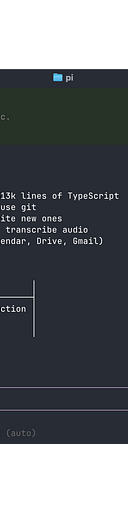
Pi Coding Agent is a free, MIT-licensed terminal coding agent harness you shape to your own workflow with TypeScript extensions, skills, prompts, and themes.
Visit Website
Cognition builds Devin, an autonomous AI software engineer that plans, codes, tests, and ships merge-ready pull requests inside your
Visit WebsiteWhat real users say: Pi Coding Agent vs Cognition AI
Not marketing copy and not our opinion — a structured sweep of public discussion (reviews, forums, communities and video comments), showing what people praise and what they complain about for each tool.
Pi Coding Agent
85 mentions across 5 sources · 77% positive (averaged across 5 sources)
Hacker News, YouTube, Product Hunt, GitHub, Lemmy
What users praise
- • Lightweight and minimal system prompt saves context space.
- • Supports 15+ AI providers and hundreds of models.
- • Tree-structured session history with branching and sharing via gist.
- • Extend everything via TypeScript extensions and npm packages.
What frustrates them
- • Emacs integration has multiple bugs and limited UI support.
- • Proxy environment variables not passed to extensions.
- • Extension ecosystem raises supply chain security concerns.
- • No built-in diff view for session file changes.
Researched Jul 2, 2026
Cognition AI
50 mentions across 3 sources · 43% positive — mixed (averaged across 3 sources)
Hacker News, Bluesky, Lemmy
What users praise
- • End-to-end autonomous planning, coding, and PR creation for enterprise teams.
- • FrontierCode evaluation ensures merge-worthy code output.
- • Auto-Triage automates bug monitoring and fix PRs.
- • Native Windows VM and Android emulator support for cross-platform testing.
What frustrates them
- • Community feedback is almost nonexistent — little proof of reliability.
- • Critics question the $10B valuation given unproven adoption.
- • Political ties to Peter Thiel may deter some users.
- • Limited transparency on actual customer success stories.
Researched Jul 16, 2026
Who should pick which
- Enterprise engineering leadPick: Cognition AI
Needs autonomous bug triage, legacy modernization, and measurable productivity gains backed by a $10M guarantee. Integrates with Jira, Datadog, and GitHub.
- Indie developer / solo founderPick: Pi Coding Agent
Wants a free, flexible terminal agent that can switch between providers and be customized via TypeScript without vendor lock-in.
- Platform engineer building custom toolingPick: Pi Coding Agent
Needs extensibility via skills, themes, and packages; Pi's RPC and SDK modes allow embedding into larger workflows.
- Team with legacy COBOL codebasePick: Cognition AI
Devin explicitly supports COBOL modernization, a feature Pi does not offer.
- Power user who switches AI models frequentlyPick: Pi Coding Agent
Pi allows mid-session provider/model switching via /model command and supports 15+ providers, unlike Devin's fixed model.
Frequently Asked Questions
Pi Coding Agent vs Cognition AI: which should you choose?
If you manage a large enterprise codebase and need autonomous PR creation, bug triage, and legacy modernization, Cognition AI's Devin (with its $10M guarantee) is the clear choice. For developers who want a free, open-source, provider-agnostic terminal harness with full customizability and session branching, Pi Coding Agent wins. Most teams will pick based on autonomy vs. control.
Which tool is better for automating bug fixes?
Cognition AI's Devin has Auto-Triage that monitors issues and creates fix PRs autonomously, making it superior for automated bug fixing.
Can Pi Coding Agent work with any AI model?
Yes, Pi supports 15+ providers and hundreds of models, including Anthropic, OpenAI, Google, and many others, with mid-session switching.
Does Cognition AI offer a free tier?
It is freemium; there is likely a free tier with limited usage, but exact pricing is not publicly detailed beyond the enterprise $10M guarantee.
Which tool is more suitable for a beginner?
Neither is targeted at beginners. Devin requires enterprise context; Pi is a CLI tool for developers comfortable with terminals.
Can Pi Coding Agent generate pull requests?
Pi itself does not have built-in PR creation; it's a harness that works with models that may generate code. Devin autonomously creates PRs.
Which tool provides a graphical interface?
Devin Desktop (part of Devin) includes Windsurf IDE, a graphical interface. Pi is purely terminal-based.
Are there enterprise compliance features in Pi?
No, Pi is open-source and lacks built-in audit logging or SSO. Devin is designed for enterprise compliance.
Can I use both tools together?
Yes, some teams might use Devin for high-stakes autonomous tasks and Pi for scripting and custom workflows, but they are not integrated.
More Pi Coding Agent or Cognition AI comparisons
Cognition AI is for enterprise teams that need an autonomous AI engineer handling complex, multi-step tasks across large codebases, with a $10M productivity guarantee. Fanbox is for solo developers on
Recall and Cognition AI solve opposite ends of the AI-assisted development spectrum. Recall is a cost-free, offline memory plugin for Claude Code that helps solo developers or small teams maintain con
Value-for-Fable is a strict cost-optimization play for teams already using Claude Sonnet: it sacrifices turnkey polish for 70% cost savings and Opus-like quality via structured prompting. Cognition AI
Choose Cognition AI if you are an enterprise team needing an autonomous AI software engineer that independently plans, codes, tests, and ships production code with enterprise-grade integrations and a
Choose Cognition AI (Devin) if you're an enterprise team needing an autonomous engineer that can handle multi-step tasks like bug triage, legacy modernization, and cross-platform builds—backed by a fi
Choose Cognition AI (Devin) if you need an autonomous software engineer that handles the full dev cycle—planning, coding, testing, and shipping—and your enterprise demands legacy modernization, native
Explore each tool further
Browse these categories
One email a week — new tools, honest comparisons, no spam.
Last reviewed: July 2, 2026