RoboWork vs Spider Cloud
Side-by-side comparison of features, pricing, and ratings
At a glance
| Dimension | RoboWork | Spider Cloud |
|---|---|---|
| Core Focus | Visual AI agent builder and MCP hosting | Web crawling/scraping API for AI agents |
| Best For | AI engineers building agentic workflows, product teams automating processes, MCP server hosting | AI agents needing web data for RAG, developers building LLM tools with web context |
| Not For | Non-technical users seeking purely no-code AI assistants, teams requiring offline-only operation, high-frequency production workloads on free tier | Projects requiring extensive global residential proxy networks, simple one-off scraping tasks, teams that prefer fixed monthly subscription pricing |
| Key Feature (Unique) | Visual workflow builder with MCP support, multi-model, self-hosting option | Rust-powered engine, 99.9% success rate, AI Studio with Browser AI commands (Act, Extract, Observe), scraper catalog |
| Latest News Impact | No recent news; features as per static data | Browser AI commands (WebSocket), scraper catalog (1,000+ examples), smarter AI extraction fallback, data connectors (S3, GCS, etc.) |
Choose RoboWork if your priority is building and managing custom AI agents and workflows with visual control and flexible hosting; choose Spider Cloud if you need high-speed, low-cost web data extraction for AI agents and RAG pipelines. They serve complementary needs: RoboWork orchestrates agents, while Spider Cloud feeds them data.
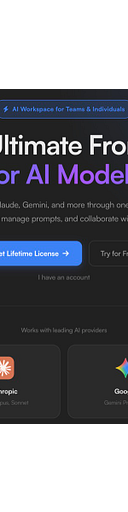
One interface for ChatGPT, Claude, Gemini, and Grok with agent building, prompt library, and MCP plugin support.
Visit Website
Spider Cloud is a web scraping, crawling, and search API that streams live pages as markdown or JSON for AI agents and RAG pipelines.
Visit WebsiteWho should pick which
- Solo founder building an AI agent prototypePick: RoboWork
RoboWork's visual builder and pre-built templates reduce coding effort, and its free tier allows prototyping without upfront cost.
- Developer building a RAG pipeline that needs fresh web dataPick: Spider Cloud
Spider Cloud's fast, cheap crawling API with structured output and data connectors is ideal for feeding web content into vector databases.
- Product team automating business processes with multi-step workflowsPick: RoboWork
RoboWork's MCP server hosting, variable management, and version control support complex workflows with multiple models and tools.
- AI engineer needing a reliable scraping solution with anti-detectionPick: Spider Cloud
Spider Cloud's Rust engine, stealth anti-detection, rotating proxies, and 99.9% success rate ensure high reliability for scraping tasks.
- Team requiring both agent orchestration and data ingestionPick: RoboWork
RoboWork can orchestrate agents that call Spider Cloud's API, combining both platforms for a complete solution. However, if choosing one, RoboWork covers orchestration; Spider Cloud is better for data.
Frequently Asked Questions
RoboWork vs Spider Cloud: which should you choose?
Choose RoboWork if your priority is building and managing custom AI agents and workflows with visual control and flexible hosting; choose Spider Cloud if you need high-speed, low-cost web data extraction for AI agents and RAG pipelines. They serve complementary needs: RoboWork orchestrates agents, while Spider Cloud feeds them data.
Can RoboWork be used to build a web scraper?
RoboWork is not a dedicated scraping tool, but its visual workflow builder can integrate with Spider Cloud or other APIs to fetch web data as part of an agent workflow.
Does Spider Cloud support self-hosting?
Spider Cloud's core engine is open-source on GitHub, enabling self-hosting. The cloud API adds stealth, AI features, and scaling.
Which tool is better for non-technical users?
RoboWork offers a visual builder and templates, making it more accessible for non-coders, but its best use is for AI engineers. Spider Cloud requires API integration, suited for developers.
Can I use Spider Cloud to crawl my own website?
Yes, Spider Cloud can crawl any publicly accessible website; it offers rotating proxies and unblocker for anti-bot measures.
Does RoboWork have a free tier?
Yes, RoboWork is freemium with a free tier that includes limited usage, but it is not suitable for high-frequency production workloads.
What is the cost difference for high-volume scraping?
Spider Cloud charges $0.03 per 1,000 pages, so 1M pages cost ~$30. RoboWork's paid plans start at $20/month, but are not priced per page; they are better for workflow execution.
Does Spider Cloud offer real-time data extraction?
Yes, with Browser AI commands via WebSocket, you can send commands like Act, Extract, and Observe in real-time for live sessions.
Which tool integrates with LangChain?
Both tools integrate with LangChain and other AI frameworks. RoboWork has integrations with OpenAI, Anthropic, etc., while Spider Cloud offers LangChain, LlamaIndex, CrewAI, and more.
More RoboWork or Spider Cloud comparisons
These aren't competitors, so there's no either/or decision here — most teams building agent products end up using both. If your problem is shipping and operating a web app or agent backend, Vercel is
These are not competitors. Power BI is a governed BI layer for Microsoft-centric organizations; Spider Cloud is HTTP plumbing that returns rendered web pages to agents and retrieval pipelines. If you
These are not competitors — they are two halves of a stack, and nobody should be choosing one over the other. Pick LM Studio if your problem is where inference runs: you want open models and the Bioni
These are not competitors — don't frame this as a pick-one decision. Spider Cloud is infrastructure you buy to get live web pages into an agent or retrieval pipeline; Amplitude is the analytics layer
These aren't competitors — pick based on the problem, not the price. If you need dashboards, governed self-service exploration, and agentic analytics on top of data you already store, Tableau is the b
These tools are not competitors — they solve different problems for different buyers. Spider Cloud is a developer API for pulling live web data into agents and RAG pipelines, with a freemium entry poi
Explore each tool further
Browse these categories
One email a week — new tools, honest comparisons, no spam.
Last reviewed: July 3, 2026