RoboWork vs Temporal AI
Side-by-side comparison of features, pricing, and ratings
At a glance
| Dimension | RoboWork | Temporal AI |
|---|---|---|
| Pricing | Freemium (free tier with limitations, paid plans for higher usage) | Freemium (pay per action on Temporal Cloud) |
| Core Approach | Visual workflow builder plus MCP server hosting | Code-first durable execution with automatic state capture |
| Best For | Rapid prototyping of AI agents and MCP-based tools | Reliable long-running workflows with fault tolerance |
| Deployment | One-click cloud or self-hosting | Self-hosted or Temporal Cloud (managed) |
| AI Integrations | OpenAI, Anthropic, Google AI, Hugging Face | OpenAI Agents SDK, Google ADK, NVIDIA GPU fleet |
| Unique Feature | MCP server hosting and visual workflow builder | Durable execution with Saga pattern and human-in-the-loop |
Choose Temporal AI if your priority is mission-critical reliability with automatic retries and state persistence for long-running AI agents or microservices orchestration. Choose RoboWork if you need a visual approach for quickly building AI agent workflows and hosting MCP servers, especially for prototyping or team collaboration. Temporal is enterprise-grade but requires more coding; RoboWork offers faster iteration at the cost of less mature fault tolerance.
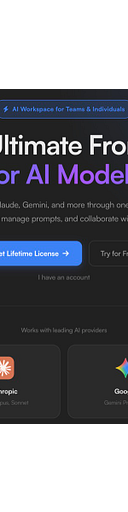
One interface for ChatGPT, Claude, Gemini, and Grok with agent building, prompt library, and MCP plugin support.
Visit Website
Durable execution platform that keeps AI agents and long-running workflows alive through crashes, retries, and abandoned sessions.
Visit WebsiteWho should pick which
- Solo Founder building AI agentsPick: RoboWork
RoboWork's visual builder and pre-built templates speed up prototyping and require less coding, letting you iterate quickly without deep infrastructure knowledge.
- Enterprise Team requiring fault-tolerant workflowsPick: Temporal AI
Temporal's durable execution with automatic retries, Saga patterns, and human-in-the-loop is purpose-built for mission-critical processes that must survive crashes.
- DevOps Engineer managing CI/CD pipelinesPick: Temporal AI
Temporal's long-running workflow support, task queues, and visibility UI are ideal for orchestrating multi-step CI/CD pipelines with error handling.
- Data Scientist prototyping MCP toolsPick: RoboWork
RoboWork's MCP server hosting and multi-model support simplify creation and testing of Model Context Protocols without managing server infrastructure.
- Product Team automating business processesPick: RoboWork
RoboWork's visual builder and team collaboration allow non-developers to contribute to automation, with version control and webhook triggers.
Frequently Asked Questions
RoboWork vs Temporal AI: which should you choose?
Choose Temporal AI if your priority is mission-critical reliability with automatic retries and state persistence for long-running AI agents or microservices orchestration. Choose RoboWork if you need a visual approach for quickly building AI agent workflows and hosting MCP servers, especially for prototyping or team collaboration. Temporal is enterprise-grade but requires more coding; RoboWork offers faster iteration at the cost of less mature fault tolerance.
Can RoboWork handle long-running workflows that last days?
RoboWork is designed for multi-step workflows but does not emphasize automatic persistence or crash recovery like Temporal. For long-running mission-critical workflows, Temporal is more reliable.
Does Temporal require writing code for every workflow?
Yes, Temporal uses a code-first approach with SDKs. There is no built-in visual builder, though you can build a custom UI on top.
Can I host RoboWork on my own infrastructure?
Yes, RoboWork supports self-hosting in addition to one-click cloud deployment.
Which platform supports human-in-the-loop?
Temporal natively supports human-in-the-loop via signals, pause/resume, and wait conditions. RoboWork does not highlight this feature.
What is MCP and why does RoboWork focus on it?
MCP (Model Context Protocol) is a standard for connecting AI models to external tools. RoboWork hosts MCP servers, making it easy to integrate agents with data sources.
Does Temporal integrate with OpenAI Agents SDK?
Yes, Temporal announced integration with the OpenAI Agents SDK at Replay 2026, allowing you to orchestrate AI agents with durability.
Which platform offers a free tier for testing?
Both offer freemium models. Temporal provides a free tier on Temporal Cloud with limited actions; RoboWork has a free tier with usage limits.
Can I use multiple AI models in one workflow on RoboWork?
Yes, RoboWork supports multi-model orchestration including GPT-4, Claude, Gemini, and open-source models.
More RoboWork or Temporal AI comparisons
This is not really a head-to-head — the two products sit in different layers of a stack, and almost nobody with a budget is choosing one over the other. Temporal answers 'how do I keep a multi-day age
These are not substitutes, so there is no either/or decision here. If your pain is "something broke in production and I need errors, traces, logs, replay, and an AI agent to explain and patch it," buy
These aren't competitors — they're different layers of the stack. Temporal is the durability engine you reach for when executions span hours, days, or weeks and must survive crashes, retries, and aban
These are not competing products and you should not be choosing between them. Temporal is infrastructure: it keeps the code your system runs from losing progress when a worker dies or a session is aba
These aren't competitors, so there's no either/or to recommend. Pick Netlify if you need somewhere to deploy and host a fullstack web app — its Agent Runners, AI Gateway, Serverless Functions, managed
These two aren't competitors — a buyer picking Temporal AI is solving reliability of long-running agent/workflow execution, while a buyer picking lift is solving PDF/document parsing into structured d
Explore each tool further
Browse these categories
One email a week — new tools, honest comparisons, no spam.
Last reviewed: July 3, 2026