
Attention Sinks
An open-source Python package that keeps Llama, Mistral, MPT, Falcon and Pythia chat models fluent across hundreds of prompts on flat VRAM.
If your single-GPU chatbot bleeds VRAM and starts repeating tokens after a few thousand turns, Attention Sinks fixes both for the price of one changed import and zero retraining. The trade is real: window attention discards everything outside the 4 sink tokens and the window, so anything you need remembered must live in retrieval or in a natively long-context model. Budget one GPU, expect a small perplexity bump at the default 1024-token window, and compare against vLLM's paged KV cache before committing.
Verified 1d ago · liveness 75/100 · cite: rightaichoice.com/tools/attention-sinks
- Developers running long chat sessions on a single GPU with a fixed VRAM ceiling
- Researchers reproducing or extending the Xiao et al. 2023 attention-sink method
- Engineers prototyping agents on Llama, Mistral, MPT, Falcon or Pythia checkpoints
- Hobbyists who want a local chat that doesn't stall after a few thousand tokens
- Workloads needing recall of every earlier token, such as full-document summarization
- Teams already standardized on vLLM or TensorRT-LLM paged KV-cache serving
- Deployments that cannot accept any perplexity increase at a 1024-token window
We scan live Reddit threads, YouTube comments, X posts, G2 reviews and other communities — and hand you an honest verdict in under a minute.
- Honest verdict, not marketing
- Real pros & cons from real users
- Attributed quotes with receipts
3 free scans · no card needed
Skip Attention Sinks if you need every earlier token retained for summarization or QA, or if your serving stack already handles KV cache through vLLM or TensorRT-LLM.
It runs on your own GPU, so the real recurring cost is the card itself — you save nothing on hardware, you just stop memory from creeping past what you already have.
The package itself is free and MIT-licensed, so the cost question is entirely about GPU. A single 24GB card covers Llama 2 7B or Mistral-7B at the 8192-token window near 14.85GB; a team that needs multi-tenant throughput is better served paying for vLLM on dedicated hardware than scaling out single-GPU sessions.
In short
Attention Sinks — An open-source Python package that keeps Llama, Mistral, MPT, Falcon and Pythia chat models fluent across hundreds of prompts on flat VRAM. Best for Developers running long chat sessions on a single GPU with a fixed VRAM ceiling, Researchers reproducing or extending the Xiao et al. 2023 attention-sink method, Engineers prototyping agents on Llama, Mistral, MPT, Falcon or Pythia checkpoints. Free to use.
What's new in Attention Sinks
Checked yesterdayAcross the latest 4 updates: 3 feature updates and 1 news mention.
Live resource usage on Jobs
A Resources panel beside the logs shows live CPU, RAM, GPU and VRAM usage every couple of seconds while a job runs — handy for watching an attention_sinks workload's memory.
Hugging Face is now on Google Cloud Marketplace
Organizations can subscribe with an existing Google Cloud account, putting Inference Providers, Inference Endpoints, Spaces, Jobs, storage and Team or Enterprise seats on one cloud invoice.
Granular Feature Access
Feature access can be scoped per resource group, so Jobs can stay open to everyone while Inference Endpoints are restricted to admins.
Filter Jobs by Label
Hugging Face Jobs can be filtered by label using clickable chips with job counts and a free-form key=value input.
What people actually say about Attention Sinks — is it worth it?
We ran a structured research pass across product reviews, community discussions, and post-purchase forum threads to surface the patterns vendors won't publish themselves. Below: the recurring strengths, the hidden costs people mention most, and the cohort that consistently regrets adopting this tool.
65 mentions across 4 sources (Hacker News, YouTube, GitHub, Lemmy) · researched Sep 1, 2026.
Average across the 4 sources that answered — each source counts once, not each post.
- +Constant memory usage regardless of conversation length — a real fix.
- +Works with Llama 2, Mistral, MPT, Falcon, Pythia out of the box.
- +No retraining needed — drop into any pretrained chat model.
- +One-line code change from standard Transformers integration.
- +Configurable window size trades minor perplexity for big VRAM savings.
- −Breaks with recent transformers versions (KeyError, etc.).
- −No Flash Attention support for Qwen models.
- −Qwen models throw TypeError — limited architecture compatibility.
- −GPTQ quantized models not supported.
- −21 open GitHub issues, no clear maintenance roadmap.
- • No paid tiers, but you may need to spend time debugging compatibility or forking for updates
- • Hugging Face paid hosting only if you want managed inference
Viability Score
How well maintained and how widely used is Attention Sinks? Built from what the vendor actually publishes (docs, changelog, tutorials, integrations, pricing), whether the site is live, and how much real users discuss it. How we calculate this
Last calculated: October 2026
How we score →Key Features
- Drop-in AutoModel replacement imported from attention_sinks instead of transformers
- Window attention that permanently retains the first 4 attention sink tokens
- Constant VRAM once generation passes the window size, instead of linear growth
- Fluent generation across hundreds of sequential prompts in chat
- Configurable window size, with 1024 used in the published experiments
- 8192-token window matches baseline perplexity at 8000 tokens near 14.85GB VRAM
- Cache-relative position assignment keeping sink tokens adjacent to live context
- Supports Llama, Mistral, MPT, Falcon and GPT-NeoX (Pythia) model families
- No retraining required on supported pretrained checkpoints
- Compatible with AutoModelForCausalLM and Transformers pipelines
- Open-source Python package installable via PyPI and GitHub
- Runs on your own GPU or on Hugging Face Inference Endpoints, Jobs or Spaces
About Attention Sinks
Attention Sinks is a free Python library that holds a pretrained chat LLM's VRAM flat across hundreds of sequential prompts without the fluency collapse that normally arrives once input passes the pretraining length. Tom Aarsen published it as a Hugging Face Community Article on October 9, 2023. It targets two failures that kill long-running assistants: memory that climbs with every generated token, and garbled output — endless newlines, stray characters like 0OgOATO0OATO, broken unicode, "assistant: assistant:" loops — that appears when a chat runs too long. The article documents Llama 2 7B losing fluency past 4096 tokens and Mistral-7B-v0.1 after roughly 10k. The fix comes from Xiao et al., 2023. Beyond the first two layers, autoregressive models dump almost all their attention on the first few tokens regardless of whether those tokens mean anything, because Softmax forces attention scores to sum to 1 and the model learns to park the surplus there. Evict those tokens with plain window attention and the score redistributes across unrelated tokens — the model collapses. Attention Sinks keeps the initial 4 tokens permanently in the window and uses cache-relative positions, so the sinks stay adjacent to live context. Integration is deliberately small: swap `from transformers import AutoModel` for `from attention_sinks import AutoModel` and the rest of your code stands. Window size is configurable — the published experiments used 1024, which pins memory constant after 1024 generated tokens at the cost of an immediate perplexity bump, while an 8192-token window matches baseline perplexity at 8000 tokens with memory near 14.85GB. Supported families are Llama, Mistral, MPT, Falcon and GPT-NeoX (Pythia), with no retraining needed. It slots into the Hugging Face ecosystem and pairs with Inference Endpoints, Jobs or Spaces for hosted compute — Jobs now shows live CPU, RAM, GPU and VRAM usage while a job runs.
Behind the Verdict
Attention Sinks is a narrow, honest piece of engineering rather than a platform. Its value is concentrated in one insight from Xiao et al.: models park attention on the first few tokens because Softmax demands the scores sum to 1, so deleting those tokens under plain window attention makes the model collapse. Retaining the first 4 tokens and assigning cache-relative positions fixes it, and the package exposes that as a drop-in AutoModel replacement — the whole change is `from attention_sinks import AutoModel`. Strengths: constant VRAM once generation passes the window size (the article's 1024-token experiments show memory flattening right after that point); fluency across hundreds of subsequent prompts where base Transformers degrades into newline spam, 0OgOATO0OATO junk or "assistant: assistant:" loops; no retraining on any supported checkpoint; and broad family coverage across Llama, Mistral, MPT, Falcon and GPT-NeoX/Pythia. The perplexity tradeoff is documented rather than hidden: an 8192-token window matched baseline perplexity at 8000 tokens with memory near 14.85GB, so you can buy quality back with VRAM. Weaknesses: it is not a zero-change deployment — you must import from attention_sinks instead of transformers, which complicates staying current with upstream Transformers releases. Forgotten content is genuinely gone; this is not a substitute for retrieval or a long-context model, so summarization or QA over a whole document is out of scope. The reference write-up is a Community Article dated October 9, 2023, and the Hugging Face pages we could reach cover the platform (blog, changelog, docs, pricing) rather than the package, so we could not confirm the current version or whether it tracks recent Transformers releases. Where it fits: a developer or small team running one GPU, a fixed VRAM ceiling, and a chat loop that must stay coherent over hundreds of turns. Where it doesn't: production inference stacks already using vLLM or TensorRT-LLM paged-attention KV-cache management, which solve the same memory problem with throughput optimizations this package doesn't attempt.
Researching Attention Sinks? Get your full AI stack in 60 seconds.
Free, no signup — tell us your goal and get tools matched to your budget & existing stack.
Real-world workflow fit
Concrete scenarios for the personas Attention Sinks actually fits — and what changes day-one when you adopt it.
Swap the AutoModel import, load Mistral-7B-Instruct-v0.1 with device_map="auto", and run a chat loop that would previously break past about 10k tokens.
Outcome: Memory flattens after the window fills instead of climbing, and the model keeps producing readable replies over hundreds of turns instead of newline loops.
Run the same long prompt sequence at window sizes 1024 and 8192, logging perplexity and VRAM for each.
Outcome: A concrete table showing the 1024 window pins memory earliest at a perplexity cost, while 8192 roughly matches baseline perplexity near 14.85GB.
Ship the attention_sinks model in a Space or a Job, watching the Jobs Resources panel for live GPU and VRAM usage.
Outcome: You catch a window size that overruns the assigned card before users do, and tune it down without redeploying from scratch.
Use Cases
- Run a Mistral-7B chatbot that stays fluent across 100+ user messages with constant GPU memory.
- Deploy Llama 2 on a single GPU for days of continuous conversation without OOM errors.
- Prototype an endless-stream support assistant on a Falcon checkpoint.
- Benchmark perplexity and VRAM tradeoffs at different window sizes for long-sequence generation.
- Add endless chat to an existing Transformers pipeline with one changed import.
Models Under the Hood
as of 2026-10-18
Limitations
- Fluency holds only for chat-style models in the supported families (Llama, Mistral, MPT, Falcon and GPT-NeoX/Pythia), and you must import your model class from attention_sinks rather than transformers, so it is not a zero-change deployment.
- Window attention discards everything outside the sink tokens and the sliding window, so long-range recall has to come from retrieval or a native long-context model.
- The reference write-up is a Hugging Face Community Article dated October 9, 2023, and the reachable vendor pages cover the Hugging Face platform rather than the package itself, so no current version or capability details beyond that article could be confirmed — verify it tracks your Transformers release before production use.
as of 2026-10-17
Verification history
We have re-verified Attention Sinks 9 times since . Each pass re-reads the vendor's own pages and re-checks every listed field against that evidence; passes where nothing had changed are marked as such.
- — re-checked, vendor evidence unchanged
- — re-verified summary, description, our verdict, our analysis, pricing model, pricing tiers, features, integrations, who it suits, who should skip it
- — re-verified summary, description, our verdict, our analysis, pricing model, pricing tiers, features, integrations, who it suits, who should skip it
- — re-verified summary, description, our verdict, our analysis, pricing model, pricing tiers, features, integrations, who it suits, who should skip it
- — re-verified summary, description, our verdict, our analysis, pricing model, pricing tiers, features, integrations, who it suits, who should skip it
- — re-verified summary, description, our verdict, our analysis, pricing model, pricing tiers, features, integrations, who it suits, who should skip it
Showing the 6 most recent of 9 verification passes.
Free to cite with attribution — this page re-verifies continuously.
12-month cost
Project the real annual outlay, including the implied monthly cost when only an annual tier is published.
Vendor list price only. Add-on usage, seat overages, and contract minimums are surfaced under Hidden costs & gotchas.
Plans compared
For each published Attention Sinks tier: who it actually fits, and what it adds vs. the previous tier. Cross-reference the cost calculator above for projected annual outlay.
Open Source (attention_sinks)
$0
Ideal for
Developers and researchers running Llama, Mistral, MPT, Falcon or Pythia chats on their own GPU who want constant VRAM without a paid platform.
What this tier adds
Starting tier: free package on PyPI and GitHub with the drop-in AutoModel, 4 retained sink tokens and configurable window size; compute is yours.
Where the pricing makes sense
The company stage and team size where Attention Sinks's pricing actually pencils out — and where peers do it cheaper.
The package itself is free and MIT-licensed, so the cost question is entirely about GPU. A single 24GB card covers Llama 2 7B or Mistral-7B at the 8192-token window near 14.85GB; a team that needs multi-tenant throughput is better served paying for vLLM on dedicated hardware than scaling out single-GPU sessions.
Setup time & first value
How long it actually takes to get something useful out of Attention Sinks — broken out by persona, not the marketing-page minute.
Under an hour for a developer already running Transformers — install the PyPI package, change one import line, and reuse your existing pipeline. Add another hour or two if you want to sweep window sizes and record perplexity and VRAM for the 1024 vs 8192 comparison.
Switching to or from Attention Sinks
How to bring data in from common predecessors and how to get it back out — written for the switcher, not the buyer.
- →From plain Transformers AutoModel: change the import to attention_sinks and keep the rest of the script as-is.
- →From window attention hand-rolled on top of past_key_values: delete the cache-shrinking code and let the package retain the 4 sink tokens.
- →From a natively long-context model on a small GPU: cap the window to fit VRAM and rely on the sinks for fluency.
- ↗To vLLM: move to its paged-attention KV cache for multi-tenant throughput instead of single-session windows.
- ↗To a long-context model: drop the wrapper when the base model's pretraining length covers your whole conversation.
- ↗To plain Transformers: revert the import line if your sessions stay under the model's pretraining length.
Integrations
Resources & Guides
Tutorials & Learning
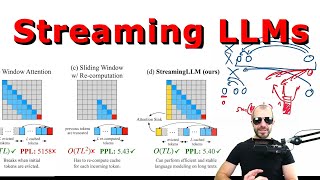
Efficient Streaming Language Models with Attention Sinks (Paper Explained)
Yannic Kilcher
Attention Sinks Explained: Why Deleting Token One Breaks Your LLM | 20-Min Deep Dive
Papers by Hand
#286 Attention Sinks for Language modeling with 4M+ tokens
Data Science Gems
YouTube returned 6 videos for “Attention Sinks”, and we withheld 2: 2 did not mention Attention Sinks. Showing the 4 we can prove are about Attention Sinks.
Official links
Tools that pair well with Attention Sinks
Common stack mates teams adopt alongside Attention Sinks, with the specific reason each pairing earns its keep.

Omniai
Open-source Ruby gem giving one unified API across Anthropic, DeepSeek, Google, Mistral, Llama, and OpenAI

Transformers
Open-source Python library for loading, fine-tuning, and running transformer models across text, vision, audio, and video.

Vercel AI SDK
Open-source TypeScript AI SDK for streaming AI apps and agents across 100+ models with built-in fallbacks
Featured Head-to-Head Comparisons
Attention Sinks vs Spider Cloud
Spider Cloud and Attention Sinks solve completely different problems: one is a web scraping API for feeding live data into AI pipelines, the other is a library for extending LLM context windows with constant VRAM. Your choice depends on whether you need external data or longer conversations. If you're building a RAG agent that requires up-to-date web content, Spider Cloud is the obvious pick; if you're deploying a chatbot that needs to run indefinitely on limited hardware, Attention Sinks is the way to go.
Attention Sinks vs Temporal Ai
Only buy Temporal AI if you need rock-solid durability, automatic retries, and state management for complex multi-step workflows or production AI agents. Attention Sinks is free, lightweight, and perfect for extending chatbots on cheap hardware—but it's a narrow utility, not a platform. For most serious AI teams, Temporal's orchestration is the clear winner despite its higher cost and complexity.
Attention Sinks vs Voyage Ai
Voyage AI is the clear winner for enterprises needing top-tier retrieval accuracy in finance/legal domains with dedicated support. Attention Sinks is a brilliant free tool for hobbyists wanting to run endless chatbots on limited hardware. Choose Voyage for production RAG on sensitive data; pick Attention Sinks for experimentation and low-cost deployment.
Alternatives to Attention Sinks
View all
Omniai
Open-source Ruby gem giving one unified API across Anthropic, DeepSeek, Google, Mistral, Llama, and OpenAI

Transformers
Open-source Python library for loading, fine-tuning, and running transformer models across text, vision, audio, and video.

Vercel AI SDK
Open-source TypeScript AI SDK for streaming AI apps and agents across 100+ models with built-in fallbacks
Frequently Asked Questions
Categories
Used Attention Sinks? Help shape our editorial sentiment research.