
Cape Analytics
AI property intelligence for insurance and real estate risk
Must-evaluate for insurance carriers and real estate investors needing scalable, data-driven property risk scores. Its proven reduction in wildfire risk and wind claim accuracy justifies the investment—if your workflow can handle another integration. Alternatives like Betterview or Nearmap offer similar aerial imagery analytics, but CAPE's focus on specific peril metrics (wildfire, wind, hail) set it apart for insurers.
Verified 16d ago · liveness 54/100 · cite: rightaichoice.com/tools/cape-analytics
- Personal lines underwriters quantifying roof condition and wildfire exposure
- Actuaries modeling wildfire, wind, and hail risk with peril-specific metrics
- Commercial insurers assessing property condition at portfolio scale
- Real estate investors and home equity lenders refining valuations with condition data
- Small agencies with low transaction volumes
- Users needing real-time or on-demand inspection
- Markets with sparse geospatial data coverage
We scan live Reddit threads, YouTube comments, X posts, G2 reviews and other communities — and hand you an honest verdict in under a minute.
- Honest verdict, not marketing
- Real pros & cons from real users
- Attributed quotes with receipts
3 free scans · no card needed
Skip Cape Analytics if you are a small agency with low volume or need real-time inspection—its historical imagery data and consultation-based model may not fit your needs.
Implementation and integration costs are not shown upfront, so budget for engineering time to connect CAPE with your underwriting systems.
Cape Analytics positions itself for enterprise insurers and large real estate investors. Its pricing is not public, but it's likely competitive with other geospatial analytics platforms like Betterview or Nearmap, which also use imagery. For smaller players, the cost may be prohibitive.
In short
Cape Analytics — AI property intelligence for insurance and real estate risk. Best for Personal lines underwriters quantifying roof condition and wildfire exposure, Actuaries modeling wildfire, wind, and hail risk with peril-specific metrics, Commercial insurers assessing property condition at portfolio scale. Contact Sales pricing.
Viability Score
How well maintained and how widely used is Cape Analytics? Built from what the vendor actually publishes (docs, changelog, tutorials, integrations, pricing), whether the site is live, and how much real users discuss it. How we calculate this
Last calculated: September 2026
How we score →Key Features
- Roof condition assessment (Good/Excellent)
- Roof geometry identification (Hip)
- Tree overhang detection (Major)
- Wildfire risk scoring (Low/High)
- Pool count detection
- Exterior condition rating (Good)
- Living area measurement (4,300 SF)
- Distance to park calculation (200 ft)
- Peril risk metrics (Wildfire, Wind, Hail)
- Property condition-based valuation error reduction (10%)
- Wind claim likelihood prediction (2.5X for bad roofs)
- Wildfire risk reduction via vegetation distance (76%)
- Geospatial imagery analytics
- Computer vision technology
- Scalable data infrastructure
About Cape Analytics
Cape Analytics delivers property intelligence by fusing geospatial imagery analytics with computer vision to streamline insurance underwriting, rating, and coverage decisions. Targeting personal lines underwriters, actuaries, commercial insurers, and real estate investors, CAPE provides specific property condition data—like roof quality, tree overhang, wildfire risk, pool count, and exterior condition—from satellite and aerial imagery. Key features include roof condition and geometry analysis, tree overhang detection, wildfire risk scoring (with a proven 76% risk reduction via vegetation removal), pool count, living area measurement, and distance-to-park computation. The platform also offers peril metrics for wildfire, wind, and hail, and has demonstrated a nearly 10% reduction in valuation error and a 2.5X higher wind claim likelihood for bad-condition roofs. Compared to traditional inspections, CAPE provides scalable, consistent insights without field visits, making it particularly suited for high-volume, data-driven risk assessment. Pricing is not publicly listed; you must request a consultation.
Behind the Verdict
Cape Analytics is a specialized tool that excels at turning satellite and aerial imagery into actionable property risk intelligence. The core strengths are its quantitative, imagery-derived data points—roof condition, tree overhang, pool detection, and living area—that can be directly integrated into underwriting and rating models. The platform's claim to reduce valuation error by nearly 10% and predict wind claims 2.5X better for bad-condition roofs gives it a strong ROI story for carriers. Wildfire risk scoring, with a 76% risk reduction via vegetation removal, is another compelling feature. However, you should be aware of its limitations. It's not a self-service tool; you must go through a consultation and contract, which means sales cycles and integration overhead. The data is derived from historical imagery, so it's not real-time, and interior conditions aren't assessed. Geographic coverage may have gaps, especially in rural or international areas. If your agency has low transaction volumes, the integration cost may not justify the return. Where it fits: personal lines insurers that process high volumes of policies, actuaries building catastrophe models, commercial insurers assessing property risk at portfolio scale, and real estate investors or home equity lenders who need objective condition data to refine valuations. It's less suitable for small agencies, claims adjusters needing interior or live video inspection, or markets with sparse geospatial data.
Researching Cape Analytics? Get your full AI stack in 60 seconds.
Free, no signup — tell us your goal and get tools matched to your budget & existing stack.
Real-world workflow fit
Concrete scenarios for the personas Cape Analytics actually fits — and what changes day-one when you adopt it.
You receive a new homeowner policy application and need to assess roof condition and wildfire risk.
Outcome: Within minutes, you pull up CAPE's roof condition score (Good/Excellent) and wildfire risk level (Low/High) for the property, allowing you to make a fast, data-backed underwriting decision and potentially adjust pricing.
You are developing a wind claim model and need to factor in roof condition.
Outcome: You integrate CAPE's roof condition and geometry data into your model, using the 2.5X higher wind claim likelihood for bad roofs to refine loss predictions and reserve setting.
You are appraising several properties and need objective condition data to refine valuations.
Outcome: You access CAPE's exterior condition ratings, pool counts, and living area measurements, reducing valuation error by up to 10% and making more informed investment decisions.
Use Cases
- Automate property risk inspection for personal lines underwriting.
- Score roof condition and age to predict wind and hail claims.
- Assess wildfire risk using vegetation proximity and roof material.
- Evaluate commercial property condition for better pricing.
- Monitor portfolio risk by tracking property changes over time.
- Enhance property valuations for real estate loan trading.
Models Under the Hood
as of 2026-08-31
Limitations
- Access requires a consultation and contract; no self-service pricing is available.
- Refresh frequency and geographic coverage are not disclosed.
- Data is primarily derived from satellite imagery, so interior condition is not assessed.
as of 2026-08-30
Verification history
We have re-verified Cape Analytics 17 times since . Each pass re-reads the vendor's own pages and re-checks every listed field against that evidence; passes where nothing had changed are marked as such.
- — re-checked, vendor evidence unchanged
- — re-checked, vendor evidence unchanged
- — re-checked, vendor evidence unchanged
- — re-checked, vendor evidence unchanged
- — re-verified summary, description, our verdict, our analysis, pricing model, pricing tiers, features, integrations, who it suits, who should skip it
- — re-verified summary, description, our verdict, our analysis, pricing model, pricing tiers, features, integrations, who it suits, who should skip it
Showing the 6 most recent of 17 verification passes.
Free to cite with attribution — this page re-verifies continuously.
Where the pricing makes sense
The company stage and team size where Cape Analytics's pricing actually pencils out — and where peers do it cheaper.
Cape Analytics positions itself for enterprise insurers and large real estate investors. Its pricing is not public, but it's likely competitive with other geospatial analytics platforms like Betterview or Nearmap, which also use imagery. For smaller players, the cost may be prohibitive.
Setup time & first value
How long it actually takes to get something useful out of Cape Analytics — broken out by persona, not the marketing-page minute.
Expect a few weeks to a few months, depending on your contract negotiation and data integration. Once onboarded, you can usually get property data within minutes per property, but initial API integration and testing can take time.
Switching to or from Cape Analytics
How to bring data in from common predecessors and how to get it back out — written for the switcher, not the buyer.
- →From traditional field inspections: Replace manual field visits with CAPE's satellite imagery analysis, cutting inspection time and costs.
- ↗To in-house imagery analysis: You could build your own computer vision pipeline using open satellite data, but you'd lose CAPE's ready-made risk scores and industry expertise.
Resources & Guides
Tutorials & Learning

Demo Day - Fintech Category - Cape Analytics
CB Insights
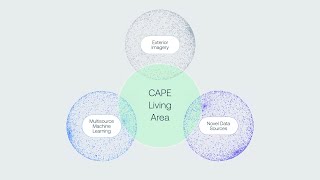
Living Area | Primary Property Elements | CAPE Analytics
CAPE Analytics

Cape Analytics
Jonathan Lockwood
YouTube returned 6 videos for “Cape Analytics”, and we withheld 1: 1 did not mention Cape Analytics. Showing the 5 we can prove are about Cape Analytics.
Official links
Tools that pair well with Cape Analytics
Common stack mates teams adopt alongside Cape Analytics, with the specific reason each pairing earns its keep.
Restb.ai
Real estate computer vision AI that turns property photos into standardized property intelligence at scale

Google Cloud Vision AI
Google Cloud Vision AI: image, document, video APIs with gen AI OCR and no-code modeling

Collov AI
Collov AI is a visual agent platform for autonomous, multi-step visual task execution in real estate and enterprise workflows.
Alternatives to Cape Analytics
View allRestb.ai
Real estate computer vision AI that turns property photos into standardized property intelligence at scale

Google Cloud Vision AI
Google Cloud Vision AI: image, document, video APIs with gen AI OCR and no-code modeling

Frequently Asked Questions
Best-of guides
Used Cape Analytics? Help shape our editorial sentiment research.