
CrowdSynthetic
Free open-source crowd safety simulator for concert evacuation planning
CrowdSynthetic is a smart free starting point for studying crowd safety and evacuation logic in concert settings, but it's a POC, not production software. Use it for education, early-stage planning, or as a base for custom research. Skip it for live events or real-time monitoring—it lacks the integration and polish you'd need. If you need production-grade simulation, look at AnyLogic or similar commercial tools.
Verified 5d ago · liveness 60/100 · cite: rightaichoice.com/tools/crowdsynthetic
- Event organizers needing a free simulation for concert evacuation planning
- Safety managers prototyping evacuation scenarios for stadiums and temples
- Researchers studying pedestrian dynamics and crowd behavior
- Students learning crowd simulation concepts hands-on
- Production-ready crowd management in live events
- Real-time monitoring due to lack of data integration
- Non-technical users needing a polished GUI
We scan live Reddit threads, YouTube comments, X posts, G2 reviews and other communities — and hand you an honest verdict in under a minute.
- Honest verdict, not marketing
- Real pros & cons from real users
- Attributed quotes with receipts
3 free scans · no card needed
Skip CrowdSynthetic if you need production-grade crowd management with real-time data integration, 3D visualization, or a polished GUI for non-technical users, or if you're making safety-critical decisions without validation.
CrowdSynthetic is free and open-source, so it's ideal for individuals, students, and small teams who want to experiment without cost. It's cheaper than commercial tools like AnyLogic, which require expensive licenses. However, you'll need to invest time in Python setup and potentially custom code to get the most out of it.
In short
CrowdSynthetic — Free open-source crowd safety simulator for concert evacuation planning. Best for Event organizers needing a free simulation for concert evacuation planning, Safety managers prototyping evacuation scenarios for stadiums and temples, Researchers studying pedestrian dynamics and crowd behavior. Free to use.
What people actually say about CrowdSynthetic — is it worth it?
We ran a structured research pass across product reviews, community discussions, and post-purchase forum threads to surface the patterns vendors won't publish themselves. Below: the recurring strengths, the hidden costs people mention most, and the cohort that consistently regrets adopting this tool.
4 mentions across 1 source (Product Hunt) · researched Jul 3, 2026.
- +Open-source with MIT license encourages customization.
- +Runs locally with no cloud dependency.
- +Heatmap visualization and risk scoring in real time.
- +Trend-based prediction and AI recommendation text.
- +Free to use for any purpose.
- −Lacks independent validation or reviews outside Product Hunt.
- −Limited to concert-style layouts defined in JSON.
- −Proof-of-concept — may not handle real-world complexity.
- −No mobile or web interface; requires Python environment.
- −Documentation and tutorials sparse or absent.
- • Requires Python 3.9+ and dependencies — no SaaS option
- • No paid support or enterprise edition available
Viability Score
How well maintained and how widely used is CrowdSynthetic? Built from what the vendor actually publishes (docs, changelog, tutorials, integrations, pricing), whether the site is live, and how much real users discuss it. How we calculate this
Last calculated: September 2026
How we score →Key Features
- Configurable JSON layout (zones, stage, exits)
- Capacity-based zone risk scoring
- Trend-based prediction ('FRONT in X seconds')
- AI-generated recommendation text
- Real-time heatmap overlay
- Custom avatar drawing
- Automatic NORMAL/EVACUATION mode switching
- EVAC mode with freeze-frame completion
- CSV and JSON logging of metrics
- Modularized Python source code (src/)
- Real-time window with UI overlays
- Python 3.9+ support
- OpenCV visual output
- MIT licensed open source
- Keyboard controls (Q to quit)
About CrowdSynthetic
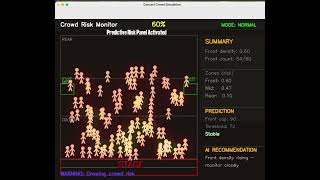
CrowdSynthetic is a free, open-source crowd safety simulator built for concert-style layouts. It reads a configurable JSON file that defines zones, stage, and exits, then simulates agents moving, accumulating risk, and triggering evacuation logic. Designed as a proof-of-concept, it serves event organizers, safety managers, researchers, and students who need a lightweight, zero-cost way to explore crowd dynamics and evacuation scenarios without commercial simulation software. The simulator automatically switches between NORMAL and EVACUATION modes based on real-time crowd risk, displaying a live window with avatars, heatmap overlay, and UI indicators. It supports capacity-based zone risk scoring, trend-based predictions like "FRONT in X seconds," and AI-generated recommendation text. When an evacuation completes, the final frame freezes until you press a key, giving you a moment to inspect the outcome. All metrics are logged to CSV and JSON files for post-run analysis. CrowdSynthetic runs on Python 3.9+ and uses OpenCV for visual output. The code is modularized in the src/ directory, making it easier to read, extend, and adapt for academic research or custom experiments. It's MIT-licensed, so you can modify and share it freely. That said, this is a demonstration project, not a production tool—there's no real-time data integration, 3D visualization, or polished GUI. Compared to commercial tools like AnyLogic, CrowdSynthetic offers a free, hands-on way to prototype crowd density and evacuation logic. It's ideal for learning, teaching, and proof-of-concept modeling, but you shouldn't rely on it for live event management or safety-critical decisions. Technical users comfortable with Python will find it a practical starting point for custom simulations.
Behind the Verdict
When you're piecing together an evacuation plan on a tight budget, CrowdSynthetic is one of the few free options that actually models crowd risk in a concert layout. The JSON-driven setup means you can tweak zones, stage position, and exits without touching core code—handy for testing 'what if' scenarios. But let's be realistic: this is a proof-of-concept. The heatmap and risk predictions give you a visual feel, not a certified safety analysis. If you're a student or researcher exploring pedestrian dynamics, it's a gem because the code is open and modular. You can trace exactly how risk builds, how triggers switch to EVAC mode, and how metrics get logged to CSV/JSON. That transparency is rare in commercial tools. Where it bites is in production. There's no real-time data hookup, no 3D, no polished GUI—so don't expect to run a live event with it. For that, you'd need something like AnyLogic, which comes with a price tag and a learning curve. But if your goal is to learn the mechanics of crowd simulation or prototype ideas fast, CrowdSynthetic delivers. Just know the limits: it's a single-file layout world, no multi-scenario orchestration, and the 'AI' in the name is really about generated recommendations, not deep learning. In practice, it's a tinkerer's tool—frustrating if you want turnkey, rewarding if you like to dig into code.
Researching CrowdSynthetic? Get your full AI stack in 60 seconds.
Free, no signup — tell us your goal and get tools matched to your budget & existing stack.
Real-world workflow fit
Concrete scenarios for the personas CrowdSynthetic actually fits — and what changes day-one when you adopt it.
You're planning a concert and need to assess worst-case evacuation scenarios. You clone the repo, edit layout.json to match your venue (zones, stage, exits), run the simulation, and watch the heatmap to see where congestion builds. You export the CSV log to review zone risk scores and adjust exit placements.
Outcome: You gain a basic, visual understanding of potential bottlenecks and can make informed layout decisions before the event.
You want to test a new evacuation strategy. You modify the Python code in src/ to change agent behavior, run multiple simulations with different parameters, and compare the CSV/JSON logs to see which strategy reduces risk scores.
Outcome: You have a free, flexible platform to prototype and validate new crowd safety ideas.
You're taking a course on crowd dynamics and need a hands-on project. You install CrowdSynthetic, read the code, and experiment with different JSON layouts and parameters. You use the logs to write a report on how risk evolves in different scenarios.
Outcome: You learn simulation concepts and have a concrete artifact for your assignment.
Use Cases
- Simulate crowd movement in a concert layout to identify potential congestion zones before an event.
- Test evacuation strategies by running multiple simulations with different exit configurations.
- Analyze zone-level risk scores to optimize staff placement and signage.
- Use historical simulation data to train machine learning models for real-time crowd monitoring.
- Demonstrate crowd safety concepts in academic or training environments.
Limitations
- CrowdSynthetic is a proof-of-concept simulation, not a production system.
- It requires Python 3.9+ and manual setup.
- The simulation is limited to a single configurable layout and does not support real-time data ingestion or integration with live camera feeds.
- The AI recommendation text is based on simulated data, not real-world sensors.
as of 2026-08-21
Verification history
We have re-verified CrowdSynthetic 7 times since . Each pass re-reads the vendor's own pages and re-checks every listed field against that evidence; passes where nothing had changed are marked as such.
- — re-verified summary, description, our verdict, our analysis, pricing model, pricing tiers, features, integrations, who it suits, who should skip it
- — re-verified summary, description, our verdict, our analysis, pricing model, pricing tiers, features, integrations, who it suits, who should skip it
- — re-verified summary, description, our verdict, our analysis, pricing model, pricing tiers, features, integrations, who it suits, who should skip it
- — re-verified summary, description, our verdict, our analysis, pricing model, pricing tiers, features, integrations, who it suits, who should skip it
- — re-verified summary, description, our verdict, our analysis, pricing model, pricing tiers, features, integrations, who it suits, who should skip it
- — re-verified summary, description, our verdict, our analysis, pricing model, pricing tiers, features, integrations, who it suits, who should skip it
Showing the 6 most recent of 7 verification passes.
Free to cite with attribution — this page re-verifies continuously.
12-month cost
Project the real annual outlay, including the implied monthly cost when only an annual tier is published.
Vendor list price only. Add-on usage, seat overages, and contract minimums are surfaced under Hidden costs & gotchas.
Plans compared
For each published CrowdSynthetic tier: who it actually fits, and what it adds vs. the previous tier. Cross-reference the cost calculator above for projected annual outlay.
Free
$0
Ideal for
Students, researchers, and tinkerers who want a zero-cost sandbox for learning and prototyping crowd safety simulations.
What this tier adds
Open-source code with MIT license, Python-based, and includes all features—no paid tiers exist.
Where the pricing makes sense
The company stage and team size where CrowdSynthetic's pricing actually pencils out — and where peers do it cheaper.
CrowdSynthetic is free and open-source, so it's ideal for individuals, students, and small teams who want to experiment without cost. It's cheaper than commercial tools like AnyLogic, which require expensive licenses. However, you'll need to invest time in Python setup and potentially custom code to get the most out of it.
Setup time & first value
How long it actually takes to get something useful out of CrowdSynthetic — broken out by persona, not the marketing-page minute.
For a technical user with Python 3.9+ and pip, you can install dependencies and run the basic simulation within 15-30 minutes. Customizing the layout.json file takes another 10-20 minutes. Non-technical users may need a few hours to get comfortable.
Switching to or from CrowdSynthetic
How to bring data in from common predecessors and how to get it back out — written for the switcher, not the buyer.
- ↗To AnyLogic: For production-grade simulations, you can port your layout and risk logic concepts from CrowdSynthetic to AnyLogic's more advanced modeling environment.
- ↗To MassMotion or Pathfinder: For detailed evacuation analysis, you can use your CrowdSynthetic findings as a starting point and replicate scenarios in those commercial tools.
Resources & Guides
Tutorials & Learning

Official links
Tools that pair well with CrowdSynthetic
Common stack mates teams adopt alongside CrowdSynthetic, with the specific reason each pairing earns its keep.

Finster AI
Enterprise AI for finance: automate data synthesis, analysis, and presentation with traceable citations

Mineral (Alphabet X)
Alphabet X's per-plant AI crop intelligence, now powering Driscoll's and John Deere
Dcipher Insight Booster
Automate enterprise-scale research, analysis, and report generation with agentic AI.
Featured Head-to-Head Comparisons
Crowdsynthetic vs Isomorphic Labs
If you are an event planner or researcher needing a free, open-source crowd simulation tool, CrowdSynthetic is a solid choice despite being a proof-of-concept. For pharma companies seeking cutting-edge AI drug discovery partnerships, Isomorphic Labs offers unparalleled predictive and generative capabilities built on AlphaFold, but only through high-stakes collaborations. These tools serve entirely different domains — pick based on your industry and budget.
Crowdsynthetic vs Codametrix
Crowdsynthetic vs Screenplayiq
ScreenplayIQ and CrowdSynthetic serve completely different domains: ScreenplayIQ is a paid screenplay analysis tool for film professionals seeking market insights, while CrowdSynthetic is a free open-source crowd simulation tool for event safety planners. Choose based on your industry—scriptwriters should pick ScreenplayIQ, while event organizers go with CrowdSynthetic.
Alternatives to CrowdSynthetic
View allFinster AI
Enterprise AI for finance: automate data synthesis, analysis, and presentation with traceable citations
Mineral (Alphabet X)
Alphabet X's per-plant AI crop intelligence, now powering Driscoll's and John Deere
Dcipher Insight Booster
Automate enterprise-scale research, analysis, and report generation with agentic AI.
Frequently Asked Questions
Categories
Best-of guides
Used CrowdSynthetic? Help shape our editorial sentiment research.