
Dash0
OpenTelemetry-native observability with AI SRE Agent0 for automated production insight.
If you're OTel-native and want AI automation, Dash0 is a strong pick. Agent0's autonomous RCA and fix PRs genuinely save SRE time, and AI Coding Insights fills a real gap for coding-agent teams. However, the 30-day log and span retention is a hard constraint for compliance-heavy teams. Weigh that before committing.
Verified 14d ago · liveness 87/100 · cite: rightaichoice.com/tools/dash0
- Teams adopting OpenTelemetry who want a managed platform
- SREs and developers needing fast root cause analysis
- AI-forward companies using coding agents that want production visibility
- Organizations preferring transparent consumption-based pricing
- Teams needing long-term log or span retention beyond 30 days
- Organizations requiring on-premise or self-hosted observability
- Teams deeply invested in proprietary observability tools
We scan live Reddit threads, YouTube comments, X posts, G2 reviews and other communities — and hand you an honest verdict in under a minute.
- Honest verdict, not marketing
- Real pros & cons from real users
- Attributed quotes with receipts
3 free scans · no card needed
Skip Dash0 if you need more than 30 days of log or span retention, require an on-premises or air-gapped deployment, or aren't willing to adopt OpenTelemetry instrumentation—otherwise, it's a strong OTel-native AI observability platform.
Going past your budgeted telemetry volumes can inflate costs—monthly budget limits and spam filters are your guardrails.
Dash0's consumption-based pricing starts at $0.20 per million metric data points and $0.60 per million log records/spans, with no per-seat or base platform fees. This is simpler and often cheaper than Datadog's per-host pricing, but you'll pay for what you send, so high-volume teams could exceed a flat-rate competitor. Ideal for OTel-native teams that want pay-as-you-go and no lock-in.
In short
Dash0 — OpenTelemetry-native observability with AI SRE Agent0 for automated production insight. Best for Teams adopting OpenTelemetry who want a managed platform, SREs and developers needing fast root cause analysis, AI-forward companies using coding agents that want production visibility. Free to start; paid plans from $0.2/mo.
What's new in Dash0
Checked 5 days agoAcross the latest 10 updates: 5 feature updates, 1 community discussion and 4 news mentions.
Dash0 Joins the Agentic AI Foundation
Dash0 joins the Agentic AI Foundation, a move that may influence future agentic observability integrations and standards.
Custom skills for Agent0
Admins can now write custom skills for Agent0, callable via '/' in chat or auto-selected. Skills encode team-specific runbooks and context.
Migration to Graviton 5: What upgrading our ClickHouse cluster actually accomplished
Dash0 details the performance and cost impact of migrating its ClickHouse cluster to Graviton 5 processors.
SignalControl is now available
SignalControl, the ingestion pipeline for filtering, sampling, and aggregating telemetry before storage, is now included in every Dash0 account.
Dash0 Acquires Polar Signals, Bringing Continuous Profiling, Including GPU and CUDA Insight, Into SignalStore and Agent0
Dash0 acquires Polar Signals, integrating continuous profiling (GPU/CUDA) into SignalStore and Agent0.
Two founders, one dinner, and the deal that followed. Here's the story, from us
Dash0 recounts the origin story of its Polar Signals acquisition, providing context on the deal's strategic rationale.
In Search of Observability's Rails Moment
Dash0 discusses the need for standardized observability practices, drawing parallels to the Rails framework's impact on web development.
See Every Lambda Invocation, Even the Ones That Never Finish
Dash0 introduces Darkplane, a solution for capturing all Lambda invocations, including those that time out or fail to complete.
Introducing AI Coding Insights: Stop Guessing What Your Coding Agents Deliver
Dash0 launches AI Coding Insights, providing visibility into coding agent performance and output.
Build with AI. Ship with confidence.
Dash0 announces capabilities to support AI application development with confidence, including observability for AI workflows.
What people actually say about Dash0 — is it worth it?
We ran a structured research pass across product reviews, community discussions, and post-purchase forum threads to surface the patterns vendors won't publish themselves. Below: the recurring strengths, the hidden costs people mention most, and the cohort that consistently regrets adopting this tool.
71 mentions across 3 sources (Hacker News, YouTube, Product Hunt) · researched Aug 11, 2026.
Average across the 3 sources that answered — each source counts once, not each post.
- +OpenTelemetry-native, eliminates vendor lock-in and proprietary agents.
- +Consumption-based pricing is transparent and predictable.
- +Unified SignalStore combines logs, metrics, traces, events, RUM in one place.
- +Keyboard navigation and smooth UX appreciated by devs.
- +Strong CNCF standards alignment (PromQL, SQL, Apache Iceberg).
- −AI fix PR generation (Agent0) is not available until June 2026.
- −Short retention for spans/logs (30 days) may hamper deep dives.
- −Requires OpenTelemetry setup, steep for teams without it.
- −Community feedback limited; mostly marketing, not long-term user reviews.
- −Pricing details incomplete in community data; hidden costs uncertain.
- • Consumption-based pricing may lead to unexpected charges if telemetry volume spikes
- • No transparent pricing tiers published, only consumption-based model
Viability Score
How well maintained and how widely used is Dash0? Built from what the vendor actually publishes (docs, changelog, tutorials, integrations, pricing), whether the site is live, and how much real users discuss it. How we calculate this
Last calculated: September 2026
How we score →Key Features
- OpenTelemetry-native ingestion for logs, metrics, traces, events, profiles, and RUM
- SignalStore unified data store with PromQL and SQL querying
- Agent0: autonomous incident investigation, root cause analysis, and fix PR generation
- AI Coding Insights: monitor coding agent output and cycle time
- GitLab integration: Agent0 reads diffs/issues/pipelines and opens merge requests
- Slack integration: mention @Dash0 to investigate alerts or open PRs in-thread
- Approval gate for Agent0 write actions (off by default, single-use approvals)
- Automations for runbook tasks and routine handling
- Distributed tracing with trace trees and heatmap drilldowns
- Perses-based dashboards with configuration as code
- Real user monitoring (RUM) for web events and full user sessions
- Infrastructure monitoring with Kubernetes pre-built dashboards
- Synthetic monitoring with API check runs
- AWS Lambda observability including invocations that never finish
- MCP server, CLI, and API for AI agents and humans
About Dash0
Dash0 is a modern observability platform built entirely on OpenTelemetry, unifying logs, metrics, traces, events, profiles, and real user monitoring into a single SignalStore. It's designed for developers, SREs, and platform engineers who ship code faster with AI coding agents and need production visibility. Query all telemetry with PromQL and SQL, and integrate with any OTel-compatible tool or SDK, avoiding vendor lock-in. Dash0's mission is to close the loop between AI-assisted development and production operations, helping teams ship more and break less. The platform covers the full observability spectrum: APM, distributed tracing, infrastructure and Kubernetes monitoring, log management, real user monitoring, synthetic checks, and dashboards built on Perses. Agent0, an AI SRE now generally available, autonomously investigates incidents, performs root cause analysis across logs, metrics, traces, and profiles, and can generate fix PRs. Recent integrations let Agent0 open merge requests in GitLab and be summoned directly in Slack, plus an approval gate for write actions. AI Coding Insights gives visibility into what coding agents like Claude Code and Cursor are actually delivering in production. Automations handle runbook tasks, and both humans and AI agents can access everything through an MCP server, CLI, and API. Dash0's pricing is consumption-based and transparent: you pay only for the telemetry you send, with no per-seat fees. Metric data points and synthetic checks are retained 13 months; spans, logs, and web events for 30 days. A 14-day unlimited free trial requires no credit card, and you can purchase through AWS, GCP, Azure, or Vercel marketplaces. Built-in cost controls include monthly budget limits, spam filters, and a cost forecast. Dash0 is best for teams already adopting OpenTelemetry and wanting a managed platform, plus AI-forward organizations seeking production visibility and automated incident response. It's positioned as a simpler, faster
Behind the Verdict
Dash0 is making a plausible bet: that the AI coding boom is going to drown teams in incidents, and that observability needs to be rebuilt around that reality. The core pitch is simple — get production visibility and let an AI agent handle the firefighting. When you're OTel-native and already comfortable with open standards, Dash0 removes the migration tax that proprietary tools impose, and the unified SignalStore with PromQL and SQL querying keeps power users happy. Pick Dash0 if your team ships with AI coding agents and you need to see what they're actually doing in production. AI Coding Insights is a specific, timely feature — most observability tools don't tell you which agent wrote the buggy code. Agent0's ability to not just detect but investigate and open fix PRs is the kind of automation that pays for itself in SRE hours. The approval gate for write actions is a welcome safety valve, and Slack and GitLab hooks mean you can run incident response from the tools you already live in. Pass if you're locked into a proprietary stack like Datadog and can't stomach another migration — the OTel-native stance is great, but it doesn't help if your entire pipeline is agent-instrumented with proprietary SDKs. Also pass if you need long-term log retention for compliance: 30 days is short for industries with audit requirements. There's no on-prem option either, so regulated environments that must self-host will need to look elsewhere. The closest alternative is Grafana Cloud or Datadog — Grafana offers more flexibility on retention and dashboards, while Datadog has deeper feature set but steeper cost and lock-in. Dash0's advantage is simplicity and clear AI integration; its disadvantage is that it's younger and you're trusting a startup to keep pace. In practice, we'd reach
Researching Dash0? Get your full AI stack in 60 seconds.
Free, no signup — tell us your goal and get tools matched to your budget & existing stack.
Real-world workflow fit
Concrete scenarios for the personas Dash0 actually fits — and what changes day-one when you adopt it.
On-call engineer gets an alert via Slack, asks @Dash0 for root cause, Agent0 traces the issue to a specific commit and drafts a fix PR.
Outcome: Incident resolved faster—Agent0 pinpoints the root cause and opens a PR, cutting investigation time from hours to minutes.
Developer uses Claude Code with Dash0's MCP server to query production metrics and logs during feature development.
Outcome: Code is more reliable because developers can see production impact before shipping, reducing incidents.
Engineer sets up Dash0 via Terraform, creating dashboards and alerts as code, and deploys OpenTelemetry collectors to Kubernetes.
Outcome: Observability stack is fully versioned and reproducible, enabling fast configuration changes and auditability.
Use Cases
- Monitor Kubernetes clusters with OTel-native dashboards and alerts
- Troubleshoot slow database queries using distributed tracing with heatmaps
- Reduce observability costs with transparent consumption-based pricing
- Unify logs, metrics, and traces in one pane without switching tools
- Set up synthetic API checks to catch downtime before users notice
- Automate root cause analysis and fix PRs with Agent0
- Monitor Cloud SQL instances with automatic metric collection
- Track coding agent productivity and production impact with AI Coding Insights
Models Under the Hood
as of 2026-09-14
Limitations
- Dash0 is a SaaS platform only—no on-premises option, so air-gapped environments can't use it.
- Retention is fixed: metrics and synthetic checks 13 months, spans/logs/web events 30 days, which may limit long-term analysis.
- Consumption-based pricing can surprise if you don't set budget limits and spam filters; there is no free tier, only a 14-day trial.
- Agent0 credits cost $0.60 each, adding incremental cost for complex investigations.
- The MCP delegation uses credits and admin can disable it.
- Setup requires OpenTelemetry instrumentation, which is a real investment if you're not already on it.
as of 2026-08-26
Verification history
We have re-verified Dash0 18 times since . Each pass re-reads the vendor's own pages and re-checks every listed field against that evidence; passes where nothing had changed are marked as such.
- — re-verified summary, description, our verdict, our analysis, pricing model, pricing tiers, features, integrations, who it suits, who should skip it
- — re-verified summary, description, our verdict, our analysis, pricing model, pricing tiers, features, integrations, who it suits, who should skip it
- — re-verified summary, description, our verdict, our analysis, pricing model, pricing tiers, features, integrations, who it suits, who should skip it
- — re-verified summary, description, our verdict, our analysis, pricing model, pricing tiers, features, integrations, who it suits, who should skip it
- — re-verified summary, description, our verdict, our analysis, pricing model, pricing tiers, features, integrations, who it suits, who should skip it
- — re-verified summary, description, our verdict, our analysis, pricing model, pricing tiers, features, integrations, who it suits, who should skip it
Showing the 6 most recent of 18 verification passes.
Free to cite with attribution — this page re-verifies continuously.
12-month cost
Project the real annual outlay, including the implied monthly cost when only an annual tier is published.
Vendor list price only. Add-on usage, seat overages, and contract minimums are surfaced under Hidden costs & gotchas.
Plans compared
For each published Dash0 tier: who it actually fits, and what it adds vs. the previous tier. Cross-reference the cost calculator above for projected annual outlay.
Free Trial
$0
Ideal for
Teams evaluating Dash0 who want full-feature access for 14 days without a credit card.
What this tier adds
Starting free entry point: full access, including Agent0 Credits, with no cost.
Metric Data Points
$0.20 per million/mo
Ideal for
Teams already sending metrics via OpenTelemetry who need a scalable, time-series store.
What this tier adds
First telemetry type tier: $0.20 per million points, with 13 months retention.
Spans or Span Events
$0.60 per million/mo
Ideal for
Teams needing distributed tracing for troubleshooting and performance analysis.
What this tier adds
Adds trace ingestion at $0.60 per million, with 30 days retention.
Log Records
$0.60 per million/mo
Ideal for
Teams that need centralized log management with OTel-native ingestion.
What this tier adds
Adds log ingestion at $0.60 per million, with 30 days retention.
Web Events
$0.60 per million/mo
Ideal for
Teams wanting real user monitoring for web sessions and frontend telemetry.
What this tier adds
Adds RUM event ingestion at $0.60 per million, with 30 days retention.
Synthetic API Check Runs
$0.20 per thousand/mo
Ideal for
SREs who want proactive uptime monitoring via synthetic API checks.
What this tier adds
Adds synthetic monitoring at $0.20 per thousand runs, with 13 months retention.
Agent0 Credits
$0.60 per credit
Ideal for
Teams wanting autonomous AI incident investigation and automated fix PRs.
What this tier adds
Adds AI SRE capabilities on a per-action basis at $0.60 per credit.
AI Coding Insights
$10 per user/mo
Ideal for
Engineering leaders who want to track coding agent output, cost, and cycle time.
What this tier adds
Adds AI coding agent monitoring at $10 per user/month.
Where the pricing makes sense
The company stage and team size where Dash0's pricing actually pencils out — and where peers do it cheaper.
Dash0's consumption-based pricing starts at $0.20 per million metric data points and $0.60 per million log records/spans, with no per-seat or base platform fees. This is simpler and often cheaper than Datadog's per-host pricing, but you'll pay for what you send, so high-volume teams could exceed a flat-rate competitor. Ideal for OTel-native teams that want pay-as-you-go and no lock-in.
Setup time & first value
How long it actually takes to get something useful out of Dash0 — broken out by persona, not the marketing-page minute.
For OTel-native teams: under an hour to send first data via the OpenTelemetry Collector. For teams new to OTel: 1-2 days to instrument a demo app and set up collectors. Agent0 works out of the box on trial, but connecting Slack/GitLab takes about 15 minutes per app.
Switching to or from Dash0
How to bring data in from common predecessors and how to get it back out — written for the switcher, not the buyer.
- →From Datadog: Export your telemetry via OTLP and reconfigure the OTel Collector to send to Dash0; dashboards and alerts need manual recreation, but Dash0's Terraform provider helps codify them.
- →From New Relic: Use the New Relic OTLP endpoint to forward data while you transition, then switch agents to OTel SDKs to send directly to Dash0.
- →From Prometheus/Grafana: Keep PromQL for queries; migrate dashboards to Perses format via Dash0's tools.
- ↗To Datadog or New Relic: Since Dash0 is OTel-native, you can retarget your OTel Collector to send data to any OTLP endpoint, easing exit.
- ↗To self-managed OTel stack: Export your data to a custom backend; Dash0's open interfaces make data portable, though exported data may lose some Dash0-specific context.
Integrations
Resources & Guides
- Documentationdash0.com
Welcome to Dash0
Full product docs from dash0.com
- Guidedash0.com
Dash0 Guides
Explore our step-by-step guides and best practices to expand your knowledge in Observability, OpenTelemetry and beyond.
- Resourcedash0.com
Observing Kubernetes Ingress Controllers with OpenTelemetry
Comparing OpenTelemetry support across Contour, Emissary, Istio Gateway, kgateway, and Traefik. The final post in our series on Kubernetes ingress observability.
- Resourcedash0.com
Understanding OpenTelemetry Support in Traefik
A deep dive into Traefik’s OpenTelemetry integration, exploring how traces, logs, and metrics behave in practice and where the project stands using a proposed OpenTelemetry Support Maturity Model.
- Resourcedash0.com
Understanding OpenTelemetry Support in kgateway
A deep dive into kgateway’s OpenTelemetry integration, exploring how traces, logs, and metrics behave in practice and where the project stands using a proposed OpenTelemetry Support Maturity Model.
- Resourcedash0.com
Observing vLLM with OpenTelemetry and Dash0
How to observe vLLM using OpenTelemetry and Dash0. Covers the traces vLLM actually emits, which Prometheus metrics matter, OTel Collector configuration, and what you'll see once data is flowing.
- Resourcedash0.com
Observability at the Edge: OpenTelemetry in Ingress Controllers
An evaluation of OpenTelemetry support across Kubernetes ingress controllers and gateways - tracing, metrics, logs, semantic conventions, and resource identity. Most projects "support OpenTelemetry." What that actually means varies more than you'd expect.
- Resourcedash0.com
Observing Ingress-NGINX with OpenTelemetry and Dash0
Ingress-nginx is an ingress controller. It sits at the edge of your cluster, routing external requests to pods that would otherwise not be reachable from the outside. Ingress controllers are a critical part of most Kubernetes setups, yet often remain a black box. While Ingress-NG
Tutorials & Learning
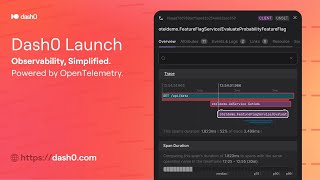
Dash0 - A tour through the product - Observability, Simplified.
Dash0
Dash0 - What is Observability? Observability and OpenTelemetry
Dash0
YouTube returned 6 videos for “Dash0”, and we withheld 4: 4 could not be judged, because “Dash0” is a single word that other videos use for other things. Showing the 2 we can prove are about Dash0.
Official links
Tools that pair well with Dash0
Common stack mates teams adopt alongside Dash0, with the specific reason each pairing earns its keep.



Featured Head-to-Head Comparisons
Dash0 vs Nectar Energy
Dash0 and Nectar Energy serve completely different domains, so the choice is straightforward. If you need to monitor cloud-native applications, debug distributed traces, and automate incident response with AI, Dash0 is your pick with its OpenTelemetry-native stack and autonomous Agent0. If you operate commercial buildings and need to cut energy costs, automate HVAC/lighting, and generate ESG reports, Nectar Energy is the dedicated solution. There is no overlap in use cases.
Dash0 vs Truemetrics
If you need observability with OpenTelemetry-native ingestion and AI-driven incident remediation, Dash0 offers a modern alternative to legacy tools with consumption-based pricing and advanced features like Agent0 and Darkplane. If your pain point is last-mile delivery inefficiency due to inaccurate navigation, truemetrics is a specialized solution that saves 32.7 seconds per stop with a lightweight SDK. The tools serve completely different domains, so your choice hinges on whether you're optimizing software systems or physical delivery routes.
Agnost Ai vs Dash0
If you're an SRE or DevOps team standardizing on OpenTelemetry and need a full-stack observability platform with built-in AI assistance, Dash0 is the clear choice — its freemium tier and transparent pricing lower the barrier. But if your pain is specifically AI-agent failures that evals miss, Agnost AI is laser-focused on that niche, though its lack of integrations and opaque pricing make it a harder sell for broader adoption.
Dash0 vs Genius Sports Ai
Choose Dash0 if you need open-standard observability with autonomous AI incident response and transparent consumption pricing. Choose Genius Sports AI if you run a professional sports league, sportsbook, or brand needing AI-driven officiating, live betting, and fan engagement. These tools serve entirely different markets—no overlap.
Dash0 vs Olas Network
Dash0 and Olas Network serve completely different use cases. Dash0 is an observability platform for teams wanting unified logs, metrics, traces, and AI-driven incident remediation, with consumption-based pricing. Olas Network is a decentralized AI agent platform for crypto users to co-own and monetize agents on-chain via token staking. Choose Dash0 if you need production monitoring and automation; choose Olas Network if you want to deploy autonomous agents in crypto markets.
Alternatives to Dash0
View all
Galileo AI Evals
AI observability and evaluation platform that turns offline evals into production guardrails.


Frequently Asked Questions
Used Dash0? Help shape our editorial sentiment research.