
DeepSeek Reasonix
DeepSeek-only coding agent you run locally, with plan approval, per-turn checkpoints, and a cache-first loop built for hours-long sessions.
Reasonix is an agent whose engineering is mostly about restraint. Plan mode, per-tool-call gating, a workspace sandbox, and per-turn checkpoints outside git make a long DeepSeek run something you can read and undo rather than a leap of faith. The cache-first loop is the commercial argument: it targets 90%+ prefix cache hit rates to cut input token costs to roughly a fifth, which is what makes leaving it running for hours affordable. It is DeepSeek-only and terminal-first by design, so multi-model shops should look at provider-agnostic agents instead. If you are standardized on DeepSeek — or on any model that supports prefix caching — this is the local-first option worth the setup.
Verified 5d ago · liveness 73/100 · cite: rightaichoice.com/tools/deepseek-reasonix
- Developers standardized on DeepSeek who run long autonomous coding sessions and watch token spend
- Terminal power users who want a full-screen TUI with diff review and slash commands
- Privacy-sensitive teams that require code to stay on local machines and their own model key
- Teams that need auditable autonomy: plan approval, gated tool calls, per-turn undo
- Multi-model teams that need Claude, GPT, Gemini, and DeepSeek in one session
- Groups without a DeepSeek API key or the willingness to provision one
- Anyone who needs the vendor to host, run, and support the agent for them
We scan live Reddit threads, YouTube comments, X posts, G2 reviews and other communities — and hand you an honest verdict in under a minute.
- Honest verdict, not marketing
- Real pros & cons from real users
- Attributed quotes with receipts
3 free scans · no card needed
Skip Reasonix if you need Claude, GPT, and DeepSeek interchangeable in one session, or if you are not willing to provision and pay for your own DeepSeek API key.
The software is MIT-licensed at no fee, but every token your agent burns is billed to your DeepSeek API account — long autonomous runs are where that adds up.
Reasonix itself carries no software fee — it is MIT-licensed and you pay DeepSeek directly for tokens at DeepSeek's published API rates. That puts the cost profile close to other bring-your-own-key agents and well below hosted, flat-rate coding subscriptions, but it moves the pricing question to DeepSeek's rate card and to how well your sessions hit the prefix cache. Cheapest when your runs are long and cache-friendly; more expensive than a fixed monthly seat if your usage is spiky and uncached.
In short
DeepSeek Reasonix — DeepSeek-only coding agent you run locally, with plan approval, per-turn checkpoints, and a cache-first loop built for hours-long sessions. Best for Developers standardized on DeepSeek who run long autonomous coding sessions and watch token spend, Terminal power users who want a full-screen TUI with diff review and slash commands, Privacy-sensitive teams that require code to stay on local machines and their own model key. Free to use.
What's new in DeepSeek Reasonix
Checked 5 days agoAcross the latest 3 updates: 1 feature update, 1 launch and 1 changelog entry.
Reasonix Studio v2.25.0
Adds a persistent subagent record pane with a 'show all' view for truncated nested output, a 'show in file manager' project menu item, and consent-based URL prompts for MCP servers that need a browser step. Also fixes Windows remote project opening and storage migration dropping
Reasonix Studio v2.20.0
Studio 2.20.0 released as part of a near-daily 2.x cadence through September 2026, followed by 2.20.1, 2.20.2, 2.20.3, and 2.20.4 patch releases on 2026-09-27.
Reasonix Studio v2.0.0
The start of the Studio 2.x release line, which runs alongside the separate 1.x command line and does not share sessions with it.
What people actually say about DeepSeek Reasonix — is it worth it?
We ran a structured research pass across product reviews, community discussions, and post-purchase forum threads to surface the patterns vendors won't publish themselves. Below: the recurring strengths, the hidden costs people mention most, and the cohort that consistently regrets adopting this tool.
8 mentions across 2 sources (Hacker News, Lemmy) · researched Jul 3, 2026.
Average across the 2 sources that answered — each source counts once, not each post.
- +Cache-first loop delivers 90%+ cache hits, cutting costs drastically.
- +Append-only history keeps prefix stable, making each turn cheaper.
- +Single Go binary—no dependencies, runs everywhere out of the box.
- +MCP support with tool prefix merging for extensibility.
- +Plan mode and sandboxed writes prevent accidental file changes.
- −Locked to DeepSeek models—no Claude, GPT, or local LLMs.
- −Skepticism about true independence from DeepSeek Inc.
- −No free tier; requires a paid DeepSeek API key to use.
- −Beginner skill level tag may oversimplify setup complexity.
- −Limited community data—very few user reviews outside HN.
- • DeepSeek API key required—pricing depends on model usage; input tokens are cheap with cache but output tokens still cost
Viability Score
How well maintained and how widely used is DeepSeek Reasonix? Built from what the vendor actually publishes (docs, changelog, tutorials, integrations, pricing), whether the site is live, and how much real users discuss it. How we calculate this
Last calculated: October 2026
How we score →Key Features
- Cache-first loop targeting 90%+ prefix cache hit rates to cut input token costs
- Local-first engine: code goes only to your configured DeepSeek model
- Reasonix Studio desktop app for macOS, Windows, and Linux with auto-update
- Full-screen terminal TUI with diff review, approvals, and slash commands
- Local web UI via reasonix serve, with optional token/password auth
- ACP editor integration for VS Code, VSCodium, and other ACP editors
- Plan mode (/plan) holds every write until you approve the plan
- Per-tool-call gating: reads, writes, and shell commands each ask separately
- Workspace sandbox bounds what a command can touch even after approval
- Per-turn checkpoints outside git to rewind a long run
- MCP over stdio, SSE, and streamable HTTP merged into one tool registry
- Markdown skills and subagents: explore, research, review, security-review
- Headless automation via reasonix run, with piped input and explicit model selection
- Feishu, Lark, and WeChat bot connections for remote approvals
- Single CGO-free Go binary, cross-compiled darwin/linux/windows on amd64/arm64
About DeepSeek Reasonix
Reasonix is a local-first coding agent built around DeepSeek models. The engine runs on your own machine and talks to the DeepSeek API key you supply, so your code goes to the model you configured and nowhere else. It ships under MIT license as a single CGO-free Go binary cross-compiled for macOS, Linux, and Windows on amd64 and arm64, installed via npm (npm i -g reasonix) or Homebrew. You get four surfaces: Reasonix Studio, the desktop app for sessions, settings, approvals, and auto-update; a full-screen terminal TUI with diff review and slash commands; a local web UI via reasonix serve with optional token/password auth; and an ACP editor integration for VS Code and VSCodium. Four layers keep long autonomous runs reviewable: plan mode holds every write until you approve the plan, reads/writes/shell commands each ask separately, a workspace sandbox bounds what an approved command can touch, and every turn writes a checkpoint outside git so a six-hour run can be rewound without touching commit history. Extensions go through MCP over stdio, SSE, and streamable HTTP, plus Markdown skills and subagents (explore, research, review, security-review) with isolated tool sets. It is DeepSeek-only by design — if you need Claude, GPT, or Gemini in the same session, pick a provider-agnostic agent instead.
Behind the Verdict
Most coding agents sell you autonomy and leave the accountability problem to you. Reasonix inverts that: the interesting parts of the product are the ones that slow it down in useful ways. Plan mode (/plan) holds every write until you have read the plan and approved it. Reads, writes, and shell commands each ask separately, so approving a file edit does not silently authorize a shell command. And when you do approve a command, the workspace sandbox still bounds what it can touch. That layering is the difference between a six-hour run you can audit and one you have to babysit. Checkpoints are the second half of that argument. Each turn writes a checkpoint outside git, so a long run can be rewound to any point without polluting commit history. Combined with the visual sidebar in Studio, which lets you rewind code or conversation without leaving the app, this makes the rewind unit a turn rather than a branch. The cache-first loop is where the money is. Reasonix targets 90%+ prefix cache hit rates and can pull input token costs to roughly a fifth of uncached rates. That matters because an autonomous agent's cost is dominated by re-sending the same context thousands of times; caching is the only lever that changes the shape of the bill rather than nibbling at it. The homepage demo shows a session ending at 18 minutes and $0.043 — the kind of number that only works if the loop is cache-shaped. The extension story is genuinely open rather than nominally open. MCP over stdio, SSE, and streamable HTTP merges external tools into one registry; Markdown skills and subagents (explore, research, review, security-review) each run with isolated tool sets. Studio v2.25.0 added a subagent record pane that persists after delegation ends and a 'show all' view when nested output is truncated — a small change that makes subagent behavior inspectable instead of opaque. Where it does not fit: Reasonix is DeepSeek-only. You bring your own DeepSeek API key, and there is no session that mixes Claude, GPT, or Gemini into the same run. It is also terminal-first — the CLI/TUI is where the product is most fully expressed, and the four surfaces are not all the same release line: Studio (2.x) and the 1.x command line ship separately and do not share sessions. Setup assumes you can provision an API key and are comfortable in a terminal or the desktop app rather than a fully hosted subscription. What it is not: a hosted service. Nothing runs on the vendor's infrastructure on your behalf; the engine is local, and the vendor does not host, run, or support the agent for you. That is the privacy proposition and the support tradeoff in one sentence.
Researching DeepSeek Reasonix? Get your full AI stack in 60 seconds.
Free, no signup — tell us your goal and get tools matched to your budget & existing stack.
Real-world workflow fit
Concrete scenarios for the personas DeepSeek Reasonix actually fits — and what changes day-one when you adopt it.
Installs the CLI with npm i -g reasonix, points it at a repo, and leaves an agent running overnight on a retry-with-backoff refactor.
Outcome: Each turn writes a checkpoint outside git, so the next morning they rewind the two turns that went wrong and keep the 14 that worked — without touching commit history.
Runs reasonix acp inside VS Code, keeps plan mode on for anything that writes, and delegates a security-review subagent with an isolated tool set.
Outcome: Code stays on local machines and goes only to their configured DeepSeek model, while every shell command still passes an explicit approval gate and the workspace sandbox.
Wires headless reasonix run into CI with piped input and an explicit model selection, then routes approval requests to a Feishu bot.
Outcome: Repetitive maintenance tasks run unattended, and anything that needs a human decision surfaces as an approval instead of a silent write.
Use Cases
- Run an always-on coding agent in a project directory that queues tasks and resumes sessions with a warm cache.
- Use plan mode to read and approve a proposed change before anything is written to disk.
- Delegate code review, security audit, or exploratory research to isolated subagents.
- Add MCP servers over stdio, SSE, or streamable HTTP to bring external tools into the agent's registry.
- Automate repetitive repo tasks with headless reasonix run in CI/CD pipelines.
- Rewind a long session to any earlier turn via checkpoints without touching git history.
- Keep code on local machines while still using a capable agent, by supplying your own model key.
Models Under the Hood
as of 2026-09-22
Limitations
- Reasonix is DeepSeek-only: you bring your own DeepSeek API key, and the engine sends your code to the model you configured and nowhere else.
- That is the privacy design, but it also means no mixed-model sessions.
- Studio (2.x) and the 1.x command line are separate release lines and do not share sessions, so a task started in the CLI is not waiting in Studio.
- The browser UI is a local-only interface run via reasonix serve; you must add token/password auth before exposing it through a tunnel or remote port. macOS users hit an occasional quarantine warning on download, and desktop 1.38.7 needed a one-time full reinstall to repair automatic updates.
as of 2026-10-02
Verification history
We have re-verified DeepSeek Reasonix 8 times since . Each pass re-reads the vendor's own pages and re-checks every listed field against that evidence; passes where nothing had changed are marked as such.
- — re-verified summary, description, our verdict, our analysis, pricing model, pricing tiers, features, integrations, who it suits, who should skip it
- — re-verified summary, description, our verdict, our analysis, pricing model, pricing tiers, features, integrations, who it suits, who should skip it
- — re-verified summary, description, our verdict, our analysis, pricing model, pricing tiers, features, integrations, who it suits, who should skip it
- — re-verified summary, description, our verdict, our analysis, pricing model, pricing tiers, features, integrations, who it suits, who should skip it
- — re-verified summary, description, our verdict, our analysis, pricing model, pricing tiers, features, integrations, who it suits, who should skip it
- — re-verified summary, description, our verdict, our analysis, pricing model, pricing tiers, features, integrations, who it suits, who should skip it
Showing the 6 most recent of 8 verification passes.
Free to cite with attribution — this page re-verifies continuously.
12-month cost
Project the real annual outlay, including the implied monthly cost when only an annual tier is published.
Vendor list price only. Add-on usage, seat overages, and contract minimums are surfaced under Hidden costs & gotchas.
Plans compared
For each published DeepSeek Reasonix tier: who it actually fits, and what it adds vs. the previous tier. Cross-reference the cost calculator above for projected annual outlay.
Self-hosted (BYO DeepSeek API Key)
$0/mo
Ideal for
Developers or teams already standardized on DeepSeek who are comfortable provisioning an API key and paying per token.
What this tier adds
Starting tier: MIT-licensed software at no fee, with model usage billed separately by DeepSeek.
Where the pricing makes sense
The company stage and team size where DeepSeek Reasonix's pricing actually pencils out — and where peers do it cheaper.
Reasonix itself carries no software fee — it is MIT-licensed and you pay DeepSeek directly for tokens at DeepSeek's published API rates. That puts the cost profile close to other bring-your-own-key agents and well below hosted, flat-rate coding subscriptions, but it moves the pricing question to DeepSeek's rate card and to how well your sessions hit the prefix cache. Cheapest when your runs are long and cache-friendly; more expensive than a fixed monthly seat if your usage is spiky and uncached.
Setup time & first value
How long it actually takes to get something useful out of DeepSeek Reasonix — broken out by persona, not the marketing-page minute.
CLI/TUI: install with npm i -g reasonix or Homebrew, add your DeepSeek API key, and you can be in a repo within a few minutes. Studio desktop: download the macOS/Windows/Linux build, open a project folder — the guide notes it maps the codebase once and keeps that map for the session. Local web UI: one command, reasonix serve, plus token or password auth if you plan to expose it beyond localhost.
Switching to or from DeepSeek Reasonix
How to bring data in from common predecessors and how to get it back out — written for the switcher, not the buyer.
- →From a hosted coding agent: install the CLI or Studio, supply your own DeepSeek key, and re-add equivalent MCP servers through reasonix mcp add.
- →From a generic terminal assistant: bring existing Markdown skills into ~/.reasonix/skills/ and they load alongside the built-in explore/research/review/security-review subagents.
- →From manual git-heavy workflows: keep git as-is; per-turn checkpoints live outside git, so you can trial Reasonix without changing how you commit.
- →From VS Code Copilot-style inline tools: install the Reasonix extension and run reasonix acp to route the editor to the local engine instead.
- ↗To a provider-agnostic agent: export your Markdown skills and MCP server definitions, then re-register them in the new agent's tool registry.
- ↗To a hosted subscription: there is no session export to a hosted service; you would rebuild context in the new tool and lose the local checkpoint history.
- ↗To plain git workflows: checkpoint history outside git does not carry over, so commit any state you want to keep before switching.
Integrations
Resources & Guides
Tutorials & Learning
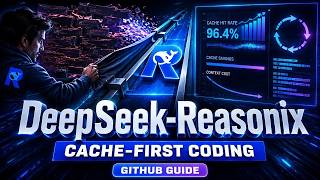
DeepSeek-Reasonix GitHub Setup Guide: Bypass Issue 3317 and Cut Agent Loops to a Fraction of a Cent
Alex Hitt

DeepSeek Reasonix:Claude Codeの安価な代替ツール?
Coding Fab

Your AI tokens are burning! How much can you save in a year with DeepSeek-Reasonix’s 99% cache h...
DevCovery
YouTube returned 6 videos for “DeepSeek Reasonix”, and we withheld 3: 3 did not mention DeepSeek Reasonix. Showing the 3 we can prove are about DeepSeek Reasonix.
Official links
Tools that pair well with DeepSeek Reasonix
Common stack mates teams adopt alongside DeepSeek Reasonix, with the specific reason each pairing earns its keep.

Poolside AI
Open-weight agentic coding models — Laguna XS 2.1 (33B) and Laguna S 2.1 (118B) — built for code that cannot leave your security boundary.

Roo Code
Roo Code is a pre-launch multi-agent AI coding assistant for VS Code, currently collecting email signups on a landing page only
Claude
Claude is Anthropic's AI assistant for long-document analysis, coding, and agentic work in one chat-and-Cowork surface.
Featured Head-to-Head Comparisons
Deepseek Reasonix vs Bito
DeepSeek Reasonix is the best choice for terminal-loving developers who want a cheap, persistent DeepSeek-specific agent with minimal overhead. Bito is ideal for engineering teams using diverse AI coding agents across multiple repos, needing system-wide context and project planning. If you live in the terminal and love DeepSeek, pick Reasonix. If you need enterprise-grade multi-repo awareness and agent-agnostic context, go with Bito.
Deepseek Reasonix vs Poolside Ai
Pick DeepSeek Reasonix if you're a solo dev or small team wanting a cheap, terminal-based agent optimized for DeepSeek's cache. Choose Poolside AI if you're an enterprise needing auditable, on-premise agents for high-stakes development. For most individuals, Reasonix's cost advantage is unbeatable; for regulated orgs, Poolside's governance is essential.
Deepseek Reasonix vs Cognition Ai
Choose Cognition AI if you're an enterprise team needing an autonomous engineer that owns the full lifecycle from planning to PR to monitoring, backed by a financial guarantee and Fortune 500 references. Choose DeepSeek Reasonix if you're a terminal-centric developer who wants a cost-efficient, always-on agent optimized for DeepSeek's prefix cache and long sessions. Reasonix is leaner and cheaper per session, but Cognition AI offers broader capabilities, integrations, and enterprise accountability.
Alternatives to DeepSeek Reasonix
View all
Poolside AI
Open-weight agentic coding models — Laguna XS 2.1 (33B) and Laguna S 2.1 (118B) — built for code that cannot leave your security boundary.

Frequently Asked Questions
Best-of guides
Used DeepSeek Reasonix? Help shape our editorial sentiment research.