
Doctor Droid
DrDroid is an AI SRE agent that maps your stack into a live knowledge graph so every on-call investigation starts with real production
Credit billing is DrDroid's real commercial edge: a 20-engineer team runs autonomous investigations without buying a licence per responder, which is hard to match against per-seat incident platforms. The MCP server and A2A protocol matter more than the marketing suggests — your in-house agents can delegate to DrDroid instead of you rebuilding context plumbing. Just read the fine print: guaranteed successful agent RCAs are an extra-cost add-on on Business and above, not on the $99/mo Startup
Verified 5d ago · liveness 75/100 · cite: rightaichoice.com/tools/doctor-droid
- SRE and platform teams whose incident context is split across Datadog, GitHub, Kubernetes and a runbook wiki
- 5–10 engineer teams piloting AI-driven investigation on the $99/mo Startup plan with 99 credits
- On-call engineers who want PagerDuty pages to arrive with findings already attached
- Enterprises needing VPC isolation, zero outbound or custom data residency alongside autonomous investigation
- Teams with no observability, alerting or incident history to crawl — the knowledge graph has nothing to map
- Organizations unwilling to grant read-only OAuth access to cloud, code and production systems
- Solo developers on side projects where the $99/mo Startup floor and low alert volume make the maths hard
We scan live Reddit threads, YouTube comments, X posts, G2 reviews and other communities — and hand you an honest verdict in under a minute.
- Honest verdict, not marketing
- Real pros & cons from real users
- Attributed quotes with receipts
3 free scans · no card needed
Skip DrDroid if you have no observability, alerting or incident history to crawl, or if you are not willing to grant read-only OAuth access to cloud, code and production systems — the knowledge graph is the product.
Going over your 99 monthly credits on the $99/mo Startup plan means buying top-ups at $1 each, with email alerts once token usage crosses 80% of available credits.
At $99/mo for 99 credits (about three investigations per credit) the Startup plan undercuts per-seat incident platforms, where every responder gets billed. Compare that to Datadog's bundled AI add-ons or incident.io seats that scale with headcount. Business starts at $999/mo cloud and $2,999/mo self-hosted for 20–200 engineers, which is where you buy volume credits, BYO LLM and SSO — and Enterprise is custom for 200+ engineers.
In short
Doctor Droid — DrDroid is an AI SRE agent that maps your stack into a live knowledge graph so every on-call investigation starts with real production. Best for SRE and platform teams whose incident context is split across Datadog, GitHub, Kubernetes and a runbook wiki, 5–10 engineer teams piloting AI-driven investigation on the $99/mo Startup plan with 99 credits, On-call engineers who want PagerDuty pages to arrive with findings already attached. Plans from $99/mo.
What's new in Doctor Droid
Checked 5 days agoAcross the latest 4 updates: 4 news mentions.
Context Engine: How DrDroid's AI Agent leverages the Continuously Improving Knowledge Graph
Explains the continuously improving knowledge graph that gives DrDroid's AI agent production context — the background engine that extracts entities, processes relations and scrapes metadata from connected systems.
How DrDroid AI SRE Agent is specialised for Production Incidents & On-call Investigations
Positions the agent specifically for production incident response and on-call investigation work rather than general-purpose ops chat.
Backtesting AI Agents: How SRE Teams Prove Reliability Before Production
Introduces a backtesting methodology so SRE teams can validate AI agent behaviour against historical incidents before enabling it in production.
AI in Engineering: 6 Trends That Will Define 2026
The company's read on six AI engineering trends expected to shape 2026, from agent reliability practices to how SRE teams adopt automation.
What people actually say about Doctor Droid — is it worth it?
We ran a structured research pass across product reviews, community discussions, and post-purchase forum threads to surface the patterns vendors won't publish themselves. Below: the recurring strengths, the hidden costs people mention most, and the cohort that consistently regrets adopting this tool.
25 mentions across 3 sources (YouTube, Product Hunt, Lemmy) · researched Aug 17, 2026.
Average across the 3 sources that answered — each source counts once, not each post.
- +Live knowledge graph mapping entities across your stack is genuinely useful.
- +Cross-tool correlation saves time by linking repos to services to pods.
- +Blast radius tracing on alerts helps prioritize incidents effectively.
- +Automated runbook execution reduces manual toil for common issues.
- +80+ integrations mean it fits into most existing workflows easily.
- −Community feedback is thin—no long-term reliability reviews yet.
- −AI predictions may be untrustworthy for rare or complex outages.
- −Pricing for heavy usage could escalate due to credit-based models.
- −Setup may exceed 30 minutes for large, heterogeneous environments.
- −Documentation and support channels are not well-documented.
- • Credit-based usage might lead to unexpected overages on Pro plans.
- • Enterprise pricing is custom; small teams might find it pricey.
Viability Score
How well maintained and how widely used is Doctor Droid? Built from what the vendor actually publishes (docs, changelog, tutorials, integrations, pricing), whether the site is live, and how much real users discuss it. How we calculate this
Last calculated: October 2026
How we score →Key Features
- Live cross-tool knowledge graph mapping repos, services, dashboards, K8s pods and cloud resources
- Read-only OAuth onboarding to cloud, code, CI/CD and observability — no agents, no code changes
- Background context engine continuously extracting entities, processing relations and scraping metadata
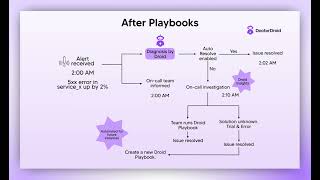
- Investigation Agent that runs any alert or incident end-to-end and returns a root cause analysis
- Auto-remediation Agent executing runbook-based fixes with human approvals
- Blast radius tracing across connected entities the moment an alert fires
- AI Memory that replays successful investigation paths and skips already-ruled-out dead ends
- Smart model switching routing simple investigations to cheaper models to stretch credits
- Alert Middleware as the first point of response for every alert
- Alert Tuning Agent that fine-tunes thresholds and files tech-debt tickets
- Trigger agents from PagerDuty, Slack, Microsoft Teams, webhook, API, MCP server or A2A protocol
- MCP server exposing org context and agents to Claude, Cursor and MCP-compatible clients
- Backtesting AI agents against historical incidents before production rollout
- Ingests runbooks, wikis, ADRs, READMEs and past incident history as grounding context
- On-premises deployment via the VPC Agent and a Mac app for desktop access
About Doctor Droid
DrDroid is an AI SRE agent built for the work that starts after you ship: alert triage, incident investigation, root cause analysis and runbook-based remediation. It is aimed at on-call engineers, SRE and platform teams who currently start every page by hand-assembling context across Datadog, GitHub, Kubernetes, a runbook wiki and whoever happens to be online. Read-only OAuth into your cloud, code, CI/CD and observability tools means no agents to install and no code changes; the vendor documents mapping the stack in about 30 minutes and building a first agent in under 5. The product's core differentiator is context rather than a chat window. Background jobs continuously extract entities, process relations and scrape metadata from connected systems, turning scattered tool data into a durable knowledge graph: which repo maps to which service, which dashboard, which Kubernetes pods, which AWS resources, and who owns it. When an alert fires, the decision engine traces blast radius across those connected entities and returns an investigation grounded in live topology, recent deploys and past incidents. Pre-built agents cover the whole lifecycle — Alert Middleware, Alert Tuning and Deployment Tracking before incidents; Investigation and Auto-remediation with human approvals during them; Observability, Reporting, Infrastructure Migration and Retrospective afterwards. AI Memory is the compounding part: every alert, deploy and investigation is retained, so the second time a failure appears DrDroid replays the investigation path that worked and skips the dead ends it already ruled out. Agents are triggered from PagerDuty, Slack or Microsoft Teams, a webhook, the API, an MCP server for Claude and Cursor, or the A2A protocol — and results land back where the work already happens. Billing is credit-based rather than per-seat: Startup is $99/mo with 99 investigation credits and top-ups at $1 each, and smart model switching averages roughly three investigations per credit.
Behind the Verdict
Where DrDroid wins is scope of context, not model quality. Plenty of tools will read your alert and summarise it. Fewer will already know that the repo in the stack trace maps to a Datadog service, a Grafana dashboard, nine K8s pods and an RDS instance — and will hand that blast radius to the agent before you finish opening your laptop. If your incident context is genuinely scattered across four or five systems, that graph is the thing you are paying for. Pick it when you are a 5–10 engineer team on Startup wanting to test AI-driven investigation cheaply, when you are 20–200 engineers who want self-hosting inside a VPC so GitHub and production databases never leave your perimeter, or when your in-house agents need somewhere to delegate via MCP or A2A. Pass if you have no observability, alerting or incident history to crawl. The knowledge graph has nothing to map, and you would be paying $99/mo for an empty canvas. Solo developers on quiet side projects hit the same maths problem. And if what you actually need is monitoring or dashboards, buy monitoring — DrDroid is an investigation layer, not a replacement for the telemetry it reads. Closest alternative is Datadog Bits AI, which is attractive purely because it is already inside the bill. The catch is per-seat economics as your responder count grows, and it only sees what Datadog sees. incident.io is the other comparison, and it wins on workflow polish if incident process is your bottleneck rather than investigation context. DrDroid's angle is cross-tool reach plus credit pricing. Two caveats worth pricing out before you buy. Credits are pooled across the team, so quiet months subsidise loud ones — but smart model switching is the assumption behind 'one credit, three investigations', and turning it off pushes every
Researching Doctor Droid? Get your full AI stack in 60 seconds.
Free, no signup — tell us your goal and get tools matched to your budget & existing stack.
Real-world workflow fit
Concrete scenarios for the personas Doctor Droid actually fits — and what changes day-one when you adopt it.
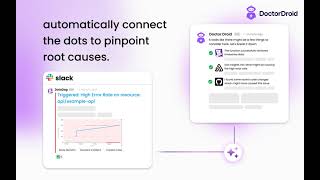
A PagerDuty page fires for payments-api latency. Instead of opening four browser tabs, the page arrives from DrDroid with the linked GitHub repo, Datadog p95 panel, Kubernetes pod list and the last three deploys already attached, plus a blast radius across connected entities.
Outcome: Triage starts on the phone rather than at the laptop, and the investigation lands back in the PagerDuty thread with a root cause and the entities that correlate with it.
A pod enters CrashLoopBackOff. The Auto-remediation Agent pulls the matching runbook, proposes the fix and waits for a human approval in Slack before executing against the cluster.
Outcome: The fix runs from the thread with an audit trail, and AI Memory records the path so the next occurrence of the same failure starts from the answer instead of rediscovering it.
Before enabling autonomous investigation, the team backtests agents against historical incidents, setting smart model switching on so simple investigations route to cheaper models.
Outcome: Reliability is proven against real past incidents rather than a vendor demo, and the credit economics are known in advance — one credit covers roughly three investigations.
Use Cases
- Investigate a PagerDuty alert by running automated root-cause analysis across logs, metrics and recent deploys.
- Auto-create and execute runbooks when a Kubernetes pod enters CrashLoopBackOff.
- Trace the blast radius from a single alert to impacted services, dashboards and AWS resources.
- Proactively suggest tightening retry budgets after detecting repeated timeouts in a microservice.
- Ingest runbooks and wikis so investigations are grounded in institutional knowledge rather than generic advice.
- Auto-triage alerts and route to the right team using patterns learned from past incidents.
- Backtest agent performance on historical incidents before pushing autonomous investigation to production.
- Delegate investigation from an in-house agent over the A2A protocol or MCP server.
Models Under the Hood
as of 2026-10-17
Limitations
- Pricing is credit-based: Startup is $99/mo for 5–10 engineer teams and includes 99 investigation credits per month with top-ups at $1 each, and one credit covers roughly three investigations on average because smart model switching routes simple investigations to cheaper models.
- Business starts at $999/mo for 20–200 engineers, while Enterprise is custom volume-credit pricing for 200+ engineers; self-hosting in your VPC, bring-your-own-LLM, and guaranteed outcome RCAs sit in the Business and Enterprise tiers, so those are sales conversations.
- Advanced automations for Teams, Google Chat, PagerDuty, Opsgenie and Zenduty require Business and above, with Enterprise adding ServiceNow and JSM.
- SOC 2 Type II and ISO 27001 certification, SSO/SCIM, audit log and custom data residency are Enterprise-level features.
- The live pages do not name any underlying AI model, so the specific LLM cannot be verified from this evidence.
as of 2026-10-03
Verification history
We have re-verified Doctor Droid 9 times since . Each pass re-reads the vendor's own pages and re-checks every listed field against that evidence; passes where nothing had changed are marked as such.
- — re-verified summary, description, our verdict, our analysis, pricing model, pricing tiers, features, integrations, who it suits, who should skip it
- — re-verified summary, description, our verdict, our analysis, pricing model, pricing tiers, features, integrations, who it suits, who should skip it
- — re-checked, vendor evidence unchanged
- — re-verified summary, description, our verdict, our analysis, pricing model, pricing tiers, features, integrations, who it suits, who should skip it
- — re-checked, vendor evidence unchanged
- — re-verified summary, description, our verdict, our analysis, pricing model, pricing tiers, features, integrations, who it suits, who should skip it
Showing the 6 most recent of 9 verification passes.
Free to cite with attribution — this page re-verifies continuously.
12-month cost
Project the real annual outlay, including the implied monthly cost when only an annual tier is published.
Vendor list price only. Add-on usage, seat overages, and contract minimums are surfaced under Hidden costs & gotchas.
Plans compared
For each published Doctor Droid tier: who it actually fits, and what it adds vs. the previous tier. Cross-reference the cost calculator above for projected annual outlay.
Startup
$99/mo
Ideal for
A 5–10 engineer team on DrDroid Cloud that wants to validate AI-driven investigation before committing to volume credits or self-hosting.
What this tier adds
Starting tier: $99/mo with 99 investigation credits, one-click cloud setup with LLM included, unlimited integrations, Slack automations and a 14-day trial.
Business (Cloud)
from $999/mo
Business (Self-hosted)
from $2,999/mo
Enterprise
Custom
Ideal for
200+ engineer organisations with compliance, data residency or ServiceNow/JSM automation requirements and high-severity incidents needing a guaranteed outcome SLA.
What this tier adds
Adds ServiceNow and JSM automations, IP allowlist and custom data residency, SOC 2 Type II and ISO 27001, license-based volume fees, dedicated onboarding and 24/7 support with a 15-min SLA.
Where the pricing makes sense
The company stage and team size where Doctor Droid's pricing actually pencils out — and where peers do it cheaper.
At $99/mo for 99 credits (about three investigations per credit) the Startup plan undercuts per-seat incident platforms, where every responder gets billed. Compare that to Datadog's bundled AI add-ons or incident.io seats that scale with headcount. Business starts at $999/mo cloud and $2,999/mo self-hosted for 20–200 engineers, which is where you buy volume credits, BYO LLM and SSO — and Enterprise is custom for 200+ engineers.
Setup time & first value
How long it actually takes to get something useful out of Doctor Droid — broken out by persona, not the marketing-page minute.
The vendor documents live-within-30-minutes for stack mapping: read-only OAuth into cloud, code, CI/CD and observability with no agents and no code changes, then background crawling builds the graph. Building a first agent is quoted at under 5 minutes. Realistically, budget the OAuth approvals from cloud and security owners as the long pole, not the technical setup. Self-hosted Business
Switching to or from Doctor Droid
How to bring data in from common predecessors and how to get it back out — written for the switcher, not the buyer.
- →From manual runbooks and a wiki: point DrDroid at your runbook and wiki repos so investigations are grounded in the same institutional knowledge your on-call already uses.
- →From PagerDuty-only triage: connect PagerDuty read-only and let Alert Middleware act as the first point of response before a human opens the page.
- →From HolmesGPT or a homegrown LLM ops script: keep the workflow and swap the reasoning layer for the knowledge graph plus Investigation Agent.
- →From Datadog dashboard hopping: keep Datadog as the system of record and let DrDroid map dashboards to services and trace blast radius across them.
- ↗To Datadog Bits AI or incident.io: you lose the cross-tool knowledge graph and the credit-based billing that avoids per-seat costs, so re-check your token spend before switching.
- ↗To HolmesGPT or another open-source agent: you keep control but take on building the context engine that maps repos to services to dashboards yourself.
- ↗To a managed observability suite: viable if you want dashboards and monitoring rather than autonomous investigation, which is a different purchase.
Integrations
Resources & Guides
Tutorials & Learning
Official links
Tools that pair well with Doctor Droid
Common stack mates teams adopt alongside Doctor Droid, with the specific reason each pairing earns its keep.

Resolve AI
AI SRE platform whose autonomous agents go on-call, triage alerts, investigate incidents and run production tasks alongside your engineers.

Relvy AI
Relvy AI is an autonomous on-call agent that investigates alerts and leaves an auditable investigation notebook your team can review.

Deeptrace
AI SRE agent that investigates every production alert and posts evidence-backed root causes in Slack in 2–3 minutes.
Featured Head-to-Head Comparisons
Doctor Droid vs Spider Cloud
If you run a multi‑tool infrastructure and need to slash MTTR, Doctor Droid’s self‑learning knowledge graph and automated runbooks are purpose‑built for SRE teams. If you need real‑time web data to power AI agents or RAG pipelines, Spider Cloud’s high‑throughput, low‑cost scraping with Browser AI commands is the better fit. They tackle entirely different problems — choose based on your pain point.
Doctor Droid vs Temporal Ai
Choose Doctor Droid if your priority is slashing MTTR and automating incident response using a knowledge graph that connects your tools. Choose Temporal AI if you need a durable execution engine to build reliable multi-step workflows, especially AI agents, that survive failures. They solve different problems: incident analysis vs. workflow orchestration.
Doctor Droid vs Presto Voice
These tools serve completely different domains. Doctor Droid is an AI SRE agent for engineering teams needing faster incident response and root-cause analysis via a knowledge graph. Presto Voice is a drive-thru voice AI platform for QSR chains aiming to boost revenue and efficiency. Choose based on your industry: infrastructure ops vs. restaurant automation.
Alternatives to Doctor Droid
View all
Resolve AI
AI SRE platform whose autonomous agents go on-call, triage alerts, investigate incidents and run production tasks alongside your engineers.


Frequently Asked Questions
Categories
Used Doctor Droid? Help shape our editorial sentiment research.