
Expected Parrot
Design research studies, pilot them with AI respondents, then field the same instruments to real people and compare.
Expected Parrot fits research teams that want AI respondents as a piloting tool but still need human data they can defend. The inspect-and-reproduce posture is the real differentiator: cached results and auditable model/response logging are what make synthetic data citable in a paper or a board deck. The open-source Python library (edsl) also means your study definitions are portable rather than locked in a UI. Pick it over pure synthetic-user products if methods rigor matters more than a polished dashboard; pick a human-only panel vendor if you never intend to use AI respondents at all.
Verified 5d ago · liveness 64/100 · cite: rightaichoice.com/tools/expected-parrot
- Academic and institutional research teams
- Enterprise insights and R&D groups running surveys and experiments
- Data-literate product and marketing researchers
- Methods-focused teams that need reproducibility
- Teams that need a one-click synthetic panel with no study design work
- Consumer-style usability testing with prototype playback
- Buyers who require a no-code tool and will not touch Python at all
We scan live Reddit threads, YouTube comments, X posts, G2 reviews and other communities — and hand you an honest verdict in under a minute.
- Honest verdict, not marketing
- Real pros & cons from real users
- Attributed quotes with receipts
3 free scans · no card needed
Skip Expected Parrot if you want a one-click synthetic audience with no instrument design — this platform assumes you bring a real research question and are willing to define respondent groups and instruments before running anything.
Expected Parrot's pricing fits teams whose volume aligns with the published tiers. Compare against the alternatives listed below for stage-specific value.
In short
Expected Parrot — Design research studies, pilot them with AI respondents, then field the same instruments to real people and compare. Best for Academic and institutional research teams, Enterprise insights and R&D groups running surveys and experiments, Data-literate product and marketing researchers. Free to start; paid plans from $99/mo.
What people actually say about Expected Parrot — is it worth it?
We scanned public community sources for Expected Parrot on Jul 3, 2026 and could not establish that the discussion we found is about this tool rather than something else sharing its name. Our own analysis of that scan says the posts were off-subject. Rather than publish a sentiment score built on the wrong subject, we publish nothing here and re-run the scan.
Viability Score
How well maintained and how widely used is Expected Parrot? Built from what the vendor actually publishes (docs, changelog, tutorials, integrations, pricing), whether the site is live, and how much real users discuss it. How we calculate this
Last calculated: October 2026
How we score →Key Features
- Study design and scoping from a plain-language research question
- Survey instruments with screeners, scales, and open-ended questions
- AI-led interviews
- Multi-agent / multi-LLM studies run against several models at once
- Model comparison across providers within a single study
- Remote cache for reproducible, cost-saving re-runs
- Auditable logs of every question, response, and model choice
- Python library (edsl) for programmatic study definition
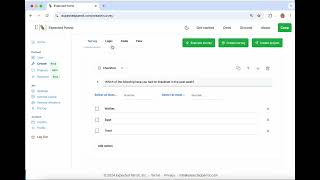
- Visual Builder for non-programmers
- Research Agent for planning studies
- AI interviewer
- Human fieldwork in the same environment as AI runs
- Instrument and finding reuse across studies
- Data export
- Reusable respondent groups and scenarios
About Expected Parrot
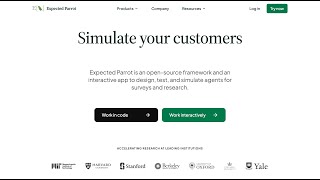
Expected Parrot is research infrastructure for studies that mix AI and human respondents in one place. You describe what you want to learn, and the platform helps you scope the question, pick a method, and plan the study. You then draft the instruments — survey questions, interview guides, respondent groups, scenarios — and review them before anything runs. Studies can be piloted with AI respondents for fast signal and then fielded to real people in the same environment, so you can compare results across humans, models, and methods without rebuilding the study in a second tool. Supported methods include AI-led interviews, structured surveys, screeners, scales, and open-ended studies. Everything is inspectable: every question, response, model choice, and result is visible and auditable, instruments and prior findings can be reused, and data can be exported. It is used by academic researchers (Harvard Business School, Stanford, LSE, Yale, Stellenbosch) and by enterprises and nonprofits, and the team is backed by Y Combinator. The core library is Python-based and open source, with a companion Builder for people who would rather not write code, plus an AI interviewer and a research agent. It differs from synthetic-user testing tools in that human fieldwork is part of the same workflow rather than a separate vendor, and the emphasis is on reproducibility — cached results mean re-running an experiment does not re-bill you for identical calls and returns the same answers.
Behind the Verdict
Most AI research tooling asks you to throw away your methodology and start again inside a new interface. Expected Parrot takes the opposite position: your instrument is the artifact. A survey, an interview guide, a set of scales, a screener — you build it once, and the same instrument runs against AI respondents and then against real people, which is the only way the comparison between the two means anything. The academic testimonials are unusually specific, which is a good sign. Thomas Graeber (Harvard Business School) singles out cached results for saving compute cost and giving perfect reproducibility across experimental iterations. Sophia Kazinnik (Stanford) points to Python-friendliness and the ability to tap multiple LLMs at once. Matthew Olckers (Stellenbosch) notes that surveys are a familiar instrument for social scientists, which lowered the technical barrier enough to scale analysis across thousands of transcripts. Jesse Bryant (Yale) frames it as LLM data labeling with basic Python skills. These are practitioners describing a workflow, not a logo wall. The honest weaknesses follow from the same facts. If you are not comfortable with a methods-first workflow — defining respondent groups, scenarios, and instruments before you run anything — the platform will feel like more setup than a quick synthetic-user test. The value proposition depends on you having a real question and a defensible design. Teams looking for a one-click "simulate 1,000 users" button are not the audience. Where it fits: academic and institutional research groups, R&D and insights teams inside enterprises that already run surveys or experiments, and data-literate product or marketing researchers who want to pilot an instrument with AI before paying for human sample. Where it does not: consumer-grade usability testing, quick landing-page polls, or anything where the deliverable is a heat map rather than a dataset. The brand is also a research-infrastructure brand, not a design-tool brand, so if you need stimulus playback or prototype click-throughs, a purpose-built prototyping research tool is the better fit.
Researching Expected Parrot? Get your full AI stack in 60 seconds.
Free, no signup — tell us your goal and get tools matched to your budget & existing stack.
Real-world workflow fit
Concrete scenarios for the personas Expected Parrot actually fits — and what changes day-one when you adopt it.
You have a survey instrument you want to validate before spending grant money on a sample. You define the questions, respondent groups, and scenarios in the Python library, run it against several LLMs at once to see whether the question wording produces stable responses, then field the same instrument to real participants and compare.
Outcome: You catch a badly worded item before fieldwork, and you have a reproducibility record of exactly which models and prompts produced the pilot data.
Your team wants to test a pricing concept but has no budget for a full study yet. You build a choice experiment in the Builder, pilot it with AI respondents, review response distributions, then run the same experiment with a human panel to check whether the pilot direction held.
Outcome: You get directional signal in days instead of weeks, and a human-data check before anyone commits to a decision.
You have thousands of open-ended survey responses to code. You set up a labeling task in the Python library, run it across models, and inspect the per-response audit trail for the cases where models disagree.
Outcome: Coded data you can defend, with a visible record of model choice and response for every item rather than a black-box label.
Use Cases
- Pilot a survey instrument with AI respondents, then field the identical instrument to a human sample and compare the two distributions.
- Run the same experiment across multiple LLMs to check whether a result is model-specific before writing it up.
- Scale qualitative coding across thousands of open-ended transcripts with an auditable labeling workflow.
- Reuse a validated instrument from a prior study instead of rebuilding it in a new tool.
- Compare human and AI responses on a conjoint or choice experiment for a methods paper.
- Let a non-programmer build and run a survey study via the Builder while the stats team keeps the Python version.
- Archive study definitions and responses so a reviewer or colleague can reproduce the analysis.
Models Under the Hood
as of 2026-09-14
Limitations
- Expected Parrot is research infrastructure, not a synthetic-user push-button.
- You need a defined question, respondent groups, and instruments before you can run anything, which is deliberate but adds setup time.
- The comparison between AI and human respondents is only as meaningful as the instrument you wrote.
- Method coverage centers on surveys, interviews, experiments, screeners, and scales — this is not a usability-testing tool with prototype interaction or click tracking.
- The most capable path is the Python library, so teams without any technical capacity will lean on the Builder and the AI interviewer and get less out of the platform.
- Pricing and plan structure were not captured in this run and are not characterized here.
as of 2026-10-03
Verification history
We have re-verified Expected Parrot 8 times since . Each pass re-reads the vendor's own pages and re-checks every listed field against that evidence; passes where nothing had changed are marked as such.
- — re-checked, vendor evidence unchanged
- — re-checked, vendor evidence unchanged
- — re-checked, vendor evidence unchanged
- — re-checked, vendor evidence unchanged
- — re-checked, vendor evidence unchanged
- — re-checked, vendor evidence unchanged
Showing the 6 most recent of 8 verification passes.
Free to cite with attribution — this page re-verifies continuously.
12-month cost
Project the real annual outlay, including the implied monthly cost when only an annual tier is published.
Vendor list price only. Add-on usage, seat overages, and contract minimums are surfaced under Hidden costs & gotchas.
Where the pricing makes sense
The company stage and team size where Expected Parrot's pricing actually pencils out — and where peers do it cheaper.
Expected Parrot's pricing fits teams whose volume aligns with the published tiers. Compare against the alternatives listed below for stage-specific value.
Setup time & first value
How long it actually takes to get something useful out of Expected Parrot — broken out by persona, not the marketing-page minute.
Setup time varies by use case. Solo users typically reach first value within an hour; teams should budget half a day for shared setup including integrations and access controls.
Switching to or from Expected Parrot
How to bring data in from common predecessors and how to get it back out — written for the switcher, not the buyer.
- →From spreadsheets and scripted survey pipelines: define the instrument once in the Python library or Builder, then run it against AI respondents and human participants from the same study definition.
- →From a synthetic-user testing tool: move to a design-first workflow where the instrument and respondent groups are reusable across AI and human runs instead of being rebuilt per test.
- →From a human-only panel vendor: keep running human fieldwork in the same environment and add an AI piloting pass on the identical instrument before you field it.
- ↗To a human-only panel vendor: export your data and instrument definitions, then re-field the study on the panel's own survey engine.
- ↗To a general-purpose LLM scripting setup: your edsl study definitions are Python, so the prompts and respondent structures carry over if you accept losing the cache and audit layer.
- ↗To a prototype usability testing tool: relevant only if your research question shifts from surveys and experiments to click-through interaction.
Resources & Guides
Tutorials & Learning
Official links
Tools that pair well with Expected Parrot
Common stack mates teams adopt alongside Expected Parrot, with the specific reason each pairing earns its keep.

Juno Research
Juno Research runs adaptive qualitative interviews with real people over WhatsApp, Messenger and SMS, then turns them into themes backed by direct quotes.

Outset
Outset runs AI-moderated interviews at scale across text, voice, video, and voice-to-voice, then synthesizes them into reports.

Marvin User Research
Marvin is an AI-native customer insights platform that runs AI-moderated interviews and delivers cited answers from your research repository.
Featured Head-to-Head Comparisons
Expected Parrot vs Screenplayiq
Choose Expected Parrot if you're a product team needing to simulate user behavior with rich analytics integrations and exportable data. Choose ScreenplayIQ if you're in film industry and need predictive box office analytics from screenplay structure. They serve entirely different domains – no direct competition.
Expected Parrot vs Truleo
Choose Truleo if you're in law enforcement needing to unearth leads from siloed data and cut report writing time drastically. Choose Expected Parrot if you're a product team wanting to simulate user behavior before shipping features. They serve entirely different domains with no overlap.
Expected Parrot vs Presto Voice
Expected Parrot and Presto Voice serve entirely different markets — one simulates customer behavior for product decisions, the other automates drive-thru ordering for QSRs. There's no direct competition; choose based on your domain: product teams should pick Expected Parrot for synthetic user testing, while restaurant chains should go with Presto Voice for voice AI that boosts revenue and efficiency. Presto's recent Dairy Queen partnership underscores its traction in QSR.
Alternatives to Expected Parrot
View allJuno Research
Juno Research runs adaptive qualitative interviews with real people over WhatsApp, Messenger and SMS, then turns them into themes backed by direct quotes.

Outset
Outset runs AI-moderated interviews at scale across text, voice, video, and voice-to-voice, then synthesizes them into reports.

Marvin User Research
Marvin is an AI-native customer insights platform that runs AI-moderated interviews and delivers cited answers from your research repository.
Frequently Asked Questions
Best-of guides
Used Expected Parrot? Help shape our editorial sentiment research.