
JIT.codes
AI code playground that turns plain-language prompts into live, editable apps with pay-per-use pricing
The AI Arena is the reason to try JIT.codes — running the same prompt against several models side by side and seeing the generated code in one browser tab is a genuinely useful prototyping loop. The usage-based model is honest for light work: Free is provider cost plus 10%, Pro at $19/mo (yearly saves two months) drops the fee to 0% and adds private mode by default. But if you generate heavily, per-use credits can outrun a flat subscription — run the math against your monthly output before committing. Pick JIT.codes over GitHub Copilot or Cursor when you want multi-model comparison and instant hosting; pick those instead when you want in-editor completion inside an existing repo.
Verified 52m ago · liveness 70/100 · cite: rightaichoice.com/tools/jit-codes
- Hobbyists and makers prototyping small web tools
- Indie developers who want usage-based pricing instead of seat licenses
- Solo developers comparing model output before committing to a stack
- Small teams doing rapid, throwaway prototyping
- Enterprise teams that need SSO, admin controls, or compliance certifications
- Teams looking to wire generation into an automated CI pipeline
- Anyone on the Free plan handling code that can't appear in a public feed
We scan live Reddit threads, YouTube comments, X posts, G2 reviews and other communities — and hand you an honest verdict in under a minute.
- Honest verdict, not marketing
- Real pros & cons from real users
- Attributed quotes with receipts
3 free scans · no card needed
Skip JIT.codes if you need SSO, compliance certifications, or a programmatic API for automation — it's a browser playground for prototyping, not a platform you wire into a delivery pipeline.
On Free, every generation bills provider cost plus a 10% platform fee, so heavy months cost more than the $0 headline suggests.
At $19/mo (or yearly, saving two months), Pro sits well under flat-rate AI coding subscriptions that charge per seat, and the 0% platform fee makes it the right pick once you're generating steadily. Below roughly $190/mo of provider cost, Free plus a credit pack is cheaper. Above that, Pro wins. Compare against seat-priced editors only if your whole team needs a license — JIT.codes has no seats at all.
In short
JIT.codes — AI code playground that turns plain-language prompts into live, editable apps with pay-per-use pricing. Best for Hobbyists and makers prototyping small web tools, Indie developers who want usage-based pricing instead of seat licenses, Solo developers comparing model output before committing to a stack. Free to start; paid plans from $5.
What's new in JIT.codes
Checked 3 days agoAcross the latest 2 updates: 1 launch and 1 pricing change.
AI Arena for model comparison launched
A new AI Arena feature lets you compare outputs from different AI models side by side inside JIT.codes, so you can pick the model that writes the code you want before committing.
Pricing page update clarifying credit packs and platform fee percentages
The pricing page now displays credit pack options at $5/$20/$50/$150 and spells out the platform fee breakdown: provider cost plus 10% on Free, 0% on Pro.
What people actually say about JIT.codes — is it worth it?
We ran a structured research pass across product reviews, community discussions, and post-purchase forum threads to surface the patterns vendors won't publish themselves. Below: the recurring strengths, the hidden costs people mention most, and the cohort that consistently regrets adopting this tool.
31 mentions across 2 sources (YouTube, Product Hunt) · researched Sep 1, 2026.
Average across the 2 sources that answered — each source counts once, not each post.
- +Transparent pay-as-you-go pricing with provider cost plus small fee.
- +Free tier includes core models and features, ideal for testing.
- +AI Arena lets you compare model outputs side by side.
- +Auto-deploy to public URL with free hosting is a big convenience.
- +Download projects as ZIP for easy export.
- −No SSO, compliance, or API, limiting enterprise adoption.
- −Public-by-default sharing may deter users needing privacy on free tier.
- −Community feedback is almost nonexistent, making it hard to trust.
- −Name clashes with Java/iOS JIT, causing search confusion.
- −Real-time collaboration may not be fully mature based on user request.
- • Credit packs for pay-as-you-go may be required beyond free tier limits.
- • Platform fee of 10% on free tier could add to AI provider costs.
Viability Score
How well maintained and how widely used is JIT.codes? Built from what the vendor actually publishes (docs, changelog, tutorials, integrations, pricing), whether the site is live, and how much real users discuss it. How we calculate this
Last calculated: October 2026
How we score →Key Features
- Conversational code generation from a chat interface
- Live in-browser preview of generated code
- Multi-model agents including GLM 4.5
- AI Arena for side-by-side model output comparison (launched 2026-05-26)
- Snapshots for project versioning and rollback
- Real-time collaboration with share links
- Auto-deploy to a public URL with free hosting
- Public community feed for sharing and remixing projects
- Download projects as ZIP
- Private mode by default (Pro)
- No upload limits under fair use (Pro)
- Priority routing for faster response times (Pro)
- Early access to experiments and new models (Pro)
- Support for all programming languages
- Credit packs for pay-as-you-go top-ups
About JIT.codes
JIT.codes is a browser-based AI code playground where you type what you want — a UI component, a feature, a small web tool — and get working, editable code with an instant live preview. It runs multiple AI models, and the AI Arena (launched 2026-05-26) lets you compare outputs from different models side by side before you commit to one. Projects are versioned with snapshots, you can collaborate in real time over share links, auto-deploy to a public URL with free hosting, or download your work as a ZIP. The community feed is public by default on Free, with a reported 130,000+ users who share and remix projects. Pricing is usage-based rather than seat-based: the Free plan charges provider cost plus a 10% platform fee, Pro is $19/mo (with a yearly option that saves two months) and drops the fee to 0%, adds private mode by default, removes upload limits under fair use, and gets priority routing. Credit packs at $5/$20/$50/$150 top up usage on demand. It suits hobbyists, solo developers, and small teams doing rapid prototyping — not enterprise compliance buyers.
Behind the Verdict
JIT.codes occupies a narrow but real slot: browser-first, conversation-first code generation with a live preview pane, aimed at people who want to see a thing working before they set up a repo. The standout capability is the AI Arena, added on 2026-05-26. Rather than trusting one model's answer, you can send the same prompt to several and compare the resulting code directly. For anyone still deciding which model suits a given task — a Tailwind layout, a small state machine, a regex — that comparison is worth more than another autocomplete and it's the feature most competitors don't surface in-product. Around that you get the expected playground furniture: chat-based generation, live preview, snapshots for rolling back or branching, real-time collaboration with share links, auto-deploy to a public URL with free hosting, and ZIP download. The community feed is public by default on Free, which is how a reported 130,000+ users find and remix each other's work; Pro flips the default to private. The pricing is the part worth reading carefully. Free is not free — it's provider cost plus a 10% platform fee, and 10% on top of every generation adds up over a month of steady use. Pro at $19/mo (or yearly, which saves two months) removes that fee entirely, so the break-even against Free is not "do I need private mode" but "do I generate more than roughly $190 of provider cost per month." Below that, Free plus a credit pack may be cheaper; above it, Pro is straightforwardly the better deal. The $5/$20/$50/$150 credit packs let you top up without a subscription, which is a reasonable fit for bursty hobby work. Note there are no seat licenses — you pay for generation, not for people. Where it doesn't fit: this is a playground, not a delivery platform. There's no SSO, no compliance certification story, and you shouldn't plan on wiring it into CI. Upload limits on Free (file size and count) will bite anyone importing a real codebase, and "no upload limits" on Pro carries an explicit fair-use qualifier with possible additional rate limits during incidents. Use it to answer "what would this look like" in two minutes instead of twenty, and to pick a model for a recurring task. Don't use it as your production editor.
Researching JIT.codes? Get your full AI stack in 60 seconds.
Free, no signup — tell us your goal and get tools matched to your budget & existing stack.
Real-world workflow fit
Concrete scenarios for the personas JIT.codes actually fits — and what changes day-one when you adopt it.
You have an idea for a small web utility. You open JIT.codes, describe the behavior in chat, watch the live preview update, snapshot the version you like, and auto-deploy it to a public URL.
Outcome: A working, hosted tool in one browser session and a ZIP you can pull down later if you want to move it into a repo.
You need a reliable way to generate a specific kind of component. You paste the same prompt into the AI Arena and compare outputs from several models side by side.
Outcome: You settle on the model that consistently produces code you don't have to rewrite, instead of guessing.
You share a project link, both edit in real time, and roll back with snapshots whenever a generation makes things worse.
Outcome: Fast iteration without a shared repo, and a clean state to export once the prototype is worth keeping.
Use Cases
- Draft a React component by describing its UI and behavior in natural language and see it render immediately.
- Iterate on a full-stack app with live preview and snapshots to roll back a bad generation.
- Pair on a project in real time with teammates through a shared link.
- Deploy a small web tool to a public URL using the built-in free hosting.
- Run one prompt across several models in the AI Arena to pick the one that writes the code you want.
- Share an AI-generated snippet to the public feed so others can remix it.
Models Under the Hood
as of 2026-10-18
Limitations
- Free applies upload limits (file size and count), makes projects public by default, uses standard response times, and adds a 10% platform fee on top of provider cost.
- Pro removes the fee, defaults to private, and lifts upload limits — but "no upload limits" is explicitly subject to fair-use and abuse prevention, and additional rate limits can apply during incidents.
- Credit packs are consumed by generation; there is no seat-based pricing, so cost scales with how much you generate rather than how many people use it.
- JIT.codes is a playground: no SSO, no compliance certifications, and no described programmatic API for automation.
as of 2026-09-27
Verification history
We have re-verified JIT.codes 9 times since . Each pass re-reads the vendor's own pages and re-checks every listed field against that evidence; passes where nothing had changed are marked as such.
- — re-checked, vendor evidence unchanged
- — re-checked, vendor evidence unchanged
- — re-checked, vendor evidence unchanged
- — re-verified summary, description, our verdict, our analysis, pricing model, pricing tiers, features, integrations, who it suits, who should skip it
- — re-verified summary, description, our verdict, our analysis, pricing model, pricing tiers, features, integrations, who it suits, who should skip it
- — re-verified summary, description, our verdict, our analysis, pricing model, pricing tiers, features, integrations, who it suits, who should skip it
Showing the 6 most recent of 9 verification passes.
Free to cite with attribution — this page re-verifies continuously.
12-month cost
Project the real annual outlay, including the implied monthly cost when only an annual tier is published.
Vendor list price only. Add-on usage, seat overages, and contract minimums are surfaced under Hidden costs & gotchas.
Plans compared
For each published JIT.codes tier: who it actually fits, and what it adds vs. the previous tier. Cross-reference the cost calculator above for projected annual outlay.
Free
$0/mo
Ideal for
Hobbyists and learners exploring what AI can do for their day-to-day coding before spending anything.
What this tier adds
Starting tier — provider cost plus a 10% platform fee, core models, upload limits, public by default.
Pro
$19.00/mo
Ideal for
Indie developers and small teams generating steadily who need private projects and predictable costs.
What this tier adds
Drops the platform fee to 0%, makes projects private by default, removes upload limits under fair use, adds priority routing and early access.
Credits Pack 5
$5.00
Ideal for
Occasional users topping up a few dollars of generation without taking a subscription.
What this tier adds
Entry-size top-up; platform fee still applies at +10% on Free, 0% on Pro.
Credits Pack 20
$20.00
Ideal for
Weekend project builders who generate enough to exhaust a small pack in a session or two.
What this tier adds
Four times the Pack 5 balance; same fee structure (+10% on Free, 0% on Pro).
Credits Pack 50
$50.00
Ideal for
Solo developers running regular prototyping sprints without a monthly subscription.
What this tier adds
Mid-size top-up; fee structure unchanged, so Pro remains better value if you're also on the paid plan.
Credits Pack 150
$150.00
Ideal for
Heavy users who prefer prepaying usage in bulk; the vendor offers a contact route for larger needs.
What this tier adds
Largest published pack; the vendor asks you to contact them for volumes beyond this.
Where the pricing makes sense
The company stage and team size where JIT.codes's pricing actually pencils out — and where peers do it cheaper.
At $19/mo (or yearly, saving two months), Pro sits well under flat-rate AI coding subscriptions that charge per seat, and the 0% platform fee makes it the right pick once you're generating steadily. Below roughly $190/mo of provider cost, Free plus a credit pack is cheaper. Above that, Pro wins. Compare against seat-priced editors only if your whole team needs a license — JIT.codes has no seats at all.
Setup time & first value
How long it actually takes to get something useful out of JIT.codes — broken out by persona, not the marketing-page minute.
Solo developers: minutes — sign up, type a prompt, see a preview, no local setup. Small teams: roughly ten minutes including inviting a collaborator and opening a share link. Model-comparison work in the AI Arena: same session, no additional configuration beyond writing the prompt you want to test.
Switching to or from JIT.codes
How to bring data in from common predecessors and how to get it back out — written for the switcher, not the buyer.
- →From a chat assistant like ChatGPT: paste your prompt into JIT.codes instead and get a live preview plus deploy rather than copy-pasting code into your own editor.
- →From GitHub Copilot or Cursor: bring the prompt, not the repo — JIT.codes suits greenfield prototypes rather than completion inside an existing codebase.
- →From a static file host: use the built-in free hosting on deploy instead of wiring up a separate pipeline for a prototype.
- ↗To a local repo: download the project as a ZIP and commit it to Git when the prototype graduates.
- ↗To a seat-priced AI editor like Copilot or Cursor: move to in-editor completion once you're maintaining a real codebase.
Resources & Guides
Tutorials & Learning
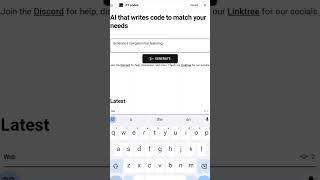
JIT.codes, an Al-driven tool that magically converts text into HTML, CSS, and JS code.
Shadan
JIT codes website for webdevelopers even don't know program#shorts #webdevelopment #youtube#leo
CodeByAbi
YouTube returned 6 videos for “JIT.codes”, and we withheld 4: 4 did not mention JIT.codes. Showing the 2 we can prove are about JIT.codes.
Official links
Tools that pair well with JIT.codes
Common stack mates teams adopt alongside JIT.codes, with the specific reason each pairing earns its keep.
Lovable
Lovable is an AI app builder that turns plain-language prompts into deployed full-stack web apps with hosting, auth and payments.

Trickle AI
Trickle builds live websites, apps and AI forms from plain-English prompts on a visual AI canvas.

Replit Agent
Replit Agent turns a plain-English prompt into a running full-stack app inside your browser, then publishes it to a live Replit URL.
Featured Head-to-Head Comparisons
Jit Codes vs Spider Cloud
Spider Cloud and JIT.codes solve completely different problems: one is a web data extraction API for AI agents, the other is an AI code generation playground. Your choice depends on whether you need to scrape the web (Spider Cloud) or generate code conversationally (JIT.codes). Spider Cloud offers a pay-as-you-go model with a Rust engine, AI Studio, and recent Browser AI commands, while JIT.codes provides transparent token-based pricing with live preview and collaboration.
Jit Codes vs Voyage Ai
For enterprises building high-accuracy RAG on domain-specific data, Voyage AI’s specialized embedding models, long-context support, and compliance (SOC2/HIPAA) are unmatched. JIT.codes is far better for developers who want to quickly prototype apps via chat without worrying about licensing costs—its freemium model and transparent pricing make it ideal for indie projects. The tools address completely different needs; choose Voyage for retrieval quality, JIT for code generation speed.
Jit Codes vs Temporal Ai
For teams building production-grade, fault-tolerant AI agents and multi-step workflows, Temporal AI is the clear choice with its durable execution, automatic retries, and enterprise integrations. For developers wanting a fast, low-cost conversational playground to prototype and share code, JIT.codes offers a simpler, transparent pricing model. Pick Temporal for reliability at scale; pick JIT.codes for speed and simplicity.
Jit Codes vs Marvin
Choose Marvin if you're a Python developer needing to embed LLM logic into your own applications with type safety and full control over data, and you're comfortable self-hosting. Choose JIT.codes if you want an interactive, collaborative playground to rapidly prototype and share apps via chat, with a transparent pay-what-you-use pricing model.
Alternatives to JIT.codes
View allLovable
Lovable is an AI app builder that turns plain-language prompts into deployed full-stack web apps with hosting, auth and payments.

Trickle AI
Trickle builds live websites, apps and AI forms from plain-English prompts on a visual AI canvas.

Replit Agent
Replit Agent turns a plain-English prompt into a running full-stack app inside your browser, then publishes it to a live Replit URL.
Frequently Asked Questions
Used JIT.codes? Help shape our editorial sentiment research.