
Kivo Health
Kivo Health runs insurance-covered virtual pulmonary rehab for COPD, with therapist-led group video sessions, a tablet sent to your door, and AI-assisted
Kivo Health is the rare virtual program that ships hardware, staffs licensed respiratory therapists, and gets paid by Medicare Advantage plans rather than by you. The numbers it publishes are the ones that matter: 24% symptom improvement, 34% functional capacity, 83% median attendance, 90 NPS, and a claimed 3.1x ROI for plans. If you are homebound, lack transport, or have already failed to attend in-person rehab, this is built for exactly your situation. If you want a self-guided app you pay for monthly, or you don't have a COPD diagnosis, look at general respiratory apps instead — Kivo is a clinical service with an eligibility gate.
Verified 7d ago · liveness 59/100 · cite: rightaichoice.com/tools/kivo-health
- Seniors with COPD who are homebound or lack transport to in-person rehab
- People whose Medicare, Medicaid, or commercial plan covers the program
- Patients who want respiratory-therapist-led care rather than a self-guided app
- Medicare Advantage plans and value-based care teams targeting COPD utilization
- People without a COPD or chronic lung diagnosis
- Anyone needing acute or emergency respiratory care
- Patients who won't attend group video sessions or can't commit to the 9-week schedule
We scan live Reddit threads, YouTube comments, X posts, G2 reviews and other communities — and hand you an honest verdict in under a minute.
- Honest verdict, not marketing
- Real pros & cons from real users
- Attributed quotes with receipts
3 free scans · no card needed
Skip Kivo Health if you don't have a COPD diagnosis, need acute or emergency respiratory care, or want a self-guided app you can buy and use on your own schedule without a referral or insurance eligibility check.
Depending on your plan you may owe a co-pay even when Kivo is listed as covered, so confirm the amount during the eligibility check rather than assuming $0.
Kivo is priced for payers and health systems, not for individuals — cost lands on your Medicare, Medicaid, or commercial plan, frequently at $0 out of pocket but sometimes with a co-pay. Compared with self-guided COPD apps that charge you a monthly subscription directly, Kivo shifts the cost to insurance in exchange for a referral or eligibility check. Against in-person pulmonary rehab, which bills through the same plans but requires travel, Kivo competes on access rather than on price.
In short
Kivo Health — Kivo Health runs insurance-covered virtual pulmonary rehab for COPD, with therapist-led group video sessions, a tablet sent to your door, and AI-assisted. Best for Seniors with COPD who are homebound or lack transport to in-person rehab, People whose Medicare, Medicaid, or commercial plan covers the program, Patients who want respiratory-therapist-led care rather than a self-guided app. Contact Sales pricing.
What's new in Kivo Health
Checked 7 days agoAcross the latest 1 update: 1 launch.
What people actually say about Kivo Health — is it worth it?
We ran a structured research pass across product reviews, community discussions, and post-purchase forum threads to surface the patterns vendors won't publish themselves. Below: the recurring strengths, the hidden costs people mention most, and the cohort that consistently regrets adopting this tool.
18 mentions across 1 source (YouTube) · researched Jul 26, 2026.
Average across the 1 source that answered — each source counts once, not each post.
- +Insurance-covered with Medicare and major payers.
- +Starter kit includes tablet, oxygen monitor, exercise bands.
- +Cellular connectivity included; no WiFi needed.
- +Structured 9-week small-group curriculum with coaching.
- +AI-personalized care plan based on individual data.
- −No independent user reviews or testimonials available.
- −Community buzz is virtually nonexistent online.
- −Pricing unclear; must contact for details.
- −Only beginner level; no advanced options mentioned.
- −No publicly available integrations list.
- • Potential out-of-pocket if insurance denies coverage
Viability Score
How well maintained and how widely used is Kivo Health? Built from what the vendor actually publishes (docs, changelog, tutorials, integrations, pricing), whether the site is live, and how much real users discuss it. How we calculate this
Last calculated: October 2026
How we score →Key Features
- Virtual pulmonary rehabilitation program for COPD
- 9-week curriculum with twice-weekly small-group video sessions
- 1:1 assessment and care planning with a licensed respiratory therapist
- Aerobic and anaerobic exercise training
- Breathing technique instruction
- Medication management and COPD education
- Starter kit mailed to your door: tablet, oxygen monitor, exercise bands
- Cellular connectivity included for members without home WiFi
- Remote monitoring via the included oxygen monitor
- Health coaching and member community after the 9-week program
- Flare-up prevention and symptom management coaching
- Insurance eligibility check and billing support
- Coverage through Medicare, Medicaid, United Healthcare, Humana, Blue Cross, Aetna, Priority Health and Clover Health
- Peer-reviewed published outcomes on symptoms, function, mood and attendance
- Health plan ROI reporting for payer partners
About Kivo Health
Kivo Health is a virtual pulmonary rehabilitation service for people managing COPD. You get a kit in the mail — a tablet with the program loaded, an oxygen monitor, and exercise bands — plus a cellular connection so you can finish sessions even without WiFi at home. Care starts with a 1:1 appointment with a licensed respiratory therapist who assesses your breathing symptoms and sets personal goals; from there you join twice-weekly small-group video classes for 9 weeks covering aerobic and anaerobic exercise, breathing techniques, and medication management, followed by ongoing health-coach and community support. The program is covered by Medicare, Medicaid, United Healthcare, Humana, Blue Cross, Aetna, Priority Health, Clover Health and other plans, often at $0 out of pocket, though co-pays can apply depending on your plan — Kivo runs an eligibility check for you. Kivo publishes peer-reviewed outcomes: 24% improvement in symptoms, 34% in functional capacity, 25% in mood, with 83% median attendance and a 90 NPS. For health plans it reports a 3.1x ROI and a projected $9.8M annual saving per 100,000 Medicare Advantage members, with $8,245 PMPY in predicted cost savings driven mainly by reduced inpatient and SNF utilization. In April 2026, Optum Arcadia and Kivo Health launched AI-powered virtual lung rehab and care for patients in California. Unlike self-guided COPD apps, Kivo pairs equipment with human clinicians and payer billing — which is the pitch, and also the gate: enrollment runs through referral or an eligibility check rather than a credit card.
Behind the Verdict
Kivo's structural bet is that COPD rehab fails on access, not on content. In-person pulmonary rehab works, but attendance is notoriously poor among the patients who need it most, so Kivo attacks the logistics: it mails a tablet with the program pre-loaded, includes an oxygen monitor and exercise bands, and bakes in cellular connectivity so a member with no home WiFi can still complete every session. That single design decision says more about who this is for than any marketing page does. The clinical layer is human rather than synthetic: a 1:1 assessment with a licensed respiratory therapist, then 9 weeks of twice-weekly small-group video sessions covering aerobic and anaerobic exercise, breathing techniques, and medication management, then a maintenance phase with health coaches and a member community. The AI framing shows up in the care program and remote monitoring rather than in a chatbot, which is the right place for it in a condition where a missed flare-up is an emergency. Outcomes are the strongest part of the case. Kivo reports 24% symptom improvement, 34% functional capacity improvement, and 25% mood improvement from peer-reviewed work, plus 83% median attendance and a 90 NPS. Attendance is the number competitors should worry about. On the payer side it publishes a 3.1x ROI, a projected $9.8M annual saving per 100,000 Medicare Advantage members, and $8,245 PMPY in predicted cost savings, mostly from avoided inpatient and SNF stays — grounded in the observation that 1 in 9 MA members has COPD and high-risk COPD members cost $29,564 PMPY, 2.9x members without COPD. The April 2026 Optum Arcadia launch extends this into California value-based care, on top of existing work with Stanford Health Care and Priority Health. The honest weaknesses: this is a COPD program and not a general respiratory one, so asthma, ILD, and post-surgical lung patients are outside the lane. Geography matters — some partnerships, Optum Arcadia included, are region-limited, so an eligible patient in the wrong state may not be able to enroll yet. And all sessions are video-based with a set 9-week cadence, which is fine for someone comfortable on a tablet and a poor fit for someone who won't show up to a group call. Kivo's outcomes are reported at the program level, so an individual buyer should treat them as population averages, not a personal guarantee.
Researching Kivo Health? Get your full AI stack in 60 seconds.
Free, no signup — tell us your goal and get tools matched to your budget & existing stack.
Real-world workflow fit
Concrete scenarios for the personas Kivo Health actually fits — and what changes day-one when you adopt it.
You ask your pulmonologist about Kivo, Kivo runs an insurance eligibility check, and a kit with the tablet, oxygen monitor, and exercise bands arrives by mail. You meet a respiratory therapist 1:1 to set goals, then join twice-weekly group video classes for 9 weeks using the tablet's built-in cellular connection because you have no WiFi.
Outcome: You complete the program from home — Kivo reports 83% median attendance and 24% symptom improvement across its peer-reviewed cohort — and move into health-coach and community support afterward.
You refer COPD patients who can't get to in-person rehab, including patients who report transportation or oxygen-related barriers. Kivo handles the eligibility check, ships the equipment, and reports progress back through your existing referral relationship.
Outcome: Patients who previously fell out of the rehab funnel get a covered program they can actually attend, and your practice has a documented option for the access-barrier conversation.
You deploy Kivo across high-risk COPD members, using the published figures as the planning basis: 11.5% COPD prevalence in MA, $29,564 PMPY for high-risk COPD members versus 2.9x lower for members without COPD, and $8,245 PMPY in predicted savings from reduced inpatient and SNF use.
Outcome: The projection is 3.1x ROI and roughly $9.8M in annual savings per 100,000 covered members, with a California rollout through the Optum Arcadia partnership as a starting point.
Use Cases
- Complete pulmonary rehab at home when you are homebound or lack transportation
- Reduce COPD symptoms through 9 weeks of guided exercise and breathing training
- Prevent flare-ups and hospital readmissions with oxygen monitoring and early intervention
- Learn how your COPD medications work and when to use them
- Join small-group video sessions with other people managing COPD
- Enroll eligible members in an insurance-covered pulmonary rehab benefit
- Deploy a scalable COPD program across a Medicare Advantage population
Limitations
- Kivo Health is built specifically for COPD, so other respiratory conditions may not be served.
- Enrollment runs through a referral or an insurance eligibility check, and depending on your plan you may owe a co-pay even when the program is covered.
- Some partnerships are regional — the April 2026 Optum Arcadia launch is limited to California — so availability depends on where you live and which plan you're on.
- All sessions are delivered as video on a tablet, so the program assumes you can participate in group calls on a fixed twice-weekly schedule.
as of 2026-10-03
Verification history
We have re-verified Kivo Health 8 times since . Each pass re-reads the vendor's own pages and re-checks every listed field against that evidence; passes where nothing had changed are marked as such.
- — re-verified summary, description, our verdict, our analysis, pricing model, pricing tiers, features, integrations, who it suits, who should skip it
- — re-checked, vendor evidence unchanged
- — re-verified summary, description, our verdict, our analysis, pricing model, pricing tiers, features, integrations, who it suits, who should skip it
- — re-checked, vendor evidence unchanged
- — re-verified summary, description, our verdict, our analysis, pricing model, pricing tiers, features, integrations, who it suits, who should skip it
- — re-checked, vendor evidence unchanged
Showing the 6 most recent of 8 verification passes.
Free to cite with attribution — this page re-verifies continuously.
12-month cost
Project the real annual outlay, including the implied monthly cost when only an annual tier is published.
Vendor list price only. Add-on usage, seat overages, and contract minimums are surfaced under Hidden costs & gotchas.
Where the pricing makes sense
The company stage and team size where Kivo Health's pricing actually pencils out — and where peers do it cheaper.
Kivo is priced for payers and health systems, not for individuals — cost lands on your Medicare, Medicaid, or commercial plan, frequently at $0 out of pocket but sometimes with a co-pay. Compared with self-guided COPD apps that charge you a monthly subscription directly, Kivo shifts the cost to insurance in exchange for a referral or eligibility check. Against in-person pulmonary rehab, which bills through the same plans but requires travel, Kivo competes on access rather than on price.
Setup time & first value
How long it actually takes to get something useful out of Kivo Health — broken out by persona, not the marketing-page minute.
For individuals: expect a few days from eligibility check to kit arrival, then your 1:1 respiratory therapist assessment before group sessions begin. For health plans and physician groups: onboarding involves contracting plus member identification, and the Optum Arcadia California launch is the clearest published template for how that rollout runs.
Switching to or from Kivo Health
How to bring data in from common predecessors and how to get it back out — written for the switcher, not the buyer.
- →From in-person pulmonary rehab: Kivo replaces the clinic commute with a mailed tablet, oxygen monitor, and exercise bands, keeping the therapist-led 9-week structure.
- →From a self-guided COPD aKivo adds licensed respiratory therapists, group video sessions, and payer coverage instead of a personal monthly subscription.
- →From no structured rehab at all: a single referral starts with a 1:1 assessment and goal-setting appointment before group classes begin.
- ↗To a general respiratory or wellness ayou lose therapist-led sessions, the mailed equipment, and insurance billing when you move to a self-guided product.
- ↗To in-person pulmonary rehab: possible if your transport and mobility situation changes, though the 9-week structured curriculum overlaps heavily.
- ↗To another payer-backed virtual program: your Kivo outcomes data and completion record are the relevant documentation to carry over.
Resources & Guides
Tutorials & Learning
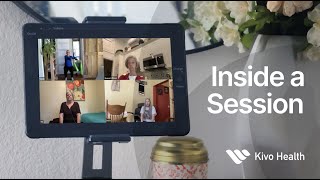

YouTube returned 5 videos for “Kivo Health”, and we withheld 3: 3 did not mention Kivo Health. Showing the 2 we can prove are about Kivo Health.
Official links
Tools that pair well with Kivo Health
Common stack mates teams adopt alongside Kivo Health, with the specific reason each pairing earns its keep.

Innovaccer
An agentic cloud for healthcare that runs AI agents over one governed data layer across clinical and administrative workflows.

Maven Clinic
Maven Clinic is a virtual care platform for every family stage — fertility, maternity, parenting, and menopause — sold mainly as an employer and health-plan

SimCare
SimCare is AI client simulation software that gives counselor trainees 500+ avatars for voice and video practice sessions with instant
Featured Head-to-Head Comparisons
Kivo Health vs Codametrix
Kivo Health and CodaMetrix serve entirely different needs—Kivo Health provides AI-driven virtual pulmonary rehabilitation for COPD patients (covered by insurance, with proven outcomes), while CodaMetrix automates medical coding for large health systems (KLAS #1, 5:1 ROI). Choose Kivo if you manage COPD populations or are a patient; choose CodaMetrix if you need to cut coding costs and denials.
Kivo Health vs Isomorphic Labs
Kivo Health and Isomorphic Labs operate in entirely different healthcare domains — virtual COPD rehab vs. AI drug discovery — and are not direct competitors. Choose Kivo Health if you're a senior with COPD or a health plan seeking a proven, insurance-covered virtual rehab program. Choose Isomorphic Labs if you're a large pharma company needing AI-driven drug design capabilities via deep partnership.
Kivo Health vs Rapidsos
Kivo Health and RapidSOS serve entirely different emergencies: Kivo focuses on chronic COPD management with insurance-covered virtual rehab, while RapidSOS delivers AI-powered emergency intelligence to 911 and enterprises. Your choice depends on whether you need chronic disease care or acute incident response.
Alternatives to Kivo Health
View all
Innovaccer
An agentic cloud for healthcare that runs AI agents over one governed data layer across clinical and administrative workflows.

Maven Clinic
Maven Clinic is a virtual care platform for every family stage — fertility, maternity, parenting, and menopause — sold mainly as an employer and health-plan

Frequently Asked Questions
Categories
Topics
Used Kivo Health? Help shape our editorial sentiment research.