
Leania.ai
A short operational scan that maps your workflows and tools, then tells you what to keep, cut, replace or automate, with the evidence for each call.
Leania.ai's hook is defensible: it outputs decisions rather than another dashboard, and it labels forecasts as forecasts instead of burying that in a footnote — the worked example marks £12.2K/yr as a forecast, "not a cashable saving". The scan is also cheap to start: about 5 minutes, no integrations required, plans advertised from $29/month. What it is not, on the evidence here, is a process-mining platform. Against Celonis or UiPath Process Mining it makes no claim to mine system event logs; its inputs are your website, a stated priority and the tools you name, which makes early output directional by design. Treat it as a fast diagnostic that ranks what to fix next, not a measured cost
Verified 1d ago · liveness 45/100 · cite: rightaichoice.com/tools/leania-ai
- Founder-led service businesses around 10–50 FTE
- Operations consultants running discovery for 20–100 FTE clients
- Fractional COOs at 70–200 FTE B2B services firms
- Digital transformation advisors working with 100–500 FTE clients
- Teams that need measured cost figures with an auditable methodology, not directional estimates
- Businesses that want a process automation engine to execute the change, not a scan that recommends it
- Operators who have already pinpointed the exact fix and only need it built
We scan live Reddit threads, YouTube comments, X posts, G2 reviews and other communities — and hand you an honest verdict in under a minute.
- Honest verdict, not marketing
- Real pros & cons from real users
- Attributed quotes with receipts
3 free scans · no card needed
Skip Leania.ai if you need hard, measured cost figures you can defend line-by-line in a finance audit rather than a ranked set of directional decisions to act on next.
Headline opportunity figures are forecasts until evidence sharpens — the published example labels £12.2K/yr as "not a cashable saving", so do not budget against them as realised savings.
Entry plans are advertised from $29/month, which puts Leania.ai well below enterprise process-mining platforms such as Celonis or UiPath Process Mining, and alongside light operational-assessment services rather than full discovery engagements. At that entry rate it is sized for founder-led and service teams of roughly 10–50 FTE; larger, multi-site operations should expect to scope further.
In short
Leania.ai — A short operational scan that maps your workflows and tools, then tells you what to keep, cut, replace or automate, with the evidence for each call. Best for Founder-led service businesses around 10–50 FTE, Operations consultants running discovery for 20–100 FTE clients, Fractional COOs at 70–200 FTE B2B services firms. Contact Sales pricing.
What people actually say about Leania.ai — is it worth it?
We ran a structured research pass across product reviews, community discussions, and post-purchase forum threads to surface the patterns vendors won't publish themselves. Below: the recurring strengths, the hidden costs people mention most, and the cohort that consistently regrets adopting this tool.
2 mentions across 1 source (Product Hunt) · researched Jul 3, 2026.
Average across the 1 source that answered — each source counts once, not each post.
- +Links operational data directly to financial outcomes, enabling ROI-based decisions.
- +Automates cost-per-process-step calculations, saving hours of manual analysis.
- +Scenario simulation allows testing changes before rolling out.
- +Aimed at ops managers and consultants who need data-driven workflow insights.
- +On-demand AI advisor approach appeals to small businesses and startups.
- −Very early stage with few integrations and limited community feedback.
- −No public pricing; enterprise contact model may exclude small teams.
- −Setup likely requires existing data infrastructure (ERP, project management tools).
- −No reviews on major platforms like G2, Capterra, or Reddit to gauge real-world performance.
- −Security and compliance details are missing, concerning for sensitive data.
- • No free tier or trial publicly mentioned; likely requires paid engagement to evaluate
- • Enterprise minimums or onboarding fees may apply
Viability Score
How well maintained and how widely used is Leania.ai? Built from what the vendor actually publishes (docs, changelog, tutorials, integrations, pricing), whether the site is live, and how much real users discuss it. How we calculate this
Last calculated: September 2026
How we score →Key Features
- Operational scan started from your website or company name
- Workflow mapping without pre-built integrations
- Workflow bottleneck detection where work slows, repeats or waits on handoffs
- Overlapping-tool detection showing capability duplication
- Manual handoff identification for repeatable work
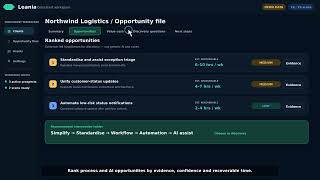
- Automation candidate ranking by worth-doing-now, not feasibility
- Keep / Cut / Replace / Automate / Validate decision output per item
- Confidence labelling, with forecasts marked as estimates inline
- Evidence trail showing the exact flagged step or tool
- Capability-overlap evidence (for example, three PM tools covering the same seven capabilities)
- Impact, effort and confidence stated beside each recommendation
- Worked example report viewable before you commit to anything
- Directional first result delivered in minutes while analysis continues
- Optional context inputs you can skip if unknown
- Process map with evidence trail across intake, triage, plan, build, ship stages
About Leania.ai
Leania.ai runs an operational scan for founder-led and service teams. You give it your website or company name plus what you already know about your priority and tools, and it maps your workflows and the tools involved — no integrations required, and no need for perfect data. The scan starts directional and sharpens as you add context. It looks for four kinds of waste: workflow bottlenecks where work slows, repeats or waits on handoffs; tools that duplicate each other or sit underused; manual handoffs that repeat weekly; and automation candidates, ranked by whether they are worth doing now rather than whether they are technically possible. The output is not a dashboard. Every workflow and tool it examines gets a recommended decision — Keep, Cut, Replace, Automate or Validate — with impact, effort and confidence stated next to it. Where a number is a forecast rather than a measured result, the report says so in the same sentence. The published worked example shows a structure of time lost, spend at risk, identified opportunity, bottlenecks, decisions and top priorities; example figures include 312 hrs/yr time lost, £11.4K/yr spend at risk and £28.4K/yr identified opportunity, all labelled estimates. Underneath each recommendation sits an evidence trail: the exact step or tool flagged, capability-overlap counts, and the rationale for why this action ranks here. The scan is shaped by interviews with founders, operators, consultants and transformation leaders.
Behind the Verdict
Strengths. The decision framing is the product. Instead of a process map you have to interpret, each item gets Keep, Cut, Replace, Automate or Validate attached to it. The honesty layer is unusual and worth noting: "Where a recommendation is a forecast rather than a measured result, it is labelled that way in the same sentence — not in a footnote," and the example report repeats "Estimate" beside each headline figure. The evidence trail is concrete — "3 PM tools cover the same 7 capabilities" and "Invoice entry · 45 min/batch · manual" — which is the difference between a recommendation you can take to a leadership meeting and one you cannot. Onboarding is deliberately low-friction: step one is your website or company name, step two confirms priority and known tools with optional inputs you can skip, step three returns a directional first result in minutes while the fuller analysis continues. The use cases map cleanly onto service businesses: overlapping project-management tools, manual invoice entry, weekly manual reporting. Weaknesses. Directional estimates are the core output, and estimates move. You should expect to revisit figures as you add context rather than treat the first report as settled. Because the scan is driven by what you tell it plus your public footprint, its value depends on you supplying accurate context about your stack and priority. On the public site there is no published API, no developer documentation and no integration catalogue — the vendor's own framing is that integrations are not required, which is a genuine benefit for getting started but also means you should not expect the scan to pull live data out of your ERP before it can say anything useful. Where it fits. Founder-led and service businesses roughly 10–500 FTE — the interview panel cites fractional COOs at 70–200 FTE B2B services, operations consultants serving 20–100 FTE clients, and founders at 10–50 FTE tech-enabled services — that know something is slowing them down and want to shorten discovery before committing budget. Teams weighing "automate vs redesign" rather than shopping for software. Where it doesn't. Anyone who needs measured, audited cost figures with a defensible methodology behind every number. And anyone whose real problem is already precisely diagnosed and who just needs the automation built.
Researching Leania.ai? Get your full AI stack in 60 seconds.
Free, no signup — tell us your goal and get tools matched to your budget & existing stack.
Real-world workflow fit
Concrete scenarios for the personas Leania.ai actually fits — and what changes day-one when you adopt it.
Runs the scan in about 5 minutes during the week before a quarterly planning session, adding the company website, a stated priority and the tools the team actually uses, including three project-management apps the team never consolidated after a merger.
Outcome: Gets a directional first result in minutes showing the overlapping PM tools covering the same capabilities and a manual reporting step burning hours weekly, with the consolidation ranked first on impact and effort — enough to put one specific decision on the planning agenda.
Uses the scan at the start of an engagement instead of a multi-week interview round, running it for each client to establish where execution is breaking before deep discovery.
Outcome: Arrives at the first client workshop with a ranked decision list and an evidence trail per item, and spends the session testing the recommendations rather than collecting the baseline.
Feeds in the client's priority and known tools, reviews the evidence trail behind each flagged bottleneck, and opens the worked example report to line up the structure against what the client expects to see.
Outcome: Presents Keep/Cut/Replace/Automate decisions with impact, effort and confidence stated beside each one, and labels forecasts as estimates up front rather than after the client challenges the numbers.
Use Cases
- Find which step in a service workflow is losing the most team hours
- Identify project-management tools that duplicate each other before renewing them
- Decide whether to automate, redesign or stop part of a process
- Shorten discovery on an operational problem before hiring a consultant
- Build a ranked, evidence-backed fix list to take into a leadership meeting
- Spot repeatable weekly manual work that is a candidate for automation
- Pressure-test whether your CRM, reporting and PM stack is earning its cost
Limitations
- Output is directional by design.
- The report itself labels early figures as estimates and marks forecasts as forecasts — one advertised opportunity of £12.2K/yr is described as "not a cashable saving".
- The scan does not require integrations, which keeps setup light, but it also means early results rest on the website and company context you supply plus a short set of optional inputs about your priority and known tools; accuracy improves only as you add that context.
- Because the scan is built from operator interviews and a worked example, its output structure is consistent and legible, but no measured baseline is claimed for your own organisation.
- Nothing on the public site describes an API, developer tooling or a way to push scan output into another system.
as of 2026-09-27
Verification history
We have re-verified Leania.ai 8 times since . Each pass re-reads the vendor's own pages and re-checks every listed field against that evidence; passes where nothing had changed are marked as such.
- — re-checked, vendor evidence unchanged
- — re-checked, vendor evidence unchanged
- — re-checked, vendor evidence unchanged
- — re-checked, vendor evidence unchanged
- — re-checked, vendor evidence unchanged
- — re-checked, vendor evidence unchanged
Showing the 6 most recent of 8 verification passes.
Free to cite with attribution — this page re-verifies continuously.
Where the pricing makes sense
The company stage and team size where Leania.ai's pricing actually pencils out — and where peers do it cheaper.
Entry plans are advertised from $29/month, which puts Leania.ai well below enterprise process-mining platforms such as Celonis or UiPath Process Mining, and alongside light operational-assessment services rather than full discovery engagements. At that entry rate it is sized for founder-led and service teams of roughly 10–50 FTE; larger, multi-site operations should expect to scope further.
Setup time & first value
How long it actually takes to get something useful out of Leania.ai — broken out by persona, not the marketing-page minute.
About 5 minutes to start, per the vendor — no integrations required. Step one is your website or company name, step two confirms your priority and the tools you know about (both optional, skippable), step three returns a directional first result in minutes while the full analysis continues. Expect the scan to sharpen over subsequent sessions as you add context.
Switching to or from Leania.ai
How to bring data in from common predecessors and how to get it back out — written for the switcher, not the buyer.
- →From a spreadsheet workflow audit: run the scan first, then use its ranked decisions to replace manual process notes with an evidence trail per item.
- →From a general-purpose AI chat tool: add your company name and known tools so the scan grounds recommendations in your actual stack rather than generic advice.
- →From a traditional discovery engagement: start the scan before the interviews so the ranked decisions become the agenda rather than the output.
- →From an overlap audit you did by hand: let the capability-overlap count confirm or correct your read on duplicated project-management tools.
- ↗To Celonis or UiPath Process Mining: move once you need event-log mining and measured cost baselines rather than directional decisions.
- ↗To a workflow automation platform: hand off the Automate-labelled items once you have decided what to build.
- ↗To a project-management consolidation project: export the Cut/Replace decisions as the business case for retiring overlapping tools.
- ↗To an in-house BI stack: rebuild the decision report natively once you need it tied to internal systems data.
Resources & Guides
Tutorials & Learning
The AI agency's secret - get more clients with out consultant portal
Leania: AI-powered Operational Efficiency

Leania.ai #aitools #tools
Nikhil Satish Pawar
YouTube returned 6 videos for “Leania.ai”, and we withheld 4: 4 could not be judged, because “Leania.ai” is a single word that other videos use for other things. Showing the 2 we can prove are about Leania.ai.
Official links
Tools that pair well with Leania.ai
Common stack mates teams adopt alongside Leania.ai, with the specific reason each pairing earns its keep.

Dcipher Insight Booster
Insight Booster automates enterprise-scale research, analysis, and report generation with agentic AI workflows.

Truleo
Truleo is AI case intelligence for law enforcement, turning jail calls, OSINT, RMS and ALPR into ranked solvability scores and new

DroneDeploy
AI reality capture platform that turns drone, robot, and 360 data into site maps, 3D models, and progress reports.
Featured Head-to-Head Comparisons
Leania Ai vs Geologicai
GeologicAI is a specialized mining solution for AI-driven core scanning and resource modeling, backed by recent acquisitions (Lumo Analytics) and $44M funding, ideal for large-scale critical mineral projects. Leania.ai is a general business workflow and cost analysis platform, suitable for operations managers in any industry but lacking the niche depth of GeologicAI. Choose GeologicAI if you're in mining; choose Leania.ai for broad operational efficiency.
Leania Ai vs Nectar Energy
Choose Nectar Energy if you manage commercial building energy systems and need automated HVAC/lighting control with ESG reporting; Leania.ai is better for cross-departmental workflow cost analysis. They solve entirely different problems—base your decision on operational domain, not feature overlap.
Leania Ai vs Screenplayiq
ScreenplayIQ and Leania.ai serve completely different domains. Pick ScreenplayIQ if you're a filmmaker wanting data-driven script feedback and box office estimates. Choose Leania.ai if you're an operations leader aiming to cut costs and optimize business workflows. There is no overlap; your decision depends entirely on your role.
Alternatives to Leania.ai
View all
Dcipher Insight Booster
Insight Booster automates enterprise-scale research, analysis, and report generation with agentic AI workflows.

Truleo
Truleo is AI case intelligence for law enforcement, turning jail calls, OSINT, RMS and ALPR into ranked solvability scores and new

DroneDeploy
AI reality capture platform that turns drone, robot, and 360 data into site maps, 3D models, and progress reports.
Frequently Asked Questions
Best-of guides
Used Leania.ai? Help shape our editorial sentiment research.