
Manim Voiceover
Open-source Manim plugin that adds voiceovers and word-synced animations directly in Python.
If you already render Manim, Manim Voiceover is the most direct way to add narration because the timing is solved in code: Whisper-based per-word alignment fires animations at the exact spoken words, and the RecorderService lets you narrate during rendering instead of syncing afterwards. Its six documented speech backends (Azure, Coqui, ElevenLabs, OpenAI, GTTS, PyTTSX3) let you prototype with free voices before paying for a proprietary one. The trade-offs are real: it is Python-only with an installation that also needs PortAudio, SoX and gettext, and your voice quality is ultimately the TTS provider's. GUI tools like Descript remain easier for non-coders, but they don't give you
Verified 5d ago · liveness 62/100 · cite: rightaichoice.com/tools/manim-voiceover
- Existing Manim users
- Educational and technical content creators
- Developers automating video pipelines
- Teams producing multi-language renders
- Non-Python users
- Video editors who want a visual timeline
- Projects needing studio-grade audio from the tool itself
We scan live Reddit threads, YouTube comments, X posts, G2 reviews and other communities — and hand you an honest verdict in under a minute.
- Honest verdict, not marketing
- Real pros & cons from real users
- Attributed quotes with receipts
3 free scans · no card needed
Skip Manim Voiceover if you don't already render animations in Manim or Python — without a Manim scene to attach audio to, there is nothing here for you to run.
Proprietary speech backends like Azure, ElevenLabs and OpenAI require their own API keys and bill you separately at their rates, on top of the plugin's free MIT license.
Manim Voiceover is free under the MIT license, published by The Manim Community Dev Team. The cost you actually budget is downstream: paid speech services such as ElevenLabs, Azure or OpenAI bill per character or per minute, while Coqui, GTTS and PyTTSX3 keep the bill at zero if you accept their voice quality. For a solo creator the paid-TTS line is typically small; for a team rendering one script across many languages it scales with total characters synthesized.
In short
Manim Voiceover — Open-source Manim plugin that adds voiceovers and word-synced animations directly in Python. Best for Existing Manim users, Educational and technical content creators, Developers automating video pipelines. Free to use.
What people actually say about Manim Voiceover — is it worth it?
We ran a structured research pass across product reviews, community discussions, and post-purchase forum threads to surface the patterns vendors won't publish themselves. Below: the recurring strengths, the hidden costs people mention most, and the cohort that consistently regrets adopting this tool.
7 mentions across 2 sources (Hacker News, GitHub) · researched Jul 5, 2026.
Average across the 2 sources that answered — each source counts once, not each post.
- +Whisper-powered per-word timing enables precise animation sync with spoken text.
- +Supports eight TTS services including Azure, ElevenLabs, and Coqui for flexibility.
- +Multi-language and translation support broadens reach for global educational content.
- +Purely Python workflow eliminates the need for external video editors.
- +Recent Qwen3-TTS integration brings voice cloning and natural voice options.
- −RecorderService hangs regularly, breaking real-time narration workflows.
- −GTTS example fails with temp file not found, blocking first-time users.
- −Numpy version conflicts cause ValueErrors on basic examples.
- −Using 'run_time=tracker.duration' can skip or drop voiceovers unpredictably.
- −55 open issues out of 303 stars suggests slow bug resolution.
- • API costs for cloud TTS services (Azure, ElevenLabs, OpenAI) are not included
- • Manim itself is free but requires separate installation and maintenance
Viability Score
How well maintained and how widely used is Manim Voiceover? Built from what the vendor actually publishes (docs, changelog, tutorials, integrations, pricing), whether the site is live, and how much real users discuss it. How we calculate this
Last calculated: October 2026
How we score →Key Features
- Per-word animation timing driven by OpenAI Whisper word timestamps
- RecorderService for recording your own voiceover with a microphone during rendering
- AI voice generation through Azure, Coqui, ElevenLabs, OpenAI, GTTS and PyTTSX3
- Uniform speech service interface so backends can be swapped by class name
- Gettext-based scene translation workflow for multi-language renders
- Command-line interface for live narration while a scene renders
- Example gallery with demo video and non-English examples
- API reference for writing custom speech services
- Installation extras documented for PortAudio, SoX and gettext
- MIT open-source license
- Python-only workflow with no video editor in the loop
- Compatible with Manim v0.3.7+
- Subtitle-aligned captions derived from word-level timestamps
- Scriptable rendering suitable for batch and automated pipelines
About Manim Voiceover
Manim Voiceover is an MIT-licensed plugin for Manim, the Python animation library, that lets you add narration to your scenes without leaving your script or opening a video editor. You can record your own voice during rendering through a command-line recorder (RecorderService), or generate a voice track from free and proprietary services including Azure, Coqui, ElevenLabs, OpenAI, Google Translate via GTTS, and PyTTSX3. Its distinguishing capability is per-word timing: animations can be triggered at exact spoken words, and this works even for recorded audio because the plugin uses OpenAI Whisper to align words to the audio. Scenes can also be translated with a gettext-based workflow that ships with an Arabic example in the gallery, so one scene can be rendered across multiple languages. Documentation covers installation extras for PortAudio, SoX and gettext, a quickstart, speech service selection, an example gallery, and an API reference for writing custom speech services. Built by The Manim Community Dev Team and distributed at v0.3.7, it is aimed at developers and educators who already render Manim and want repeatable, scriptable, captioned narration rather than a GUI editing pass.
Behind the Verdict
Manim Voiceover is best understood as infrastructure, not an app. The value it creates is alignment: Manim already knows how to animate, and the plugin gives those animations an audio clock. Speech services expose a uniform interface, so your code changes by one class name when you swap AzureService for ElevenLabsService, OpenAIService, CoquiService, GTTSService or PyTTSX3Service, and the RecorderService covers the case where you want your own voice. The Whisper-based word timing is the reason to choose this over a generic dubbing tool: because timestamps are word-level, you write animation triggers tied to specific words rather than guessed frame numbers, and it holds for recorded audio as well as synthetic TTS. Translation is handled with gettext, which keeps strings maintainable across languages, and the example gallery includes a non-English render ("Quadratic formula in Arabic") so you can see the workflow rather than imagine it. Strengths: MIT license, reproducible renders, no video editor, works for one scene or a batch of locales, extensible via the documented speech service API. Weaknesses: setup has real dependencies (PortAudio for recording, SoX, gettext for translation) on top of a working Manim install; there is no graphical timeline; the output audio quality is only as good as the backend you pick, so studio-grade results still depend on your microphone or your paid TTS plan; and per-word accuracy follows Whisper's recognition, which means dense jargon or heavy accents can misalign triggers. Where it fits: engineering-minded educators, technical YouTubers, docs teams that generate many language variants from one scene, and anyone building voiceover into a larger automated video pipeline. Where it doesn't: editors who want a drag-and-drop timeline, presenters who need lip-synced avatars, and teams with no Python in their stack.
Researching Manim Voiceover? Get your full AI stack in 60 seconds.
Free, no signup — tell us your goal and get tools matched to your budget & existing stack.
Real-world workflow fit
Concrete scenarios for the personas Manim Voiceover actually fits — and what changes day-one when you adopt it.
Installs Manim Voiceover and its PortAudio extra, writes a scene with a VoiceoverScene, then records narration with RecorderService while the scene renders, using word timestamps to fire each equation reveal.
Outcome: A narrated, correctly timed video in one render pass, with no video-editor syncing session.
Keeps narration strings in gettext catalogues, renders the scene once per locale with a chosen TTS service class, and uses word-level timestamps so animations line up in every language.
Outcome: Five locale variants produced by a script rather than five manual editing jobs.
Wraps the plugin's speech service interface in their own render job, swapping PyTTSX3 for a paid backend only on final production renders.
Outcome: Cheap drafts during iteration and higher-quality audio on release, with the same scene source.
Use Cases
- Narrate a Manim math animation for an educational YouTube video without opening a video editor
- Record your own commentary while the scene renders so the audio and animation stay in sync
- Render one scene in several languages using the gettext translation workflow
- Trigger an animation at a specific spoken word in pre-recorded narration using Whisper timestamps
- Prototype an explainer with a free TTS backend before paying for a proprietary voice
- Generate captions aligned to animation events for accessibility
- Embed voiceover rendering into a larger Python video pipeline
- Build a custom speech service against the documented API reference
Models Under the Hood
as of 2026-10-17
Limitations
- You need a working Manim and Python environment before this does anything; the recording path additionally depends on PortAudio and the translation path on gettext, with SoX also documented in the installation extras.
- There is no GUI, so every timing decision is expressed in code.
- Output audio quality is set by the backend you choose, and per-word trigger accuracy follows Whisper's recognition, so unusual vocabulary or noisy recordings can misalign animation triggers.
as of 2026-10-02
Verification history
We have re-verified Manim Voiceover 8 times since . Each pass re-reads the vendor's own pages and re-checks every listed field against that evidence; passes where nothing had changed are marked as such.
- — re-checked, vendor evidence unchanged
- — re-checked, vendor evidence unchanged
- — re-checked, vendor evidence unchanged
- — re-checked, vendor evidence unchanged
- — re-checked, vendor evidence unchanged
- — re-verified summary, description, our verdict, our analysis, pricing model, pricing tiers, features, integrations, who it suits, who should skip it
Showing the 6 most recent of 8 verification passes.
Free to cite with attribution — this page re-verifies continuously.
Where the pricing makes sense
The company stage and team size where Manim Voiceover's pricing actually pencils out — and where peers do it cheaper.
Manim Voiceover is free under the MIT license, published by The Manim Community Dev Team. The cost you actually budget is downstream: paid speech services such as ElevenLabs, Azure or OpenAI bill per character or per minute, while Coqui, GTTS and PyTTSX3 keep the bill at zero if you accept their voice quality. For a solo creator the paid-TTS line is typically small; for a team rendering one script across many languages it scales with total characters synthesized.
Setup time & first value
How long it actually takes to get something useful out of Manim Voiceover — broken out by persona, not the marketing-page minute.
Manim users with a working Python environment: roughly 15-30 minutes to install the plugin plus the PortAudio, SoX and gettext extras and render the first voiceover. Anyone starting from zero needs a Manim install first, which typically adds an hour or more. Swapping to a paid TTS backend is a class-name change plus an API key.
Switching to or from Manim Voiceover
How to bring data in from common predecessors and how to get it back out — written for the switcher, not the buyer.
- →From manual video-editor syncing: move timing into your Manim scene with per-word triggers instead of nudging clips on a timeline.
- →From a generic TTS script plus ffmpeg: replace the stitched audio track with a speech service class and let Whisper timestamps drive the animation.
- →From hard-coded frame numbers: attach animations to spoken words so re-recorded narration doesn't break your timing.
- ↗To a GUI editor like Descript: export the rendered video and re-cut the narration visually, losing the word-triggered timing.
- ↗To a hosted video API: re-implement scene timing outside Manim, since word-synced triggers are tied to this plugin's scene classes.
Integrations
Resources & Guides
- Resourcevoiceover.manim.community
Stable · Manim Voiceover
Helpful link from voiceover.manim.community
- Resourcevoiceover.manim.community
Installation · Manim Voiceover
Helpful link from voiceover.manim.community
- Quickstartvoiceover.manim.community
Quickstart · Manim Voiceover
Get up and running fast from voiceover.manim.community
- Resourcevoiceover.manim.community
Examples · Manim Voiceover
Helpful link from voiceover.manim.community
Tutorials & Learning

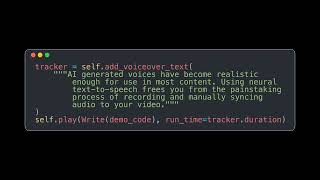
Manim Voiceover demo — basic example
Onur Solmaz
Manim Voiceover demo - actual recording with RecorderService
Onur Solmaz
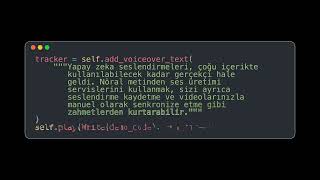
Manim Voiceover demo — Turkish translation with RecorderService
Onur Solmaz
YouTube returned 6 videos for “Manim Voiceover”, and we withheld 3: 3 did not mention Manim Voiceover. Showing the 3 we can prove are about Manim Voiceover.
Official links
Tools that pair well with Manim Voiceover
Common stack mates teams adopt alongside Manim Voiceover, with the specific reason each pairing earns its keep.

MimicPC
Browser-based cloud that runs 20+ pre-installed open-source AI apps for image, video, and audio generation

FakeYou
FakeYou generates celebrity and character AI voice lines from text, plus lip-synced talking-avatar video and beta voice cloning.

Invideo AI
Agentic AI video editing: one plain-language instruction applies across every shot on a real multitrack timeline.
Featured Head-to-Head Comparisons
Manim Voiceover vs Storyfile
StoryFile is for institutions wanting realistic, interactive human avatars from real footage, while Manim Voiceover is a free, developer-friendly tool for adding voiceovers to Manim animations programmatically. Choose StoryFile for museum exhibits or legacy projects with budget; choose Manim Voiceover for educational math/science videos without cost.
Manim Voiceover vs Splice
These tools serve completely different purposes. Splice is for music producers needing royalty-free samples and rent-to-own plugins, while Manim Voiceover is a free Python library for adding voiceovers to Manim animations. Choose Splice if you produce music; choose Manim Voiceover if you create animated educational videos with code.
Manim Voiceover vs Cognition Ai
Cognition AI and Manim Voiceover serve entirely different purposes. Cognition AI is a high-end enterprise tool for autonomous software engineering, backed by a $10M guarantee and a massive valuation, while Manim Voiceover is a free niche library for adding voiceovers to Manim animations. Choose Cognition AI if you manage large production codebases and need reliable automation; choose Manim Voiceover if you create animated educational videos with Manim and want to add narration programmatically.
Alternatives to Manim Voiceover
View all
MimicPC
Browser-based cloud that runs 20+ pre-installed open-source AI apps for image, video, and audio generation

FakeYou
FakeYou generates celebrity and character AI voice lines from text, plus lip-synced talking-avatar video and beta voice cloning.

Invideo AI
Agentic AI video editing: one plain-language instruction applies across every shot on a real multitrack timeline.
Frequently Asked Questions
Categories
Best-of guides
Used Manim Voiceover? Help shape our editorial sentiment research.