
Metaflow
Metaflow is an open-source Python framework for building and managing real-life ML, AI, and data science workflows.
For Python-native ML teams that want reproducible workflows, automatic versioning, and one-command deployment without handing a vendor the keys, Metaflow is one of the few options that has been battle-hardened at genuine scale. The 2025 additions — spin, uv, recursive and conditional steps — quietly answer the two loudest complaints: slow flow authoring and rigid DAGs. It is still code-first and self-managed, so no-code teams and shops without anyone to run Kubernetes should look at managed
Verified 4d ago · liveness 69/100 · cite: rightaichoice.com/tools/metaflow
- Python-literate data scientists and ML engineers building reproducible pipelines
- Teams that need automatic experiment tracking and versioning built into the framework
- Organizations deploying ML on their own cloud account or on-premise Kubernetes
- Shops with existing Airflow who want ML-aware development and Airflow deployment
- Teams that need a no-code or drag-and-drop workflow builder
- Groups without anyone to operate Kubernetes or a cloud stack day to day
- Projects requiring real-time streaming or low-latency inference serving
We scan live Reddit threads, YouTube comments, X posts, G2 reviews and other communities — and hand you an honest verdict in under a minute.
- Honest verdict, not marketing
- Real pros & cons from real users
- Attributed quotes with receipts
3 free scans · no card needed
Skip Metaflow if you lack engineering resources to manage your own infrastructure, or if you prefer a fully managed SaaS with built-in model serving and monitoring.
You must deploy and operate the Metaflow stack yourself on your own cloud or Kubernetes, which incurs infrastructure and engineering time.
Metaflow is open-source and free to use, but you pay for your own compute and storage. It is cheaper than managed platforms like SageMaker if you already have cloud infrastructure and know how to manage it. However, if you need fully managed convenience, managed solutions may provide better value for small teams.
In short
Metaflow — Metaflow is an open-source Python framework for building and managing real-life ML, AI, and data science workflows. Best for Python-literate data scientists and ML engineers building reproducible pipelines, Teams that need automatic experiment tracking and versioning built into the framework, Organizations deploying ML on their own cloud account or on-premise Kubernetes. Free to use.
What's new in Metaflow
Checked 2 days agoAcross the latest 5 updates: 5 feature updates.
Develop flows quickly with spin
Metaflow's new spin command lets you create flows incrementally, step-by-step, without writing the entire flow upfront.
Support for recursive and conditional steps
Metaflow now supports recursive and conditional steps, enabling you to build agentic systems with dynamic logic.
Develop custom decorators
You can now compose flows with reusable custom decorators, improving code reuse and consistency.
Support for uv
Metaflow now supports uv as a fast dependency manager, from development to cloud.
One-click local development stack
Set up the full Metaflow stack on your laptop with one click, making local development easier.
What people actually say about Metaflow — is it worth it?
We scanned public community sources for Metaflow on Jul 18, 2026 and could not establish that the discussion we found is about this tool rather than something else sharing its name. Our own analysis of that scan says the posts were off-subject. Rather than publish a sentiment score built on the wrong subject, we publish nothing here and re-run the scan.
Viability Score
How well maintained and how widely used is Metaflow? Built from what the vendor actually publishes (docs, changelog, tutorials, integrations, pricing), whether the site is live, and how much real users discuss it. How we calculate this
Last calculated: September 2026
How we score →Key Features
- Define ML workflows as DAGs in plain Python
- Develop flows incrementally with the spin command (Nov 2025)
- Recursive and conditional steps for agentic systems (Aug 2025)
- Compose flows with reusable custom decorators (Jul 2025)
- Manage dependencies with uv from dev to cloud (May 2025)
- One-click local development stack setup (Mar 2025)
- Automatic versioning of variables, code, and results inside flows
- Checkpoint long-running training with the @checkpoint decorator
- Configurable flows with the Config object
- Access secrets securely with the @secrets decorator
- Run and deploy flows programmatically from notebooks and scripts
- Real-time, dynamic cards for observability
- Trigger workflows from real-time events and reactive systems
- Scale to GPUs, multiple cores, and multiple instances in parallel
- Install dependencies from PyPI as well as Conda
About Metaflow
Metaflow is an open-source Python framework for building, versioning, and operating machine learning and data science workflows. Netflix built it for its own ML platform and open-sourced it in 2019; today it runs pipelines at hundreds of companies, from GenAI and computer vision to statistics and operations research. If your team writes Python and needs a workflow backbone that survives contact with production, this is the category to look at. Flows are plain Python, so you use whatever modeling libraries and business logic you already have. You develop and debug locally, optionally through notebooks, then deploy to production without editing the code. Versioning is automatic: Metaflow tracks and stores variables inside the flow, so experiment tracking and debugging come from the framework rather than a bolt-on tool. Compute scales out to the cloud when a laptop is not enough — GPUs, multiple cores, many instances in parallel — and you can run the Metaflow stack on your own cloud account or an on-premise Kubernetes cluster. Documented targets include AWS EKS and S3 or AWS Batch and Step Functions, Azure AKS and Blob Storage, Google GKE and Cloud Storage, and custom Kubernetes. Recent releases push in two directions. Toward faster authoring: the spin command (Nov 2025) lets you grow a flow step by step instead of writing the whole DAG upfront, custom decorators (Jul 2025) compose reusable flows, and uv support (May 2025) speeds dependency management. Toward more dynamic logic: recursive and conditional steps (Aug 2025) make agentic systems buildable. Positioning-wise, it sits above general orchestrators like Airflow in ML-awareness and offers cloud-agnostic, self-hosted deployment, while managed platforms such as SageMaker or Azure ML trade that control for less operational work.
Behind the Verdict
Pick Metaflow when your workflow problem is genuinely ML-shaped. If steps produce artifacts you need to reproduce months later, if you want to test locally and ship the identical code to cloud GPUs, and if you already run Kubernetes or a cloud account you trust, the fit is strong. The versioning is the part people underrate: it remembers variables and results inside the flow, so debugging a bad model run does not turn into an archaeology project. We would reach for spin when prototyping. Writing a full DAG before you know what step three does is how experimentation dies, and creating flows incrementally step-by-step removes that tax. Same story with uv support — dependency resolution was a perennial friction point from dev through cloud, and using a fast resolver is a practical fix rather than a marketing one. The agentic angle is worth watching. Recursive and conditional steps mean the DAG no longer has to be fixed at authoring time, which is exactly what agents with dynamic control flow need. That said, do not mistake it for an agent framework — it is an orchestration layer, and you still bring the model and the logic. Where it bites: this is code-first and self-hosted, so the total cost is not zero. Someone owns the stack, the cluster, and the upgrades. Real-time streaming and low-latency inference are not what it is for, and using it for simple ETL is overkill — a cron job and a script would do. The closest alternative is usually Apache Airflow. If your org already runs Airflow, Metaflow's Airflow integration lets you develop here and deploy there, so it is not an either/or. Prefect is the other common comparison for Python-first orchestration; Metaflow's edge is the ML-specific versioning and flow-of-data model. Against SageMaker or Azure ML, you give up a
Researching Metaflow? Get your full AI stack in 60 seconds.
Free, no signup — tell us your goal and get tools matched to your budget & existing stack.
Real-world workflow fit
Concrete scenarios for the personas Metaflow actually fits — and what changes day-one when you adopt it.
You need to move from exploratory notebooks to a reproducible training pipeline that can run in the cloud with GPUs.
Outcome: You define a flow in Python, use the @checkpoint decorator for long training, and run it locally then scale to AWS Batch. Data is versioned automatically, and you can share results with your team.
You need to deploy a model to production that reacts to new data in S3 and retrains periodically.
Outcome: You create a flow with event triggers that launches a training job, validates, and deploys the model to an endpoint. The flow runs on AWS Step Functions, and rollbacks are easy because every run is versioned.
You are prototyping a system that makes decisions based on dynamic conditions and needs to call different sub-flows iteratively.
Outcome: Using recursive and conditional steps, you build a flow that can branch and loop, run it on Kubernetes, and use real-time cards to monitor progress.
Use Cases
- Build a multi-step ML pipeline with automatic data versioning and parallel execution.
- Deploy a trained model as a production workflow that reacts to new data via events.
- Experiment with different hyperparameters across cloud GPU nodes without manual orchestration.
- Create an agentic system using recursive and conditional steps to handle dynamic logic.
- Migrate from Jupyter notebooks to a robust, reproducible pipeline with one click.
- Collaborate with a team on a shared workflow with built-in tracking and debugging.
Limitations
- Metaflow is an open-source framework that requires self-deployment on your own cloud account or on-premises Kubernetes cluster; it does not appear to be offered as a managed service.
- The framework is designed for ML/AI engineers and data scientists, emphasizing integration with existing infrastructure, security, and data governance.
- Evidence from the site does not explicitly describe native model serving or monitoring capabilities.
as of 2026-09-09
Verification history
We have re-verified Metaflow 9 times since . Each pass re-reads the vendor's own pages and re-checks every listed field against that evidence; passes where nothing had changed are marked as such.
- — re-verified summary, description, our verdict, our analysis, pricing model, pricing tiers, features, integrations, who it suits, who should skip it
- — re-verified summary, description, our verdict, our analysis, pricing model, pricing tiers, features, integrations, who it suits, who should skip it
- — re-verified summary, description, our verdict, our analysis, pricing model, pricing tiers, features, integrations, who it suits, who should skip it
- — re-checked, vendor evidence unchanged
- — re-verified summary, description, our verdict, our analysis, pricing model, pricing tiers, features, integrations, who it suits, who should skip it
- — re-checked, vendor evidence unchanged
Showing the 6 most recent of 9 verification passes.
Free to cite with attribution — this page re-verifies continuously.
Where the pricing makes sense
The company stage and team size where Metaflow's pricing actually pencils out — and where peers do it cheaper.
Metaflow is open-source and free to use, but you pay for your own compute and storage. It is cheaper than managed platforms like SageMaker if you already have cloud infrastructure and know how to manage it. However, if you need fully managed convenience, managed solutions may provide better value for small teams.
Setup time & first value
How long it actually takes to get something useful out of Metaflow — broken out by persona, not the marketing-page minute.
If you have a laptop with Python, you can install Metaflow and run your first flow in under an hour. For a team with cloud infrastructure, setting up the full stack (e.g., on EKS) may take a few days to integrate with your existing security and governance.
Switching to or from Metaflow
How to bring data in from common predecessors and how to get it back out — written for the switcher, not the buyer.
- →From Jupyter notebooks: You can gradually port code into Metaflow steps, using the spin command to develop incrementally, then run full flows.
- →From Airflow: You can develop workflows in Metaflow and deploy them to Airflow using the provided integration, keeping your existing orchestration.
- →From Prefect: You can recreate your DAGs in Metaflow's Python API and leverage automatic versioning and cloud scaling.
- ↗To a managed platform like SageMaker: You would need to convert flows into SageMaker pipelines, which is effortful but feasible given similar step-based structure.
- ↗To Prefect or Airflow: You can export your flow logic and manually re-implement orchestrations, though you lose built-in versioning and compute abstraction.
- ↗To Kubeflow: You can translate DAG code to Kubeflow pipelines, but expect effort in adapting to Kubernetes-native patterns.
Integrations
Resources & Guides
Tutorials & Learning
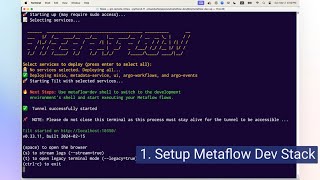
YouTube returned 6 videos for “Metaflow”, and we withheld 4: 4 could not be judged, because “Metaflow” is a single word that other videos use for other things. Showing the 2 we can prove are about Metaflow.
Official links
Tools that pair well with Metaflow
Common stack mates teams adopt alongside Metaflow, with the specific reason each pairing earns its keep.

Mostly AI
Synthetic data generation with built-in differential privacy and an open-source SDK.

Quadratic
Quadratic is the AI spreadsheet that writes Python, SQL, and formulas against live data sources.

Tidb
TiDB is an open-source distributed SQL database for AI agent memory, vector search, ACID transactions, and real-time HTAP analytics.
Featured Head-to-Head Comparisons
Metaflow vs Geologicai
GeologicAI and Metaflow serve entirely different domains: GeologicAI is a specialized mining platform that scans drill cores for critical minerals, while Metaflow is a general-purpose ML workflow tool for data scientists. If your business is mining critical minerals, GeologicAI's integrated multi-sensor suite (now with LIBS via Lumo) and rapid turnaround can accelerate projects 4x, but it requires a large budget. For building ML pipelines, Metaflow's free, open-source framework with cloud scalability and versioning is a better fit for any team. Choose based on your industry and needs.
Metaflow vs Versatile
Versatile and Metaflow serve completely different domains: Versatile is a specialized hardware+software solution for steel erectors to monitor crane picks in real time, while Metaflow is an open-source framework for building ML/AI workflows. If you're in construction steel erection, choose Versatile; for ML pipeline orchestration, choose Metaflow. There is no direct competition.
Metaflow vs Screenplayiq
ScreenplayIQ and Metaflow serve completely different audiences: ScreenplayIQ is for screenwriters and film industry professionals seeking box office predictions from script analysis, while Metaflow is an open-source ML workflow framework for data scientists. Choose based on your domain—filmmaking vs. machine learning. No feature overlap exists.
Alternatives to Metaflow
View all


Frequently Asked Questions
Best-of guides
Used Metaflow? Help shape our editorial sentiment research.