
Optifye.ai
Computer vision that reads manual assembly work from your existing CCTV cameras in real time.
Optifye.ai is worth a serious look if you run manual assembly lines behind existing IP cameras and have no way to time them today. Three capabilities do the work: 3-day AI training on your own camera streams, cycle-time and bottleneck detection per workstation, and daily automated WhatsApp production reports that get the numbers in front of supervisors without anyone filling a sheet. The trade-offs are equally concrete — it supplies no hardware, retains video for only 10 minutes, and takes three days before it produces anything. Compare it with Drishti if you want human-in-the-loop video analytics with a longer track record, or ProGlove if you would rather capture operator data with
Verified 18h ago · liveness 54/100 · cite: rightaichoice.com/tools/optifye-ai
- Factory operations managers tracking manual assembly efficiency
- Manufacturing process engineers running lean or continuous-improvement programs
- Quality assurance teams reducing scrap on manual lines
- Production supervisors in automotive, apparel, welding, medical and electronics
- Fully automated factories with no manual labour to observe
- Small workshops with fewer than about 10 workers
- Offices, retail and other non-manufacturing environments
We scan live Reddit threads, YouTube comments, X posts, G2 reviews and other communities — and hand you an honest verdict in under a minute.
- Honest verdict, not marketing
- Real pros & cons from real users
- Attributed quotes with receipts
3 free scans · no card needed
Skip Optifye.ai if your plant is fully automated, runs fewer than about 10 manual operators, or has no IP/CCTV cameras on the floor — the vision models have nothing to train on or measure.
Your cameras have to actually see the workstation: cameras mounted for security at ceiling height may need re-aiming or added units before the vision models can read cycle times, and that is a cost Optifye does not
Optifye quotes pricing directly to each plant, so cost scales with lines and workstations rather than a published per-seat rate. That suits mid-size and larger manufacturers in automotive, apparel, welding, medical and electronics who already own the cameras. A camera-based system with no hardware to buy is usually cheaper to start than hardware-led competitors such as ProGlove wearables, though heavier human-review platforms like Drishti price in more analyst time. Ask for a single-line quote
In short
Optifye.ai — Computer vision that reads manual assembly work from your existing CCTV cameras in real time. Best for Factory operations managers tracking manual assembly efficiency, Manufacturing process engineers running lean or continuous-improvement programs, Quality assurance teams reducing scrap on manual lines. Contact Sales pricing.
What people actually say about Optifye.ai — is it worth it?
We ran a structured research pass across product reviews, community discussions, and post-purchase forum threads to surface the patterns vendors won't publish themselves. Below: the recurring strengths, the hidden costs people mention most, and the cohort that consistently regrets adopting this tool.
10 mentions across 1 source (Hacker News) · researched Jul 3, 2026.
Average across the 1 source that answered — each source counts once, not each post.
- +Real-time operator efficiency monitoring via existing CCTV cameras.
- +SOP compliance tracking with alerts for quality issues.
- +Bottleneck detection for throughput optimization.
- +Automated scrap reduction through error catching.
- +Digitizes manual processes previously hard to measure.
- −Widely condemned as dystopian sweatshop surveillance.
- −Founders criticized for designing tools for 'ruling class'.
- −No positive user testimonials found in community data.
- −Demo was deleted after backlash, reducing transparency.
- −Potential to dehumanize workers and cause stress.
- • Integration and training costs not publicly listed
- • Potential legal fees from worker pushback or union disputes
Viability Score
How well maintained and how widely used is Optifye.ai? Built from what the vendor actually publishes (docs, changelog, tutorials, integrations, pricing), whether the site is live, and how much real users discuss it. How we calculate this
Last calculated: October 2026
How we score →Key Features
- Plugs into existing IP/CCTV cameras, no new hardware
- 3-day AI training period on your own camera streams
- Cycle time analysis per workstation
- Real-time operator efficiency monitoring
- Performance comparison across operators and lines
- SOP compliance monitoring with error catching
- Bottleneck detection and line balancing
- Precise workspace and line output counting
- Real-time quality checking of assembly steps
- Line and workstation visibility dashboards
- Automated daily WhatsApp production reports
- Ideal yield analysis against true production potential
- Role-based access controls
- 10-minute video data retention for security
- Enterprise-grade encryption for camera-stream data
About Optifye.ai
Optifye.ai is a computer-vision platform for manufacturers with manual assembly lines. It plugs into the IP/CCTV cameras you already have on the floor — no new hardware — and its vision models train on your camera streams for three days before a dashboard starts showing cycle times per workstation, operator efficiency comparisons, line and workstation output counts, SOP step compliance, bottleneck locations and real-time quality checks. The company says most manufacturers run at about 65% of their true production potential, and the product is built around closing that gap: you set standard targets for manual operations, see who is following the right assembly steps and who is not, and get a daily automated WhatsApp production report so supervisors and plant heads work off the same numbers. According to the vendor, it is used by more than 50 manufacturers across automotive, apparel, welding, medical and electronics. Video data is retained for 10 minutes for security, access is role-based, and the vendor describes enterprise-grade encryption and access controls. It is aimed at operations managers, process engineers and QA teams who want data on labour-intensive work that was previously unmeasurable, and it does not serve fully automated plants, non-manufacturing sites, or facilities without IP/CCTV infrastructure.
Behind the Verdict
Optifye's pitch is narrow and credible: manual assembly is the last big chunk of factory work that nobody has numbers for, and the cheapest sensor for it is the camera already mounted above the line. The three-step flow in the vendor's own material is honest about what deployment costs you — set up IP cameras, let the vision models train on the streams for 3 days, then open the dashboard, which connects to Optifye's server and starts showing real-time insights. Strengths: the feature set maps to daily production meetings rather than to a data-science project. Cycle Time Analysis gives per-workstation times; Bottleneck Detection is framed as balancing a line in minutes rather than hours; Precise Workspace Metrics replaces manual counting with per-line and per-workspace output numbers; Real-time Quality Checking shows who is following the right assembly steps and who is not; Automated Reports push a daily WhatsApp summary to the team. Efficiency Analytics compares operator and line performance, and the vendor explicitly targets the gap between current output and ideal yield — its own page claims most manufacturers run at only 65% of true production potential. The Maso Group testimonial from Aditi Someshwar is specific in a way most factory case studies are not: detailed reporting for a completely manual operation, with no digital interface and a single camera. Weaknesses: this is a camera-dependent product with no hardware of its own, so a plant with poor camera placement or no IP/CCTV coverage gets nothing; the 3-day training period is dead time before first value; video retention of 10 minutes means the system is a live performance instrument, not an incident-review archive; and there are no documented third-party integrations in what we could see, so budget for exporting numbers into whatever MES or ERP you already run. Fit: mid-size and larger plants in automotive, apparel, welding, medical and electronics with 10+ operators on manual lines, an existing camera network, and a plant head who will act on a daily WhatsApp report. Not a fit: fully automated plants, workshops under roughly 10 workers, offices and retail, or any site without IP/CCTV infrastructure. Treat it as a measurement layer that sits beside, not inside, your automation stack — and pilot it on one line, because the value depends on whether your camera angles actually see the work.
Researching Optifye.ai? Get your full AI stack in 60 seconds.
Free, no signup — tell us your goal and get tools matched to your budget & existing stack.
Real-world workflow fit
Concrete scenarios for the personas Optifye.ai actually fits — and what changes day-one when you adopt it.
You mount the existing IP cameras on one manual assembly line, Optifye trains its vision models on those streams for 3 days, then the dashboard goes live showing cycle times per workstation and operator efficiency.
Outcome: Within the first week you can see which workstation is constraining the line and by how much, and you set a standard cycle target for the shift instead of relying on stopwatch studies.
Real-time Quality Checking watches the assembly steps at each workspace, and any operator skipping or reordering a documented step is flagged as it happens.
Outcome: Scrap and rework traced back to wrong assembly steps surface the same day rather than being found at final inspection, and the SOP deviations name the exact workstation.
Every evening an automated WhatsApp production report arrives with output counts, cycle times and efficiency by line; during the day the dashboard shows bottleneck locations across lines.
Outcome: The morning review starts from the same numbers the supervisors saw, and you rebalance operators between lines in minutes instead of waiting for a weekly compilation.
Use Cases
- Time every workstation on a manual assembly line without adding a single sensor or scanner.
- Spot which operator or station is capping throughput before the shift ends, not at month-end.
- Catch SOP deviations as they happen to cut scrap and rework in manual steps.
- Give supervisors a daily WhatsApp production report instead of handwritten output counts.
- Set data-backed standard targets for work the plant has never been able to measure.
- Compare line and shift performance to decide where to rebalance labour.
Limitations
- The vision models need a 3-day training period on your operations before any insight appears.
- Optifye supplies no cameras or hardware — it depends entirely on your existing IP/CCTV coverage and camera angles, so poor placement limits what it can see.
- Video retention is capped at 10 minutes, which makes it a live performance tool rather than a review or incident archive.
- No third-party integrations were documented in the material we could review, so plan for manual export into MES or ERP systems.
as of 2026-10-07
Verification history
We have re-verified Optifye.ai 9 times since . Each pass re-reads the vendor's own pages and re-checks every listed field against that evidence; passes where nothing had changed are marked as such.
- — re-checked, vendor evidence unchanged
- — re-checked, vendor evidence unchanged
- — re-checked, vendor evidence unchanged
- — re-checked, vendor evidence unchanged
- — re-checked, vendor evidence unchanged
- — re-checked, vendor evidence unchanged
Showing the 6 most recent of 9 verification passes.
Free to cite with attribution — this page re-verifies continuously.
12-month cost
Project the real annual outlay, including the implied monthly cost when only an annual tier is published.
Vendor list price only. Add-on usage, seat overages, and contract minimums are surfaced under Hidden costs & gotchas.
Where the pricing makes sense
The company stage and team size where Optifye.ai's pricing actually pencils out — and where peers do it cheaper.
Optifye quotes pricing directly to each plant, so cost scales with lines and workstations rather than a published per-seat rate. That suits mid-size and larger manufacturers in automotive, apparel, welding, medical and electronics who already own the cameras. A camera-based system with no hardware to buy is usually cheaper to start than hardware-led competitors such as ProGlove wearables, though heavier human-review platforms like Drishti price in more analyst time. Ask for a single-line quote
Setup time & first value
How long it actually takes to get something useful out of Optifye.ai — broken out by persona, not the marketing-page minute.
Plan for camera setup plus a 3-day AI training period before first insight, so roughly one week to first value on a single line — Optifye plugs into your existing CCTV infrastructure but the vision models must learn your operations. Plant-wide, expect longer per line and site, with the training window repeating for each new operation you add. Role-based access needs setting up alongside the
Switching to or from Optifye.ai
How to bring data in from common predecessors and how to get it back out — written for the switcher, not the buyer.
- →From manual stopwatch time studies: replace spot-check timing with continuous per-workstation cycle time analysis from cameras already on the line.
- →From handwritten or spreadsheet output counts: Precise Workspace Metrics give per-line and per-workspace counts so supervisors stop tallying by hand.
- →From nothing at all on manual work: the 3-day AI training turns previously unmeasured labour into dashboard data you can set standard targets against.
- ↗To Drishti or a similar human-in-the-loop video analytics platform: if you need analyst-reviewed video events or a longer reviewable archive rather than 10-minute retention.
- ↗To ProGlove or similar wearable scanners: if your plant prefers per-operator hardware capture over camera-based observation.
- ↗To a fuller MES with machine-data analytics: if your bottleneck is automated, not manual, work and cameras have nothing to observe.
Resources & Guides
Tutorials & Learning
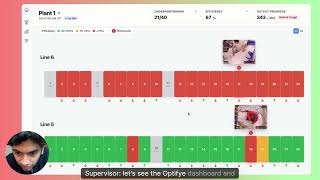
YouTube returned 6 videos for “Optifye.ai”, and we withheld 5: 5 could not be judged, because “Optifye.ai” is a single word that other videos use for other things. Showing the 1 we can prove is about Optifye.ai.
Official links
Tools that pair well with Optifye.ai
Common stack mates teams adopt alongside Optifye.ai, with the specific reason each pairing earns its keep.

Assert AI
On-prem computer vision that turns your existing CCTV cameras into real-time safety, quality, and productivity intelligence.

Doxel
Doxel uses hard-hat-mounted 360 capture and computer vision to measure construction work-in-place against your BIM.

Tractable AI
Enterprise computer-vision AI that turns vehicle photos into certainty-scored repair estimates for insurers, repairers, and recyclers.
Featured Head-to-Head Comparisons
Optifye Ai vs Geologicai
GeologicAI is the right choice for large-scale critical minerals mining operations seeking end-to-end integrated core scanning and AI modeling with sub-48-hour turnaround. Optifye.ai is ideal for factory managers wanting to digitize manual assembly lines using existing CCTV cameras to boost efficiency and quality. Choose based on your domain: mining vs. manufacturing.
Optifye Ai vs Screenplayiq
These tools serve completely different domains: ScreenplayIQ is for film industry professionals seeking data-driven script marketability insights, while Optifye.ai is for manufacturing teams aiming to boost manual assembly line efficiency. Choose based on your industry—there's no overlap in use cases.
Optifye Ai vs Nectar Energy
Nectar Energy and Optifye.ai serve completely different domains: building energy management vs. factory worker efficiency. Choose Nectar if you manage commercial HVAC/lighting and need automated control plus ESG reporting (new module May 2026). Choose Optifye if you run manual assembly lines and need real-time operator efficiency insights from existing CCTV. They are not direct competitors.
Alternatives to Optifye.ai
View all
Assert AI
On-prem computer vision that turns your existing CCTV cameras into real-time safety, quality, and productivity intelligence.

Doxel
Doxel uses hard-hat-mounted 360 capture and computer vision to measure construction work-in-place against your BIM.

Tractable AI
Enterprise computer-vision AI that turns vehicle photos into certainty-scored repair estimates for insurers, repairers, and recyclers.
Frequently Asked Questions
Best-of guides
Topics
Used Optifye.ai? Help shape our editorial sentiment research.