
Peakflo AI Voice Agents
Peakflo AI Voice Agents run collections, sales and service calls grounded in live ERP data.
If your collections or order-status calls already run on Xero, NetSuite, QuickBooks, SAP or Business Central, Peakflo's voice agents sit in a spot most voice AI vendors genuinely don't reach — the ERP sync back of payment promises and disputes is the part that saves real hours. Voice quality you can judge yourself before committing: call the demo line at +1 (205) 509-8668 and pick Sales, Logistics or Collections. Pricing is custom, so plan on a scoping conversation rather than a self-serve
Verified 2d ago · liveness 69/100 · cite: rightaichoice.com/tools/peakflo-ai-voice-agents
- Finance and AR teams automating collections and payment reminders with live ERP context
- Logistics companies running delivery updates and order confirmations at volume
- Insurance teams handling policy renewals and first notice of loss calls
- Healthcare organizations automating patient service queries with data pulled from systems
- Teams needing fully open-ended conversational flows outside structured finance and ops scenarios
- Small businesses without an ERP or clean structured data to feed personalization
- Organizations that need on-premise deployment
We scan live Reddit threads, YouTube comments, X posts, G2 reviews and other communities — and hand you an honest verdict in under a minute.
- Honest verdict, not marketing
- Real pros & cons from real users
- Attributed quotes with receipts
3 free scans · no card needed
Skip Peakflo AI Voice Agents if your calls need fully open-ended conversational flows outside structured finance and ops scenarios, or if you require on-premise deployment.
Integrations like SFTP field mapping are set up by Peakflo experts, so onboarding hours get scoped and billed separately from the subscription.
Peakflo does not publish a price list for AI Voice Agents; the pricing page routes you to a 15-30 minute call with solution experts who scope a plan against your workflow. That model suits mid-market and enterprise finance, logistics, insurance and healthcare teams with a defined ERP and call volume, and it will feel heavy for a small business that wants to swipe a card and test 100 calls.
In short
Peakflo AI Voice Agents — Peakflo AI Voice Agents run collections, sales and service calls grounded in live ERP data. Best for Finance and AR teams automating collections and payment reminders with live ERP context, Logistics companies running delivery updates and order confirmations at volume, Insurance teams handling policy renewals and first notice of loss calls. Contact Sales pricing.
What people actually say about Peakflo AI Voice Agents — is it worth it?
We ran a structured research pass across product reviews, community discussions, and post-purchase forum threads to surface the patterns vendors won't publish themselves. Below: the recurring strengths, the hidden costs people mention most, and the cohort that consistently regrets adopting this tool.
16 mentions across 2 sources (YouTube, Product Hunt) · researched Sep 9, 2026.
Weighted by the 33 posts each of 2 sources contributed.
- +Human-like voice conversations with cross-call memory for context-aware follow-ups
- +Real-time ERP data pull (invoice, payment, due dates) personalizes each call
- +No-code script customization with conditional logic for adaptive call flows
- +Automated outbound calling triggers based on due dates, behavior, and SLAs
- +Concurrent calling handles 5x more calls daily, improving team capacity
- −All feedback is launch-centric; no long-term user experience or reliability data
- −Requires ERP integration, limiting use for smaller or less structured businesses
- −Pricing is contact-based, not transparent, creating ROI uncertainty
- −Compliance features (PII-redacted audit trails, data residency) not yet confirmed
- −No independent reviews or community discussions beyond the launch day
- • No public pricing, likely custom setup and integration fees
- • Potential per-minute or per-call charges that scale with volume
Viability Score
How well maintained and how widely used is Peakflo AI Voice Agents? Built from what the vendor actually publishes (docs, changelog, tutorials, integrations, pricing), whether the site is live, and how much real users discuss it. How we calculate this
Last calculated: October 2026
How we score →Key Features
- Human-like voice conversations with memory carried across calls
- Real-time data pull from ERPs (invoice number, payment amount, due date, order status)
- No-code call flow design with conditional logic
- Automated outbound calls triggered by due dates, behavior, follow-up SLAs or custom rules
- Adaptive scripts and tone tuned per use case (collections, sales, logistics, insurance, healthcare)
- Multi-language and dialect support for cross-border collections and global support
- Concurrent AI calling for higher daily call volume
- Smart escalation to human agents on confusion, anger or unusual behavior
- Manager approval workflows for payment disputes and due-date extension requests
- Post-call outcomes and payment promises synced to ERP, CRM, Slack or email
- Auto-logged call transcripts, notes, status changes and escalations for audit trails
- Call performance dashboard (connected calls, responses, outcomes, escalations, duration)
- Automatic follow-up task assignment to team members in Peakflo
- Two-way integrations pulling triggers and personalization inputs from Slack, CRM and billing systems
- Live demo line with selectable call types (Sales, Logistics, Collections, Healthcare, Insurance)
About Peakflo AI Voice Agents
Peakflo AI Voice Agents is a voice AI product aimed at finance, AR, logistics, insurance, healthcare and e-commerce teams that live on high call volumes. The pitch is narrow on purpose: instead of a blank conversational canvas, each call is fed personalized context pulled from your ERP, billing and CRM systems — invoice number, payment amount, due date, order status — so the agent opens the conversation already knowing the account. Peakflo lists this against a backdrop of finance and ops workflows, and the product is sold alongside its invoice-to-cash and procure-to-pay modules rather than as a standalone dialer. Setup leans on no-code conditional logic. You build call flows around customer segment, invoice size, payment behavior or a custom rule, then trigger outbound calls off due dates, behavioral signals, follow-up SLAs or custom triggers. Agents carry memory across interactions — a promised payment or a callback request picks up on the next call instead of resetting — and the script, tone and logic shift per use case: payment reminders, sales prospecting, delivery confirmations, policy renewals, first notice of loss, survey calls. Peakflo states agents converse in multiple languages and dialects, which it maps to cross-border collections, regional sales and global support, and supports concurrent AI calling. Post-call is where the workflow gets useful. Outcomes, payment promises and customer responses push back into ERP, CRM, Slack or email; follow-up tasks get assigned to team members inside Peakflo; transcripts, notes, status changes and escalations auto-log for audit. Disputes or due-date extension requests route to a manager for approval, and the agent escalates to a human when it reads confusion, anger or unusual behavior. A single dashboard tracks connected calls, responses, outcomes, escalations and duration. Peakflo advertises a 90% productivity lift with no extra headcount, 24/7 availability and 5x daily call volume through concurrent
Behind the Verdict
The question I'd ask before anything else: does the personalization actually matter to your calls? Peakflo's whole argument is that a voice agent which already knows the invoice number, amount and due date beats one that opens with a generic script. That's true in collections and order-status work, and close to worthless in exploratory sales. If your calls are structured and data-backed, this is a strong fit. If they're open-ended, keep shopping. We'd reach for this when the workflow is already defined — payment reminders, delivery confirmations, policy renewals, first notice of loss — and there's an ERP feeding the call. The no-code conditional logic is the practical bit here: you can branch on customer segment or invoice size without waiting on engineering, which is usually what kills voice pilots inside finance teams. The approval routing for disputes and due-date extensions is also more thought-through than most voice tools; it assumes the agent will hit edge cases and hands them to a manager instead of pretending it won't. The honest limitations are about fit, not quality. There's no fully open-ended conversational mode — this is a workflow product, and Peakflo's assumptions come baked in. Small businesses without structured data to feed personalization will get a fraction of the value. On-premise deployment isn't part of the picture. And if your process needs a human to take every call with zero latency, an AI agent is the wrong tool regardless of vendor. The closest comparison is a generic voice AI platform: cheaper per call, more flexible on paper, but you're the one wiring the ERP, the dispute logic and the follow-up tasks. Peakflo sells the opposite trade — less canvas, more of the finance plumbing already built. That's a good trade if you're running the
Researching Peakflo AI Voice Agents? Get your full AI stack in 60 seconds.
Free, no signup — tell us your goal and get tools matched to your budget & existing stack.
Real-world workflow fit
Concrete scenarios for the personas Peakflo AI Voice Agents actually fits — and what changes day-one when you adopt it.
Invoices aged past 30 days trigger outbound calls. The agent opens with the invoice number, amount and due date pulled live from NetSuite, offers a payment link, and records a promise-to-pay date. If the customer disputes the charge or asks to extend the due date, the agent routes the request to the manager for approval instead of negotiating.
Outcome: Payment promises, disputes and status changes post back to NetSuite automatically, follow-up tasks land in Peakflo, and the dashboard shows exactly which calls connected and which converted.
Order-status changes and delivery delays trigger calls to end customers. The agent confirms the order and delivery window from live order data, adapts tone for a delay, and escalates to a human when the caller sounds angry or asks something outside the script.
Outcome: Delivery confirmations run at volume without adding headcount, and every transcript and escalation is logged so the ops team can review disputes after the fact.
Policy renewal dates and first-notice-of-loss intake trigger calls. The agent walks the customer through renewal details or captures the loss report, keeps memory of prior calls so the customer does not repeat information, and hands off to a human adjuster when the conversation goes off-script.
Outcome: Intake notes and escalations sync to the CRM, and the team reviews connected calls, outcomes and escalations from one dashboard.
Use Cases
- Automate collection calls with personalized payment reminders based on live invoice data.
- Run sales outreach and inbound qualification with adaptive scripts that respond to prospect questions.
- Handle healthcare patient service queries about appointments or billing.
- Send delivery update calls to customers with real-time order status.
- Run insurance policy renewal calls with first notice of loss handling.
- Confirm IT and services orders and push status updates to customers at volume.
- Route invoice disputes and due-date extension requests to a manager for approval before the call closes.
- Escalate confused or upset callers to a human agent in real time instead of leaving them in a loop.
Limitations
- The product is built around agentic workflows tied to ERP/accounting integrations (Xero, NetSuite, QuickBooks, SAP, Microsoft D365 Business Central and others), so the quality of your calls tracks the quality and structure of your ERP data -- flat or messy records produce flat or messy conversations.
- Setup for integrations such as SFTP field mapping involves Peakflo experts, which adds onboarding effort before you reach first value.
- Pricing is quoted by the vendor's solution experts rather than published on the pricing page, so you cannot estimate cost without a scoping call.
- The published use cases are structured finance and operations scenarios (collections, delivery updates, renewals, order confirmations, patient service), not open-ended conversation.
as of 2026-10-07
Verification history
We have re-verified Peakflo AI Voice Agents 11 times since . Each pass re-reads the vendor's own pages and re-checks every listed field against that evidence; passes where nothing had changed are marked as such.
- — re-checked, vendor evidence unchanged
- — re-verified summary, description, our verdict, our analysis, pricing model, pricing tiers, features, integrations, who it suits, who should skip it
- — re-verified summary, description, our verdict, our analysis, pricing model, pricing tiers, features, integrations, who it suits, who should skip it
- — re-verified summary, description, our verdict, our analysis, pricing model, pricing tiers, features, integrations, who it suits, who should skip it
- — re-verified summary, description, our verdict, our analysis, pricing model, pricing tiers, features, integrations, who it suits, who should skip it
- — re-verified summary, description, our verdict, our analysis, pricing model, pricing tiers, features, integrations, who it suits, who should skip it
Showing the 6 most recent of 11 verification passes.
Free to cite with attribution — this page re-verifies continuously.
12-month cost
Project the real annual outlay, including the implied monthly cost when only an annual tier is published.
Vendor list price only. Add-on usage, seat overages, and contract minimums are surfaced under Hidden costs & gotchas.
Where the pricing makes sense
The company stage and team size where Peakflo AI Voice Agents's pricing actually pencils out — and where peers do it cheaper.
Peakflo does not publish a price list for AI Voice Agents; the pricing page routes you to a 15-30 minute call with solution experts who scope a plan against your workflow. That model suits mid-market and enterprise finance, logistics, insurance and healthcare teams with a defined ERP and call volume, and it will feel heavy for a small business that wants to swipe a card and test 100 calls.
Setup time & first value
How long it actually takes to get something useful out of Peakflo AI Voice Agents — broken out by persona, not the marketing-page minute.
Expect a scoping call with Peakflo's solution experts first, since pricing and workflow design are quoted rather than self-serve. Once scoped, plan for ERP integration and field-mapping work (SFTP and similar connectors are set up with Peakflo's help) before calls sound personalized. Teams with a clean ERP and a defined single use case reach a working outbound flow fastest; multi-use-case
Switching to or from Peakflo AI Voice Agents
How to bring data in from common predecessors and how to get it back out — written for the switcher, not the buyer.
- →From manual collections calling: map invoice fields and due-date triggers from your ERP, then replace dialer lists with rule-based outbound calls.
- →From generic voice AI vendors: rebuild your scripts as no-code conditional flows so they can read invoice number, amount and due date at call time.
- →From an in-house dialer + CRM script: connect the ERP so outcomes and payment promises post back automatically instead of being typed in.
- ↗To a generic voice AI platform: expect to rebuild ERP data grounding and post-call sync yourself, since those are Peakflo's main lock-in.
- ↗To human-staffed calling: export transcripts, call outcomes and escalations from Peakflo to hand over account history.
- ↗To your ERP's native collections module: payment promises and dispute records already synced into the ERP travel with the account.
Integrations
Resources & Guides
Tutorials & Learning
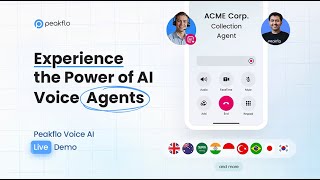
Peakflo AI Voice Agents | Live Demo
Peakflo
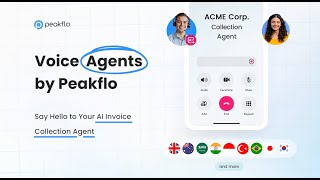
Peakflo AI Voice Agents for Invoice Collection Calls
Peakflo

Peakflo AI Voice Agents for Sales Lead Qualification
Peakflo
YouTube returned 6 videos for “Peakflo AI Voice Agents”, and we withheld 2: 2 did not mention Peakflo AI Voice Agents. Showing the 4 we can prove are about Peakflo AI Voice Agents.
Official links
Tools that pair well with Peakflo AI Voice Agents
Common stack mates teams adopt alongside Peakflo AI Voice Agents, with the specific reason each pairing earns its keep.

Synthflow AI
Synthflow AI runs enterprise voice AI agents on its own telephony network for automated phone calls at scale.

ElevenLabs Conversational AI
Build voice and chat agents from a prompt in about five minutes, grounded in your own knowledge base.
Voiceflow
Voiceflow is a visual platform for building AI chat and voice agents that designers and engineers ship together.
Featured Head-to-Head Comparisons
Peakflo Ai Voice Agents vs Truleo
If you're in law enforcement and need to surface leads from siloed data like RMS, CAD, and jail calls, Truleo is your tool. For businesses automating collections, logistics, or sales calls with real-time ERP context, Peakflo's AI voice agents are a better fit. They serve completely different markets—choose based on your sector and data sources.
Peakflo Ai Voice Agents vs Presto Voice
If you run a QSR chain with drive-thrus and want to boost revenue via upselling, Presto Voice is your pick—its 95% non-intervention rate and proven lift from Dairy Queen and Taco John's make it a clear leader. For finance or logistics teams needing to automate calls with live ERP data (invoices, payments), Peakflo AI Voice Agents wins with deep ERP integrations and adaptive scripts. Choose based on your primary use case: drive-thru vs. back-office call automation.
Peakflo Ai Voice Agents vs B Rokratt
Choose Peakflo if you need an AI voice agent that automates business calls using live ERP data — ideal for collections, logistics, or sales outreach. Choose Bürokratt only if you are an Estonian resident or e-resident seeking free, natural-language access to government services. They serve completely different markets: Peakflo is a commercial call automation platform, while Bürokratt is a public sector assistant tied to Estonia.
Alternatives to Peakflo AI Voice Agents
View all
Synthflow AI
Synthflow AI runs enterprise voice AI agents on its own telephony network for automated phone calls at scale.

ElevenLabs Conversational AI
Build voice and chat agents from a prompt in about five minutes, grounded in your own knowledge base.
Frequently Asked Questions
Best-of guides
Topics
Used Peakflo AI Voice Agents? Help shape our editorial sentiment research.