
PitchBob
AI pitch deck generator that turns your business idea into investor-ready startup documents via guided chat.
PitchBob is a solid pick for first-time founders who need structured guidance from idea to investor-ready deck. The one-time plans offer good value, especially the 0→1 package. But skip it if you need fine-grained design control or real-time collaboration — you'll hit limits fast. For design flexibility, look at Pitch; for deeper financial modeling, consider LivePlan instead.
Verified 13d ago · liveness 59/100 · cite: rightaichoice.com/tools/pitchbob
- First-time startup founders needing a guided pitch deck builder and investor-ready documents
- Students and accelerator participants preparing business plans and one-pagers
- Corporate innovators validating and packaging new venture ideas
- Fundraising entrepreneurs seeking structured, multi-language pitch materials
- Experienced designers needing custom slide layouts and full design control
- Teams requiring collaborative real-time editing on the same deck
- Founders seeking deep financial modeling and detailed projections
We scan live Reddit threads, YouTube comments, X posts, G2 reviews and other communities — and hand you an honest verdict in under a minute.
- Honest verdict, not marketing
- Real pros & cons from real users
- Attributed quotes with receipts
3 free scans · no card needed
Skip PitchBob if you're an experienced designer needing pixel-perfect slide control, require real-time collaborative editing, or need deep financial modeling—those are better handled by dedicated presentation, collaboration, and financial tools.
The free tier is limited; to unlock a full pitch deck and all documents, you need to pay $29.9 or more, which may surprise users expecting free full-featured generation.
PitchBob's pricing fits solo founders or small teams that want an affordable, one-time path to a pitch deck: $29.9 for a full document set is cheaper than hiring a consultant, while the $19.9/month Founders Co-Pilot undercuts most subscription-based competitors like LivePlan. But for design-heavy needs, tools like Pitch offer more value, and for comprehensive financial planning, LivePlan or similar may justify a higher price.
In short
PitchBob — AI pitch deck generator that turns your business idea into investor-ready startup documents via guided chat. Best for First-time startup founders needing a guided pitch deck builder and investor-ready documents, Students and accelerator participants preparing business plans and one-pagers, Corporate innovators validating and packaging new venture ideas. Free to start; paid plans from $19.9/mo.
What's new in PitchBob
Checked 15 days agoAcross the latest 8 updates: 6 feature updates, 1 community discussion and 1 news mention.
How AI Videos Help Startups With Investors
PitchBob explains how AI-generated videos can improve startup pitches to investors.
How Early-Stage Startups Can Effectively Gain An Edge With AI
PitchBob discusses how early-stage startups can use AI to gain a competitive advantage.
Investor Pitch Customization: Software for Businesses and Resonating with Different Types
PitchBob covers how software can customize investor pitches for different audience types.
PitchBob Earns Best Business Software Title for Its Sales-Centric Design by Top Software Directory
PitchBob named best business software for sales-centric design by a top software directory.
Why I’m Not Afraid ChatGPT Will Kill My Startup — Even Though It’s Built on OpenAI’s API
PitchBob founder explains why ChatGPT won't kill their startup despite reliance on OpenAI.
Scouting Startups by Tech, Geography, and Stage: How Custom Filters Work
PitchBob explains how custom filters enable scouting startups by tech, geography, and stage.
Case Study: How We Used PitchBob’s AI Analyst to Evaluate Startup Pitches — And How It Matched VC Judgments
Case study shows PitchBob's AI Analyst evaluating pitches and matching VC judgments.
Case Study: How Foundly Went from Stuck to Scaling with Mentorship
Case study on Foundly using PitchBob mentorship to scale from stuck to growing.
Viability Score
How well maintained and how widely used is PitchBob? Built from what the vendor actually publishes (docs, changelog, tutorials, integrations, pricing), whether the site is live, and how much real users discuss it. How we calculate this
Last calculated: September 2026
How we score →Key Features
- AI pitch deck generator (10-15 slides)
- Business plan creation via guided chat
- One-pager and executive summary generation
- Landing page builder from chat
- Voice input support for describing your idea
- Multi-language support (English, Spanish, French, Arabic, etc.)
- Founder agreement generation
- Co-founder contribution tracking
- Automatic founder and stakeholder reports
- Chat via WhatsApp, Slack, and Microsoft Teams
- File upload for existing decks or one-pagers
- Human feedback on your idea (in 'Improve my pitch')
- EU startup grant eligibility check
- Investor outreach and mentorship services
- AI-generated videos for pitches
About PitchBob
PitchBob is an AI-powered copilot designed to help early-stage founders, students, and corporate innovators turn rough business ideas into polished startup assets without facing the blank page problem. Instead of a generic AI writing tool, PitchBob works through a conversational interface where you describe your idea via text or voice, and the bot asks targeted questions to challenge assumptions and enrich content. It then generates a full set of documents, including a pitch deck, business plan, one-pager, and landing page, all from a single chat flow. Beyond the core deck, PitchBob produces a suite of practical artifacts: founder agreements, monthly co-founder contribution tracking, and auto-generated founder and stakeholder reports. It supports multiple languages and integrates with WhatsApp, Slack, and Microsoft Teams, letting you interact with the bot directly from your preferred messaging channel. Over 60,000 tech entrepreneurs have trusted the platform, and it is officially used by accelerators, universities, and corporations for startup education and validation. Pricing is flexible and geared toward different needs. There's a free tier for exploration, a one-time 0→1 plan at $29.9 that creates a complete document set in one dialog, and an 'Improve my pitch' service at $99 where you upload your existing deck and the bot generates the rest. For ongoing support, the Founders Co-Pilot subscription at $19.9/month adds a monthly rhythm of planning, reflection, and reports. White-label solutions for organizations start at $99/month. Additional services include human feedback on your idea, EU grant eligibility checks, mentorship, and investor outreach. Compared to using ChatGPT alone, PitchBob is purpose-built for startup fundraising. Its guided Q&A flow, artifact generation, and messaging integrations provide a more structured and comprehensive path to investor-ready materials. That makes it a focused alternative for founders who want a step-by-step process
Behind the Verdict
When you're staring at a blank page and the clock is ticking, PitchBob earns its keep. The guided chat asks the right questions—the kind that make you think through your business model, market, and traction—and then assembles a deck and supporting docs without you touching a template. We'd reach for it when you need a solid first draft fast, especially if you're a solo founder or student with limited time to learn deck design. Where it bites: customization is shallow. You get a clean, professional layout, but you can't drag-and-drop elements or play with the visual design. If your pitch depends on a distinctive brand or complex diagrams, you'll end up exporting to PowerPoint or Google Slides and redoing the visuals anyway. That extra step is fine for a first pass, but it's a hidden cost for design-sensitive founders. Collaboration is another gap. There's no real-time multi-user editing, so if you're building a deck with a co-founder or team, you'll be trading files back and forth. The WhatsApp/Slack/Teams integration helps with conversation, but the actual document work remains single-player. We'd caution teams to check if that workflow fits before committing. On pricing, the 0→1 one-time plan is the standout—for $29.9 you get a complete deck plus business plan, one-pager, and landing page. That's hard to beat for a one-off need. The $99 'Improve my pitch' tier makes sense if you already have a draft and want to expand it without a long chat. But the $19.9/month subscription is only worth it if you'll actually use the monthly reporting and ongoing planning features—otherwise, the one-time plans are the better value. Compared to ChatGPT with a good prompt, PitchBob adds structure and artifact generation that generic AI can't match, but ChatGPT gives you unlimited
Researching PitchBob? Get your full AI stack in 60 seconds.
Free, no signup — tell us your goal and get tools matched to your budget & existing stack.
Real-world workflow fit
Concrete scenarios for the personas PitchBob actually fits — and what changes day-one when you adopt it.
You have a rough idea but no deck, sign up, select the 0→1 plan, and start chatting with the bot. Answer the guided questions, and within minutes you get a 10-15 slide pitch deck, a one-pager, and a business plan draft.
Outcome: You receive a structured, investor-ready document set that you can refine and share with potential investors.
You already have a one-pager or pitch deck, but need a full set of documents in another language. Use the 'Improve my pitch' service to upload your file, and the bot generates the rest in your target language.
Outcome: You get a complete, translated document package that you can use to expand to new markets.
You run an accelerator and need to provide a standardized pitch deck tool to your cohorts. Use the white-label solution to brand the tool as your own and offer it to startups in your program.
Outcome: You provide a professional, guided tool to your startups, increasing their readiness for demo day.
Use Cases
- Create a professional pitch deck from scratch by chatting with the AI bot.
- Upload an existing one-pager and receive an improved version in any language.
- Generate investor-ready executive summaries and business model canvases.
- Use the Founders Co-Pilot to maintain monthly planning and stakeholder reports.
- Check eligibility for European startup grants and get mentorship support.
- Leverage white-label solution for accelerators and universities to offer to their cohorts.
Models Under the Hood
as of 2026-09-09
Limitations
- PitchBob is an AI-powered startup tool that uses ChatGPT to generate pitch decks, one-pagers, and other fundraising documents.
- It supports multiple languages and integrates with Slack, Microsoft Teams, and Discord (coming in Q4 2025).
- The tool offers plans starting from $19.9/month or a one-time fee for specific services.
- However, it lacks deep financial modeling, custom slide design, and real-time team collaboration features.
- The chatbot-centric interface may not suit those who prefer direct document editing.
as of 2026-08-27
Verification history
We have re-verified PitchBob 6 times since . Each pass re-reads the vendor's own pages and re-checks every listed field against that evidence; passes where nothing had changed are marked as such.
- — re-verified summary, description, our verdict, our analysis, pricing model, pricing tiers, features, integrations, who it suits, who should skip it
- — re-verified summary, description, our verdict, our analysis, pricing model, pricing tiers, features, integrations, who it suits, who should skip it
- — re-verified summary, description, our verdict, our analysis, pricing model, pricing tiers, features, integrations, who it suits, who should skip it
- — re-verified summary, description, our verdict, our analysis, pricing model, pricing tiers, features, integrations, who it suits, who should skip it
- — re-verified summary, description, our verdict, our analysis, pricing model, pricing tiers, features, integrations, who it suits, who should skip it
- — re-verified summary, description, our verdict, our analysis, pricing model, pricing tiers, features, integrations, who it suits, who should skip it
Free to cite with attribution — this page re-verifies continuously.
12-month cost
Project the real annual outlay, including the implied monthly cost when only an annual tier is published.
Vendor list price only. Add-on usage, seat overages, and contract minimums are surfaced under Hidden costs & gotchas.
Plans compared
For each published PitchBob tier: who it actually fits, and what it adds vs. the previous tier. Cross-reference the cost calculator above for projected annual outlay.
Free
$0
Ideal for
Anyone exploring PitchBob's features, playing with the chatbot, or looking to generate a basic pitch deck to understand the value.
What this tier adds
Free entry point with basic pitch deck generation and access to explore features.
0→1
$29.9 one-time
Ideal for
First-time founders who need a complete set of startup documents in one go, including a pitch deck, business plan, and founder agreement, without ongoing commitment.
What this tier adds
One-time fee of $29.9 that unlocks a full document set, founder agreement, and co-founder tracking, all in a single dialog.
Improve my pitch
$99 one-time
Ideal for
Founders who already have a deck or one-pager and want it polished, translated, and expanded into a full set of documents, with optional human feedback.
What this tier adds
One-time $99 service: upload your existing file, and the bot generates all other documents, plus optional human feedback and language translation.
Founders Co-Pilot
$19.9/month
Ideal for
Long-term startup builders who need ongoing monthly planning, reflection, and auto-generated stakeholder reports to stay disciplined.
What this tier adds
Monthly subscription at $19.9 that adds recurring planning sessions, founder/stakeholder reports, and a continuous improvement framework.
Enterprise (White Label)
From $99/month
Ideal for
Corporations, universities, accelerators, VC funds, or government hubs wanting to offer PitchBob's tools as a branded service to their communities, including VC pipeline scoring and startup scouting.
What this tier adds
Starting at $99/month, this tier provides white-label branding, VC pipeline scoring, startup scouting, and perk partnerships—quite a step up from the individual plans.
Where the pricing makes sense
The company stage and team size where PitchBob's pricing actually pencils out — and where peers do it cheaper.
PitchBob's pricing fits solo founders or small teams that want an affordable, one-time path to a pitch deck: $29.9 for a full document set is cheaper than hiring a consultant, while the $19.9/month Founders Co-Pilot undercuts most subscription-based competitors like LivePlan. But for design-heavy needs, tools like Pitch offer more value, and for comprehensive financial planning, LivePlan or similar may justify a higher price.
Setup time & first value
How long it actually takes to get something useful out of PitchBob — broken out by persona, not the marketing-page minute.
You can get your first pitch deck in under 10 minutes by chatting with the bot on the free tier. For the one-time plans (0→1 or Improve), expect 15-30 minutes for a complete document set. The Founders Co-Pilot setup takes about 5 minutes to connect your preferred messaging channel.
Switching to or from PitchBob
How to bring data in from common predecessors and how to get it back out — written for the switcher, not the buyer.
- →From ChatGPT: Start a new chat with PitchBob, paste your business idea or existing content, and let the guided flow structure it into a proper pitch deck.
- ↗To Pitch: Export your PitchBob-generated deck content and import it into Pitch for custom design and collaborative editing.
- ↗To LivePlan: Use PitchBob's business plan content as a base, then input financials into LivePlan for detailed projections.
Integrations
Resources & Guides
Tutorials & Learning

Create a Winning Pitch Deck with pitchbob.io | AI Tool
The AI Entrepreneurs
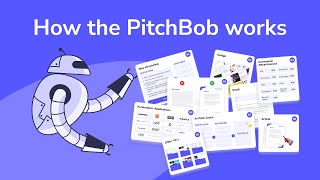
How it works | PitchBob.io
PitchBob.io–AI Co-Pilot for Entrepreneurs

Pitchbob io Product Hunt Review
PitchBob.io–AI Co-Pilot for Entrepreneurs
YouTube returned 6 videos for “PitchBob”, and we withheld 2: 2 could not be judged, because “PitchBob” is a single word that other videos use for other things. Showing the 4 we can prove are about PitchBob.
Official links
Tools that pair well with PitchBob
Common stack mates teams adopt alongside PitchBob, with the specific reason each pairing earns its keep.

STORYD
AI business presentation generator that creates storytelling decks in seconds

Twistly
AI presentation maker that turns topics, PDFs, and Word docs into editable PowerPoint slides.
SlidesAI
AI presentation maker: turn notes, docs & prompts into stunning slides in Google Slides, PowerPoint, ChatGPT, or your browser.
Featured Head-to-Head Comparisons
Pitchbob vs Transfix
These tools serve completely different markets. Transfix is an enterprise TMS for freight brokers needing AI-driven pricing and workflow automation; PitchBob is a freemium startup co-pilot for crafting pitch decks and business plans. Choose based on industry: logistics or entrepreneurship. Both leverage AI effectively but in distinct domains.
Pitchbob vs Cryptohopper
If you need an automated crypto trading bot with social trading, backtesting, and AI integration, Cryptohopper is the clear choice. If you're a startup founder looking for an AI co-pilot to create pitch decks and business plans, PitchBob is purpose-built for that. They serve completely different needs — pick the one that matches your primary goal.
Pitchbob vs Bitsgap
Bitsgap and PitchBob serve entirely different needs. Bitsgap is for crypto traders seeking automated bots across 17+ exchanges, with powerful demo and backtesting. PitchBob is a startup-focused AI that guides founders through pitch deck and business plan creation, backed by recent awards and free scouting features. Choose based on your domain: trading vs. startup fundraising.
Alternatives to PitchBob
View all

Frequently Asked Questions
Best-of guides
Used PitchBob? Help shape our editorial sentiment research.