
Qwen-Image
Open-source text-to-image model with MIT-licensed weights and legible in-image text.
Pick Qwen-Image 3.0 if you need MIT-licensed image generation you can host, fine-tune on proprietary data, and ship commercially without permission — and if someone on your team can stand up a PyTorch environment. The 2026-08-05 launch of Qwen Image 3.0 Pro on QwenCloud adds a managed route with improved quality and control, so the same model family now covers the engineer who wants full control and the team that just wants output. Skip it if you need a browser app today with zero setup, or if you need a contractually guaranteed production SLA on day one — self-hosting puts GPUs, dependencies and inference on you.
Verified 3d ago · liveness 70/100 · cite: rightaichoice.com/tools/qwen-image
- ML engineers with existing PyTorch pipelines
- Researchers fine-tuning on proprietary datasets
- Teams that need MIT-licensed output for commercial use
- Developers building an image-generation product they fully own
- Non-technical users who want a browser prompt box
- Teams requiring a vendor SLA or enterprise support contract on day one
- Anyone unwilling to manage GPUs for the self-hosted path
We scan live Reddit threads, YouTube comments, X posts, G2 reviews and other communities — and hand you an honest verdict in under a minute.
- Honest verdict, not marketing
- Real pros & cons from real users
- Attributed quotes with receipts
3 free scans · no card needed
Skip Qwen-Image if you want image generation from a browser prompt box with no ML environment to stand up, or if you need a contractually guaranteed production SLA on day one rather than running the weights yourself.
Running the open-weights model means paying for your own GPU capacity — the licence is free, the inference hardware is not
The MIT-licensed weights cost nothing to use, which puts Qwen-Image below any per-image or subscription text-to-image service on licence spend alone — the real comparison is your GPU bill plus engineer time against a managed vendor's rate. Qwen Image 3.0 Pro on QwenCloud (2026-08-05) is the managed option for teams that would rather not carry that infrastructure cost.
In short
Qwen-Image — Open-source text-to-image model with MIT-licensed weights and legible in-image text. Best for ML engineers with existing PyTorch pipelines, Researchers fine-tuning on proprietary datasets, Teams that need MIT-licensed output for commercial use. Free to use.
What people actually say about Qwen-Image — is it worth it?
We ran a structured research pass across product reviews, community discussions, and post-purchase forum threads to surface the patterns vendors won't publish themselves. Below: the recurring strengths, the hidden costs people mention most, and the cohort that consistently regrets adopting this tool.
55 mentions across 4 sources (Hacker News, Product Hunt, GitHub, Lemmy) · researched Jul 3, 2026.
Average across the 4 sources that answered — each source counts once, not each post.
- +State-of-the-art photorealism and natural detail generation.
- +Best-in-class text rendering accuracy among open models.
- +Fully open-source with MIT license; no usage restrictions.
- +Strong prompt adherence for moderately complex scenes.
- +Active community creating fine-tunes (Lightning, Layered, Edit).
- −Requires 48GB+ VRAM; single 4090 insufficient for FP16.
- −VAE produces blurry or airbrushed outputs in some cases.
- −Local inference often fails to reproduce cloud results.
- −No official multi-GPU support for dual consumer cards.
- −Incompatible with Ascend and AMD GPUs.
- • Hardware cost: $10k+ for dual RTX 6000 or H100 rental (~$2/hr on spot).
- • Cloud API costs via Alibaba Cloud (not yet available for 2.0).
Viability Score
How well maintained and how widely used is Qwen-Image? Built from what the vendor actually publishes (docs, changelog, tutorials, integrations, pricing), whether the site is live, and how much real users discuss it. How we calculate this
Last calculated: October 2026
How we score →Key Features
- Open-source text-to-image generation with MIT-licensed weights
- Photorealistic image output from text prompts
- Legible text rendering inside generated images
- Fine-grained natural detail in generated output
- Transformer-based architecture compatible with PyTorch
- Fine-tuning support for custom and proprietary datasets
- Self-hosting on local hardware or your own cloud
- Customizable inference pipeline for production deployment
- Version 3.0 with richer content generation
- Enhanced knowledge depth for contextually accurate detail
- Managed Qwen Image 3.0 Pro tier on QwenCloud (2026-08-05)
- Improved quality and control in the 3.0 Pro release
- Supports diverse artistic styles and subjects
- Download clients for Web, iOS, Android, macOS and Windows
About Qwen-Image
Qwen-Image is the Qwen team's open-source text-to-image generation model, currently at version 3.0. The MIT-licensed weights are the headline: you can self-host on your own hardware, fine-tune on proprietary datasets, and ship commercial output without asking a vendor for permission. It runs on a transformer architecture that fits the standard PyTorch ecosystem, so it drops into Python training and inference pipelines your team likely already runs. What it's known for is photorealistic output, fine-grained natural detail, and unusually legible text rendering inside generated images — the thing most text-to-image models still fumble. Version 3.0 adds richer content generation and better knowledge depth, which shows up as more contextually accurate detail rather than just prettier pixels. There are two ways to consume it. The open-weights path means you own the weights and the pipeline, but you also own the GPUs, dependencies, and inference stack. The managed path arrived on 2026-08-05, when Qwen Image 3.0 Pro launched on QwenCloud with improved quality and control, covering teams that want the same model family without maintaining GPU infrastructure. It's aimed at ML engineers, researchers, and developers — not at someone who wants a browser tab and a prompt box. Against DALL-E 3 or Midjourney the trade is explicit: you give up plug-and-play convenience and take on setup, hardware, and ML environment skills in exchange for ownership, fine-tuning, and no per-image restrictions.
Behind the Verdict
Qwen-Image's real differentiator isn't raw image quality — plenty of models produce photorealistic output in 2026 — it's the licence plus the text rendering. MIT-licensed weights mean you can fine-tune on your own product photography, generate catalog images in a consistent house style, and ship commercial output without negotiating output rights with a model vendor. For teams in regulated or confidential domains, that's often the deciding factor before quality even enters the conversation. The legible in-image text matters more than it sounds. Illustrated book pages, marketing graphics and packaging mockups all need readable type inside the image, and it's the failure mode most text-to-image models still exhibit. Qwen-Image handles it well enough that these become real production use cases rather than party tricks. The cost of admission is the ML environment. You own the GPUs, the dependencies, the inference pipeline, and the tuning. Fine-tuning on proprietary datasets is a genuine capability, but it assumes someone on your team works comfortably inside PyTorch. Output quality also shifts with prompt complexity and hardware configuration, so you'll want your own eval harness rather than trusting someone else's benchmarks. The 2026-08-05 launch of Qwen Image 3.0 Pro on QwenCloud fills the obvious gap: the same model family, managed, with improved quality and control, no local GPU infrastructure. That's the route for a team that wants Qwen-Image output but doesn't want to run inference. The published detail on the Pro tier is still thin, so evaluate it against your own throughput and control requirements before you commit a production workload to it. Where it doesn't fit: anyone who wants a browser prompt box and nothing else. If you're comparing on convenience, Midjourney and DALL-E 3 win on day one. Qwen-Image wins on ownership, fine-tuning, and per-image restrictions — which is a different purchase decision entirely.
Researching Qwen-Image? Get your full AI stack in 60 seconds.
Free, no signup — tell us your goal and get tools matched to your budget & existing stack.
Real-world workflow fit
Concrete scenarios for the personas Qwen-Image actually fits — and what changes day-one when you adopt it.
Clone the MIT-licensed weights, wire them into the team's existing PyTorch training and inference stack, and run a first batch of prompts on in-house GPUs to compare output against the model they're replacing.
Outcome: A working self-hosted image-generation pipeline with no per-image restrictions and no vendor negotiation before the first commercial output ships.
Fine-tune Qwen-Image 3.0 on an internal image set that can't leave the organisation, then measure whether 3.0's richer content generation and knowledge depth actually improve contextually accurate detail versus the base model.
Outcome: Full-weight access and an interpretable fine-tune, which is the thing closed text-to-image APIs cannot offer for confidential data.
Fine-tune on existing product photography so generated catalog shots hold the house style, and use the legible in-image text rendering for on-image labels and captions.
Outcome: Commercially shippable catalog imagery produced in house, with readable type inside the image rather than overlaid afterwards.
Use Cases
- Fine-tune on your own product photography to generate catalog images in a consistent house style
- Prototype concept art for game or film pre-production without per-image vendor restrictions
- Generate illustrated book or marketing pages where text inside the image must be readable
- Research text-to-image alignment and interpretability with full access to model weights
- Build a private image-generation pipeline for a regulated or confidential domain
- Ship commercial image generation without negotiating output rights with a model vendor
Models Under the Hood
as of 2026-09-09
Limitations
- The open-weights path means you self-host: GPUs, model weights, dependencies and inference pipelines are your responsibility.
- Output quality varies with prompt complexity and with your hardware configuration.
- Fine-tuning and production inference both assume you or someone on your team can work inside a PyTorch environment.
- The managed alternative is Qwen Image 3.0 Pro on QwenCloud, launched 2026-08-05 with improved quality and control, but the details published so far are thin — evaluate it against your own throughput and control requirements before committing a production workload to it.
as of 2026-10-14
Verification history
We have re-verified Qwen-Image 8 times since . Each pass re-reads the vendor's own pages and re-checks every listed field against that evidence; passes where nothing had changed are marked as such.
- — re-verified summary, description, our verdict, our analysis, pricing model, pricing tiers, features, integrations, who it suits, who should skip it
- — re-verified summary, description, our verdict, our analysis, pricing model, pricing tiers, features, integrations, who it suits, who should skip it
- — re-verified summary, description, our verdict, our analysis, pricing model, pricing tiers, features, integrations, who it suits, who should skip it
- — re-verified summary, description, our verdict, our analysis, pricing model, pricing tiers, features, integrations, who it suits, who should skip it
- — re-checked, vendor evidence unchanged
- — re-verified summary, description, our verdict, our analysis, pricing model, pricing tiers, features, integrations, who it suits, who should skip it
Showing the 6 most recent of 8 verification passes.
Free to cite with attribution — this page re-verifies continuously.
12-month cost
Project the real annual outlay, including the implied monthly cost when only an annual tier is published.
Vendor list price only. Add-on usage, seat overages, and contract minimums are surfaced under Hidden costs & gotchas.
Plans compared
For each published Qwen-Image tier: who it actually fits, and what it adds vs. the previous tier. Cross-reference the cost calculator above for projected annual outlay.
Open Source Model
$0/mo
Ideal for
ML engineers and researchers who own their GPU capacity and want to fine-tune or ship commercial output from MIT-licensed weights
What this tier adds
Starting tier — the self-hosted path with MIT-licensed weights and commercial output rights, but you supply GPUs, dependencies and inference
Qwen Image 3.0 Pro (QwenCloud)
Not specified
Ideal for
Teams that want Qwen-Image 3.0 output without running local GPU infrastructure or maintaining an inference stack
What this tier adds
Adds a managed QwenCloud route with improved quality and control over the prior release, launched 2026-08-05; published pricing detail is not specified
Where the pricing makes sense
The company stage and team size where Qwen-Image's pricing actually pencils out — and where peers do it cheaper.
The MIT-licensed weights cost nothing to use, which puts Qwen-Image below any per-image or subscription text-to-image service on licence spend alone — the real comparison is your GPU bill plus engineer time against a managed vendor's rate. Qwen Image 3.0 Pro on QwenCloud (2026-08-05) is the managed option for teams that would rather not carry that infrastructure cost.
Setup time & first value
How long it actually takes to get something useful out of Qwen-Image — broken out by persona, not the marketing-page minute.
For an ML engineer already running PyTorch: a working self-hosted inference run in a day or two, with fine-tuning on proprietary data adding days-to-weeks depending on dataset size and GPU capacity. For a researcher, evaluation scaffolding is the long pole. Teams taking the managed Qwen Image 3.0 Pro route on QwenCloud skip the environment build entirely.
Switching to or from Qwen-Image
How to bring data in from common predecessors and how to get it back out — written for the switcher, not the buyer.
- →From Midjourney or DALL-E 3: move prompt workloads onto self-hosted Qwen-Image where per-image restrictions or output-rights terms were the blocker
- →From a closed text-to-image API: swap the hosted endpoint for the MIT-licensed weights in your existing Python inference pipeline
- →From Stable Diffusion checkpoints: port the pipeline to Qwen-Image 3.0 where legible in-image text rendering is the requirement
- ↗To Midjourney or DALL-E 3: if you need a browser prompt box and zero ML environment maintenance
- ↗To Qwen Image 3.0 Pro on QwenCloud: stay in the same model family but drop the GPU and inference-stack responsibilities
Resources & Guides
Tutorials & Learning

【これは良い】ローカル画像モデル『Qwen-Image-2.1』が軽くて日本語も対応してて質が高いので解説します!
まさおAIじっくり解説ch

【無料&爆速】NanoBanana級ローカル画像編集AI「Qwen-Image-Edit-2511」&「Qwen-Image-Layered」のComfyUI導入方法と使い方
AIで創作効率化とマネタイズby嗚呼蛙
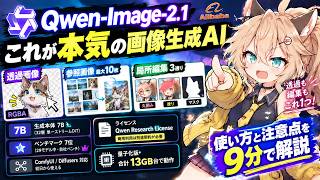
Qwen-Image-2.1とは?透過画像・10枚参照編集・ライセンス変更を9分で解説
AI速報ラジオ
YouTube returned 6 videos for “Qwen-Image”, and we withheld 1: 1 did not mention Qwen-Image. Showing the 5 we can prove are about Qwen-Image.
Official links
Tools that pair well with Qwen-Image
Common stack mates teams adopt alongside Qwen-Image, with the specific reason each pairing earns its keep.
Ideogram
Ideogram is a text-to-image generator built to render legible typography inside AI-generated images.
Flux
FLUX from Black Forest Labs generates image, video, audio, and robot action — pay-per-generation via API or deploy the open weights

MimicPC
Browser-based cloud that runs 20+ pre-installed open-source AI apps for image, video, and audio generation
Featured Head-to-Head Comparisons
Qwen Image vs The New Black
For fashion-specific design needs (tech packs, virtual try-on), choose The New Black. For advanced, flexible text-to-image generation with superior photorealism and text rendering, choose Qwen-Image if you have technical expertise. Qwen-Image's open-source nature offers unmatched customization but lacks a ready-to-use interface.
Qwen Image vs Qoves
For someone seeking a personalized, research-backed facial improvement plan without surgery, QOVES is the clear choice. For developers or artists needing a state-of-the-art, free, open-source text-to-image model, Qwen-Image is unbeatable. There is no direct overlap: QOVES analyzes faces, Qwen-Image generates them.
Qwen Image vs Adobe Firefly Services
If you need top-tier photorealism, text rendering, and full control over the model without licensing costs, Qwen-Image is unmatched. But if you require enterprise-compliance, scalable APIs, and native Adobe integrations for high-volume content production, Adobe Firefly Services is the pragmatic choice despite its pay-as-you-go pricing.
Alternatives to Qwen-Image
View all
Frequently Asked Questions
Categories
Used Qwen-Image? Help shape our editorial sentiment research.