
Qwen3.6-35B-A3B
Open-weight 35B Mixture-of-Experts model with ~3B active parameters for local agentic coding and reasoning.
If your agentic coding or math reasoning workload can live inside 32K context and you already own 16 GB of unified memory or an RTX 4090, Qwen3.6-35B-A3B is one of the more practical open-weight picks — Apache 2.0 keeps commercial deployment clean. It is not a managed endpoint. You are the ops team: the throughput win from ~3B active parameters is real, but it arrives attached to your own inference stack.
Verified 14h ago · liveness 72/100 · cite: rightaichoice.com/tools/qwen3-6-35b-a3b
- Developers building agentic coding assistants that need fast local reasoning without per-token API costs
- Teams deploying on-premise LLMs under a permissive Apache 2.0 license
- Power users running reasoning workloads on a 16 GB Mac via SSD-streamed MoE
- Researchers studying Mixture-of-Experts sparsity and efficiency tradeoffs
- Beginners who want a ready-to-use chat app with no setup or infrastructure work
- Workloads that routinely need context beyond the documented 32K window
- Buyers who require an SLA, guaranteed uptime, or enterprise support contracts
We scan live Reddit threads, YouTube comments, X posts, G2 reviews and other communities — and hand you an honest verdict in under a minute.
- Honest verdict, not marketing
- Real pros & cons from real users
- Attributed quotes with receipts
3 free scans · no card needed
Skip Qwen3.6-35B-A3B if your workload needs more than the documented 32K context window, or if you need a vendor SLA and a support contact rather than community GitHub issues when inference breaks.
There are no licence fees, but you pay for the hardware: a 35B-parameter model needs enough RAM or VRAM to hold the full weight set even though only about 3B parameters activate per token.
Cost sits entirely in infrastructure, not licences: the weights are Apache 2.0 and free to download from Hugging Face or GitHub. That makes it far cheaper than per-token closed APIs at sustained high volume, but more expensive than a chat subscription for anyone who lacks a spare GPU or a 16 GB Mac and would have to buy hardware or rent a cloud GPU to run it.
In short
Qwen3.6-35B-A3B — Open-weight 35B Mixture-of-Experts model with ~3B active parameters for local agentic coding and reasoning. Best for Developers building agentic coding assistants that need fast local reasoning without per-token API costs, Teams deploying on-premise LLMs under a permissive Apache 2.0 license, Power users running reasoning workloads on a 16 GB Mac via SSD-streamed MoE. Free to use.
What people actually say about Qwen3.6-35B-A3B — is it worth it?
We ran a structured research pass across product reviews, community discussions, and post-purchase forum threads to surface the patterns vendors won't publish themselves. Below: the recurring strengths, the hidden costs people mention most, and the cohort that consistently regrets adopting this tool.
39 mentions across 3 sources (Hacker News, Product Hunt, Lemmy) · researched Jul 3, 2026.
Average across the 3 sources that answered — each source counts once, not each post.
- +Runs 50-90 tok/s on consumer hardware like M1 Pro and RTX 3090.
- +Apache 2.0 license permits commercial use, modification, and redistribution.
- +Strong agentic coding and tool calling capabilities praised by the community.
- +Multimodal reasoning often comparable to much larger dense models like Claude Opus.
- +Can be fine-tuned and deployed via Docker, llama.cpp, or MLX.
- −MoE architecture may be less accurate than dense 27B for deep reasoning.
- −Quantization quality is critical—poor quants degrade output noticeably.
- −Vision encoder required separately for multimodal tasks.
- −Low-end GPUs (e.g., GTX 1060) achieve only 11 tok/s.
- −Setup can involve tweaking llama.cpp flags and quantization levels.
- • Compute costs for self-hosting (GPU hardware or cloud instances)
- • Potential cost of fine-tuning infrastructure if customizing
Viability Score
How well maintained and how widely used is Qwen3.6-35B-A3B? Built from what the vendor actually publishes (docs, changelog, tutorials, integrations, pricing), whether the site is live, and how much real users discuss it. How we calculate this
Last calculated: October 2026
How we score →Key Features
- Mixture-of-Experts architecture with 35B total and roughly 3B active parameters per token
- Agentic coding and autonomous tool calling for multi-step workflows
- Multimodal reasoning pairing text with vision when an optional vision encoder is attached
- Throughput comparable to a dense 3B model despite the larger parameter count
- SSD-streamed MoE execution on 16 GB Macs including M1 Pro
- Quantized GGUF and AWQ builds for reduced memory footprint
- Docker-based inference servers for quicker local setup
- Direct Python integration through the Qwen framework
- Fine-tuning support for domain-specific customization
- Multilingual support across English, Chinese and other languages
- Context support up to 32K tokens
- Open weights published on Hugging Face and GitHub
- Optimized for consumer GPUs such as the RTX 4090
- Self-hosted deployment with no per-token API fees
About Qwen3.6-35B-A3B
Qwen3.6-35B-A3B is an open-weight Mixture-of-Experts language model from the Qwen family: 35B total parameters with roughly 3B active per token. That sparsity is the whole reason it's interesting — you get the throughput profile of a small dense model while keeping the reasoning headroom of a much larger one. Weights ship openly under Apache 2.0, so commercial use, modification, and redistribution are permitted; you pull them from Hugging Face or GitHub and run inference yourself, with no per-token billing. Deployment is bring-your-own-stack. The Qwen framework gives you direct Python integration, Docker-based inference servers shorten local setup, and quantized GGUF or AWQ builds cut the memory footprint when hardware is tight. The model handles code generation, autonomous tool calling for multi-step agent workflows, multilingual work across English, Chinese and other languages, and multimodal reasoning when paired with a vision encoder. Context is documented at up to 32K tokens. Hardware reality matters here. A 2026-08-23 Hacker News thread benchmarking local LLMs on prosumer gear named Qwen3.6-35B-A3B among the models tested, with 16 GB Macs (including M1 Pro) running it via SSD-streamed MoE and consumer GPUs like the RTX 4090 identified as practical targets. That 3B-active design is what makes a 16 GB machine a viable host rather than a joke. Positioning: this competes with closed API providers on control and cost, not on polish. There is no hosted chat product attached to the weights — you supply the GPU or Mac, the inference server, and any fine-tuning expertise. Teams that want an SLA should look elsewhere; teams that want no per-token fees and full weight control can start here.
Behind the Verdict
Pick this when the constraint you're optimizing is control, not convenience. A 35B MoE with about 3B active parameters per token lets a 16 GB Mac or a single consumer GPU serve reasoning and tool-calling workloads that would otherwise need a rented endpoint. Apache 2.0 means you can ship it inside a commercial product, modify it, and redistribute without negotiating anything. Pass when nobody on the team wants to own inference. There's no hosted product here — no signup that gives you a chat window. You assemble vLLM, llama.cpp or Ollama, load the weights through the Qwen framework or a Docker server, and babysit the quantization choice. Watch the context ceiling. 32K is documented, and long agent transcripts burn through it fast once tool call traces and file contents pile up. If your workflow regularly needs more, plan for retrieval or chunking rather than assuming you can stretch it. The closest alternative is a closed frontier API. That trade is straightforward: you give up per-token pricing, data leaving your network, and rate limits, and in return you take on GPUs, uptime, and model updates on your own schedule. For a solo developer with an M1 Pro and a side project, the open weights usually win on cost. For a product team with an on-call rotation and a latency SLO, the closed API usually wins on sleep. One caveat on quantization: smaller footprints buy memory headroom at the cost of quality, and the sweet spot moves depending on whether you're doing code generation or free-form reasoning. Budget time to benchmark your own task before committing a deployment. Community numbers on prosumer hardware are a useful starting map, not a guarantee for your workload.
Researching Qwen3.6-35B-A3B? Get your full AI stack in 60 seconds.
Free, no signup — tell us your goal and get tools matched to your budget & existing stack.
Real-world workflow fit
Concrete scenarios for the personas Qwen3.6-35B-A3B actually fits — and what changes day-one when you adopt it.
You pull a quantized GGUF build from Hugging Face and run it locally through an SSD-streamed MoE setup, wiring it into a coding agent that writes and tests functions in your editor.
Outcome: You get agentic coding assistance with no per-token bill, at token speeds acceptable for interactive work rather than bulk generation.
You stand up a Docker-based inference server on the workstation and point your internal SaaS tooling at it for classification and reasoning calls, using the Qwen framework for Python integration.
Outcome: High-volume internal reasoning runs at a fixed hardware cost instead of a metered API bill, and no prompt data leaves your network.
You load the open weights, apply domain-specific training data, and watch expert load balancing while training to keep the MoE routing healthy, then quantize to AWQ for deployment.
Outcome: A specialized reasoning model you own outright — modifiable and redistributable under Apache 2.0 — that a competitor cannot deprecate out from under you.
Use Cases
- Build an autonomous coding agent that writes, tests, and debugs code.
- Run real-time multimodal reasoning on live video or images.
- Deploy a cost-effective, low-latency reasoning API for your SaaS product.
- Fine-tune the model on domain-specific data for specialized reasoning tasks.
- Create a local AI assistant that runs on a single consumer GPU.
Models Under the Hood
as of 2026-09-09
Limitations
- As an MoE model, Qwen3.6-35B-A3B may behave slightly differently from dense models on certain tasks, and optimal performance requires careful expert load balancing during fine-tuning.
- The documented context window is 32K tokens — enough for most agentic workflows, restrictive for long-repository or long-document work.
- Because the weights are open, there is no commercial support SLA; you rely on community forums and GitHub issues when something breaks.
- You also supply your own hardware and inference stack, which means the real cost is engineering time, not licence fees.
as of 2026-09-26
Verification history
We have re-verified Qwen3.6-35B-A3B 9 times since . Each pass re-reads the vendor's own pages and re-checks every listed field against that evidence; passes where nothing had changed are marked as such.
- — re-verified summary, description, our verdict, our analysis, pricing model, pricing tiers, features, integrations, who it suits, who should skip it
- — re-verified summary, description, our verdict, our analysis, pricing model, pricing tiers, features, integrations, who it suits, who should skip it
- — re-verified summary, description, our verdict, our analysis, pricing model, pricing tiers, features, integrations, who it suits, who should skip it
- — re-verified summary, description, our verdict, our analysis, pricing model, pricing tiers, features, integrations, who it suits, who should skip it
- — re-verified summary, description, our verdict, our analysis, pricing model, pricing tiers, features, integrations, who it suits, who should skip it
- — re-verified summary, description, our verdict, our analysis, pricing model, pricing tiers, features, integrations, who it suits, who should skip it
Showing the 6 most recent of 9 verification passes.
Free to cite with attribution — this page re-verifies continuously.
12-month cost
Project the real annual outlay, including the implied monthly cost when only an annual tier is published.
Vendor list price only. Add-on usage, seat overages, and contract minimums are surfaced under Hidden costs & gotchas.
Plans compared
For each published Qwen3.6-35B-A3B tier: who it actually fits, and what it adds vs. the previous tier. Cross-reference the cost calculator above for projected annual outlay.
Open-Source Model
$0
Ideal for
Developers, researchers, and teams with existing GPU or 16 GB Mac hardware who want agentic coding and reasoning with zero per-token fees.
What this tier adds
Starting tier: the weights themselves, free under Apache 2.0, with the licence permitting commercial use, modification, redistribution, fine-tuning, and quantization.
Where the pricing makes sense
The company stage and team size where Qwen3.6-35B-A3B's pricing actually pencils out — and where peers do it cheaper.
Cost sits entirely in infrastructure, not licences: the weights are Apache 2.0 and free to download from Hugging Face or GitHub. That makes it far cheaper than per-token closed APIs at sustained high volume, but more expensive than a chat subscription for anyone who lacks a spare GPU or a 16 GB Mac and would have to buy hardware or rent a cloud GPU to run it.
Setup time & first value
How long it actually takes to get something useful out of Qwen3.6-35B-A3B — broken out by persona, not the marketing-page minute.
For a developer already comfortable with llama.cpp, Ollama, or vLLM: an afternoon to a day to first useful output, dominated by downloading quantized weights and tuning the context size to your memory. On a 16 GB Mac with SSD-streamed MoE, expect extra time spent dialling in offload settings before tokens flow at usable speed. Teams going through Docker-based inference servers can be serving
Switching to or from Qwen3.6-35B-A3B
How to bring data in from common predecessors and how to get it back out — written for the switcher, not the buyer.
- →From a closed per-token API: route a slice of your reasoning traffic to a locally served Qwen3.6-35B-A3B build and compare quality and latency before cutting spend.
- →From a dense 7B-13B local model: swap the weights behind your existing llama.cpp or Ollama endpoint and re-check memory headroom, since MoE holds more parameters in memory.
- →From a hosted GPU endpoint: move weights onto your own RTX 4090 or Mac and remove the per-hour rental from your stack.
- →From a generic open chat model: keep your prompt template and add tool-calling schemas to take advantage of the agentic coding behaviour.
- ↗To a hosted closed API: needed when you want an SLA, guaranteed uptime, and no infrastructure to own; expect per-token billing to replace fixed hardware cost.
- ↗To a longer-context model: required if your documents or repositories outgrow the documented 32K context window.
- ↗To a dense model of similar size: consider it if MoE routing behaviour is causing inconsistent results on your specific task set.
- ↗To a managed Qwen API endpoint: a path for teams that want the same model family without running their own inference server.
Integrations
Resources & Guides
Tutorials & Learning
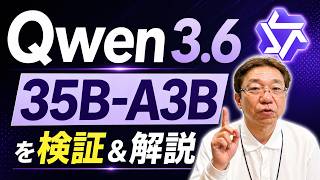
Qwen3.6-35B-A3Bの実力は?性能・特徴を解説!
Tech千一夜 | ソフトウェアの作り方チャンネル

【ゆっくり解説】もうクラウド不要?最強無料ローカルAI「Qwen3.6-35B-A3B」がClaude級の衝撃
サルでもわかるAIにゅーす速報【ゆっくり解説】
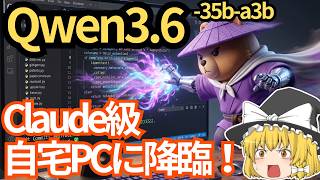
【ローカルLLM】もうAPI代で悩まない?Claude級の自動化をローカルで実現する『Qwen3.6-35B-A3B』の実力【ゆっくり解説】
ゆっくりテックウォッチ
YouTube returned 6 videos for “Qwen3.6-35B-A3B”, and we withheld 1: 1 did not mention Qwen3.6-35B-A3B. Showing the 5 we can prove are about Qwen3.6-35B-A3B.
Official links
Tools that pair well with Qwen3.6-35B-A3B
Common stack mates teams adopt alongside Qwen3.6-35B-A3B, with the specific reason each pairing earns its keep.

Qwen3.6-27B
Open-source 27B agentic coding model with multimodal reasoning and a 50%-leaner ThinkingCap fine-tune.

Falcon LLM
Apache 2.0 open-weight model family from TII Abu Dhabi, spanning hybrid Transformer-Mamba, Arabic, reasoning, and multimodal vision models.

LFM
Liquid AI's open-weight LFM2.5 model family runs native text, vision, and audio AI locally on CPU, GPU, or NPU.
Featured Head-to-Head Comparisons
Qwen3 6 35b A3b vs Truleo
Truleo and Qwen3.6-35B-A3B serve completely different domains. Choose Truleo if you are a law enforcement agency needing to consolidate siloed data and automate intelligence briefings; it's a turnkey, CJIS-compliant solution. Choose Qwen3.6-35B-A3B if you are a developer or researcher wanting a free, open-source MoE model for agentic coding and multimodal reasoning. They are not direct competitors.
Qwen3 6 35b A3b vs Presto Voice
Choose Presto Voice if you run a QSR chain needing proven drive-thru automation with upselling ROI; recent Dairy Queen partnership confirms industry traction. Choose Qwen3.6-35B-A3B if you're a developer seeking a cost‑efficient, open‑source MoE model for agentic coding and reasoning tasks. These tools serve entirely different domains – there's no overlap.
Qwen3 6 35b A3b vs Praktika
Choose Praktika if you're a language learner wanting immersive speaking practice with real-time corrections; choose Qwen3.6-35B-A3B if you're a developer needing a cost-efficient, open-source MoE model for coding, reasoning, and multimodal tasks. Both excel in their domains, but they serve entirely different audiences.
Alternatives to Qwen3.6-35B-A3B
View all
Qwen3.6-27B
Open-source 27B agentic coding model with multimodal reasoning and a 50%-leaner ThinkingCap fine-tune.

Falcon LLM
Apache 2.0 open-weight model family from TII Abu Dhabi, spanning hybrid Transformer-Mamba, Arabic, reasoning, and multimodal vision models.

Frequently Asked Questions
Categories
Used Qwen3.6-35B-A3B? Help shape our editorial sentiment research.