
Recut
Recut strips silence out of your video and audio automatically, then exports a clean XML cut list to your editor.
If silence removal is what's eating your edit days, Recut is a cheap way to buy that time back, and the one-time license means no monthly bill. The v4.4.x run added MP3 export, quality and speed controls, a Final Cut Pro compound-clip option, and a CLI for batch work, which rounds out what was already a focused tool. The $99 pricing-page license includes lifetime updates; the homepage lists a $129 one-time purchase, and monthly runs $15/mo. Just don't buy it expecting transcription or um/uh cleanup — the vendor says those would be separate add-ons if they ship.
Verified 16h ago · liveness 83/100 · cite: rightaichoice.com/tools/recut
- YouTubers trimming pauses from talking-head videos and vlogs
- Podcasters cutting silence from multi-mic audio and video interviews
- Streamers assembling highlight reels from hours of VOD footage
- Marketers producing educational or talking-head videos at volume
- Editors who need AI transcription or automatic filler-word (um/uh) removal — the vendor lists those as possible future
- Teams needing cloud-based or real-time collaborative editing
- Creators wanting a full editor with color grading, effects, and titles
We scan live Reddit threads, YouTube comments, X posts, G2 reviews and other communities — and hand you an honest verdict in under a minute.
- Honest verdict, not marketing
- Real pros & cons from real users
- Attributed quotes with receipts
3 free scans · no card needed
Skip Recut if your bottleneck is filler-word removal or transcription rather than dead air, or if you edit mostly music, b-roll, or ambient footage where removing silence changes nothing.
The pricing page lists $99 for a one-time license while the homepage lists a $129 one-time purchase, so check which figure applies before you buy.
One-time pricing puts Recut at the low end of the editing-toolchain budget next to subscription editors: $99 one-time on the pricing page ($129 on the homepage) with lifetime updates, versus $15/mo if you'd rather rent it. That's a good fit for a solo creator or a small team who own their NLE, and a harder sell only if you need transcription or cloud collaboration that Recut doesn't offer.
In short
Recut — Recut strips silence out of your video and audio automatically, then exports a clean XML cut list to your editor. Best for YouTubers trimming pauses from talking-head videos and vlogs, Podcasters cutting silence from multi-mic audio and video interviews, Streamers assembling highlight reels from hours of VOD footage. Free to start; paid plans from $15/mo.
What's new in Recut
Checked todayAcross the latest 5 updates: 1 feature update and 4 changelog entries.
Recut v4.4.8
Fixed a bug where the license wasn't recognized when opening an existing project, and improved playback at faster speeds.
Recut v4.4.7
Playback is smoother, Mac users can drag videos to the dock icon or use Open With, ProRes crashes are fixed, and new projects now always ask for confirmation first.
Recut v4.4.4
Fixed 'Bad Image' errors on Windows.
Recut v4.4.3
Added command line flags for setting quality and speed, plus advanced ones for CRF and preset.
Recut v4.4
Better video export quality and size, new quality and speed controls, MP3 as an export option, Final Cut Pro compound clip export, and a command line interface for hands-off editing.
What people actually say about Recut — is it worth it?
We ran a structured research pass across product reviews, community discussions, and post-purchase forum threads to surface the patterns vendors won't publish themselves. Below: the recurring strengths, the hidden costs people mention most, and the cohort that consistently regrets adopting this tool.
49 mentions across 4 sources (Hacker News, YouTube, Product Hunt, Lemmy) · researched Aug 7, 2026.
Average across the 4 sources that answered — each source counts once, not each post.
- +Incredibly fast at cutting silences — seconds, not minutes.
- +Multi-track sync keeps cuts aligned across cameras and mics.
- +One-time purchase option saves money vs subscription tools.
- +Non-destructive: originals untouched, exports to NLE projects.
- +Simple, focused UI — no learning curve or feature bloat.
- −Does only one thing: silence removal, no filler-word or um detection.
- −No free tier — trial caps at 3 exports, then you pay.
- −Limited community data on bugs, support, or long-term reliability.
- −Requires an intermediate skill level to leverage advanced features.
- −No built-in transcription or editing capabilities beyond cutting.
- • No free tier after trial — you must pay to keep using it.
- • The one-time price is $129, but monthly $15/mo adds up to $180/year.
Viability Score
How well maintained and how widely used is Recut? Built from what the vendor actually publishes (docs, changelog, tutorials, integrations, pricing), whether the site is live, and how much real users discuss it. How we calculate this
Last calculated: October 2026
How we score →Key Features
- Automatically detects and removes silence from audio and video files
- Exports XML cut lists to Adobe Premiere Pro, DaVinci Resolve, Final Cut Pro, ScreenFlow, and CapCut
- Exports standard MP4, WAV, M4A, and MP3 files (MP3 added in v4.4)
- Multi-track audio and video support with synchronized cuts across cameras and mics
- Non-destructive workflow that never alters your original files
- Adjustable sensitivity controls for natural-sounding cuts
- Export quality and speed controls (v4.4)
- Command-line interface with CRF and preset flags for batch editing (v4.4, expanded in v4.4.3)
- Final Cut Pro compound clip export (v4.4)
- Playback at faster speeds, improved in v4.4.7 and v4.4.8
- macOS drag-to-dock and Open With support for opening files (v4.4.7)
- Double-click a Recut Project file to open it (v4.4.7)
- ProRes crash fixes (v4.4.7)
- License recognition fix when opening an existing project (v4.4.8)
- Cross-platform desktop app for macOS and Windows
About Recut
Recut is a Mac and Windows desktop app that removes dead air from your footage for you. You load files in, it analyzes the audio, and it builds an automated cut list in seconds. From there you can export an XML to Adobe Premiere Pro, DaVinci Resolve, Final Cut Pro, ScreenFlow, or CapCut, or ship a finished file as MP4, WAV, M4A, or MP3. Multi-track support keeps multiple cameras and microphones cutting in sync, and your originals are never altered — Recut only produces a cut list rather than overwriting your source files. Adjustable sensitivity controls let you tune how aggressive the cuts are so the result sounds natural instead of clipped and robotic. The audience is anyone who records a lot of talking: YouTubers, podcasters, streamers, marketers, and interview editors. Development has kept moving through mid-2026: the v4.4 line added MP3 export, export quality and speed controls, CRF and preset CLI flags, and Final Cut Pro compound clip export, while v4.4.7 brought macOS dock-dragging and Open With shortcuts plus ProRes crash fixes, and v4.4.8 repaired a license-recognition bug on existing projects and sped up playback at faster speeds. There's a command-line interface if you want to batch this without touching the UI. It's a rough-cut assistant, not an editor — for transcription or filler-word removal you're looking at Descript or your NLE.
Behind the Verdict
Recut does one job and does it narrowly: it listens to your audio, finds the quiet stretches, and hands you a cut list. That focus is the point. You load a talking-head video, an interview, or a multi-mic podcast recording, and within seconds you have a rough cut with the pauses gone. From there you export an XML to Adobe Premiere Pro, DaVinci Resolve, Final Cut Pro, ScreenFlow, or CapCut and do the creative work yourself — Recut never touches your originals. Strengths. The workflow is non-destructive by design, exporting a cut list rather than mangling source files, and multi-track support keeps several cameras and microphones cutting in sync. Sensitivity controls are the thing reviewers call out again and again, because they're what makes the result sound natural instead of machine-clipped; one testimonial specifically contrasts it with Premiere's own silence removal, which "often made my videos sound like a robot." Multi-person licensing is simple — one license per user, installable on that person's Mac and Windows machines. And the pricing model is unusual in a good way: a $99 one-time license on the pricing page with lifetime updates, alongside a $15/mo subscription and a 3-export, no-watermark, no-credit-card trial. The 2026 release cadence has been steady and mostly about polish rather than new surface area. v4.4 (March 2026) added MP3 export, quality and speed controls for video export, Final Cut Pro compound-clip export, and a command-line interface for hands-off batch work, plus CRF and preset flags in v4.4.3. v4.4.7 (June 18, 2026) smoothed playback and added macOS quality-of-life touches — drag a video to the dock icon, use the Open With menu, double-click a Recut project file — and fixed ProRes crashes. v4.4.8 (June 28, 2026) fixed a bug where the license wasn't recognized when opening an existing project and improved playback at faster speeds. That's a healthy maintenance rhythm for a small utility. Weaknesses and where it doesn't fit. Recut is explicitly not a transcription tool. The pricing page is upfront that features with ongoing server costs — transcription, removing ums and uhs, "and other fancy AI stuff" — aren't included today and would be an optional add-on with a separate charge if they ever arrive. If filler-word removal is your problem, you want Descript or your NLE's own tools. It's also not a full editor: no color grading, effects, or titles here, and nothing here is cloud-based or real-time collaborative, so teams that edit together in a browser won't find a home. It ships for macOS and Windows only, so Linux users are out of luck. And if your footage isn't mostly speech — b-roll reels, music videos, ambient footage — trimming silence adds little value. Where it fits. Solo creators and small editing teams who record a lot of talking and who already have a preferred NLE. The pattern in the testimonials is consistent: two to four hours of timeline scrubbing collapses into seconds, and the editor keeps the creative
Researching Recut? Get your full AI stack in 60 seconds.
Free, no signup — tell us your goal and get tools matched to your budget & existing stack.
Real-world workflow fit
Concrete scenarios for the personas Recut actually fits — and what changes day-one when you adopt it.
Recorded a 40-minute talking-head video and wants the dead air gone before opening Premiere. Drops the file into Recut, tunes the sensitivity slider so the cuts sound natural, exports an XML, and opens it in Premiere Pro to add b-roll and titles.
Outcome: The rough cut lands in Premiere in about as long as it takes to export, with the original recording untouched on disk.
Loads both camera files and both mic tracks as separate tracks, lets Recut analyze them as a group so the cuts stay in sync, then exports MP4 or WAV for the audio edit and an XML for the video edit.
Outcome: One pass strips silence across all tracks at once instead of four separate timeline sessions.
Points the CLI at a folder of VOD captures with the quality and speed flags set, and lets Recut produce cut MP4s overnight without opening the UI.
Outcome: Hours of footage come back pre-trimmed for highlight assembly.
Use Cases
- Remove long pauses from talking-head YouTube videos in seconds.
- Clean up interview recordings by cutting silent gaps between answers.
- Create a rough edit of a podcast episode by stripping silence between sentences.
- Batch-process multiple footage files via the CLI without touching the UI.
- Export a Final Cut Pro project with silence removed as compound clips.
- Cut several camera angles and mic tracks in one synchronized pass.
- Reduce repetitive clicking and the repetitive strain injuries that come with it.
- Hand an editor a clean XML rough cut instead of an untrimmed timeline.
Limitations
- Recut is a Mac and Windows desktop app that automatically detects and removes silence, exporting a non-destructive XML cut list (or standard MP4, WAV, M4A, MP3 files) for editors like Adobe Premiere, DaVinci Resolve, Final Cut Pro, ScreenFlow, and CapCut.
- It's a rough-cut assistant, not an editor — there's no color grading, effects, or titles.
- The pricing page states that features carrying ongoing server costs — transcription, removing ums and uhs, and other AI features — are not currently included and, if added, would be optional add-ons with a separate charge.
- A command-line interface is available for hands-off editing.
- Version 4.4.x work through mid-2026 focused on export quality, playback smoothness, and macOS quality-of-life fixes rather than new editing surface.
as of 2026-10-09
Verification history
We have re-verified Recut 9 times since . Each pass re-reads the vendor's own pages and re-checks every listed field against that evidence; passes where nothing had changed are marked as such.
- — re-verified summary, description, our verdict, our analysis, pricing model, pricing tiers, features, integrations, who it suits, who should skip it
- — re-verified summary, description, our verdict, our analysis, pricing model, pricing tiers, features, integrations, who it suits, who should skip it
- — re-verified summary, description, our verdict, our analysis, pricing model, pricing tiers, features, integrations, who it suits, who should skip it
- — re-verified summary, description, our verdict, our analysis, pricing model, pricing tiers, features, integrations, who it suits, who should skip it
- — re-verified summary, description, our verdict, our analysis, pricing model, pricing tiers, features, integrations, who it suits, who should skip it
- — re-verified summary, description, our verdict, our analysis, pricing model, pricing tiers, features, integrations, who it suits, who should skip it
Showing the 6 most recent of 9 verification passes.
Free to cite with attribution — this page re-verifies continuously.
12-month cost
Project the real annual outlay, including the implied monthly cost when only an annual tier is published.
Vendor list price only. Add-on usage, seat overages, and contract minimums are surfaced under Hidden costs & gotchas.
Plans compared
For each published Recut tier: who it actually fits, and what it adds vs. the previous tier. Cross-reference the cost calculator above for projected annual outlay.
Free Trial
$0
Ideal for
Anyone who wants to confirm Recut works with their camera files, mic setup, and NLE before paying anything.
What this tier adds
Free entry point — full feature set, no watermark, but limited to 3 exports and no credit card required.
Monthly
$15/mo
Ideal for
A creator with a short or seasonal project — a single documentary, a launch video, or a batch to get through this month.
What this tier adds
Adds unlimited use for one user at $15/mo, cancel any time, versus the trial's 3-export cap.
One-Time Purchase
$99 one-time
Ideal for
A creator or editor who will use silence removal for years and would rather not carry another subscription.
What this tier adds
Same feature set as Monthly but a one-time $99 payment with lifetime updates included and a 30-day money-back guarantee.
One-Time Purchase (Homepage)
$129 one-time
Ideal for
Buyers who land on the homepage rather than the pricing page and purchase from the buy box there.
What this tier adds
Same one-time license terms as the pricing-page purchase, listed at $129 rather than $99.
Where the pricing makes sense
The company stage and team size where Recut's pricing actually pencils out — and where peers do it cheaper.
One-time pricing puts Recut at the low end of the editing-toolchain budget next to subscription editors: $99 one-time on the pricing page ($129 on the homepage) with lifetime updates, versus $15/mo if you'd rather rent it. That's a good fit for a solo creator or a small team who own their NLE, and a harder sell only if you need transcription or cloud collaboration that Recut doesn't offer.
Setup time & first value
How long it actually takes to get something useful out of Recut — broken out by persona, not the marketing-page minute.
Solo creator: install and process your first file in a few minutes — Recut ships with a built-in tutorial (added v4.1.0), and the free trial needs no credit card. Multi-track editors: budget 15–30 minutes for your first pass to set sensitivity and export settings the way you like them. CLI users: expect a short session to learn the CRF and preset flags added in v4.4.3 before batching.
Switching to or from Recut
How to bring data in from common predecessors and how to get it back out — written for the switcher, not the buyer.
- →From manual timeline scrubbing in Premiere, Resolve, or Final Cut: process the same files in Recut and import the exported XML instead of clicking through every pause.
- →From Premiere's built-in silence removal: swap it for Recut's adjustable sensitivity, which testimonials describe as producing a smoother, less robotic result.
- →From a paid subscription editor used only for silence trimming: replace that recurring bill with the one-time license.
- ↗To Descript: for transcription and automatic um/uh removal, which Recut does not include and the vendor lists as a possible future add-on.
- ↗To your NLE's own tools: for color grading, effects, and titles, which Recut doesn't do and never claimed to.
- ↗To a cloud collaborative editor: for real-time multi-editor sessions across the internet, which Recut's desktop-only model doesn't cover.
Integrations
Resources & Guides
Tutorials & Learning
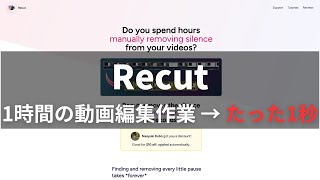
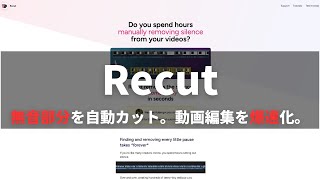
YouTube returned 6 videos for “Recut”, and we withheld 4: 4 could not be judged, because “Recut” is a single word that other videos use for other things. Showing the 2 we can prove are about Recut.
Official links
Tools that pair well with Recut
Common stack mates teams adopt alongside Recut, with the specific reason each pairing earns its keep.
Descript
Descript is a text-based AI video and audio editor — cut footage by editing the transcript, then let Underlord finish the job.
Cleanvoice
Cleanvoice is an AI podcast editor that removes filler words, dead air, mouth sounds and background noise from audio and video in a few clicks — no transcript
Designs.ai
Designs.ai turns one plain-language brief into on-brand images, video, audio, slides, and copy using six specialist AI agents.
Featured Head-to-Head Comparisons
Recut vs Splice
Splice is the go-to for music producers needing a huge royalty-free sample library and rent-to-own plugins, while Recut is essential for video editors who want to remove silence automatically. They serve completely different workflows, so choose Splice for music creation and Recut for video editing efficiency.
Recut vs Landr Mastering
These tools serve completely different workflows. LANDR is for finalizing audio tracks with AI mastering, while Recut is for trimming silence from video/audio in post-production. Choose LANDR if you need pro-quality masters without a human engineer; choose Recut if you spend hours manually cutting pauses from interviews or talking-head content.
Recut vs Storyfile
These tools are not direct competitors. Choose StoryFile if you need an authentic, interactive AI avatar from real footage for museums or legacy preservation – it’s enterprise-only with custom pricing. Choose Recut if you’re a content creator who needs a fast, affordable silence remover – it’s a one-time or low subscription desktop tool.
Alternatives to Recut
View allDescript
Descript is a text-based AI video and audio editor — cut footage by editing the transcript, then let Underlord finish the job.
Cleanvoice
Cleanvoice is an AI podcast editor that removes filler words, dead air, mouth sounds and background noise from audio and video in a few clicks — no transcript
Designs.ai
Designs.ai turns one plain-language brief into on-brand images, video, audio, slides, and copy using six specialist AI agents.
Frequently Asked Questions
Best-of guides
Topics
Used Recut? Help shape our editorial sentiment research.