
SciSpace BioMed Agent
An AI co-scientist that chains 150+ biological tools to run multi-omics, clinical genomics, and drug discovery analysis from plain-language prompts.
SciSpace BioMed Agent is one of the few domain agents doing genuine analysis rather than summarizing text. If you're a bench scientist, clinician-scientist, or trainee who needs variant prioritization against ClinVar and gnomAD, .h5ad cell type annotation with UMAP output, or ADMET prediction on a compound series, the chained-tool approach saves you weeks of glue code. It is not a fit if you need to embed the analysis in your own pipeline, keep data off third-party infrastructure, or hand-tune every parameter of a tool. Compare against a manual Snakemake/Nextflow stack (more control, far more setup) and against generic assistants like ChatGPT (broader but no biological action space behind
Verified 4d ago · liveness 77/100 · cite: rightaichoice.com/tools/scispace-biomed-agent
- Academic labs in genetics, genomics, cell biology, microbiology, pharmacology, and systems biology
- Clinician-scientists working on rare diseases and translational genomics
- Biotech and pharma teams exploring targets, screens, and repurposing ideas
- Students and trainees who want expert-level pipelines without scripting experience
- Researchers who need raw API access for automated pipelines
- Teams that require offline or on-premise deployment for sensitive data
- Users looking for a general-purpose AI assistant
We scan live Reddit threads, YouTube comments, X posts, G2 reviews and other communities — and hand you an honest verdict in under a minute.
- Honest verdict, not marketing
- Real pros & cons from real users
- Attributed quotes with receipts
3 free scans · no card needed
Skip SciSpace BioMed Agent if you need to drive each bioinformatics step programmatically inside your own pipeline, or if your data cannot leave your institution's infrastructure.
Free-plan daily credits run out quickly once you start running multi-step agent workflows, and moving to Premium at $20/mo is the practical fix.
At $20/mo, Premium undercuts per-seat commercial bioinformatics platforms and dedicated cloud compute you would otherwise rent for the same analyses, which makes it an easy add for an individual lab member or a small academic group. Enterprise pricing is negotiated and aimed at biotech and pharma orgs that need team-wide seats and secure data boundaries — a different budget line than a single Premium subscription.
In short
SciSpace BioMed Agent — An AI co-scientist that chains 150+ biological tools to run multi-omics, clinical genomics, and drug discovery analysis from plain-language prompts. Best for Academic labs in genetics, genomics, cell biology, microbiology, pharmacology, and systems biology, Clinician-scientists working on rare diseases and translational genomics, Biotech and pharma teams exploring targets, screens, and repurposing ideas. Free to start; paid plans from $20/mo.
What's new in SciSpace BioMed Agent
Checked 4 days agoAcross the latest 1 update: 1 launch.
What people actually say about SciSpace BioMed Agent — is it worth it?
We ran a structured research pass across product reviews, community discussions, and post-purchase forum threads to surface the patterns vendors won't publish themselves. Below: the recurring strengths, the hidden costs people mention most, and the cohort that consistently regrets adopting this tool.
24 mentions across 3 sources (YouTube, Product Hunt, Bluesky) · researched Jul 28, 2026.
Average across the 3 sources that answered — each source counts once, not each post.
- +Chains 150+ tools and 100+ databases in a single workflow
- +Natural language interface reduces weeks of analysis to minutes
- +Transparent reasoning chains help verify outputs
- +Supports single-cell RNA-seq, exome variants, ADMET, CRISPR design
- +Generates UMAP/t-SNE visualizations automatically
- −AI hallucination concerns unaddressed in community data
- −Handling of ambiguous or low-quality datasets is unclear
- −Limited source upload flexibility (only single files)
- −No offline or local deployment option
- −Only web-based — potential data privacy issues
- • 20% discount code CGBIO20 for monthly, 40% CGBIO40 annual — promotional only
Viability Score
How well maintained and how widely used is SciSpace BioMed Agent? Built from what the vendor actually publishes (docs, changelog, tutorials, integrations, pricing), whether the site is live, and how much real users discuss it. How we calculate this
Last calculated: October 2026
How we score →Key Features
- Conversational query interface for biomedical analysis requests
- Single-cell RNA-seq cell type annotation from uploaded .h5ad files
- UMAP and t-SNE visualization output
- Exome variant prioritization using ClinVar and gnomAD evidence scores
- Rare disease differential diagnosis reasoning with causal gene highlighting
- ADMET and drug-likeness prediction for candidate compounds
- Drug repurposing candidate ranking by disease pathway
- CRISPR screen design and analysis
- Gene regulatory network inference from multi-omic data
- Regulon activity scoring across cell types
- Joint snRNA-seq + snATAC-seq pipeline execution
- Transparent reasoning chain at each analysis step
- Access to 150+ specialized biological tools and 100+ software packages
- Curated biomedical databases for variants, pathways, drug–target interactions and clinical data
- Wet-lab protocol recommendation
About SciSpace BioMed Agent
SciSpace BioMed Agent is a specialized research agent that sits inside the SciSpace platform and turns plain-language biomedical questions into chained, inspectable analyses. Rather than stitching together scripts and separate bioinformatics packages, you describe the goal — prioritize these exome variants, annotate this single-cell dataset, propose repurposing candidates for this pathway — and the agent routes your request through a unified "biomedical action space" of 100+ software packages, 150+ specialized biological tools, and curated databases spanning variants, pathways, gene regulation, drug–target interactions, and clinical data. It covers 20+ subfields including genetics, genomics, synthetic biology, cell biology, physiology, microbiology, pharmacology, bioengineering, biophysics, molecular biology, and pathology. Named workflows include scRNA-seq cell type annotation from .h5ad files with UMAP/t-SNE plots, exome variant prioritization using ClinVar and gnomAD evidence scores, rare disease differential diagnosis reasoning, ADMET and drug-likeness prediction for compounds like erlotinib, pooled CRISPR screen design, and joint snRNA-seq + snATAC-seq regulatory network inference with regulon activity scoring. Every step reports its reasoning chain, so you can inspect how the agent reached a causal gene call or a repurposing shortlist and reuse the workflow. It is built for academic labs, clinician-scientists on rare disease cases, biotech and pharma target-discovery teams, and trainees who need expert-level pipelines without years of scripting. It is cloud-only and runs through the SciSpace web platform, so heavy batch automation via your own pipeline code is outside its design center. Scalable seats, secure data boundaries, and priority support are available on the SciSpace Enterprise Plan.
Behind the Verdict
The interesting thing about BioMed Agent is not the chat box — it's the action space underneath it. The vendor documents 100+ biomedical software packages (statistics, image analysis, sequence processing, structural biology), 150+ specialized biological tools including wet-lab protocols and AI prediction models, and dozens of curated databases covering variants, pathways, gene regulation, drug–target interactions, and clinical data. A general assistant can explain what gnomAD allele frequency means; this agent can actually run the prioritization and show you the score it used. Strengths. The workflow coverage is unusually broad for a single product: drug repurposing and target/screen design in pharmacology, patient gene prioritization and rare disease differential reasoning in clinical genomics, and scRNA-seq annotation plus joint snRNA-seq/snATAC-seq regulatory network inference in single-cell and multi-omics. The transparency layer matters more than vendors usually admit — you get a reasoning chain per step, which is the thing that makes a result defensible in a lab meeting or a clinical discussion. Data ingestion is pragmatic: you attach a .h5ad and get UMAP/t-SNE plots plus a marker-based cell type summary rather than a bare label list. Weaknesses. It is web-platform-bound. The seed notes that the tool is cloud-only, which means sensitive patient-linked data has to be handled under whatever boundaries your Enterprise agreement provides. Teams that already have mature Nextflow/Snakemake pipelines will find the conversational layer convenient for exploration but constraining for production batch runs, because you're not hand-editing parameters per step. Accuracy tracks the underlying literature, databases, and models, so a niche subfield with thin database coverage will underperform a well-annotated one like oncology or rare Mendelian disease. Where it fits. Best inside academic labs in genetics, genomics, cell biology, microbiology, pharmacology, and systems biology; clinician-scientists working rare disease and translational genomics cases; and biotech/pharma discovery teams that want fast target and repurposing hypotheses before committing wet-lab time. Students and trainees get expert-level pipelines without the scripting apprenticeship. Where it doesn't. Researchers who need raw programmatic control over each bioinformatics tool, teams requiring offline or on-premise deployment, and anyone who wanted a general-purpose assistant for everyday work. For those, a scripted pipeline stack or a general model is the better purchase.
Researching SciSpace BioMed Agent? Get your full AI stack in 60 seconds.
Free, no signup — tell us your goal and get tools matched to your budget & existing stack.
Real-world workflow fit
Concrete scenarios for the personas SciSpace BioMed Agent actually fits — and what changes day-one when you adopt it.
You have a .h5ad file from a human lung tissue scRNA-seq run and need cell type labels before your lab meeting.
Outcome: You attach the file, the agent matches gene signatures to known markers, returns UMAP/t-SNE plots and a summary of cell types and markers you can drop straight into slides.
A patient presents with progressive muscle weakness, ptosis, and fatigability, with variants in CHRNA1, RAPSN, and DOK7.
Outcome: You get a prioritized differential diagnosis list with the reasoning chain behind each ranking, which you can review before ordering confirmatory testing.
You want to know which of a candidate drug list is most promising to repurpose against a disease with a known pathway.
Outcome: The agent ranks the candidates, pulls supporting drug–target and pathway evidence, and reports the chain of tools it used so you can re-run or challenge the analysis internally.
Use Cases
- Analyze single-cell RNA-seq from human lung tissue to cluster and label cell types.
- Prioritize exome variants for breast cancer using ClinVar and gnomAD scores.
- Predict ADMET and drug-likeness profiles for erlotinib and related EGFR inhibitors.
- Design and analyze a pooled CRISPR screen for PD-1 response in human T cells.
- Summarize recent Alzheimer's research, highlighting biomarkers, targets, and trials.
- Jointly analyze snRNA-seq and snATAC-seq to infer gene regulatory networks.
- Work up a rare disease case with ptosis and fatigability against CHRNA1, RAPSN, and DOK7 variants.
- Rank candidate drugs for repurposing against a disease with a known pathway.
Limitations
- The BioMed Agent is a specialized research co-scientist available through the SciSpace platform online; it is not a general-purpose assistant.
- Result accuracy depends on the underlying literature, databases, and models, so coverage will be thinner in niche biomedical subfields than in well-annotated areas.
- Because it runs in the browser, work is tied to SciSpace's infrastructure rather than your local compute or your own pipeline runner.
- Credits and higher agent/tool limits are attached to Premium, and team-wide seats with secure data boundaries sit on the Enterprise Plan.
- There is also a 24-hour money-back window on paid plans rather than an ongoing free trial.
as of 2026-10-04
Verification history
We have re-verified SciSpace BioMed Agent 9 times since . Each pass re-reads the vendor's own pages and re-checks every listed field against that evidence; passes where nothing had changed are marked as such.
- — re-checked, vendor evidence unchanged
- — re-checked, vendor evidence unchanged
- — re-verified summary, description, our verdict, our analysis, pricing model, pricing tiers, features, integrations, who it suits, who should skip it
- — re-verified summary, description, our verdict, our analysis, pricing model, pricing tiers, features, integrations, who it suits, who should skip it
- — re-verified summary, description, our verdict, our analysis, pricing model, pricing tiers, features, integrations, who it suits, who should skip it
- — re-verified summary, description, our verdict, our analysis, pricing model, pricing tiers, features, integrations, who it suits, who should skip it
Showing the 6 most recent of 9 verification passes.
Free to cite with attribution — this page re-verifies continuously.
12-month cost
Project the real annual outlay, including the implied monthly cost when only an annual tier is published.
Vendor list price only. Add-on usage, seat overages, and contract minimums are surfaced under Hidden costs & gotchas.
Plans compared
For each published SciSpace BioMed Agent tier: who it actually fits, and what it adds vs. the previous tier. Cross-reference the cost calculator above for projected annual outlay.
Free
$0/mo
Ideal for
Students and researchers evaluating the agent on a single small analysis before committing budget.
What this tier adds
Starting tier — limited daily credits with access to AI research tools, Chat with PDF, literature search, and basic agent functionality.
Premium
$20/mo
Ideal for
Individual lab members, postdocs, and clinician-scientists running regular multi-step analyses.
What this tier adds
Adds unlimited access to AI research tools and higher credit limits for agents and tools, plus priority features.
Enterprise
Custom
Ideal for
Biotech and pharma teams deploying the Biomedical Agent across an organization.
What this tier adds
Adds team-wide seats, secure data boundaries, and priority support for production use over individual Premium.
Where the pricing makes sense
The company stage and team size where SciSpace BioMed Agent's pricing actually pencils out — and where peers do it cheaper.
At $20/mo, Premium undercuts per-seat commercial bioinformatics platforms and dedicated cloud compute you would otherwise rent for the same analyses, which makes it an easy add for an individual lab member or a small academic group. Enterprise pricing is negotiated and aimed at biotech and pharma orgs that need team-wide seats and secure data boundaries — a different budget line than a single Premium subscription.
Setup time & first value
How long it actually takes to get something useful out of SciSpace BioMed Agent — broken out by persona, not the marketing-page minute.
For a student or postdoc, first value is minutes: sign up, paste a question or attach a .h5ad file, and read the first analysis. Academic labs typically take under an hour to move from one worked example to a real project dataset. Biotech and pharma teams should budget days to weeks for Enterprise onboarding around seats and data boundaries before production use.
Switching to or from SciSpace BioMed Agent
How to bring data in from common predecessors and how to get it back out — written for the switcher, not the buyer.
- →From manual bioinformatics scripts: start by re-running one existing scRNA-seq annotation or variant prioritization task conversationally and compare the output against your scripted result.
- →From generic AI assistants: move your variant prioritization and ADMET questions over and use the reasoning chain instead of the assistant's unsourced explanation.
- →From point bioinformatics tools: consolidate cell type annotation, variant scoring, and network inference into one agent session instead of separate interfaces.
- ↗To a scripted pipeline stack: take the tool chain the agent listed in its reasoning steps and reimplement those same steps in Nextflow or Snakemake.
- ↗To on-premise analysis: export the input data and reproduce the annotation or prioritization locally when data cannot stay in a third-party cloud.
- ↗To a general AI assistant: use it only for literature explanation, since it will not reproduce the biological action space behind the agent's analyses.
Integrations
Resources & Guides
Tutorials & Learning
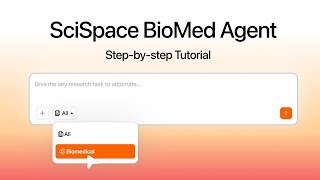
SciSpace BioMed Agent Tutorial — AI Co-Scientist for Biomedical research
SciSpace
Introducing SciSpace BioMed Agent
SciSpace

SciSpace BioMed Agent チュートリアル: AI による生物医学研究の分析
ManuAGI - AutoGPT Tutorials
YouTube returned 6 videos for “SciSpace BioMed Agent”, and we withheld 2: 2 did not mention SciSpace BioMed Agent. Showing the 4 we can prove are about SciSpace BioMed Agent.
Official links
Tools that pair well with SciSpace BioMed Agent
Common stack mates teams adopt alongside SciSpace BioMed Agent, with the specific reason each pairing earns its keep.

Recursion
Clinical-stage AI drug discovery company running a wet-and-dry lab-in-the-loop engine with 2M weekly experiments and a 50+ PB phenomics dataset

Nimbus Therapeutics
Clinical-stage biotech designing highly selective small-molecule drugs for oncology, immunology, and metabolic disease through partnership-led discovery.

Insilico Medicine
Generative AI drug discovery suite covering target ID, molecule design, biologics engineering and clinical trial prediction.
Featured Head-to-Head Comparisons
Scispace Biomed Agent vs Praktika
Praktika and SciSpace BioMed Agent serve entirely different domains—language learning vs. biomedical research—so the choice depends on your field. If you're improving spoken English or another language, Praktika's AI tutors provide real-time feedback and adaptive plans. If you're analyzing genomics data or designing drugs, SciSpace BioMed Agent's integrated tool ecosystem is unmatched. No cross-over use cases exist.
Scispace Biomed Agent vs Isomorphic Labs
Choose SciSpace BioMed Agent if you need an accessible, feature-rich AI agent for multi-omic analysis, rare disease diagnostics, and drug repurposing—especially in academic or biotech settings with limited budget. Choose Isomorphic Labs only if you are a large pharma company seeking a deep partnership for AI-driven drug design at scale, backed by AlphaFold expertise and significant funding.
Scispace Biomed Agent vs Codametrix
If you're a researcher needing genomic analysis and drug repurposing, SciSpace BioMed Agent is affordable and powerful. If you're a large health system drowning in coding costs and denials, CodaMetrix is proven ROI (30% cost reduction, 60% fewer denials) and KLAS #1. They serve completely different needs.
Alternatives to SciSpace BioMed Agent
View all
Recursion
Clinical-stage AI drug discovery company running a wet-and-dry lab-in-the-loop engine with 2M weekly experiments and a 50+ PB phenomics dataset

Nimbus Therapeutics
Clinical-stage biotech designing highly selective small-molecule drugs for oncology, immunology, and metabolic disease through partnership-led discovery.

Insilico Medicine
Generative AI drug discovery suite covering target ID, molecule design, biologics engineering and clinical trial prediction.
Frequently Asked Questions
Best-of guides
Used SciSpace BioMed Agent? Help shape our editorial sentiment research.