
Statsig
Statsig unifies experimentation, feature flags, product analytics, and session replay in one platform with warehouse-native deployment.
Statsig is the strongest unified platform for teams that need experimentation, feature flags, and analytics in one place. Its warehouse-native design, advanced stats engine, and new AI governance features outshine point solutions like Optimizely or LaunchDarkly. The free tier is generous for starting out, but the breadth can be overkill if you only need basic flags.
Verified 8d ago · liveness 87/100 · cite: rightaichoice.com/tools/statsig
- Engineering teams needing fine-grained feature flag controls
- Data scientists requiring warehouse-native experimentation
- Product managers running hundreds of A/B tests
- Data engineering teams consolidating experimentation, flags, and analytics
- Small teams needing only basic feature flags without analytics
- Non-technical users who cannot manage SDK integration
- Organizations with very low event volumes
We scan live Reddit threads, YouTube comments, X posts, G2 reviews and other communities — and hand you an honest verdict in under a minute.
- Honest verdict, not marketing
- Real pros & cons from real users
- Attributed quotes with receipts
3 free scans · no card needed
Skip Statsig if you only need basic feature flags without analytics, or if your team lacks the technical resources for SDK integration and a steep learning curve.
Beyond 5M events per month on Pro, you pay $0.05 per 1K events, which can add up quickly at high volume.
Statsig's pricing fits growing product teams that need a full stack of experimentation, flags, and analytics. The free Developer tier is generous (2M events/month, unlimited flag checks), while Pro at $150/mo is competitive against point solutions like LaunchDarkly or Optimizely, which often cost more per seat. Enterprise pricing is custom, but volume discounts apply for large organizations.
In short
Statsig — Statsig unifies experimentation, feature flags, product analytics, and session replay in one platform with warehouse-native deployment. Best for Engineering teams needing fine-grained feature flag controls, Data scientists requiring warehouse-native experimentation, Product managers running hundreds of A/B tests. Free to start; paid plans from $150/mo.
What's new in Statsig
Checked 8 days agoAcross the latest 5 updates: 2 feature updates and 3 news mentions.
Running faster tests: Modifying metrics (Part 2)
Explains how to pick and transform metrics to reduce experiment runtime, part 2 of a series.
PM roundtable: How do you prioritize experiments?
Three PMs from Statsig and Amplitude discuss how they weigh risk, impact, and statistics when choosing experiments.
August updates: Layers Targeting, Create Modals Updates, New Targeting Rules, Feature Gate User Override, PagerDuty Integration
New targeting rules, feature gate user override, and PagerDuty integration for alerts.
Statsig MCP: Heading toward headless workflows
The MCP server now supports full lifecycle management of feature gates without a browser.
Statsig + Amplitude: The drop on Phase 1
Statsig and Amplitude announce the start of Phase 1 in their partnership.
Viability Score
How well maintained and how widely used is Statsig? Built from what the vendor actually publishes (docs, changelog, tutorials, integrations, pricing), whether the site is live, and how much real users discuss it. How we calculate this
Last calculated: September 2026
How we score →Key Features
- A/B testing and multivariate experimentation
- Feature flags with gradual rollouts and targeting
- Product analytics with metrics explorer
- Session replay linked to experiments and metrics
- Web analytics for site performance
- Infra analytics with OpenTelemetry traces and logs
- Warehouse-native deployment (no ETL)
- Dynamic configs and parameter stores
- Autotune for automated parameter optimization
- Layers, holdouts, and multi-armed bandits
- Power analysis for sample size calculation
- CUPED and multiple comparison corrections
- Sequential testing and switchback tests
- AI copilot and Knowledge Graph
- MCP server for headless feature gate management
About Statsig
Statsig is a unified product development platform that combines experimentation, feature flags, product analytics, session replay, web analytics, and infrastructure analytics. It's built for engineering, data science, and product teams who want to measure the impact of every release—from standard features to AI-powered experiences—and iterate with confidence. The platform processes over 1 trillion events daily, serves 2.5 billion monthly experiment subjects, and maintains 99.99% API and console uptime, with sub-millisecond post-init evaluation latency. At the core is a sophisticated statistics engine supporting CUPED, Bonferroni correction, sequential testing, switchback tests, and more. Feature management includes dynamic configs, parameter stores, autotune, layers, holdouts, and multi-armed bandits. Product analytics offers a metrics explorer, and session replays are linked directly to experiments and flags. Warehouse-native architecture lets you run experimentation and analytics inside your own data warehouse without ETL, improving security and governance. Recent advancements include an AI copilot and Knowledge Graph, an MCP server for headless feature gate management (July 2026), and governance tools like Config Delete Permission and Experiment Reviews. In June 2026, Statsig announced Phase 1 integration with Amplitude, signaling strategic consolidation. The platform offers 30+ SDKs across languages and integrates with major CDPs, observability tools, and data warehouses. Statsig's free Developer plan (no credit card required) includes 2M events per month, unlimited flag checks, and 50,000 session replays, making it accessible for individual builders. Compared to point solutions like Optimizely, LaunchDarkly, Split, or Eppo, Statsig provides a comprehensive, end-to-end solution.
Behind the Verdict
Statsig's biggest strength is its all-in-one approach. Instead of stitching together separate tools for flags, experiments, and analytics, you get a single platform where session replays are directly tied to experiment variants and feature flags. That integration is a real time-saver and reduces the risk of data silos. The stats engine is genuinely sophisticated. You get CUPED, Bonferroni correction, sequential testing, switchback tests, and more, which lets you run reliable experiments at scale. The warehouse-native option is a standout — you can run everything inside your own Snowflake, Redshift, or BigQuery, which is a big win for security-conscious teams. On the downside, the platform is complex. Non-technical users may find the learning curve steep, and the sheer number of features can feel overwhelming if you only need basic flags. The free tier is generous, but event overage costs can add up quickly once you scale past 5M events per month on Pro. The recent Amplitude partnership and MCP server for headless workflows show Statsig is moving fast, but some integrations are still evolving. For teams that need a single, scalable platform for product development, Statsig is a strong choice. If you only need a simple flagging tool or you're a non-technical team, lighter alternatives might be a better fit.
Researching Statsig? Get your full AI stack in 60 seconds.
Free, no signup — tell us your goal and get tools matched to your budget & existing stack.
Real-world workflow fit
Concrete scenarios for the personas Statsig actually fits — and what changes day-one when you adopt it.
You've just launched a new onboarding flow and want to A/B test it against the old one. With Statsig, you create an experiment in minutes using the visual editor, define your target audience, and let CUPED reduce the required sample size. Within days, you see results with clear statistical significance, and you can drill into session replays to see how users interact with each variant.
Outcome: You ship the winning variant confidently, with robust data to back the decision.
Your team wants to run a switchback test for a marketplace feature where traditional randomization isn't feasible. You configure the switchback test in Statsig, set up the warehouse-native deployment to keep data in your own Snowflake, and use the metrics explorer to define custom metrics. The platform handles the statistical analysis, including sequential testing to prevent early peeking.
Outcome: You get reliable results without moving data out of your warehouse, and you can iterate on the feature faster.
You need to roll out a new AI-powered feature to 10% of users, then gradually increase. Using Statsig's feature flags, you set up a percentage-based rollout with automatic rollback if monitoring metrics regress. You also use the MCP server to manage the flag lifecycle headlessly from your CI/CD pipeline.
Outcome: You release safely with full control and visibility, and can quickly roll back if anything goes wrong.
Use Cases
- Run A/B tests with CUPED and multiple comparison corrections to reduce experiment duration.
- Gradually roll out features to user segments using feature flags with automatic rollback.
- Link session replays to experiment variants to understand user behavior qualitatively.
- Monitor infra health alongside product metrics using OpenTelemetry traces and logs.
- Set up automated AI safety benchmarks as part of release pipelines for AI config changes.
- Import existing experiment assignment data from a warehouse to run analysis in Warehouse Native.
- Use the Knowledge Graph to trace the impact of a code change through flags, experiments, and metrics.
- Automate benchmark testing for AI config changes and block unsafe rollouts using Release Pipelines and webhooks.
Limitations
- The freemium model charges for events beyond included volumes and limits session replays.
- Advanced features like warehouse-native deployment, SSO, and HIPAA compliance are reserved for Enterprise plans.
- The platform's breadth can be overwhelming for simple needs, and non-technical users may face a learning curve.
- Some integrations (e.g., Amplitude Phase 1) are still evolving.
as of 2026-08-30
Verification history
We have re-verified Statsig 16 times since . Each pass re-reads the vendor's own pages and re-checks every listed field against that evidence; passes where nothing had changed are marked as such.
- — re-verified summary, description, our verdict, our analysis, pricing model, pricing tiers, features, integrations, who it suits, who should skip it
- — re-verified summary, description, our verdict, our analysis, pricing model, pricing tiers, features, integrations, who it suits, who should skip it
- — re-verified summary, description, our verdict, our analysis, pricing model, pricing tiers, features, integrations, who it suits, who should skip it
- — re-verified summary, description, our verdict, our analysis, pricing model, pricing tiers, features, integrations, who it suits, who should skip it
- — re-verified summary, description, our verdict, our analysis, pricing model, pricing tiers, features, integrations, who it suits, who should skip it
- — re-verified summary, description, our verdict, our analysis, pricing model, pricing tiers, features, integrations, who it suits, who should skip it
Showing the 6 most recent of 16 verification passes.
Free to cite with attribution — this page re-verifies continuously.
12-month cost
Project the real annual outlay, including the implied monthly cost when only an annual tier is published.
Vendor list price only. Add-on usage, seat overages, and contract minimums are surfaced under Hidden costs & gotchas.
Plans compared
For each published Statsig tier: who it actually fits, and what it adds vs. the previous tier. Cross-reference the cost calculator above for projected annual outlay.
Developer
$0/mo
Ideal for
Individual builders and early-stage startups who want to experiment and ship features without upfront cost. The free tier gives you enough events and session replays to validate the platform.
What this tier adds
Free entry point with 2M events per month, unlimited flag checks, and 50,000 session replays. No credit card required.
Pro
$150/mo
Ideal for
Growing teams that need advanced analytics, unlimited retention, and API controls. The $150/mo flat rate is cost-effective for teams running serious experimentation at moderate scale.
What this tier adds
Adds advanced experimentation and analytics, unlimited retention, change reviews, and API controls. Events beyond 5M/month cost $0.05 per 1K.
Enterprise
Custom
Ideal for
Large organizations that require warehouse-native deployment, SSO, and HIPAA compliance. Custom contracts allow volume discounts and tailored agreements.
What this tier adds
Adds warehouse-native deployment, data imports, SSO/RBAC, priority support, and HIPAA-eligibility. Pricing is custom, event or experiment based.
Where the pricing makes sense
The company stage and team size where Statsig's pricing actually pencils out — and where peers do it cheaper.
Statsig's pricing fits growing product teams that need a full stack of experimentation, flags, and analytics. The free Developer tier is generous (2M events/month, unlimited flag checks), while Pro at $150/mo is competitive against point solutions like LaunchDarkly or Optimizely, which often cost more per seat. Enterprise pricing is custom, but volume discounts apply for large organizations.
Setup time & first value
How long it actually takes to get something useful out of Statsig — broken out by persona, not the marketing-page minute.
For a developer, you can get Statsig running in under an hour: sign up for the free Developer plan, install the SDK (React, Node, Python, etc.), and start flagging or running experiments. For a data science team setting up warehouse-native, allow a few days to configure connections and validate data.
Switching to or from Statsig
How to bring data in from common predecessors and how to get it back out — written for the switcher, not the buyer.
- →From LaunchDarkly: Use Statsig's feature flag SDKs and APIs to replicate your flags, then gradually migrate traffic while keeping existing rollouts.
- →From Optimizely: Import your experiment definitions and historical data into Statsig's warehouse-native or cloud console.
- →From Eppo: Use Statsig's metrics explorer and stats engine to replace Eppo's analytics, and bring your warehouse data with you.
- ↗To LaunchDarkly: Export your feature flags and configurations via the API to replicate them in LaunchDarkly.
- ↗To Optimizely: Manually recreate experiments and use the data export to move historical results.
Integrations
Resources & Guides
- Resourcedocs.statsig.com
Statsig Overview
Statsig is a unified platform for feature flags, A/B testing, and product analytics. Ship, measure, and learn with tools used by leading tech companies.
- Resourcestatsig.com
Statsig Blog | The authoritative source for data-driven insights
Statsig is your modern product development platform, with an integrated toolkit for experimentation, feature management, product analytics, session replays, and much more. Trusted by thousands of companies, from OpenAI to series A startups.
- Documentationstatsig.com
Get Started
Full product docs from statsig.com
- Resourcestatsig.com
Platform Overview
Learn what Statsig is used for and how to set it up using the Cloud or Warehouse Native deployment models, including key concepts and onboarding steps.
- Resourcestatsig.com
Integrations
Statsig is your modern product development platform, with an integrated toolkit for experimentation, feature management, product analytics, session replays, and much more. Trusted by thousands of companies, from OpenAI to series A startups.
- Resourcestatsig.com
The modern product development platform
The most affordable platform with a generous free tier. Statsig's pricing is designed to scale with your business.
- Resourcestatsig.com
Resources
Helpful link from statsig.com
- Resourcestatsig.com
Support
Helpful link from statsig.com
- Resourcestatsig.com
University
Helpful link from statsig.com
- Resourcestatsig.com
Customer Stories
Helpful link from statsig.com
Tutorials & Learning

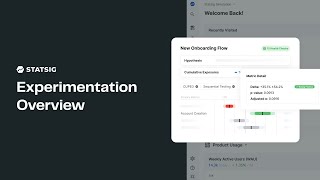
Official links
Tools that pair well with Statsig
Common stack mates teams adopt alongside Statsig, with the specific reason each pairing earns its keep.

PostHog
PostHog is an open-source product OS that unifies analytics, session replay, feature flags, and a data warehouse in one platform.

Hotjar
Digital experience analytics with heatmaps, session replay, surveys, and AI insights—now powered by Contentsquare.

Eppo
Warehouse-native A/B testing and feature flagging, now Datadog Experiments.
Alternatives to Statsig
View all

Frequently Asked Questions
Used Statsig? Help shape our editorial sentiment research.