Supabase
Supabase is the open-source Postgres development platform with auth, data APIs, edge functions, realtime, storage, and vector embeddings
Supabase is the default pick when you know you want relational data and don't want to rebuild auth, realtime, and storage from scratch. The $25/mo Pro ceiling is genuinely low for 100K monthly active users and $10 in compute credit — most startups will never outgrow it. Just budget deliberately: compute, disk, egress, and log drains stack on top of the plan fee, and SOC2/ISO 27001 sits behind the $599/mo Team plan.
Verified 8d ago · liveness 97/100 · cite: rightaichoice.com/tools/supabase
- Startups that need auth, Postgres, realtime, and storage live before their first users arrive
- Development teams that want SQL and a portable database they can self-host or exit with
- AI apps storing and querying vector embeddings alongside relational data
- Solo founders and indie hackers going from idea to deployed product in a weekend
- Air-gapped or strict on-premise deployments — self-hosting means you own backups, upgrades, and uptime
- Document-store workloads where flexible, schema-less writes matter more than relational integrity
- Startups that need SOC2, ISO 27001, HIPAA, or SSO before paying for the $599/mo Team plan
We scan live Reddit threads, YouTube comments, X posts, G2 reviews and other communities — and hand you an honest verdict in under a minute.
- Honest verdict, not marketing
- Real pros & cons from real users
- Attributed quotes with receipts
3 free scans · no card needed
Skip Supabase if you need a non-relational database, require strict on-premise or air-gapped deployment, or need guaranteed single-tenant infrastructure at low scale; if you're deeply locked into AWS/GCP native services, you might find it redundant.
Going past 100,000 monthly active users on Pro adds $0.00325 per MAU, which can accumulate in high-traffic apps.
Supabase's freemium model is a great fit for startups and indie hackers; the Free tier is generous for prototyping, and Pro at $25/mo plus $10 compute credit beats many alternatives like Firebase's Blaze plan for Postgres users. For enterprise needs, Team at $599/mo and Enterprise are pricier than some competitors, but you get SOC2, SSO, and SLAs.
In short
Supabase — Supabase is the open-source Postgres development platform with auth, data APIs, edge functions, realtime, storage, and vector embeddings. Best for Startups that need auth, Postgres, realtime, and storage live before their first users arrive, Development teams that want SQL and a portable database they can self-host or exit with, AI apps storing and querying vector embeddings alongside relational data. Free to start; paid plans from $25/mo.
What's new in Supabase
Checked 6 days agoAcross the latest 10 updates: 6 feature updates, 3 launches and 1 changelog entry.
Database Replication is now Pipelines
Replication renamed to Pipelines and moved to Database > Pipelines in the Dashboard. Read replicas now live in Project Settings > Infrastructure; old URLs redirect.
Studio Health Check Advisors
Advisors now monitor service health, starting with per-service error rate checks for PostgREST, Auth, Storage and Edge Functions. Available in Studio Health tab and Management API.
Observability on Auto-Pilot
Supabase shipped agent tooling for monitoring, including a 'Hire an agent' guide with four defined roles and prepared prompts for Claude and Codex.
Supabase is now available in Gemini Enterprise
Supabase connects to Gemini Enterprise, letting users query Supabase projects with natural language inside the platform.
Enterprise-managed auth for the Supabase MCP server
The Supabase MCP server adds enterprise-managed authentication for organization-level access control.
Connect client traces to your logs
Client traces can now be joined to Supabase logs for end-to-end debugging across frontend and backend.
Supabase is now a connector on Perplexity Computer
Supabase is available as a connector on Perplexity Computer, enabling project queries through the Perplexity platform.
Postgres Changes gets AND filters, new operators, and column selection
Realtime Postgres Changes adds AND filters, additional filter operators, and column selection to reduce payload size.
Introducing Supabase Evals
Supabase Evals launched for testing and scoring AI-generated database and backend workflows.
Sign in with ChatGPT is in beta on Supabase
Supabase Auth adds beta support for Sign in with ChatGPT as an authentication provider.
Viability Score
How well maintained and how widely used is Supabase? Built from what the vendor actually publishes (docs, changelog, tutorials, integrations, pricing), whether the site is live, and how much real users discuss it. How we calculate this
Last calculated: September 2026
How we score →Key Features
- Dedicated Postgres database for every project
- Authentication with Row Level Security policies
- Instant REST APIs via PostgREST
- GraphQL API support
- Realtime data sync over WebSockets
- Edge Functions serverless deployment
- File Storage with on-the-fly transformations
- Vector embeddings via OpenAI and Hugging Face
- Table Editor and SQL Editor in the dashboard
- MCP server with Okta enterprise-managed auth
- Unified Logs (open beta) with ClickHouse-backed endpoint
- Supabase Pipelines streaming Postgres changes to BigQuery (public alpha)
- One-click Grafana Cloud dashboards and alerting on all plans
- Sign in with ChatGPT (beta)
- Read replicas under Project Settings to Infrastructure
About Supabase
Supabase gives you a full Postgres database per project and wraps it with the services most apps need on day one: Authentication with Row Level Security, instant REST data APIs, Realtime sync, Edge Functions, File Storage, and vector embeddings for AI workloads. It's aimed at developers who want a production backend without running servers — solo builders shipping a weekend MVP, startups scaling to 100,000+ monthly active users, and platform teams that want SQL rather than a proprietary query layer. Day-to-day work happens in the dashboard: a Table Editor for CRUD, a SQL Editor for direct queries, and RLS Policies for access rules. Compute scales from a shared 1 GB Micro instance up to 64 vCPUs / 256 GB RAM, and advanced disk configs reach 60 TB with 80,000 IOPS on High Performance storage. Production templates (Stripe Subscriptions, Next.js, LangChain, Flutter, Expo) cover the boring setup work. Recent releases lean toward observability and interoperability. A one-click Grafana Cloud integration ships pre-built dashboards and alerting on every plan, including Free. Supabase Pipelines streams Postgres changes to BigQuery in near real time (public alpha), Unified Logs is in open beta, and the Management API's logs.all endpoint is removed on 2026-09-23 as logs move to a ClickHouse-backed endpoint. The MCP server now supports enterprise-managed auth via Okta, and Sign in with ChatGPT is in beta. Against Firebase you trade NoSQL convenience for a portable Postgres core, SQL, and an open-source escape hatch. Against AWS RDS or GCP, you trade granular infrastructure control for not having to assemble auth, APIs, storage, and realtime yourself.
Behind the Verdict
Pick Supabase when the shape of your data is relational and you'd rather write SQL than fight a proprietary query API. We'd reach for it on greenfield products where auth, row-level security, realtime subscriptions, and file storage all need to exist before you have users — that's a week of work you skip. The AI angle is real, not marketing. Vector embeddings pair with OpenAI and Hugging Face, and the MCP server lets Claude Code or Cursor inspect your live schema and draft migrations and RLS policies. Community threads consistently flag the Advisors and security/performance linters as the reason they trust what they shipped — those catch bad RLS before it becomes an incident. Where it bites: pricing is layered. The plan fee is the floor, not the bill. Compute runs from $10/mo for Micro to $3,730/mo for 16XL, disk over 8 GB is $0.125/GB on General Purpose, and each Log Drain adds $60 per project per month. Scale compute without watching those lines and a $25 invoice becomes a $400 one. Compliance is the other gating item. SOC2 Type 2, ISO 27001, HIPAA as a paid add-on, SSO, and project-scoped read-only access all arrive with Team at $599/mo. Companies that need those controls before their first customer simply pay 24x the Pro rate, and there's no middle tier. Pass if you need a document store — Postgres will fight you on schema-less writes. Pass if you're air-gapped or need single-tenant infrastructure at low scale; self-hosting exists but you own the operations, backups, and upgrades. And if your team is already deep in AWS RDS, IAM, and Cognito, the abstraction may cost more than it saves. Closest alternative is Firebase: easier for non-SQL teams, harder to leave. If you want SQL portability, Supabase is the safer long-term bet. Watch the 2026-09-23 removal of
Researching Supabase? Get your full AI stack in 60 seconds.
Free, no signup — tell us your goal and get tools matched to your budget & existing stack.
Real-world workflow fit
Concrete scenarios for the personas Supabase actually fits — and what changes day-one when you adopt it.
You need a database, auth, and hosting without managing servers.
Outcome: Start a Supabase project, set up auth with email/password, create tables in the Table Editor, and deploy an Edge Function—all within an hour. You can then use the REST API to connect your frontend.
You're on Pro and need to monitor usage and handle log analytics.
Outcome: Enable the Grafana Cloud integration to get pre-built dashboards and alerts. Use Unified Logs to consolidate logs, and set up Pipelines to stream Postgres changes to BigQuery for analytics.
You need SSO, SOC2, and HIPAA for your app.
Outcome: Upgrade to Team plan for SSO, SOC2/ISO 27001, and access to HIPAA add-on. Use the Management API and AWS PrivateLink (Enterprise) for secure networking.
Use Cases
- Build a real-time chat app with Auth and Realtime subscriptions
- Create a SaaS product with user sign-ups and row-level security
- Host and serve user-uploaded images with on-the-fly transformations
- Add vector search to an AI application using pgvector
- Develop a serverless API using Edge Functions and Postgres
- Migrate a Firebase app to an open-source Postgres stack
- Stream Postgres changes to BigQuery for analytics pipelines
- Monitor production apps with Grafana Cloud dashboards and alerts
Models Under the Hood
as of 2026-09-22
Limitations
- Free projects are paused after 1 week of inactivity and there is a limit of 2 active projects.
- Log retention is limited: 7 days on Pro and 28 days on Team; Team pricing starts at $599/month.
- Usage beyond plan limits incurs metered charges (e.g. $0.00325 per MAU past 100K, $0.125 per GB disk over 8 GB on Pro), and Log Drains cost an additional $60 per drain, per project.
- The Management API logs.all endpoint is deprecated and must be migrated to the new ClickHouse-backed logs endpoint.
as of 2026-08-30
Verification history
We have re-verified Supabase 19 times since . Each pass re-reads the vendor's own pages and re-checks every listed field against that evidence; passes where nothing had changed are marked as such.
- — re-verified summary, description, our verdict, our analysis, pricing model, pricing tiers, features, integrations, who it suits, who should skip it, GitHub stars
- — re-verified summary, description, our verdict, our analysis, pricing model, pricing tiers, features, integrations, who it suits, who should skip it, GitHub stars
- — re-verified summary, description, our verdict, our analysis, pricing model, pricing tiers, features, integrations, who it suits, who should skip it, GitHub stars
- — re-verified summary, description, our verdict, our analysis, pricing model, pricing tiers, features, integrations, who it suits, who should skip it, GitHub stars
- — re-verified summary, description, our verdict, our analysis, pricing model, pricing tiers, features, integrations, who it suits, who should skip it, GitHub stars
- — re-verified summary, description, our verdict, our analysis, pricing model, pricing tiers, features, integrations, who it suits, who should skip it, GitHub stars
Showing the 6 most recent of 19 verification passes.
Free to cite with attribution — this page re-verifies continuously.
12-month cost
Project the real annual outlay, including the implied monthly cost when only an annual tier is published.
Vendor list price only. Add-on usage, seat overages, and contract minimums are surfaced under Hidden costs & gotchas.
Plans compared
For each published Supabase tier: who it actually fits, and what it adds vs. the previous tier. Cross-reference the cost calculator above for projected annual outlay.
Free
$0/mo
Ideal for
Passion projects and simple websites where you can tolerate pauses after a week of inactivity and a 2-project limit.
What this tier adds
Free entry point with unlimited API requests, 50k MAU, 500 MB database, and 1 GB storage.
Pro
From $25/mo
Ideal for
Production apps with scaling needs; includes first project, email support, and daily backups.
What this tier adds
Adds 100k MAU, 8 GB disk, 250 GB egress, 100 GB storage, email support, and 7-day log retention vs Free.
Team
From $599/mo
Ideal for
Teams needing SSO, SOC2/ISO 27001, and control over backups; includes priority support and SLAs.
What this tier adds
Adds SOC2/ISO 27001, SSO, HIPAA add-on, 14-day backups, 28-day logs, and priority support vs Pro.
Enterprise
Custom
Ideal for
Large organizations with strict compliance, uptime SLAs, and dedicated support; custom pricing.
What this tier adds
Adds designated support manager, uptime SLAs, AWS PrivateLink, 24x7 support, and private Slack channel vs Team.
Where the pricing makes sense
The company stage and team size where Supabase's pricing actually pencils out — and where peers do it cheaper.
Supabase's freemium model is a great fit for startups and indie hackers; the Free tier is generous for prototyping, and Pro at $25/mo plus $10 compute credit beats many alternatives like Firebase's Blaze plan for Postgres users. For enterprise needs, Team at $599/mo and Enterprise are pricier than some competitors, but you get SOC2, SSO, and SLAs.
Setup time & first value
How long it actually takes to get something useful out of Supabase — broken out by persona, not the marketing-page minute.
For an indie hacker, you can be up and running with a Postgres database, auth, and a REST API in under 30 minutes. For a startup team, expect 1-2 hours to integrate client libraries and set up Edge Functions. For enterprise, plan a few days for SSO, compliance reviews, and networking.
Switching to or from Supabase
How to bring data in from common predecessors and how to get it back out — written for the switcher, not the buyer.
- →From Firebase: Use the migration guides to transfer Firestore data to Postgres and set up Auth with Supabase.
- →From MongoDB: Use Wrappers to create a foreign data wrapper for MongoDB, or migrate data via ETL tools.
- →From Heroku Postgres: Use pg_dump and pg_restore to move your data.
- →From Vercel Postgres: Connect your existing Postgres instance or migrate using standard PostgreSQL tools.
- ↗To AWS RDS: Export your Postgres data and set up a new RDS instance, then point your app to it.
- ↗To Railway or Render: Use Postgres-compatible hosting and migrate data with pg_dump.
- ↗To Firebase: Migrate data to Firestore via ETL, but note the loss of SQL and realtime features.
Integrations
Resources & Guides
- Documentationsupabase.com
Supabase Docs
Supabase is the Postgres development platform providing all the backend features you need to build a product.
- Quickstartsupabase.com
Getting Started
Resources for getting started with Supabase.
- Guidesupabase.com
Database
Use Supabase to manage your data.
- Guidesupabase.com
Auth
Use Supabase to Authenticate and Authorize your users.
- Guidesupabase.com
Storage
Use Supabase to store and serve files.
- Guidesupabase.com
Realtime
Send and receive messages to connected clients.
- Guidesupabase.com
Edge Functions
Globally distributed TypeScript functions.
- Guidesupabase.com
AI & Vectors
The best vector database is the database you already have.
Tutorials & Learning
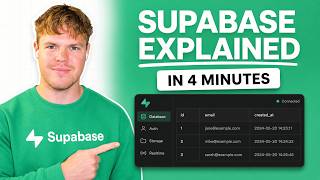
YouTube returned 6 videos for “Supabase”, and we withheld 5: 5 could not be judged, because “Supabase” is a single word that other videos use for other things. Showing the 1 we can prove is about Supabase.
Tools that pair well with Supabase
Common stack mates teams adopt alongside Supabase, with the specific reason each pairing earns its keep.

Alternatives to Supabase
View all
Popular in Developer Infrastructure

Temporal AI
Temporal is the durable execution platform for AI agents and long-running workflows that survive crashes, retries, and abandoned sessions.

Frequently Asked Questions
Categories
Best-of guides
Topics
Used Supabase? Help shape our editorial sentiment research.