
SWE Smith
Auto-generate 100s-1000s of SWE task instances from any GitHub repo in ~10 minutes
SWE-smith is essential if you need custom training data for software engineering agents and have the CLI and Docker skills to run it. The 50k+ pre-generated instances and trained 32B model give immediate value, but the Python-only support and self-hosted setup are real barriers. For teams that fit the profile, it's near-essential; for everyone else, it's a pass.
Verified 5d ago · liveness 69/100 · cite: rightaichoice.com/tools/swe-smith
- Researchers building SWE agents who need custom training data
- Teams fine-tuning open-source LMs for code repair or generation
- Developers working on domain-specific bug detection and automated patching
- Anyone needing a large dataset of task instances for benchmarking or training
- Users seeking a ready-to-use software engineering agent
- Non-technical users without command-line and Docker experience
- Projects requiring non-Python repositories (currently Python-only)
We scan live Reddit threads, YouTube comments, X posts, G2 reviews and other communities — and hand you an honest verdict in under a minute.
- Honest verdict, not marketing
- Real pros & cons from real users
- Attributed quotes with receipts
3 free scans · no card needed
Skip SWE-smith if you're not comfortable with Docker, Git, and the command line, or if you need training data from non-Python repos—it's a self-hosted, Python-only research tool, not a turnkey agent.
SWE-smith is completely free and open-source (MIT), making it a zero-cost alternative to expensive data-generation services. For researchers and teams that can handle Docker and the CLI, the price is unbeatable—you only pay with your time setting up environments.
In short
SWE Smith — Auto-generate 100s-1000s of SWE task instances from any GitHub repo in ~10 minutes. Best for Researchers building SWE agents who need custom training data, Teams fine-tuning open-source LMs for code repair or generation, Developers working on domain-specific bug detection and automated patching. Free to use.
What's new in SWE Smith
Checked 17 days agoAcross the latest 1 update: 1 launch.
What people actually say about SWE Smith — is it worth it?
We ran a structured research pass across product reviews, community discussions, and post-purchase forum threads to surface the patterns vendors won't publish themselves. Below: the recurring strengths, the hidden costs people mention most, and the cohort that consistently regrets adopting this tool.
18 mentions across 3 sources (Hacker News, GitHub, Lemmy) · researched Jul 30, 2026.
Average across the 3 sources that answered — each source counts once, not each post.
- +Generates hundreds of task instances from any GitHub repo in ~10 minutes.
- +Includes automatic dependency resolution and environment creation per commit.
- +Built-in validation and difficulty rating for generated instances.
- +Pre-generated dataset of 50k+ instances across 128 popular Python repos.
- +SWE-agent-LM-32B model achieves 40% pass@1 on SWE-bench Verified.
- −Initial setup is complex and time-consuming, especially for beginners.
- −Currently only supports Python repositories out of the box.
- −No official support or documentation; relies on GitHub issues.
- −Generated instance quality depends on repository test coverage.
- −Limited community feedback outside academic circles and GitHub.
- • Compute costs for running the generation pipeline (cloud/GPU)
- • Storage for generated instances and environments
Viability Score
How well maintained and how widely used is SWE Smith? Built from what the vendor actually publishes (docs, changelog, tutorials, integrations, pricing), whether the site is live, and how much real users discuss it. How we calculate this
Last calculated: September 2026
How we score →Key Features
- Automated task instance generation from GitHub repos
- Dependency resolution and environment creation per commit
- Built-in validation and difficulty rating
- Train custom LMs with SFT or GRPO
- 50k+ pre-generated instances included
- 128 popular Python repositories covered
- SWE-agent-LM-32B model (40% pass@1 on SWE-bench Verified)
- Mini-SWE-Agent integration (65% pass@1)
- Command-line interface
- Docker-based environment management
- MIT open-source codebase
- Supports Python repositories only
- Tutorials for building environments and training agents
About SWE Smith
SWE-smith is an open-source framework that turns any GitHub repository into a pipeline of task instances for training software engineering agents. Built by researchers from Stanford, Princeton, and Alibaba Qwen, it replaces weeks of manual data curation with an automated process that, after setup, produces hundreds to thousands of instances in about 10 minutes. The full pipeline handles dependency resolution, environment creation, instance generation, validation, difficulty rating, and language model training, so you can go from raw code to a fine-tuned agent without leaving the command line. You also get instant access to a dataset of more than 50,000 pre-generated task instances spanning 128 popular Python repositories, which means you can start training or benchmarking immediately even if you never run the pipeline yourself. The project ships with SWE-agent-LM-32B, a model that reaches 40% pass@1 on SWE-bench Verified, and integrates with Mini-SWE-Agent, a 100-line agent that hits 65% pass@1. Everything is MIT-licensed and free, a deliberate contrast to the typical cost of proprietary training data. SWE-smith is not a ready-to-use agent. It's the data-generation layer that powers better agents. It's aimed at researchers and developers comfortable with Docker and command-line tools, and it currently supports only Python repositories, with non-Python expansion explicitly on the roadmap. If you're fine-tuning open-source language models for code repair or need a large, domain-specific dataset for benchmarking, SWE-smith does in minutes what used to take weeks. Compared to fixed benchmarks like SWE-bench, SWE-smith gives you the flexibility to generate custom instances from your own repositories, making it a strong fit for teams building specialized agents. It's free, open source, and backed by a 50k+ instance dataset, but it demands technical skill and a Python-only scope. If you want a working agent out of the box, look to SWE-agent instead.
Behind the Verdict
Let's be blunt: generating high-quality training data for software engineering agents is a slog. SWE-smith automates that slog, and it does so for free. The pipeline is genuinely comprehensive, from dependency resolution and environment creation to validation, difficulty rating, and even LM training with SFT or GRPO. If you've ever spent days hand-curating bug reports, this tool is a relief. When should you pick SWE-smith? If you're a researcher fine-tuning open-source models for code repair, this is almost a no-brainer — though we avoid that phrase. The included 50k+ instance dataset across 128 Python repos gives you immediate material, and the trained SWE-agent-LM-32B at 40% pass@1 on SWE-bench Verified is a solid baseline. Teams working on domain-specific bug detection will also find the custom generation capability a differentiator. But there are real caveats. The tool is Python-only. If your stack is JavaScript, Go, or anything else, you're out of luck until the promised non-Python expansion lands. Also, it's not a managed service. You'll need Docker, a command line, and comfort debugging environment setup. Non-technical users need not apply. Where does SWE-smith sit against alternatives? SWE-bench gives you a fixed, static dataset; SWE-smith lets you generate your own from any repo, making it more flexible for custom benchmarks. But it doesn't give you a ready-to-use agent — that's SWE-agent's job. Mini-SWE-Agent, with its 65% pass@1, is a separate integrated project, not something SWE-smith replaces. In practice, the biggest pain point will be setup. Even with the 10-minute claim, you'll likely spend longer getting Docker and dependencies sorted on your first run. Also, because it's open source and research-focused, expect rough edges in documentation and
Researching SWE Smith? Get your full AI stack in 60 seconds.
Free, no signup — tell us your goal and get tools matched to your budget & existing stack.
Real-world workflow fit
Concrete scenarios for the personas SWE Smith actually fits — and what changes day-one when you adopt it.
Wants to fine-tune a SWE-agent on a custom domain-specific Python codebase but spends weeks manually curating bug-fix tasks.
Outcome: With SWE-smith, within 10 minutes after setup, they generate 500 task instances from their repo, complete with environments and validation, then train their model using the built-in LM training pipeline.
Needs a large, diverse dataset to benchmark their in-house agent against SWE-bench but wants to ensure it's not overfit to the public benchmark.
Outcome: They use SWE-smith to generate custom instances from 10 internal repos, run validation and difficulty rating, and use the 50k+ pre-generated dataset as a supplement to create a robust evaluation suite.
Wants to create a repository-specific test suite for bug-fixing bots that contribute to their project.
Outcome: They run SWE-smith against their repo, filter instances by difficulty, and use the generated environments to automatically verify patches from bots, streamlining the contribution queue.
Use Cases
- Generate custom training instances for a private Python repository to fine-tune a SWE-agent
- Pre-train an agent on difficulty-rated bug-fixing tasks to improve patch correctness
- Create a dataset of supervised fine-tuning examples from open-source Python projects for academic research
- Evaluate a new SWE-agent architecture against a set of generated instances
- Build a repository-specific validation pipeline for agent-based code repair systems
Models Under the Hood
as of 2026-09-14
Limitations
- SWE-smith primarily targets Python repositories, with expansion to non-Python repositories listed as a future direction.
- The tool relies on Docker-based environment creation, which may fail for complex or outdated dependency chains.
- It assumes familiarity with Git, Docker, and command-line workflows, making it suitable for advanced users.
as of 2026-08-28
Verification history
We have re-verified SWE Smith 5 times since . Each pass re-reads the vendor's own pages and re-checks every listed field against that evidence; passes where nothing had changed are marked as such.
- — re-verified summary, description, our verdict, our analysis, pricing model, pricing tiers, features, integrations, who it suits, who should skip it
- — re-verified summary, description, our verdict, our analysis, pricing model, pricing tiers, features, integrations, who it suits, who should skip it
- — re-verified summary, description, our verdict, our analysis, pricing model, pricing tiers, features, integrations, who it suits, who should skip it
- — re-verified summary, description, our verdict, our analysis, pricing model, pricing tiers, features, integrations, who it suits, who should skip it
- — re-verified summary, description, our verdict, our analysis, pricing model, pricing tiers, features, integrations, who it suits, who should skip it
Free to cite with attribution — this page re-verifies continuously.
12-month cost
Project the real annual outlay, including the implied monthly cost when only an annual tier is published.
Vendor list price only. Add-on usage, seat overages, and contract minimums are surfaced under Hidden costs & gotchas.
Plans compared
For each published SWE Smith tier: who it actually fits, and what it adds vs. the previous tier. Cross-reference the cost calculator above for projected annual outlay.
Open Source
$0
Ideal for
Researchers and developers who need custom SWE training data and are comfortable with Docker and CLI; no cost and full source access.
What this tier adds
Starting tier: MIT-licensed, free, includes all features and the 50k+ instance dataset.
Where the pricing makes sense
The company stage and team size where SWE Smith's pricing actually pencils out — and where peers do it cheaper.
SWE-smith is completely free and open-source (MIT), making it a zero-cost alternative to expensive data-generation services. For researchers and teams that can handle Docker and the CLI, the price is unbeatable—you only pay with your time setting up environments.
Setup time & first value
How long it actually takes to get something useful out of SWE Smith — broken out by persona, not the marketing-page minute.
For a research engineer comfortable with Docker and Git, expect to install dependencies and download assets in 30 minutes, then generate the first batch of instances within 10 minutes after setup. A non-expert may need half a day to get everything running.
Integrations
Resources & Guides
Tutorials & Learning
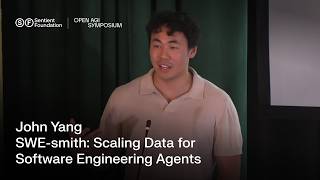
YouTube returned 6 videos for “SWE Smith”, and we withheld 5: 5 did not mention SWE Smith. Showing the 1 we can prove is about SWE Smith.
Official links
Tools that pair well with SWE Smith
Common stack mates teams adopt alongside SWE Smith, with the specific reason each pairing earns its keep.



Featured Head-to-Head Comparisons
Swe Smith vs Presto Voice
If you're a QSR chain looking to boost drive-thru revenue and efficiency, Presto Voice is the turnkey enterprise solution with proven upselling and high non-intervention rates. If you're a researcher or developer building software engineering agents and need custom training data, SWE Smith is a free, open-source framework that automates dataset generation. These tools serve entirely different markets, so your choice depends entirely on whether you're optimizing fast-food operations or advancing AI for code repair.
Swe Smith vs Locus Robotics
If you run a warehouse and need to handle variable order volumes with proven AMRs, Locus Robotics is a solid operational pick despite its contact-based pricing. If you're building an AI agent that writes code and need custom training data without paying per task, SWE-smith's free, fast framework is unbeatable. Choose Locus for physical fulfillment automation; choose SWE-smith for software engineering agent research.
Swe Smith vs Truleo
These tools serve completely different domains: Truleo is a paid law enforcement intelligence platform for detectives and command staff, while SWE-smith is a free open-source framework for researchers generating SWE task instances. Choose based on your sector—public safety or software engineering R&D.
Alternatives to SWE Smith
View all
Open Interpreter
Open Interpreter runs natural-language commands on your computer from the terminal

Outlier AI
Freelance platform where experts train AI models and earn weekly pay

AfterQuery
Expert-curated reasoning data that trains frontier models to think like specialists.
Frequently Asked Questions
Used SWE Smith? Help shape our editorial sentiment research.