
Temp Mail
Temp Mail generates instant disposable email addresses so you can receive mail without exposing your real inbox.
Temp Mail is the shortest path from "this site wants an email" to "here is an address" — load the page, and the inbox is already there with copy, refresh, change, and delete controls on one row. The vendor's own copy describes addresses as self-destructing, and the inbox is receive-only, so don't treat it as a mailbox you'll live in. The mobile apps and the companion Temp Number service for SMS OTP codes are what separate it from bare web rivals like 10 Minute Mail; Guerrilla Mail and Mailinator remain the better picks when you need sending or developer-oriented tooling. If your only job is grabbing a verification link, Temp Mail does it with the least friction of anything in the category.
Verified 3d ago · liveness 60/100 · cite: rightaichoice.com/tools/temp-mail
- Anyone who needs a one-time receiving address in seconds
- Shoppers claiming a trial or gated download without joining a mailing list
- Mobile users who want the same tool as an iOS or Android app
- Anyone who needs an SMS OTP code received via the linked Temp Number service
- Anyone who needs to send email from the address
- Long-term or professional correspondence that must survive past the expiry window
- Services that block known disposable-email domains
We scan live Reddit threads, YouTube comments, X posts, G2 reviews and other communities — and hand you an honest verdict in under a minute.
- Honest verdict, not marketing
- Real pros & cons from real users
- Attributed quotes with receipts
3 free scans · no card needed
Skip Temp Mail if you need to send or reply from the address, keep the mailbox beyond its self-destruct window, or sign up to a service that screens for known disposable-email domains.
The free inbox is ad-supported, so expect advertising alongside your mail unless you move to the Premium option linked on the homepage.
Temp Mail's free tier costs nothing, which puts it on the cheapest end of the disposable-inbox category. The homepage links a Premium tier, but the plans page was not reachable this run, so we can't compare its price against paid alternatives like Mailinator's paid plans. For pure throwaway receiving, the free tier is what most buyers will use.
In short
Temp Mail — Temp Mail generates instant disposable email addresses so you can receive mail without exposing your real inbox. Best for Anyone who needs a one-time receiving address in seconds, Shoppers claiming a trial or gated download without joining a mailing list, Mobile users who want the same tool as an iOS or Android app. Free to use.
What people actually say about Temp Mail — is it worth it?
We ran a structured research pass across product reviews, community discussions, and post-purchase forum threads to surface the patterns vendors won't publish themselves. Below: the recurring strengths, the hidden costs people mention most, and the cohort that consistently regrets adopting this tool.
81 mentions across 5 sources (Hacker News, YouTube, Product Hunt, App Store, Lemmy) · researched Sep 24, 2026.
Weighted by the 87 posts each of 5 sources contributed.
- +One-click address generation with no registration or personal details required
- +Free tier actually works for quick signups, downloads, and one-off coupons
- +Web plus iOS and Android apps cover the common use cases
- +Reviews consistently call it easy to use and less ad-heavy than rivals
- +Receives attachments and images, not just plain text
- −A growing number of sites detect and block disposable addresses outright
- −Free addresses vanish after one hour — too short for slower workflows
- −App Store complaints about continued charges after a cancelled trial
- −Some users get stuck behind error or 'too many requests' pop-ups
- −Cannot send mail, so it's receive-only by design
- • Premium price is not published, so you must contact sales to learn the cost
- • An App Store reviewer reports still being charged after cancelling a free trial via Apple
- • Time lost to blocked domains and locked-out app sessions acts as a hidden friction cost
Viability Score
How well maintained and how widely used is Temp Mail? Built from what the vendor actually publishes (docs, changelog, tutorials, integrations, pricing), whether the site is live, and how much real users discuss it. How we calculate this
Last calculated: October 2026
How we score →Key Features
- Instant temporary email address generated on page load
- No registration or personal details required
- Receive incoming mail with attachments and images
- Copy the temporary address to clipboard in one click
- Manual Refresh control to check for new mail
- Change to a different temporary address instantly
- Delete the temporary inbox on demand
- Self-destructing addresses that expire after a period
- Inbox view showing sender, subject and a view action
- Native iOS app
- Native Android app
- Companion Temp Number service for receiving SMS OTP codes
- Premium tier offered on the site (contents not published on reachable pages)
About Temp Mail
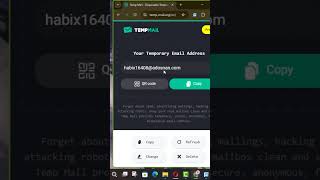
Temp Mail is a free disposable email service that creates a random temporary address the moment you load the page. You get an inbox immediately — no registration, no personal details, no commitment. The site describes the address as self-destructing after a period, and the copy frames the whole point as keeping your real mailbox free of spam, promotional mailings, and database-breach exposure. The inbox receives incoming mail with attachments and images and gives you four controls: copy the address, refresh to check for new mail, change to a different address, and delete the inbox. Alongside the web inbox, the site links native iOS and Android apps and a companion Temp Number tool for receiving SMS OTP codes. Temp Mail positions itself as a receiving-only utility: you cannot send from the address, and the vendor's own pages treat the address as short-lived. The homepage also carries a Premium link, but because the plans page was not reachable this run, no tier pricing appears here. Compared with 10 Minute Mail, its differentiators are the mobile apps and the linked SMS-number service; compared with Mailinator or Guerrilla Mail, it is a simpler consumer-facing tool rather than a developer platform. It sits in the same category as tempmail, throwaway email, fake-mail, burner mail, and trash-mail services the vendor lists on its own page.
Behind the Verdict
Temp Mail is a single-purpose utility, and it is honest about that. The homepage delivers exactly what it promises: a temporary address generated on load, an empty inbox ready for incoming mail, and four buttons — Copy, Refresh, Change, Delete — that cover the entire lifecycle of a throwaway address. There is no dashboard to learn, no onboarding sequence, no account to create. For the specific job of receiving a verification link or a one-time code without handing over your real address, that simplicity is the feature. What it receives: the inbox renders sender, subject, and a view action, and the vendor's pages state that attachments and images come through. That matters more than it sounds — plenty of throwaway inboxes choke on anything beyond plain text, and a confirmation email with an inline logo or a PDF receipt is common. What it doesn't do: the vendor describes addresses as self-destructing after a set time, so nothing here is durable. It is receive-only — you cannot reply or send. The service is built for consumer friction-removal, not for developer pipelines; Mailinator and Guerrilla Mail cover that ground better. And the whole category shares one structural risk: sites that maintain blocklists of known disposable-email domains will reject the address, and delivery from every sender is not guaranteed. The mobile apps and the linked Temp Number service for SMS OTP codes are the clearest differentiators against browser-only rivals like 10 Minute Mail. The homepage also links a Premium tier, but the plans page was not reachable during this run, so we cannot describe its contents or cost here. Where it fits: one-off signups, gated downloads, trial claims, clicking a confirmation link, and testing your own app's sign-up flow with dummy addresses. Where it doesn't: anything you need to keep, anything you need to send from, anything confidential, and any service that screens for disposable domains.
Researching Temp Mail? Get your full AI stack in 60 seconds.
Free, no signup — tell us your goal and get tools matched to your budget & existing stack.
Real-world workflow fit
Concrete scenarios for the personas Temp Mail actually fits — and what changes day-one when you adopt it.
You land on a streaming or SaaS trial page that demands an email before it will let you in. You open Temp Mail in a second tab, copy the address the page hands you, paste it into the signup form, and hit Refresh in the Temp Mail inbox until the confirmation mail arrives.
Outcome: You are inside the trial without your real address joining the vendor's marketing list, and the address self-destructs on its own afterwards.
You have just finished a registration form and want to verify the confirmation-email path end to end. You generate a Temp Mail address, submit it through your own form, and watch the inbox for the activation link.
Outcome: You confirm the verification email renders correctly and the link works, without standing up a mail server or hiring testers.
A service asks for a phone number, not an email. You open the companion Temp Number tool the site links, receive the SMS OTP code there, and use it to finish the registration — keeping your own number out of the form.
Outcome: Registration completes without your personal phone number being handed to the service.
Use Cases
- Sign up for a free trial without exposing your real email address.
- Register on a forum, blog, or Wi-Fi portal that gates content behind an email field.
- Download gated content without joining the vendor's mailing list.
- Test your own app's email verification flow with disposable addresses.
- Collect a one-time OTP code through the linked Temp Number service when a site asks for a phone number.
- Avoid promotional mail after a store loyalty or contest sign-up.
- Create a second account on a service that needs a different address from your default.
Limitations
- Temp Mail is receive-only — there is no way to send or reply from the address.
- The vendor's own copy describes addresses as self-destructing after a set time, so nothing you receive should be treated as durable.
- Delivery reliability from every sender is not guaranteed, and services that maintain blocklists of known disposable-email domains will reject the address outright.
- The homepage links a Premium tier, but the plans page was not reachable during this run, so nothing about its contents or cost is stated here.
as of 2026-10-05
Verification history
We have re-verified Temp Mail 9 times since . Each pass re-reads the vendor's own pages and re-checks every listed field against that evidence; passes where nothing had changed are marked as such.
- — re-verified summary, description, our verdict, our analysis, pricing model, pricing tiers, features, integrations, who it suits, who should skip it
- — re-checked, vendor evidence unchanged
- — re-checked, vendor evidence unchanged
- — re-checked, vendor evidence unchanged
- — re-checked, vendor evidence unchanged
- — re-checked, vendor evidence unchanged
Showing the 6 most recent of 9 verification passes.
Free to cite with attribution — this page re-verifies continuously.
12-month cost
Project the real annual outlay, including the implied monthly cost when only an annual tier is published.
Vendor list price only. Add-on usage, seat overages, and contract minimums are surfaced under Hidden costs & gotchas.
Where the pricing makes sense
The company stage and team size where Temp Mail's pricing actually pencils out — and where peers do it cheaper.
Temp Mail's free tier costs nothing, which puts it on the cheapest end of the disposable-inbox category. The homepage links a Premium tier, but the plans page was not reachable this run, so we can't compare its price against paid alternatives like Mailinator's paid plans. For pure throwaway receiving, the free tier is what most buyers will use.
Setup time & first value
How long it actually takes to get something useful out of Temp Mail — broken out by persona, not the marketing-page minute.
Essentially zero. The address is generated the moment the Temp Mail page loads — you copy it, paste it into the form, and wait for the mail. Mobile users can install the iOS or Android app first if they prefer, which adds the app-store download to the clock. There is no account, no confirmation of your own, and no configuration step.
Switching to or from Temp Mail
How to bring data in from common predecessors and how to get it back out — written for the switcher, not the buyer.
- →From 10 Minute Mail: paste your target site's signup form a Temp Mail address instead, and use the copy/refresh controls the same way you would there — you get the same throwaway inbox plus native iOS and Android apps.
- →From Guerrilla Mail: for simple one-off receiving, use Temp Mail's one-click address and inbox; Guerrilla Mail remains the pick if you need to send or keep an address longer.
- ↗To Guerrilla Mail: move over if you need to send mail from the throwaway address or hold it longer than Temp Mail's self-destruct window.
- ↗To Mailinator: move over if you need developer-oriented, API-driven disposable inboxes rather than a consumer one-off address.
Resources & Guides
Tutorials & Learning

無料の使い捨てメールアドレス「Temp Mail」の使い方
Websplaining
仮のメールアドレスを今すぐゲット!📨 | 無料メールツールで安全を確保 #TempMail #FreeEmail
AAN Creation - Tech

How To Use Temp Mail (2026 Guide)
SimplyStep
YouTube returned 6 videos for “Temp Mail”, and we withheld 1: 1 did not mention Temp Mail. Showing the 5 we can prove are about Temp Mail.
Official links
Tools that pair well with Temp Mail
Common stack mates teams adopt alongside Temp Mail, with the specific reason each pairing earns its keep.

Canary Mail
Canary Mail is an AI email client with an on-device Copilot, PGP encryption, and a unified inbox for Mac, iOS, Windows, and Android.

Coro
Coro consolidates endpoint, email, cloud and network security into one AI-agent platform that auto-remediates 95% of threats.
Tessian
Tessian's behavioral email security AI is now delivered through Proofpoint's Core Email Protection.
Featured Head-to-Head Comparisons
Temp Mail vs Audioeye
AudioEye and Temp Mail serve entirely different needs. AudioEye is a heavy-duty enterprise accessibility compliance platform for organizations facing legal risk, while Temp Mail is a lightweight disposable email tool for privacy and spam protection. They are not direct competitors; choose based on your need: legal compliance vs. temporary inbox.
Temp Mail vs Sublime Security
Temp Mail and Sublime Security solve completely different problems. Temp Mail is a free disposable email tool for personal privacy and quick signups. Sublime is an enterprise-grade AI email security platform for advanced threat detection. Choose Temp Mail if you need a throwaway inbox; choose Sublime if you're a security team fighting BEC and phishing.
Temp Mail vs Push Security
Push Security and Temp Mail serve entirely different purposes: Push is an enterprise browser security platform to stop sophisticated attacks and control AI tool usage, while Temp Mail is a simple disposable email service to avoid spam. If you're a security professional looking to protect against AiTM, ClickFix, and session hijacking, choose Push. If you need a quick throwaway email for signing up for untrusted sites, Temp Mail is free and easy.
Alternatives to Temp Mail
View all
Canary Mail
Canary Mail is an AI email client with an on-device Copilot, PGP encryption, and a unified inbox for Mac, iOS, Windows, and Android.

Frequently Asked Questions
Categories
Topics
Used Temp Mail? Help shape our editorial sentiment research.