
Tetra Nerf
Tetra-NeRF builds neural radiance fields on tetrahedra from your existing point cloud for novel view synthesis.
If you already have a point cloud and want to test whether an adaptive tetrahedral representation beats your voxel or point-based NeRF baseline, Tetra-NeRF is worth a weekend. The Delaunay-plus-barycentric-interpolation pipeline is a real representational change with a verifiable ICCV 2023 paper behind it. Pass if you have no point cloud or need per-scene training to disappear.
Verified 14h ago · liveness 60/100 · cite: rightaichoice.com/tools/tetra-nerf
- CV researchers exploring NeRF scene representations beyond voxel grids
- Graphics practitioners who already hold SfM or LiDAR point clouds
- Academic groups benchmarking novel view synthesis on Blender and 360° datasets
- Developers needing higher-fidelity novel view synthesis from sparse inputs plus a point cloud
- Anyone without a point cloud — a single image is not enough input
- Real-time or interactive rendering products, since training is required per scene
- Beginners unfamiliar with NeRFs, Delaunay triangulation or 3D geometry
We scan live Reddit threads, YouTube comments, X posts, G2 reviews and other communities — and hand you an honest verdict in under a minute.
- Honest verdict, not marketing
- Real pros & cons from real users
- Attributed quotes with receipts
3 free scans · no card needed
Skip Tetra-NeRF if you have no point cloud to start from or you need real-time rendering — it trains a separate model per scene, so there is nothing to stream interactively.
Training is per scene, so every new scene or capture means another full training run on your own GPU hardware.
Tetra-NeRF is distributed as an open research release — the paper, the PyTorch code and the browser demo — which puts it in a different category from commercial novel view synthesis services that charge per scene or per render. For an academic group, the effective cost is GPU time for per-scene training, not a licence. That makes it cheaper to try than hosted reconstruction products and more expensive in engineering hours than a packaged tool.
In short
Tetra Nerf — Tetra-NeRF builds neural radiance fields on tetrahedra from your existing point cloud for novel view synthesis. Best for CV researchers exploring NeRF scene representations beyond voxel grids, Graphics practitioners who already hold SfM or LiDAR point clouds, Academic groups benchmarking novel view synthesis on Blender and 360° datasets. Free to use.
What people actually say about Tetra Nerf — is it worth it?
We ran a structured research pass across product reviews, community discussions, and post-purchase forum threads to surface the patterns vendors won't publish themselves. Below: the recurring strengths, the hidden costs people mention most, and the cohort that consistently regrets adopting this tool.
10 mentions across 2 sources (Bluesky, GitHub) · researched Jul 5, 2026.
Average across the 2 sources that answered — each source counts once, not each post.
- +Adaptive tetrahedral representation yields finer details near surfaces.
- +State-of-the-art SSIM (0.994) on Blender ship object reported.
- +Efficient training compared to uniform voxel NeRFs.
- +Integrates classical geometry (Delaunay triangulation) with neural rendering.
- +Open-source PyTorch implementation with code and paper available.
- −Installation is a nightmare: CGAL, OptiX, CUDA required.
- −Frequent OOM errors on GPUs with <=8 GB memory.
- −Build process often fails with cryptic CMake errors.
- −No pre-built binaries or Docker container provided.
- −Very limited documentation for non-experts.
- • Requires expensive GPU (>=8 GB VRAM)
- • Significant time investment in installation
Viability Score
How well maintained and how widely used is Tetra Nerf? Built from what the vendor actually publishes (docs, changelog, tutorials, integrations, pricing), whether the site is live, and how much real users discuss it. How we calculate this
Last calculated: October 2026
How we score →Key Features
- Adaptive tetrahedral scene representation built from an input point cloud
- Delaunay triangulation to generate the tetrahedral mesh
- Barycentric interpolation of per-vertex features inside tetrahedra
- Shallow MLP predicting density and colour
- Volumetric rendering with ray sampling through tetrahedra
- Efficient training compared to voxel-based NeRF representations
- State-of-the-art novel view synthesis results on Blender and 360° datasets
- Support for both sparse and dense point clouds, e.g. from SfM or LiDAR
- Interactive browser demo with trained models, point clouds and tetrahedra
- Demo scenes: blender/lego, 360/garden, 360/bonsai (sparse), 360/kitchen (dense)
- PyTorch implementation
- Open-source code released alongside the ICCV 2023 paper
- Published at ICCV 2023 (proceedings pages 18458-18469)
- Paper PDF available for full method and evaluation
About Tetra Nerf
Tetra-NeRF is a research-grade method for novel view synthesis and 3D reconstruction that represents a neural radiance field over tetrahedra instead of a uniform voxel grid. You give it a point cloud — SfM, LiDAR, or similar — and the PyTorch code runs a Delaunay triangulation to turn those points into a tetrahedral mesh. Rays are then sampled through the tetrahedra, per-vertex features are barycentric-interpolated, and a shallow MLP predicts density and colour for volumetric rendering. Because the mesh concentrates compute wherever the points are, you get more detail around surfaces that actually exist and avoid the holes point-based NeRFs tend to produce. The method comes from Jonáš Kulhánek and Torsten Sattler at Czech Technical University in Prague, published at ICCV 2023 (proceedings pages 18458–18469). The paper, the open-source implementation, and an interactive browser demo are all public. The demo ships trained models alongside their original point clouds and tetrahedra, covering blender/lego, 360/garden and 360/bonsai in sparse form plus 360/kitchen as a dense example — useful for seeing how sparse versus dense input changes the result before you commit to your own data. Who is this for? Computer vision and graphics researchers who already hold point-cloud data and want higher-fidelity renders from arbitrary viewpoints. The codebase assumes you're comfortable with Delaunay triangulation, barycentric interpolation and per-scene training — it's research code, not a product with a UI. If you're starting from a single photograph, or you need interactive rendering without a training step, this isn't the tool. Positioning-wise: against voxel-grid NeRFs (Instant-NGP-style hash encodings) the tetrahedral representation buys detail near the surface; against point-based NeRFs it trades holes for better performance. Feed-forward reconstruction stacks will beat it on wall-clock time because Tetra-NeRF trains per scene. Read the paper, then poke the demo.
Behind the Verdict
The pitch here is narrow and honest: replace the uniform voxel subdivision inside a NeRF with a Delaunay tetrahedral mesh built from a point cloud you already have. That single design choice is the whole method, and it's why the results hold up around surfaces without the holes you get from point-based representations. We'd reach for this when your pipeline already produces a point cloud — SfM output, LiDAR scans, photogrammetry — and your current NeRF baseline looks soft or holey near geometry. Feeding the same points into a tetrahedral mesh and letting the MLP learn density and colour over it is a cheap experiment with a published reference to compare against. Where it bites: it's research code, per-scene training, and the quality depends heavily on the input point cloud. Sparse SfM points give you a coarse mesh; dense LiDAR gives you something finer but heavier to triangulate. Neither is plug-and-play, and neither runs without you knowing what a tetrahedron is. The closest alternative depends on your baseline. If you're on voxel grids, compare against Instant-NGP-style hash encodings — you'll likely see more surface detail from Tetra-NeRF but a slower, fussier setup. If you're on pointNeRF or similar, Tetra-NeRF is the cleaner bet for avoiding holes. If you need fast, feed-forward reconstruction from images, neither applies — you're in a different category. In practice, start with the browser demo. It ships trained models with their original point clouds and tetrahedra for blender/lego, 360/garden, 360/bonsai (sparse) and 360/kitchen (dense). Seeing how sparse versus dense input changes the result tells you quickly whether your data is in range. One caveat on freshness: this hasn't shipped a major update in the window we track, and there's no hosted service or
Researching Tetra Nerf? Get your full AI stack in 60 seconds.
Free, no signup — tell us your goal and get tools matched to your budget & existing stack.
Real-world workflow fit
Concrete scenarios for the personas Tetra Nerf actually fits — and what changes day-one when you adopt it.
You already have an SfM point cloud from a capture of an object. You run the Delaunay triangulation to build the tetrahedral mesh, sample rays through the tetrahedra with barycentric interpolation, and train the shallow MLP that predicts density and colour.
Outcome: You get renders from viewpoints you did not capture, and you can compare them directly against a voxel-based or point-based baseline on the same scene.
You load a dense point cloud into the pipeline, let the Delaunay step produce tetrahedra, and train on the dense scene rather than a sparse one.
Outcome: Detail concentrates around the surfaces your LiDAR actually measured, instead of being spread evenly across a uniform grid.
Before running any training, you open the browser demo and inspect the trained models for blender/lego, 360/garden, 360/bonsai and 360/kitchen alongside their original point clouds and tetrahedra.
Outcome: You see what the representation is doing to the geometry before committing GPU hours to reproducing it.
Use Cases
- Produce novel views of an object from a sparse set of input images plus an existing point cloud.
- Build a 3D reconstruction by triangulating a point cloud and training a NeRF on it.
- Improve scene representation for robotic manipulation pipelines where point clouds are already available.
- Benchmark adaptive tetrahedral NeRF against voxel-based and point-based baselines on Blender and 360° datasets.
- Prototype a system that feeds SfM point clouds into NeRF rendering.
- Inspect tetrahedra and trained models in the browser demo before running your own training.
- Study adaptive scene representations as part of NeRF research or coursework.
Limitations
- Tetra-NeRF requires an input point cloud that is triangulated into a tetrahedral mesh, so it is not a single-image method and output quality depends on the density and cleanliness of the input geometry.
- Training is per scene via a shallow MLP and volumetric rendering, and the deliverables are research-grade: an ICCV 2023 paper, a PyTorch implementation, and an interactive browser demo rather than a packaged application.
- The method assumes familiarity with neural radiance fields and tetrahedral meshes.
as of 2026-10-11
Verification history
We have re-verified Tetra Nerf 10 times since . Each pass re-reads the vendor's own pages and re-checks every listed field against that evidence; passes where nothing had changed are marked as such.
- — re-verified summary, description, our verdict, our analysis, pricing model, pricing tiers, features, integrations, who it suits, who should skip it
- — re-checked, vendor evidence unchanged
- — re-checked, vendor evidence unchanged
- — re-checked, vendor evidence unchanged
- — re-checked, vendor evidence unchanged
- — re-checked, vendor evidence unchanged
Showing the 6 most recent of 10 verification passes.
Free to cite with attribution — this page re-verifies continuously.
12-month cost
Project the real annual outlay, including the implied monthly cost when only an annual tier is published.
Vendor list price only. Add-on usage, seat overages, and contract minimums are surfaced under Hidden costs & gotchas.
Plans compared
For each published Tetra Nerf tier: who it actually fits, and what it adds vs. the previous tier. Cross-reference the cost calculator above for projected annual outlay.
Open source
$0
Ideal for
Researchers and graphics practitioners who already hold an SfM or LiDAR point cloud and want to test an adaptive tetrahedral NeRF representation without a licence fee.
What this tier adds
Starting point: the ICCV 2023 paper, the PyTorch implementation and the browser demo are all public, with no paid tier attached.
Where the pricing makes sense
The company stage and team size where Tetra Nerf's pricing actually pencils out — and where peers do it cheaper.
Tetra-NeRF is distributed as an open research release — the paper, the PyTorch code and the browser demo — which puts it in a different category from commercial novel view synthesis services that charge per scene or per render. For an academic group, the effective cost is GPU time for per-scene training, not a licence. That makes it cheaper to try than hosted reconstruction products and more expensive in engineering hours than a packaged tool.
Setup time & first value
How long it actually takes to get something useful out of Tetra Nerf — broken out by persona, not the marketing-page minute.
If you already have a point cloud and a working PyTorch environment, expect an afternoon to clone the code, get the data pipeline running and start a first training run on a small sparse scene. Reading the ICCV 2023 paper first adds an hour or two. Without prior NeRF or Delaunay experience, budget days rather than hours.
Resources & Guides
Tutorials & Learning
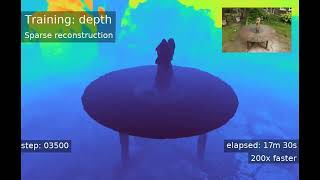
YouTube returned 6 videos for “Tetra Nerf”, and we withheld 5: 5 did not mention Tetra Nerf. Showing the 1 we can prove is about Tetra Nerf.
Official links
Tools that pair well with Tetra Nerf
Common stack mates teams adopt alongside Tetra Nerf, with the specific reason each pairing earns its keep.

Infinigen
Open-source procedural generation that renders photorealistic 3D worlds and labeled synthetic training data from Python code alone.

Polycam
Polycam turns phone LiDAR, photos and drone footage into 3D models, floor plans and point clouds for AEC and real estate teams.

Promethean AI
AI assistant for 3D world building that indexes your existing asset library without uploading it to the cloud.
Featured Head-to-Head Comparisons
Genspark vs Tetra Nerf
If you need a multifunctional AI workspace for research, content creation, and no-code tool building, Genspark is your all-in-one choice—especially with its recent Workspace 6.0 update. If you're a computer vision researcher or graphics practitioner working with point clouds and need state-of-the-art novel view synthesis, Tetra NeRF is the specialized, free, open-source solution. There is no overlap in audience; pick based on your domain: productivity vs. 3D rendering.
Tetra Nerf vs Surge Ai
Tetra-NeRF and Surge AI serve completely different purposes. Tetra-NeRF is a free, open-source tool for computer vision researchers needing high-quality novel view synthesis from point clouds. Surge AI is a premium human feedback platform for frontier AI labs, offering expert annotators for RLHF and red teaming. Choose Tetra-NeRF if you have point cloud data and need to generate photorealistic views; choose Surge AI if you are training or evaluating advanced AI models and need rigorous, expert-graded feedback.
Tetra Nerf vs Praktika
Praktika and Tetra Nerf serve entirely different domains: Praktika is a mobile language-learning app for speaking practice, while Tetra Nerf is a research-focused neural rendering library for novel view synthesis from point clouds. Choose based on your primary goal: improve conversational fluency (Praktika) or generate high-quality 3D views (Tetra Nerf).
Alternatives to Tetra Nerf
View all
Infinigen
Open-source procedural generation that renders photorealistic 3D worlds and labeled synthetic training data from Python code alone.
Polycam
Polycam turns phone LiDAR, photos and drone footage into 3D models, floor plans and point clouds for AEC and real estate teams.

Promethean AI
AI assistant for 3D world building that indexes your existing asset library without uploading it to the cloud.
Frequently Asked Questions
Used Tetra Nerf? Help shape our editorial sentiment research.