
Thunder Compute (YC S24)
Lowest-cost per-minute cloud GPUs for AI training, inference, and batch jobs.
Thunder Compute delivers the lowest on-demand GPU prices we've seen, often beating Runpod and Lambda, with per-minute billing that suits bursty workloads. The GPU-over-TCP virtualization is a genuine technical edge that improves utilization and cuts waste. But you sacrifice multi-region deployment and custom SLAs; if those matter, look elsewhere.
Verified 10d ago · liveness 69/100 · cite: rightaichoice.com/tools/thunder-compute-yc-s24
- Data scientists who need affordable GPU compute for training and inference
- Startups with bursty workloads wanting per-minute billing
- Researchers running batch jobs with fixed pricing and guaranteed availability
- Developers using VS Code or Cursor for cloud IDE workflows
- Users needing bare-metal or dedicated GPU servers
- Teams requiring multi-region or global deployment
- Those wanting a spot marketplace with variable pricing for the absolute lowest cost
We scan live Reddit threads, YouTube comments, X posts, G2 reviews and other communities — and hand you an honest verdict in under a minute.
- Honest verdict, not marketing
- Real pros & cons from real users
- Attributed quotes with receipts
3 free scans · no card needed
Skip Thunder Compute if you require multi-region deployment, bare-metal instances, or enterprise-grade SLAs and dedicated support—this is a self-serve, US-focused cloud.
Additional storage beyond the included 100GB is billed at $0.03 per 100 GB per hour while the instance is running, which can add up for data-heavy workloads.
Thunder Compute's pricing is ideal for cost-sensitive individuals and startups who value transparency and per-minute flexibility. It undercuts AWS, CoreWeave, and Lambda on A100 and H100 rates, and is comparable to Vast.ai's spot prices but with guaranteed availability. It's pricier than Vast.ai's lowest spot rates but cheaper than most on-demand providers.
In short
Thunder Compute (YC S24) — Lowest-cost per-minute cloud GPUs for AI training, inference, and batch jobs. Best for Data scientists who need affordable GPU compute for training and inference, Startups with bursty workloads wanting per-minute billing, Researchers running batch jobs with fixed pricing and guaranteed availability. Plans from $0.35.
What's new in Thunder Compute (YC S24)
Checked 8 days agoAcross the latest 3 updates: 2 feature updates and 1 news mention.
Thunder Compute raises $13M Series A to unlock idle enterprise GPU capacity
GPU virtualization startup raises $13M Series A led by Matrix Partners to scale and unlock idle enterprise GPUs.
GPU Virtualization: Approaches and Tradeoffs
Comparative analysis of GPU virtualization methods, covering performance and tradeoffs.
How Thunder Compute works (GPU-over-TCP)
Technical deep dive on Thunder Compute's GPU-over-TCP architecture for pooling remote GPUs.
What people actually say about Thunder Compute (YC S24) — is it worth it?
We ran a structured research pass across product reviews, community discussions, and post-purchase forum threads to surface the patterns vendors won't publish themselves. Below: the recurring strengths, the hidden costs people mention most, and the cohort that consistently regrets adopting this tool.
6 mentions across 2 sources (Hacker News, Lemmy) · researched Jul 3, 2026.
Average across the 2 sources that answered — each source counts once, not each post.
- +Promises 80% cheaper than AWS and below Runpod prices.
- +Per-minute billing with no minimum commitment.
- +GPU-over-TCP virtualization for higher utilization.
- +Fast provisioning—instances launch in minutes.
- +Persistent storage via snapshots and no egress fees.
- −Zero independent user reviews or testimonials available.
- −Platform is still in early growth phase, reliability unproven.
- −No uptime SLAs or transparency on performance benchmarks.
- −Heavy hiring of low-level engineers suggests rough edges.
- −No marketplace or community like Vast.ai.
- • No hidden costs mentioned—but without user data, cannot confirm
Viability Score
How well maintained and how widely used is Thunder Compute (YC S24)? Built from what the vendor actually publishes (docs, changelog, tutorials, integrations, pricing), whether the site is live, and how much real users discuss it. How we calculate this
Last calculated: September 2026
How we score →Key Features
- Per-minute billing on all GPU instances
- GPU-over-TCP virtualization for efficient scheduling
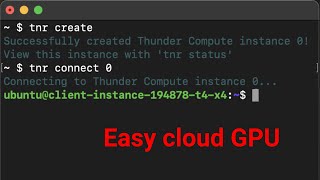
- Launch production-ready instances in minutes
- 1-8x GPU servers for training and inference
- Persistent storage via snapshots
- Scale vCPUs and RAM per instance
- No data egress fees
- VS Code, Cursor, and Windsurf extensions
- Jupyter Notebook support
- Docker with SSH and port forwarding
- MCP Server integration
- Fixed transparent pricing
- Enterprise-grade data centers
- Student discounts and referral program
About Thunder Compute (YC S24)
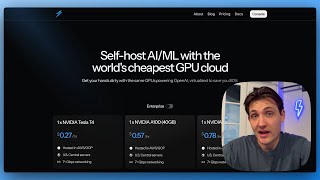
Thunder Compute is a GPU cloud platform built for data scientists, startup teams, and researchers who need affordable, reliable instances for AI training, inference, and batch workloads. Unlike traditional cloud providers, Thunder uses proprietary GPU-over-TCP virtualization to detach and reconnect idle GPUs in milliseconds, improving scheduling efficiency and cutting waste. The savings pass directly to you: on-demand pricing that undercuts AWS, Azure, and Google Cloud, with no minimum commitment and no data egress fees. You pay per minute for exactly what you use, making this a strong fit for bursty, cost-conscious workloads. The platform's key features include per-minute billing, fast provisioning (launch instances in minutes), persistent storage via snapshots (save and restore your exact environment anytime), and the ability to deploy anything from a single GPU to 8x GPU servers. You can scale vCPUs and RAM as needed, all running on enterprise-grade data centers with dependable power, cooling, and network connectivity. The pricing page shows A100 80GB at $1.09/hr and H100 PCIe at $3.20/hr, undercutting Vast.ai, Runpod, TensorDock, AWS, CoreWeave, Lambda, Paperspace, Azure, Google Cloud, and Oracle Cloud in direct comparisons. Unlike spot marketplaces like Vast.ai, prices are fixed and transparent, with guaranteed availability. Thunder Compute integrates with popular development tools like VS Code, Cursor, and Windsurf through extensions, plus Docker, Jupyter, and an MCP Server, so you can jump straight into a cloud IDE. Recent engineering blogs detail the GPU-over-TCP virtualization tech and compare approaches, but the core pitch remains: production-grade reliability at a fraction of hyperscaler cost. For buyers who care most about price and flexibility, Thunder Compute is a genuine alternative to hyperscalers and a cheaper option than Runpod or Lambda for on-demand work. What you trade away is multi-region deployment and custom SLAs; you also won't get
Behind the Verdict
When cost is your #1 constraint, Thunder Compute is hard to beat. The published A100 80GB rate of $1.09/hr and H100 PCIe at $3.20/hr undercut almost every on-demand provider we track, and the per-minute billing means you're not paying for idle time. That's a real advantage for startups running spikey training jobs or researchers doing iterative experiments. The GPU-over-TCP virtualization is more than a marketing hook. It lets the platform detach idle GPUs in milliseconds and reconnect them, which is how they squeeze out utilization and pass on savings. The engineering blogs are worth reading if you care about the mechanics. For the rest of us, the takeaway is simple: the same GPU, lower price. But cheap isn't everything. Thunder Compute doesn't offer multi-region deployment or custom SLAs, so if your workload demands geographic redundancy or contractual uptime guarantees, you'll need to look at hyperscalers or specialized providers. There's also no bare-metal option, which is a dealbreaker for teams that need raw hardware access. And unlike Vast.ai, there's no spot market—prices are fixed, which is great for predictability but means you won't catch those occasional 50%-off fire sales. We'd reach for Thunder Compute when we're prototyping, running batch inference, or doing fine-tuning on a budget. In practice, we'd set up snapshots early so we can roll back to a known-good environment without reconfiguring. The persistent storage via snapshots is straightforward, but remember: first 100GB is included while running, then it's $0.03/100GB/hr, and snapshots at rest cost $0.05/GB/mo. Those add-ons can nibble at your savings if you're careless. Compared to Runpod, Thunder is often cheaper on A100 but slightly more on H100—Runpod lists H100 at $1.99/hr. So it's worth
Researching Thunder Compute (YC S24)? Get your full AI stack in 60 seconds.
Free, no signup — tell us your goal and get tools matched to your budget & existing stack.
Real-world workflow fit
Concrete scenarios for the personas Thunder Compute (YC S24) actually fits — and what changes day-one when you adopt it.
Fine-tune a large language model on a dataset
Outcome: Launch an A100 80GB instance in minutes via VS Code extension, run the training job for a few hours, and pay only $1.09 per GPU-hour, saving up to 80% compared to AWS.
Deploy a batch inference service that runs nightly
Outcome: Create an 8x H100 cluster with per-minute billing, run batch jobs during off-peak hours, and snapshot the environment for reuse, keeping costs low and predictable.
Run a series of experiments requiring different GPU types
Outcome: Switch between RTX A6000, L40, and A100 instances with per-minute billing, test different models without committing to full-hour reservations, and restore previous environments from snapshots.
Use Cases
- Run fine-tuning jobs on A100 80GB GPUs for 80% less than AWS.
- Deploy an 8x H100 cluster for batch inference at $2.19/GPU/hr.
- Launch a Jupyter notebook on an L40 GPU in minutes via VSCode extension.
- Snapshot your training environment and restore it later without re-setup.
- Scale from a single RTX A6000 to multi-GPU without changing workflows.
- Test and iterate on models with per-minute billing to minimize costs.
Models Under the Hood
as of 2026-09-08
Limitations
- Pricing is per GPU-hour with configurations ranging from 1x to 8x GPUs, and additional storage is billed at $0.03 per 100 GB per hour after the first 100 GB.
- Snapshots for long-term storage cost $0.05 per GB per month.
- The platform supports expandable vCPU and RAM configurations, and there are no data egress fees, though specific limits on data transfer are not documented.
as of 2026-08-23
Verification history
We have re-verified Thunder Compute (YC S24) 6 times since . Each pass re-reads the vendor's own pages and re-checks every listed field against that evidence; passes where nothing had changed are marked as such.
- — re-verified summary, description, our verdict, our analysis, pricing model, pricing tiers, features, integrations, who it suits, who should skip it
- — re-verified summary, description, our verdict, our analysis, pricing model, pricing tiers, features, integrations, who it suits, who should skip it
- — re-verified summary, description, our verdict, our analysis, pricing model, pricing tiers, features, integrations, who it suits, who should skip it
- — re-verified summary, description, our verdict, our analysis, pricing model, pricing tiers, features, integrations, who it suits, who should skip it
- — re-verified summary, description, our verdict, our analysis, pricing model, pricing tiers, features, integrations, who it suits, who should skip it
- — re-verified summary, description, our verdict, our analysis, pricing model, pricing tiers, features, integrations, who it suits, who should skip it
Free to cite with attribution — this page re-verifies continuously.
12-month cost
Project the real annual outlay, including the implied monthly cost when only an annual tier is published.
Vendor list price only. Add-on usage, seat overages, and contract minimums are surfaced under Hidden costs & gotchas.
Plans compared
For each published Thunder Compute (YC S24) tier: who it actually fits, and what it adds vs. the previous tier. Cross-reference the cost calculator above for projected annual outlay.
RTX A6000
$0.35/GPU/hr
Ideal for
Data scientists and researchers needing a budget-friendly GPU with 48GB VRAM for moderate training and inference tasks, with flexibility to scale to 8 GPUs.
What this tier adds
Lowest entry price at $0.35/GPU/hr; provides a starting point with 48GB VRAM and per-minute billing.
L40
$0.79/GPU/hr
Ideal for
Professionals who need more RAM and vCPUs than the A6000, for larger models or more complex workloads, at a moderate price point.
What this tier adds
More vCPUs (6-12) and RAM (up to 96GB) for $0.79/GPU/hr, offering better performance per dollar for memory-intensive jobs.
A100 80GB
$1.09/GPU/hr
Ideal for
Serious AI training and fine-tuning jobs that benefit from 80GB VRAM, with pricing far below hyperscalers.
What this tier adds
Adds 80GB VRAM and higher CPU/RAM options at $1.09/GPU/hr, a sweet spot for large model training.
H100 PCIe
$3.20/GPU/hr
Ideal for
High-performance training and inference at scale, where the latest GPU architecture delivers maximum throughput.
What this tier adds
Top performance with 80GB VRAM and up to 16 vCPUs, at $2.19/GPU/hr, still undercutting AWS and CoreWeave.
Where the pricing makes sense
The company stage and team size where Thunder Compute (YC S24)'s pricing actually pencils out — and where peers do it cheaper.
Thunder Compute's pricing is ideal for cost-sensitive individuals and startups who value transparency and per-minute flexibility. It undercuts AWS, CoreWeave, and Lambda on A100 and H100 rates, and is comparable to Vast.ai's spot prices but with guaranteed availability. It's pricier than Vast.ai's lowest spot rates but cheaper than most on-demand providers.
Setup time & first value
How long it actually takes to get something useful out of Thunder Compute (YC S24) — broken out by persona, not the marketing-page minute.
You can get started in under 10 minutes: sign up, add a payment method, install the VS Code extension, and launch your first instance. Creating an instance takes about a minute, and connecting via the extension is immediate.
Switching to or from Thunder Compute (YC S24)
How to bring data in from common predecessors and how to get it back out — written for the switcher, not the buyer.
- →From AWS EC2: Create an instance on Thunder, transfer your code and data via SSH or scp, and use snapshots to capture your environment for later reuse.
- →From Runpod: Install the Thunder VS Code extension or use Docker with SSH to bring your existing container images, then resume your workloads with lower costs.
- →From local GPU server: Use the Thunder console to launch a similar configuration, upload your datasets, and run your training scripts with minimal changes.
- ↗To CoreWeave: If you need enterprise SLAs or multi-region, export your snapshots and redeploy on CoreWeave's managed Kubernetes.
- ↗To AWS: For organizations standardized on AWS, use their tooling to migrate your workloads, but expect higher costs.
Integrations
Resources & Guides
- Documentationthundercompute.com
Docs · Thunder Compute (YC S24)
Full product docs from thundercompute.com
- Quickstartthundercompute.com
Quickstart · Thunder Compute (YC S24)
Get up and running fast from thundercompute.com
- Documentationthundercompute.com
Api Reference · Thunder Compute (YC S24)
Full product docs from thundercompute.com
Tutorials & Learning

Official links
Tools that pair well with Thunder Compute (YC S24)
Common stack mates teams adopt alongside Thunder Compute (YC S24), with the specific reason each pairing earns its keep.

CoreWeave
AI-native GPU cloud for large-scale training, inference, and agentic AI

DataCrunch
European full-stack AI cloud with NVIDIA GPUs, instant InfiniBand clusters, and serverless inference.

Unsloth
Run and fine-tune LLMs locally on your own hardware with Unsloth — fast, memory-efficient, no cloud needed.
Featured Head-to-Head Comparisons
Thunder Compute Yc S24 vs Spider Cloud
Spider Cloud and Thunder Compute solve completely different problems. Choose Spider Cloud if you need real-time web data for AI agents or RAG pipelines — its Rust engine, AI extraction, and browser commands are purpose-built. Choose Thunder Compute if you need cheap, on-demand GPUs for training or inference — its per-minute billing and GPU virtualization undercut traditional clouds. They are complementary, not competing.
Thunder Compute Yc S24 vs Voyage Ai
Voyage AI and Thunder Compute serve entirely different layers of the AI stack. Choose Voyage AI if you need domain-tuned embeddings for high-accuracy retrieval in enterprise RAG pipelines, especially in regulated sectors like finance or legal. Choose Thunder Compute if you’re a data scientist or startup seeking dirt-cheap, on-demand GPU compute for training or inference, with per-minute billing and fast provisioning. They are complementary, not direct competitors.
Thunder Compute Yc S24 vs Temporal Ai
Temporal AI and Thunder Compute address entirely different needs — one is a durable execution platform for orchestrating resilient workflows, the other is cheap GPU compute for training/inference. Choose Temporal if you need fault-tolerant AI agents and long-running processes; choose Thunder Compute if you need affordable, on-demand GPUs with per-minute billing. They are complementary: you could use Thunder Compute for GPU-intensive tasks triggered by Temporal workflows.
Alternatives to Thunder Compute (YC S24)
View all

DataCrunch
European full-stack AI cloud with NVIDIA GPUs, instant InfiniBand clusters, and serverless inference.

Frequently Asked Questions
Categories
Best-of guides
Used Thunder Compute (YC S24)? Help shape our editorial sentiment research.