
VeritasGraph
Open-source GraphRAG & knowledge graph framework for auditable, multi-hop AI reasoning.
VeritasGraph is a solid open-source foundation for teams that need auditable GraphRAG with strong source attribution and on-premise deployment. It shines for regulated industries that must keep data sovereign and prove where answers come from. But don't expect a polished product: docs are thin, there's no managed service, and the project is the work of a single developer. If you need mature support, look at Neo4j's GraphRAG or Microsoft's GraphRAG. If you're comfortable building on a framework and value transparency, VeritasGraph is worth exploring.
Verified 5d ago · liveness 56/100 · cite: rightaichoice.com/tools/veritasgraph
- Enterprise AI architects building grounded RAG systems
- Researchers and developers working with knowledge graphs
- Government entities requiring sovereign AI deployments
- Teams needing explainable, attributable LLM outputs
- Users looking for a no-code GUI tool
- Beginner AI practitioners without graph or RAG experience
- Teams needing a fully managed cloud service with SLAs
We scan live Reddit threads, YouTube comments, X posts, G2 reviews and other communities — and hand you an honest verdict in under a minute.
- Honest verdict, not marketing
- Real pros & cons from real users
- Attributed quotes with receipts
3 free scans · no card needed
Skip VeritasGraph if you need a turnkey, managed solution with GUI, SLAs, and extensive docs — it's a developer-focused framework requiring hands-on expertise.
VeritasGraph is free (open source), so the only cost is your engineering time. Compare to Neo4j (graph DB licensing) or Microsoft GraphRAG (cloud compute). It's ideal for cost-conscious teams that already have graph expertise.
In short
VeritasGraph — Open-source GraphRAG & knowledge graph framework for auditable, multi-hop AI reasoning. Best for Enterprise AI architects building grounded RAG systems, Researchers and developers working with knowledge graphs, Government entities requiring sovereign AI deployments. Free to use.
Viability Score
How well maintained and how widely used is VeritasGraph? Built from what the vendor actually publishes (docs, changelog, tutorials, integrations, pricing), whether the site is live, and how much real users discuss it. How we calculate this
Last calculated: September 2026
How we score →Key Features
- Multi-hop reasoning over knowledge graphs
- Ontology-aware retrieval
- Verifiable source attribution
- RDF and linked-data support
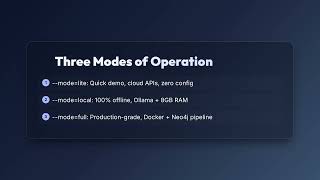
- Local or cloud deployment
- Integration with pgvector
- Integration with Neo4j
- Integration with FAISS
- Compatible with LangChain
- Compatible with LlamaIndex
- Open-source on GitHub
- Entity extraction capabilities
- On-premise deployment
- Works with unstructured data
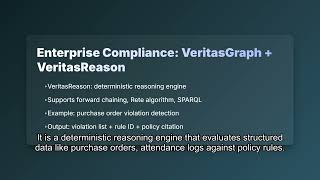
- Reasoning layer for LLMs
About VeritasGraph
VeritasGraph is an open-source framework for building knowledge graphs and GraphRAG pipelines that prioritize verifiable attribution and multi-hop reasoning. You model your data as nodes, edges, and ontologies, then use a reasoning layer that LLMs can query for grounded, explainable answers. It supports ontology-aware retrieval and works over both structured (RDF, linked-data) and unstructured data. You can deploy it locally or in the cloud, making it suitable for regulated environments where data sovereignty and auditability are non-negotiable. The framework integrates with vector databases like pgvector, Neo4j, and FAISS, and connects to popular LLM frameworks such as LangChain and LlamaIndex. Built by Bibin Prathap, an AI specialist and Microsoft MVP focused on enterprise knowledge graphs and on-premise GenAI automation, the project is hosted on GitHub and designed for domain-specific extension. For teams that already understand knowledge graphs and need an open, auditable foundation for GraphRAG, VeritasGraph offers a lightweight alternative to heavy enterprise graph databases while keeping reasoning transparent. However, the documentation and community are still nascent—this is a framework for builders, not for buyers looking for turnkey solutions.
Behind the Verdict
VeritasGraph stands out for its explicit focus on verifiable attribution and multi-hop reasoning over knowledge graphs — exactly what regulated sectors like healthcare and government need. Because it's open-source and self-hostable, you avoid sending sensitive data to third-party clouds, which is a huge plus for sovereign AI initiatives. The integration with pgvector, Neo4j, and FAISS means you can plug it into your existing stack, and the LangChain/LlamaIndex compatibility lets you keep your current tooling. The author's deep background in enterprise knowledge graphs and on-prem GenAI (as a Microsoft MVP) shows in the architecture. However, this is not a product — it's a framework. There's no GUI, no managed hosting, and documentation is still limited, so you'll need seasoned graph/RAG engineers on staff. The project is also young, so expect to contribute fixes and adapt it to your domain. VeritasGraph is ideal for organizations that prioritize data control and auditability over convenience, but it's a poor fit for teams wanting a quick, out-of-the-box solution.
Researching VeritasGraph? Get your full AI stack in 60 seconds.
Free, no signup — tell us your goal and get tools matched to your budget & existing stack.
Real-world workflow fit
Concrete scenarios for the personas VeritasGraph actually fits — and what changes day-one when you adopt it.
Needs to build a grounded Q&A system over internal documents with source citations.
Outcome: Models data as knowledge graph, deploys locally, queries with LLM, gets answers with verifiable sources.
Wants to reason over clinical ontologies while keeping patient data on-premise.
Outcome: Uses VeritasGraph's RDF support and local deployment to run sovereign GraphRAG without cloud exposure.
Must deliver AI answers in a compliant, auditable manner.
Outcome: Leverages entity extraction and reasoning layer to produce explainable outputs for regulatory review.
Use Cases
- Build a multi-hop question answering system over your internal RDF knowledge base
- Enable verifiable attribution for LLM responses in regulated document review
- Create an ontology-aware retrieval system that filters results by domain concepts
- Deploy a local GraphRAG pipeline on sensitive data without sending it to the cloud
- Integrate knowledge graph reasoning into existing LangChain or LlamaIndex pipelines
- Automate document review and complaints triage in enterprise settings
- Power BI copilots with grounded, explainable answers from your knowledge graph
Models Under the Hood
as of 2026-09-01
Limitations
- The platform is offered as a service by a single developer, and the documentation is limited.
- It is designed for regulated enterprises and may require technical expertise for deployment and customization.
- There is no publicly available API or managed hosting.
as of 2026-09-01
Verification history
We have re-verified VeritasGraph 7 times since . Each pass re-reads the vendor's own pages and re-checks every listed field against that evidence; passes where nothing had changed are marked as such.
- — re-checked, vendor evidence unchanged
- — re-checked, vendor evidence unchanged
- — re-checked, vendor evidence unchanged
- — re-checked, vendor evidence unchanged
- — re-checked, vendor evidence unchanged
- — re-verified summary, description, our verdict, our analysis, pricing model, pricing tiers, features, integrations, who it suits, who should skip it
Showing the 6 most recent of 7 verification passes.
Free to cite with attribution — this page re-verifies continuously.
12-month cost
Project the real annual outlay, including the implied monthly cost when only an annual tier is published.
Vendor list price only. Add-on usage, seat overages, and contract minimums are surfaced under Hidden costs & gotchas.
Plans compared
For each published VeritasGraph tier: who it actually fits, and what it adds vs. the previous tier. Cross-reference the cost calculator above for projected annual outlay.
Open Source (GitHub)
$0/mo
Ideal for
Developers and enterprises that want full control over their GraphRAG stack, are comfortable self-hosting, and need auditability.
What this tier adds
Free entry point with full source code, self-hosted deployment, and community support via GitHub.
Where the pricing makes sense
The company stage and team size where VeritasGraph's pricing actually pencils out — and where peers do it cheaper.
VeritasGraph is free (open source), so the only cost is your engineering time. Compare to Neo4j (graph DB licensing) or Microsoft GraphRAG (cloud compute). It's ideal for cost-conscious teams that already have graph expertise.
Setup time & first value
How long it actually takes to get something useful out of VeritasGraph — broken out by persona, not the marketing-page minute.
For a developer familiar with graph DBs: a few hours to deploy locally and connect pgvector/Neo4j. Expect a couple of days to adapt schema and integrate with LangChain. No-code users will struggle — this is a builder's tool.
Integrations
Resources & Guides
Tutorials & Learning
Official links
Featured Head-to-Head Comparisons
Veritasgraph vs Spider Cloud
Spider Cloud and VeritasGraph solve opposite ends of the data problem: Spider Cloud excels at fetching fresh, structured web data at scale for AI agents, while VeritasGraph helps you build and query explainable knowledge graphs from existing data. Choose Spider Cloud if you need real-time web content for RAG or AI training; choose VeritasGraph if you need auditable reasoning over structured knowledge in regulated environments. They're complementary — you could use Spider Cloud to feed data into a VeritasGraph knowledge pipeline.
Veritasgraph vs Temporal Ai
Temporal AI and VeritasGraph serve fundamentally different purposes: Temporal ensures fault-tolerant execution of AI agents and workflows, while VeritasGraph focuses on auditable reasoning over knowledge graphs. Choose Temporal if you need reliable, stateful orchestration (e.g., agents that survive crashes). Choose VeritasGraph if you need explainable, grounded LLM outputs with verifiable sources. They are complementary — you could use Temporal to orchestrate a VeritasGraph reasoning pipeline.
Veritasgraph vs Screenplayiq
ScreenplayIQ and VeritasGraph are too different to compete directly. ScreenplayIQ is a specialized tool for screenwriters analyzing feature film scripts with box office forecasting, while VeritasGraph is an open-source framework for enterprise GraphRAG applications. Choose ScreenplayIQ if you need narrative analysis and market predictions for movie scripts; choose VeritasGraph if you're building auditable, knowledge-grounded AI systems for regulated or sovereign environments.
Popular in Vector Databases & Retrieval

Voyage AI
Specialized embedding models and rerankers for high-accuracy enterprise RAG, with 32K-token context and multimodal support.

Nomic Embed
Open-source embeddings plus agentic AEC automation for drawing review and compliance.

Ragatouille
Easily train and use ColBERT late-interaction retrieval in any RAG pipeline.
Frequently Asked Questions
Used VeritasGraph? Help shape our editorial sentiment research.