
Video Localization
Video Localization by Algebras dubs finished videos into 13+ languages and re-times the speaker's lips to the new audio track.
Buy this if lip-sync fidelity and idiom-level rewriting are what your audience notices — the cultural adaptation layer is the reason to pay Algebras rather than a cheap caption tool. The published tiers run $15 for 10 minutes, $79 for 60 minutes ($1.32/min, marked "Save 12%"), and $239 for 240 minutes ($1.00/min, marked "Save 33%"), so per-minute cost drops sharply as you commit to more finished video. Use VIDEO15PH for 10 free minutes before committing: ten minutes will tell you whether the synthesized voice survives a real edit. Deepdub is the obvious head-to-head, and on a short marketing clip the two are close; the gap opens on multi-hour material, where Algebras' claimed cross-scene
Verified 11d ago · liveness 68/100 · cite: rightaichoice.com/tools/video-localization
- Localization teams that need dubbed video with believable lip-sync, not just captions
- Course and training providers pushing multi-hour lessons into new languages
- Creators and studios launching the same video across several markets at once
- Enterprises wiring dubbing into an existing production pipeline via REST API
- Anyone needing live or real-time translation during a stream — this is file-in, file-out
- One-off clips under 10 minutes, where the $15 pricing floor outweighs the value
- Teams that only need a subtitle file and will not use dubbed audio
We scan live Reddit threads, YouTube comments, X posts, G2 reviews and other communities — and hand you an honest verdict in under a minute.
- Honest verdict, not marketing
- Real pros & cons from real users
- Attributed quotes with receipts
3 free scans · no card needed
Skip Video Localization if you need live or real-time translation during a stream, or if you only want a subtitle file and will never use the dubbed audio track.
The 10-minute block prices at $1.50/min, three times the $0.50-per-minute step down you get at the 240-minute block, so small jobs are the expensive way to buy.
Algebras prices in blocks of finished minutes rather than seats, so cost tracks output: $15 for 10 minutes ($1.50/min), $79 for 60 minutes ($1.32/min, marked "Save 12%") and $239 for 240 minutes ($1.00/min, marked "Save 33%"). That puts it in the range of paid dubbing vendors like Deepdub rather than caption tools, and it scales down per minute the more finished video you route through, which rewards studios and course producers over one-off users.
In short
Video Localization — Video Localization by Algebras dubs finished videos into 13+ languages and re-times the speaker's lips to the new audio track. Best for Localization teams that need dubbed video with believable lip-sync, not just captions, Course and training providers pushing multi-hour lessons into new languages, Creators and studios launching the same video across several markets at once. Plans from $15.
What's new in Video Localization
Checked 3 days agoAcross the latest 1 update: 1 launch.
What people actually say about Video Localization — is it worth it?
We ran a structured research pass across product reviews, community discussions, and post-purchase forum threads to surface the patterns vendors won't publish themselves. Below: the recurring strengths, the hidden costs people mention most, and the cohort that consistently regrets adopting this tool.
23 mentions across 3 sources (Hacker News, YouTube, Lemmy) · researched Aug 17, 2026.
Average across the 3 sources that answered — each source counts once, not each post.
- +Cultural awareness AI adapts humor, tone, and intent per language
- +Lip-sync and rhythm preservation for natural delivery
- +Long-form video support retains context across scenes and speakers
- +REST API enables batch processing and workflow automation
- +Transparent volume-based pricing with discounts at scale
- −No free tier locks out casual testers and small creators
- −ZERO independent community reviews—only vendor marketing
- −Cultural adaptation claims lack public proof or comparisons
- −Competitors like Vozo and BlipCut have more tutorials and testimonials
- −Per-minute cost may be higher than literal subtitling tools
- • No free tier means any test costs money (except 10-min promo)
- • Higher per-minute rates for small batches may add up
- • No listed enterprise custom pricing or volume tiers beyond 240 min
Viability Score
How well maintained and how widely used is Video Localization? Built from what the vendor actually publishes (docs, changelog, tutorials, integrations, pricing), whether the site is live, and how much real users discuss it. How we calculate this
Last calculated: October 2026
How we score →Key Features
- 1-click translation producing timed subtitles and dubbed speech from one upload
- Automatic transcription, translation and voice synthesis in a single pass
- Lip-sync and rhythm preservation re-timing the speaker's mouth to the new language audio
- Cultural awareness agents rewrite idioms, jokes and tone instead of translating literally
- Context retention across scenes and speakers for consistent terminology, style and tone
- Long-form support for multi-hour, multi-speaker recordings such as courses and podcasts
- Localization into Arabic, Spanish, Urdu, English, French, German and Chinese
- Additional documented languages: Japanese, Portuguese, Italian, Korean, Russian and Hindi
- REST API for batch processing hundreds of videos or automated workflows
- Per-minute pricing published in 10, 60 and 240 minute blocks
- Save 12% on the 60-minute block and 33% on the 240-minute block versus the 10-minute rate
- Localization revenue calculator estimating total market opportunity by target language
- BeginIT case study covering course translation across Eurasia, Africa and the Middle East
- Promo code VIDEO15PH gives new users 10 free minutes
- Product Hunt launch promotion running with the VIDEO15PH code
About Video Localization
Video Localization by Algebras is a file-in, file-out dubbing service. You upload a finished video and it returns the same video speaking another language, with the original speaker's lips re-timed to the new audio. The full chain runs in one pass: automatic transcription, translation, voice synthesis, subtitle timing, and lip-sync. The vendor's stated differentiator is cultural adaptation rather than word-for-word translation — its "cultural awareness" agents rewrite tone, jokes, and idioms so a line lands as it did in the source language. A second differentiator is long-form context: the engine retains terminology, style, and tone across scenes and speakers, which matters on multi-hour courses, podcasts, and recorded lectures where a term rendered badly in minute four must not repeat in minute ninety. Documented languages cover Arabic, Spanish, Urdu, English, French, German, Chinese, Japanese, Portuguese, Italian, Korean, Russian, and Hindi. A REST API supports batch processing, so localization can be wired into an existing pipeline instead of driven by hand. Pricing is published per block of finished minutes: $15 for 10 minutes ($1.50/min), $79 for 60 minutes ($1.32/min, marked "Save 12%"), and $239 for 240 minutes ($1.00/min, marked "Save 33%"). The promo code VIDEO15PH gives new accounts 10 free minutes; the homepage says it is live on Product Hunt with that code. Algebras publishes a localization revenue calculator that takes your source language and current revenue and estimates total market opportunity, plus a case study from BeginIT, which needed video courses translated across Central and South Eurasia, Africa, and the Middle East within a six-month window. Buyers comparing this against Deepdub are comparing two vendors selling dubbing a viewer will not switch off, not a caption file.
Behind the Verdict
The honest framing on Algebras' Video Localization is that it sells a delivery outcome, not a feature list. Dubbing that a viewer will sit through requires three things to hold at once: the translated line has to sound like something a native speaker would say, the synthesized voice has to sound like the original speaker, and the lips have to match the new audio. Algebras attacks all three in one pass — transcription, translation, voice synthesis, subtitle timing and lip-sync — and its marketing leans on the first and third of those. "Cultural awareness" is the claim that agents understand tone, culture and intent and rewrite jokes and idioms rather than converting them literally. Lip-sync and rhythm preservation are the claim that the re-timed mouth movement tracks the new language's audio rather than the old one. Where this matters most is long-form. A 90-minute course or a multi-hour recorded lecture has recurring terminology, named entities, and a consistent instructor voice; the vendor says it retains context across scenes and speakers so terminology, style and tone stay consistent even in multi-hour content. That is the specific claim a buyer should stress-test, because it is where cheap dubbing tools visibly fall apart — one bad rendering of a technical term propagates across the whole recording. Long-form consistency and a premium price ladder are the two things generic caption tools cannot mirror, and they are the reason this category exists. Support on file covers Arabic, Spanish, Urdu, English, French, German, Chinese, Japanese, Portuguese, Italian, Korean, Russian and Hindi. The API is the other structural advantage: batch processing lets you push hundreds of videos or wire dubbing into an existing production pipeline rather than driving each file by hand, and the homepage names both batch runs and automated workflows as the use case. Pricing is published in blocks of finished minutes rather than by subscription: $15 for 10 minutes at $1.50/min, $79 for 60 minutes at $1.32/min, and $239 for 240 minutes at $1.00/min. The 60- and 240-minute tiers are the ones that make sense for anything beyond a test — the 10-minute floor is priced as a trial, and the per-minute rate falls by a third at the top block. The visible gaps are the usual ones for a young service. There is no described real-time or live translation: this is file-in, file-out, so streaming is out of scope. The site shows a case study and a revenue calculator but the long-form evidence is a single named project, BeginIT, rather than a wall of references — worth weighing if you are buying for an enterprise program. Before you commit real budget, run the free promo minutes against your worst-case asset: a long recording with several speakers, technical vocabulary, and at least one joke. That single test will tell you more than any of the marketing claims.
Researching Video Localization? Get your full AI stack in 60 seconds.
Free, no signup — tell us your goal and get tools matched to your budget & existing stack.
Real-world workflow fit
Concrete scenarios for the personas Video Localization actually fits — and what changes day-one when you adopt it.
Upload a recorded lecture series with one instructor and recurring technical terminology, select the target languages, and let the engine run transcription, translation, voice synthesis, subtitle timing and lip-sync in one pass while retaining context across scenes and speakers.
Outcome: A dubbed course that keeps terminology, style and tone consistent across hours of material, delivered at the 240-minute block's $1.00/min rate.
Run a single launch video through the cultural awareness layer so idioms and jokes are rewritten rather than translated literally, then push the same asset into several target languages from the 13-language supported set.
Outcome: Per-market cuts that sound like they were written locally, with lip-sync matched to each new audio track.
Call the REST API to batch process a back catalogue of videos rather than uploading each file by hand, and run the localization revenue calculator first to size the market opportunity by target language.
Outcome: Automated multilingual publishing that scales with every video the pipeline produces, priced per finished minute.
Use Cases
- Dub marketing videos into 10+ languages with idiom-level cultural adaptation rather than literal translation
- Translate long-form educational courses while preserving instructor tone and recurring terminology
- Localize corporate training materials for global employees across 13 documented languages
- Automate dubbing of YouTube content via REST API batch workflows
- Adapt humor and idioms for regional audiences without losing the impact of the original line
- Re-time lip movement on a finished video so dubbed audio matches the on-screen speaker
Limitations
- This is file-in, file-out dubbing: the sources describe no live or real-time translation, so streaming is out of scope.
- The entry block is $15 for 10 minutes at $1.50/min — the highest per-minute rate published — so very short clips carry the worst value per minute.
- Published blocks are 10, 60 and 240 minutes, and the 240-minute block at $239 ($1.00/min) is the best published per-minute rate, which means low-volume buyers pay materially more per minute than high-volume ones.
- Long-form evidence on the site is a single named case study (BeginIT) rather than a broad reference list.
- If you need dubbing inside a pipeline, plan on the REST API rather than a native plugin for an editing suite.
as of 2026-09-27
Verification history
We have re-verified Video Localization 7 times since . Each pass re-reads the vendor's own pages and re-checks every listed field against that evidence; passes where nothing had changed are marked as such.
- — re-verified summary, description, our verdict, our analysis, pricing model, pricing tiers, features, integrations, who it suits, who should skip it
- — re-checked, vendor evidence unchanged
- — re-checked, vendor evidence unchanged
- — re-verified summary, description, our verdict, our analysis, pricing model, pricing tiers, features, integrations, who it suits, who should skip it
- — re-checked, vendor evidence unchanged
- — re-verified summary, description, our verdict, our analysis, pricing model, pricing tiers, features, integrations, who it suits, who should skip it
Showing the 6 most recent of 7 verification passes.
Free to cite with attribution — this page re-verifies continuously.
12-month cost
Project the real annual outlay, including the implied monthly cost when only an annual tier is published.
Vendor list price only. Add-on usage, seat overages, and contract minimums are surfaced under Hidden costs & gotchas.
Plans compared
For each published Video Localization tier: who it actually fits, and what it adds vs. the previous tier. Cross-reference the cost calculator above for projected annual outlay.
10 minutes
$15
Ideal for
A solo creator or marketing lead testing whether the voice clone and lip-sync survive a real edit before committing budget.
What this tier adds
Starting tier at $15 for 10 minutes, the highest published per-minute rate at $1.50/min.
60 minutes
$79
Ideal for
A creator or small studio localizing one long-form video or a short series into a new market.
What this tier adds
60 minutes for $79, $1.32/min and marked "Save 12%", adding long-form context retention and REST API access for batch runs.
240 minutes
$239
Ideal for
Course providers, studios and enterprises pushing multi-hour, multi-speaker material into several languages.
What this tier adds
240 minutes for $239, the best published rate at $1.00/min and marked "Save 33%", with multi-hour multi-speaker support and volume discounts.
Where the pricing makes sense
The company stage and team size where Video Localization's pricing actually pencils out — and where peers do it cheaper.
Algebras prices in blocks of finished minutes rather than seats, so cost tracks output: $15 for 10 minutes ($1.50/min), $79 for 60 minutes ($1.32/min, marked "Save 12%") and $239 for 240 minutes ($1.00/min, marked "Save 33%"). That puts it in the range of paid dubbing vendors like Deepdub rather than caption tools, and it scales down per minute the more finished video you route through, which rewards studios and course producers over one-off users.
Setup time & first value
How long it actually takes to get something useful out of Video Localization — broken out by persona, not the marketing-page minute.
For a single video, first value is one upload away — you pick a language and the same pass handles transcription, translation, voice synthesis, subtitle timing and lip-sync. Budget a short review cycle for checking terminology and tone on the output before publishing. For pipeline use, add engineering time to wire the REST API into batch runs. New accounts can test with the VIDEO15PH promo code
Switching to or from Video Localization
How to bring data in from common predecessors and how to get it back out — written for the switcher, not the buyer.
- →From subtitle-only localization tools: move up to dubbed audio with lip-sync while keeping the translated subtitle track you already relied on
- →From manual studio dubbing: replace per-project quoting with published per-minute blocks starting at $15 for 10 minutes
- →From Deepdub-style vendors: run the same asset through both and compare long-form terminology consistency before switching
- ↗To caption-only tools: if your audience only ever reads subtitles, the dubbed audio layer is the part you give up
- ↗To a real-time translation service: if you need live dubbing during a stream, this file-in file-out pipeline will not carry over
Resources & Guides
Tutorials & Learning
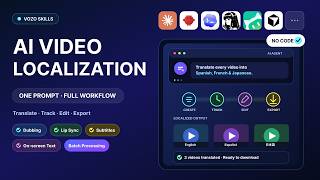
AI Video Localization with AI Agents | Vozo Skills Tutorial
Vozo AI

The ONLY Way to do Video Localization in 2024
Plainly
YouTube returned 6 videos for “Video Localization”, and we withheld 4: 4 did not mention Video Localization. Showing the 2 we can prove are about Video Localization.
Official links
Tools that pair well with Video Localization
Common stack mates teams adopt alongside Video Localization, with the specific reason each pairing earns its keep.

Rask AI
AI video and audio localization platform that dubs, lip-syncs, and translates your content into 135+ languages.

GhostCut
GhostCut is a cloud AI video localization platform that removes hard subtitles, translates, and dubs video in a single batch pass.

TranslateVideo
AI video dubbing, captions, and voice cloning in 81 languages from 50 seconds of audio
Featured Head-to-Head Comparisons
Video Localization vs Splice
Splice is the clear choice for music producers needing affordable, royalty-free samples and plugin rent-to-own. Video Localization is purpose-built for creators who need culturally nuanced, lip-synced video dubbing, but its per-minute pricing lacks a free tier. Choose based on your medium: audio vs. video.
Video Localization vs Landr Mastering
Choose LANDR Mastering if you're a musician needing affordable, professional AI mastering with a free preview option. Choose Video Localization if you need AI-powered dubbing with lip-sync and cultural adaptation for video content. They solve completely different problems—pick based on whether your focus is audio or video localization.
Video Localization vs Storyfile
StoryFile is for organizations that need authentic, interactive conversational AI using real human footage, ideal for museums and legacy. Video Localization is for content creators and enterprises who need to dub and lip-sync videos into multiple languages. They are not direct competitors; choose based on whether you need interactive avatars or scalable video translation.
Alternatives to Video Localization
View all
Rask AI
AI video and audio localization platform that dubs, lip-syncs, and translates your content into 135+ languages.

GhostCut
GhostCut is a cloud AI video localization platform that removes hard subtitles, translates, and dubs video in a single batch pass.

TranslateVideo
AI video dubbing, captions, and voice cloning in 81 languages from 50 seconds of audio
Frequently Asked Questions
Categories
Used Video Localization? Help shape our editorial sentiment research.