Terracotta AI vs Temporal AI
Side-by-side comparison of features, pricing, and ratings
At a glance
| Dimension | Terracotta AI | Temporal AI |
|---|---|---|
| Pricing | Free tier (limited scans) + paid plans | Free tier (server limits) + usage-based billing |
| Core Function | IaC PR review for misconfigurations | Workflow orchestration with durable execution |
| Key Integrations | GitHub, Slack, Terraform, Pulumi, CloudFormation | OpenAI Agents SDK, Google ADK, Slack, Kubernetes |
| Best For | DevOps enforcing IaC standards, security audits | AI agents, long-running workflows, Saga patterns |
| Not For | App code review, non-GitHub repos | Simple cron jobs, stateless APIs, CRUD apps |
| Latest News | No recent news | Usage-based billing, Custom Roles pre-release (Jun 2026) |
Temporal AI and Terracotta AI serve completely different purposes: Temporal is for building reliable, stateful workflows (AI agents, microservices) with durable execution, while Terracotta is a narrow IaC security scanner for Terraform/Pulumi PRs. Choose Temporal if you need fault-tolerant orchestration; choose Terracotta if you’re a DevOps team wanting automated infrastructure compliance.
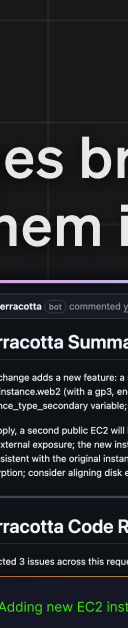
Terracotta AI reviews every Terraform pull request for security, compliance, cost, and drift — inside the PR, before you merge.
Visit Website
Temporal is the durable execution platform where AI agents and long-running workflows survive crashes, retries, and abandoned sessions
Visit WebsiteWhat real users say: Terracotta AI vs Temporal AI
Not marketing copy and not our opinion — a structured sweep of public discussion (reviews, forums, communities and video comments), showing what people praise and what they complain about for each tool.
Terracotta AI
14 mentions across 2 sources · 40% positive — mixed (averaged across 2 sources)
Hacker News, Lemmy
What users praise
- • Specialized in IaC — understands Terraform, Pulumi, CloudFormation semantics.
- • Natural language policy creation avoids complex scripting.
- • Y Combinator backed — some pedigree in startup execution.
- • Freemium model lowers barrier for individual developers.
What frustrates them
- • No independent user reviews or testimonials available.
- • Only found a single founder post — no real community.
- • Limited to three IaC frameworks — no CDK or Ansible.
- • Effectiveness at scale is completely unproven.
Researched Jul 3, 2026
Temporal AI
No verifiable community signal. We scanned public discussion on Oct 7, 2026 and found posts matching the name “Temporal AI”, but could not establish that they are about this product rather than something else sharing its name. Rather than publish a score built on the wrong subject, we publish none.
Who should pick which
- AI Agent DeveloperPick: Temporal AI
Temporal's durable execution, OpenAI Agents SDK integration, and human-in-the-loop features are essential for building crash-resistant AI agents.
- DevOps EngineerPick: Terracotta AI
Terracotta automates IaC reviews for Terraform/Pulumi, catching security misconfigs before deployment, saving manual toil.
- Platform EngineerPick: Terracotta AI
Enforce infrastructure standards with custom policies, CIS/SOC2 rules, and drift detection across multi-cloud.
- SREPick: Temporal AI
Temporal's Saga patterns and automatic retries reduce incident rates in complex distributed systems.
- Security EngineerPick: Terracotta AI
Pre-deployment compliance checks for IaC with inline PR comments and Slack alerts keep security tight.
Frequently Asked Questions
Terracotta AI vs Temporal AI: which should you choose?
Temporal AI and Terracotta AI serve completely different purposes: Temporal is for building reliable, stateful workflows (AI agents, microservices) with durable execution, while Terracotta is a narrow IaC security scanner for Terraform/Pulumi PRs. Choose Temporal if you need fault-tolerant orchestration; choose Terracotta if you’re a DevOps team wanting automated infrastructure compliance.
Can Temporal and Terracotta be used together?
Yes, they are complementary. Temporal orchestrates workflows, while Terracotta secures the IaC that defines the infrastructure those workflows run on.
Does Terracotta support Pulumi in addition to Terraform?
Yes, Terracotta supports Terraform, Pulumi, and AWS CloudFormation.
Is Temporal only for AI agents?
No, Temporal is a general-purpose durable execution platform for microservices, orchestration, and long-running processes, not just AI.
Does Terracotta require code to be stored?
No, Terracotta offers ephemeral scanning, meaning it does not store your IaC files permanently.
Which SDKs does Temporal support?
Python, Go, TypeScript, Ruby, C#, Java, PHP, and Rust (public preview).
Can Terracotta generate cost optimization suggestions?
Yes, it provides cost optimization suggestions like right-sizing and identifying underutilized resources.
Does Temporal have a free tier?
Yes, Temporal offers a free server tier with limits. The cloud service recently introduced usage-based billing for cost transparency.
Does Terracotta work with GitHub only?
Currently it appears to be a GitHub app; the 'not for' section mentions teams not using GitHub as their Git provider.
More Terracotta AI or Temporal AI comparisons
This is not really a head-to-head — the two products sit in different layers of a stack, and almost nobody with a budget is choosing one over the other. Temporal answers 'how do I keep a multi-day age
These are not substitutes, so there is no either/or decision here. If your pain is "something broke in production and I need errors, traces, logs, replay, and an AI agent to explain and patch it," buy
These aren't competitors — they're different layers of the stack. Temporal is the durability engine you reach for when executions span hours, days, or weeks and must survive crashes, retries, and aban
These are not competing products and you should not be choosing between them. Temporal is infrastructure: it keeps the code your system runs from losing progress when a worker dies or a session is aba
These aren't competitors, so there's no either/or to recommend. Pick Netlify if you need somewhere to deploy and host a fullstack web app — its Agent Runners, AI Gateway, Serverless Functions, managed
Temporal AI and Lift address completely different problems — durable orchestration vs. document parsing. If you're building AI agents or multi-step workflows that must survive failures, Temporal is th
Explore each tool further
Browse these categories
One email a week — new tools, honest comparisons, no spam.
Last reviewed: July 3, 2026