
BitDive
Runtime verification for Java and Kotlin: capture real traces, diff PR behavior, and replay them as JUnit regression tests.
If your Java or Kotlin team lets AI agents touch production-bound code, BitDive answers the question static analysis can't: did the change alter real behavior? Recording traces and replaying them as standard JUnit means you stop hand-maintaining mocks, and the MCP server gives Cursor, Claude, or Devin runtime ground truth instead of guesses. It is not an APM replacement and it is not for non-JVM stacks - buy it for deterministic regression proof, not dashboards.
Verified 1h ago · liveness 71/100 · cite: rightaichoice.com/tools/bitdive
- Java and Spring Boot teams verifying AI-generated or agent-authored changes by behavior
- QA engineers replacing hand-written mocks in integration and container-backed tests
- Platform teams standardizing trace-based regression suites across microservices
- Teams using Cursor, Claude, Windsurf, or Devin that want runtime ground truth via MCP
- Non-JVM stacks - Java and Kotlin only
- Teams shopping for general-purpose APM, alerting, and production dashboards
- Frontend-only or full-stack products with no Java service to instrument
We scan live Reddit threads, YouTube comments, X posts, G2 reviews and other communities — and hand you an honest verdict in under a minute.
- Honest verdict, not marketing
- Real pros & cons from real users
- Attributed quotes with receipts
3 free scans · no card needed
Skip BitDive if your services aren't Java or Kotlin, or if what you actually want is production APM dashboards and alerting rather than behavior-level verification of code changes before they ship.
The free Developer Use tier is provided as-is with no SLA, indemnities, or custom engineering, so the moment your organization needs contractual coverage you are in a custom-priced conversation.
Pricing splits by adoption stage, not by feature count: one engineer validating the workflow on a real Java service pays $0, and the bill starts when multiple teams need SSO, auditability, private or air-gapped deployment, and procurement support. That makes it cheap to prove out and potentially expensive to standardize. Compared with seat-priced Java test tooling, a two-engineer pilot is effectively free; compared with a per-host APM contract, the custom rollout is a governance purchase rather
In short
BitDive — Runtime verification for Java and Kotlin: capture real traces, diff PR behavior, and replay them as JUnit regression tests. Best for Java and Spring Boot teams verifying AI-generated or agent-authored changes by behavior, QA engineers replacing hand-written mocks in integration and container-backed tests, Platform teams standardizing trace-based regression suites across microservices. Free to use.
What's new in BitDive
Checked todayAcross the latest 1 update: 1 news mention.
What people actually say about BitDive — is it worth it?
We scanned public community sources for BitDive on Aug 5, 2026 and could not establish that the discussion we found is about this tool rather than something else sharing its name. Our own analysis of that scan says the posts were off-subject. Rather than publish a sentiment score built on the wrong subject, we publish nothing here and re-run the scan.
Viability Score
How well maintained and how widely used is BitDive? Built from what the vendor actually publishes (docs, changelog, tutorials, integrations, pricing), whether the site is live, and how much real users discuss it. How we calculate this
Last calculated: October 2026
How we score →Key Features
- Method-level runtime traces with arguments, return values, and timings
- Execution tree capture with per-node timing across the call path
- SQL query capture with returned results
- HTTP request and response payload and header capture
- Kafka publish and consume message capture
- Exception details and failure path capture
- Behavioral PR review: baseline main, apply the PR, diff the traces
- Auto-generate deterministic JUnit 5 replay tests from real runtime traces
- Unit tests from traces with auto-mocked collaborators
- Full Spring context integration tests with external boundaries replayed
- Testcontainers testing with real PostgreSQL, MySQL, MongoDB, and Redis
- Boundary virtualization for databases, REST calls, and Kafka inside the JVM
- MCP server feeding runtime context to Cursor, Claude, Windsurf, and Devin
- Automatic PII masking applied before capture
- Binary capture and compression with quoted 0.5-5% CPU overhead
About BitDive
BitDive is a runtime verification platform for Java and Kotlin teams. A JVM agent records what the code actually does - method arguments and return values, execution tree timings, SQL queries with results, HTTP request and response payloads, Kafka publishes and consumed messages, and exception paths - into one runtime snapshot that becomes a behavioral baseline. The loop is closed. You capture a baseline, apply a change (by a developer or an AI agent), and capture again. BitDive diffs the traces to expose side effects, SQL drift, extra HTTP calls, and regressions such as N+1 queries. Proved-good behavior is then locked in as ordinary JUnit 5 replay suites that run via `mvn test` in CI, with database, REST, and Kafka boundaries virtualized inside the JVM instead of hand-written mocks. For teams using Cursor, Claude, Windsurf, or Devin, an MCP server hands agents captured runtime context rather than static-code guesses, and the vendor states creating and refreshing these regression suites costs zero tokens. Testcontainers users get real PostgreSQL, MySQL, MongoDB, and Redis in containers, with external APIs replayed from traces. Install is a JVM agent with no code changes, quoted at 5 minutes, with 0.5-5% CPU overhead and PII masked before capture. Deployment stays local-first: data remains in your infrastructure, with private cloud, self-hosted, and air-gapped options on the Company Rollout plan. It suits Spring Boot shops, microservice platform teams, and QA engineers who want behavior-level proof rather than another observability dashboard. Java and Kotlin only.
Behind the Verdict
The tempting pitch is the AI angle, but the durable reason to adopt BitDive is the test asset it leaves behind. A captured run turns into a normal JUnit 5 suite you run with `mvn test`, so the value survives even if your agent of choice changes next quarter. That is why I'd pick it over yet another static-analysis plugin. Where it earns its place: PR review on a service you already trust. Baseline main, apply the branch, compare traces, and the diff tells you whether the SQL changed, an extra HTTP call appeared, or a query went N+1. For backend teams drowning in hand-written mocks, the boundary virtualization - databases, REST, Kafka inside the JVM - is the part that saves real hours. The MCP server is the differentiator versus generic code assistants. Feeding an agent method arguments, payloads, and downstream responses removes a whole category of hallucinated refactors. The vendor also claims zero token usage to create and refresh these suites, since nothing is LLM-generated; tests come from recorded behavior. As of August 2026 the team published a comparison of Feign client testing approaches - WireMock, @MockBean, and runtime replay - which is a useful read if Feign sits in your stack, and it signals replay is being positioned head-on against mocking libraries rather than alongside them. What to watch. Coverage stops at the JVM. If your product is frontend-heavy or polyglot, this only instruments the Java side. The free developer tier is explicitly as-is, with no SLA and no indemnities, so don't put it on a compliance-critical path without a rollout conversation. Overhead is quoted as low single-digit CPU percent - acceptable for staging and CI, but we'd still measure it on your own hot paths before enabling it broadly. The closest alternative isn't Datadog or
Researching BitDive? Get your full AI stack in 60 seconds.
Free, no signup — tell us your goal and get tools matched to your budget & existing stack.
Real-world workflow fit
Concrete scenarios for the personas BitDive actually fits — and what changes day-one when you adopt it.
Capture a runtime baseline on main for the endpoint the agent needs to change, hand that trace to Cursor or Claude through the MCP server, let the agent apply the fix, then capture a second trace and let BitDive diff the two for changed SQL, extra HTTP calls, and timing regressions.
Outcome: The agent edits against real runtime behavior instead of static guesses, and the change lands with a concrete before/after behavioral delta rather than a reviewer's best guess.
Run a successful manual test pass, then have BitDive convert that execution into JUnit 5 replay tests with database, REST, and Kafka boundaries virtualized in the JVM — or run the Testcontainers path with real PostgreSQL, MySQL, MongoDB, and Redis and replayed external APIs.
Outcome: Hand-written @MockBean scaffolding gets replaced by recorded replay suites that run under `mvn test`, cutting the maintenance tax every time a collaborator signature changes.
Start with individual developers on the free tier to validate the workflow on real services, then move to Company Rollout when CI/CD integration, SSO, RBAC, audit logs, and self-hosted or air-gapped deployment enter the picture.
Outcome: Trace-based regression suites become a shared engineering standard with governance controls, rather than one engineer's local experiment.
Use Cases
- Diff execution traces before and after a Spring Boot upgrade to catch API drift.
- Auto-generate JUnit 5 replay tests from a successful manual test run.
- Give Cursor, Claude, Windsurf, or Devin real runtime context via MCP so their edits reflect how the code actually behaves.
- Verify that an AI-generated change introduces no new SQL queries or downstream HTTP calls.
- Replace flaky hand-written mocks with deterministic replay from captured traces.
- Compare PR behavior against a main-branch baseline to expose hidden runtime coupling.
- Run Testcontainers integration tests against real PostgreSQL, MySQL, MongoDB, and Redis with external APIs replayed from traces.
- Lock verified behavior into a zero-token JUnit regression suite in CI/CD.
Limitations
- BitDive only covers the JVM: Java and Kotlin with their frameworks, and non-JVM services get no coverage at all.
- It is a verification and regression tool, not an observability platform — there are no production monitoring dashboards, alerting, or fleet metrics.
- The free Developer Use tier is the full workflow but is provided as-is: the vendor states it carries no SLA, no indemnities, and no custom engineering obligations.
- SSO, RBAC, auditability, rollout governance, and private cloud/self-hosted/air-gapped deployment sit behind the paid Company Rollout plan.
as of 2026-09-14
Verification history
We have re-verified BitDive 9 times since . Each pass re-reads the vendor's own pages and re-checks every listed field against that evidence; passes where nothing had changed are marked as such.
- — re-verified summary, description, our verdict, our analysis, pricing model, pricing tiers, features, integrations, who it suits, who should skip it
- — re-verified summary, description, our verdict, our analysis, pricing model, pricing tiers, features, integrations, who it suits, who should skip it
- — re-verified summary, description, our verdict, our analysis, pricing model, pricing tiers, features, integrations, who it suits, who should skip it
- — re-verified summary, description, our verdict, our analysis, pricing model, pricing tiers, features, integrations, who it suits, who should skip it
- — re-checked, vendor evidence unchanged
- — re-verified summary, description, our verdict, our analysis, pricing model, pricing tiers, features, integrations, who it suits, who should skip it
Showing the 6 most recent of 9 verification passes.
Free to cite with attribution — this page re-verifies continuously.
12-month cost
Project the real annual outlay, including the implied monthly cost when only an annual tier is published.
Vendor list price only. Add-on usage, seat overages, and contract minimums are surfaced under Hidden costs & gotchas.
Plans compared
For each published BitDive tier: who it actually fits, and what it adds vs. the previous tier. Cross-reference the cost calculator above for projected annual outlay.
Developer Use Free
$0
Ideal for
A single Java or Kotlin engineer validating the verification workflow on one real service before asking the company for anything.
What this tier adds
Free entry point: full workflow — traces, before/after comparison, deterministic JUnit replay, MCP access — with no sales process, but provided as-is without SLA or custom engineering.
Company Rollout
Custom
Ideal for
Organizations moving BitDive from one engineer to multiple teams or services, especially with security, procurement, or data-residency requirements.
What this tier adds
Adds organizational rollout, SSO, RBAC, auditability and governance, private cloud/self-hosted/air-gapped deployment, procurement and security review support, priority support, and custom integration work.
Where the pricing makes sense
The company stage and team size where BitDive's pricing actually pencils out — and where peers do it cheaper.
Pricing splits by adoption stage, not by feature count: one engineer validating the workflow on a real Java service pays $0, and the bill starts when multiple teams need SSO, auditability, private or air-gapped deployment, and procurement support. That makes it cheap to prove out and potentially expensive to standardize. Compared with seat-priced Java test tooling, a two-engineer pilot is effectively free; compared with a per-host APM contract, the custom rollout is a governance purchase rather
Setup time & first value
How long it actually takes to get something useful out of BitDive — broken out by persona, not the marketing-page minute.
Individual developers: about 5 minutes to install the JVM agent with zero code changes, then a first trace against a real service — the vendor explicitly positions this as the fastest way to validate the workflow without a sales process. QA engineers adding replay suites: allow an initial session on one test flow before replacing hand-written mocks. Platform teams: the technical install is fast,
Switching to or from BitDive
How to bring data in from common predecessors and how to get it back out — written for the switcher, not the buyer.
- →From hand-written mocks: replace @MockBean scaffolding with JUnit 5 replay suites generated from captured traces.
- →From log-based debugging: swap reconstructed state from logs for a single runtime snapshot with payloads and timings.
- →From metrics-only APM: keep the dashboard for production, add BitDive for pre-merge behavioral verification.
- →From manual regression scripts: record a successful run once and replay it as a deterministic suite in CI.
- ↗To a general-purpose APM (Datadog, New Relic): export nothing — BitDive is not an observability platform, so production monitoring is a separate purchase.
- ↗To hand-written mocks: replay suites are standard JUnit 5, so you can keep editing them manually if you stop capturing new traces.
- ↗To another JVM test framework: suites run via `mvn test`, so existing Maven CI wiring carries over.
Integrations
Resources & Guides
Tutorials & Learning
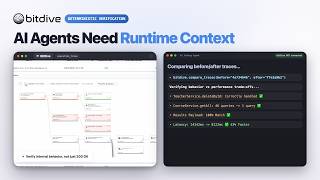
Trace-Based Verification for Java Changes with BitDive
bitdive_io
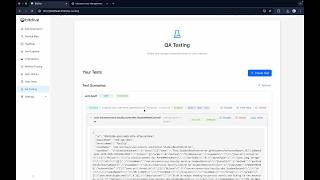
Replay Testing for Microservices, Auto Mocks from Traces, JUnit Maven CI
bitdive_io
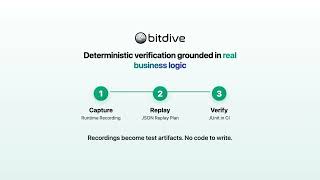
Replay to JUnit: Regression Tests for Java from Runtime Behavior
bitdive_io
YouTube returned 6 videos for “BitDive”, and we withheld 3: 3 could not be judged, because “BitDive” is a single word that other videos use for other things. Showing the 3 we can prove are about BitDive.
Official links
Tools that pair well with BitDive
Common stack mates teams adopt alongside BitDive, with the specific reason each pairing earns its keep.

Bronco AI
AI platform for chip verification that finds bugs on 100GB+ waveforms, triages nightly regressions, and speeds UVM bring-up before tape-out.

Human Behavior
AI session replay that watches every session, triages the bugs it finds, and opens pull requests to fix them.

Chrome DevTools MCP
Open-source MCP server that gives coding agents live Chrome DevTools access for debugging, automation, and performance traces.
Featured Head-to-Head Comparisons
Bitdive vs Spider Cloud
Spider Cloud and BitDive solve entirely different problems. Choose Spider Cloud if you need fast, AI-friendly web data extraction for RAG or agent workflows — its new Browser AI commands and scraper catalog make it easy to start. Choose BitDive if you are a Java/Spring team seeking runtime verification for AI-generated code and deterministic regression tests. There is no direct overlap.
Bitdive vs Temporal Ai
Temporal AI is the right choice for teams building resilient, long-running workflows and AI agents that need fault tolerance and state persistence across failures. BitDive is ideal for Java/Spring Boot teams who want to verify AI-generated code changes and automate regression testing with real runtime traces. Choose Temporal if you need cross-language durability and human-in-the-loop; choose BitDive if your stack is JVM and you prioritize trace-based test generation.
Bitdive vs Voyage Ai
Choose Voyage AI if you need high-accuracy domain-specific embeddings for RAG in finance/legal. Choose BitDive if you're a Java developer needing runtime verification and automated tests for AI-generated code changes. They solve different problems—no direct competition.
Alternatives to BitDive
View all
Bronco AI
AI platform for chip verification that finds bugs on 100GB+ waveforms, triages nightly regressions, and speeds UVM bring-up before tape-out.

Human Behavior
AI session replay that watches every session, triages the bugs it finds, and opens pull requests to fix them.

Chrome DevTools MCP
Open-source MCP server that gives coding agents live Chrome DevTools access for debugging, automation, and performance traces.
Frequently Asked Questions
Used BitDive? Help shape our editorial sentiment research.