CertPing
Enterprise certificate lifecycle management with zero-touch automation across hybrid clouds.
CertPing delivers real visibility into certificate estates with a genuinely useful free tier and scalable pay-as-you-go pricing. Its automated provisioning across major clouds and CAs eliminates manual work, but advanced features like HashiCorp Vault integration and SSO are locked behind the enterprise plan. Best for security teams needing automated lifecycle management without upfront investment.
Verified 3d ago · liveness 67/100 · cite: rightaichoice.com/tools/certping
- Enterprise security teams managing large certificate estates across hybrid clouds
- DevOps engineers automating certificate lifecycles with native cloud provisioning
- PKI administrators seeking crypto-agility and post-quantum readiness
- Brand protection analysts monitoring look-alike phishing domains and trademark conflicts
- Individual developers with only a handful of certificates (free tier limits apply)
- Teams needing on-premises deployment only (no self-hosted option)
- Organizations looking for a free forever plan with unlimited monitors
We scan live Reddit threads, YouTube comments, X posts, G2 reviews and other communities — and hand you an honest verdict in under a minute.
- Honest verdict, not marketing
- Real pros & cons from real users
- Attributed quotes with receipts
3 free scans · no card needed
Skip CertPing if you manage fewer than a handful of certificates and the free tier's 1-certificate limit is too constraining, or if you require fully on-premises deployment, mobile/desktop apps, or unlimited free monitoring.
Going beyond the free tier's 1 TLS certificate means paying $30 per managed certificate per month—so a 100-certificate estate costs $3,000/mo just for the platform, before CA fees.
CertPing's pay-as-you-go pricing at $30 per managed certificate per month is transparent and scales with usage, making it cheaper than legacy PKI platforms like Venafi or Keyfactor that require annual enterprise contracts. For small teams, the free tier is generous, but for large estates, costs can rival enterprise competitors—though you avoid upfront licensing fees.
In short
CertPing — Enterprise certificate lifecycle management with zero-touch automation across hybrid clouds. Best for Enterprise security teams managing large certificate estates across hybrid clouds, DevOps engineers automating certificate lifecycles with native cloud provisioning, PKI administrators seeking crypto-agility and post-quantum readiness. Free to start; paid plans from $30/mo.
What people actually say about CertPing — is it worth it?
We ran a structured research pass across product reviews, community discussions, and post-purchase forum threads to surface the patterns vendors won't publish themselves. Below: the recurring strengths, the hidden costs people mention most, and the cohort that consistently regrets adopting this tool.
3 mentions across 1 source (Product Hunt) · researched Jul 5, 2026.
- +Freemium pricing lowers entry barrier for small teams.
- +Unifies SSL monitoring, issuance, and brand protection in one tool.
- +Automates certificate renewal across major cloud providers.
- +Includes anti-phishing and look-alike domain detection.
- +Zero-touch provisioning to AWS ACM, Azure Key Vault, F5.
- −Community feedback is extremely sparse and not independently verified.
- −No mention of support response times or quality.
- −Integration with less common CAs may be limited.
- −Documentation and tutorials not widely reviewed yet.
- −Long-term reliability unproven in production environments.
- • Premium support may be locked behind enterprise plans
- • Advanced integrations might require higher tier
Viability Score
How well maintained and how widely used is CertPing? Built from what the vendor actually publishes (docs, changelog, tutorials, integrations, pricing), whether the site is live, and how much real users discuss it. How we calculate this
Last calculated: August 2026
How we score →Key Features
- Certificate discovery across cloud, Kubernetes, edge, and private stores
- Zero-touch issuance, renewal, and deployment to AWS ACM
- Zero-touch issuance, renewal, and deployment to Azure Key Vault
- Zero-touch issuance, renewal, and deployment to Google Certificate Manager
- DNS-01 validation for Route 53, Cloudflare, GoDaddy, and more
- Legacy and post-quantum crypto inventory with cryptographic bill of materials (CBOM)
- Migration workflows targeting NIST-standard algorithms ML-KEM, ML-DSA, SLH-DSA
- Certificate Transparency log scanning to detect rogue and shadow certificates
- Auto-revocation of compromised certificates
- Policy-driven lifecycle governance with audit history
- Role-based access control and scoped credentials
- Enterprise SSO (SAML, OIDC), team management, and organization scope
- Anti-phishing monitors with WHOIS, DNS, mail, and TLS evidence correlation
- USPTO trademark tracking with attorney review workflow
- Website monitoring with DNS, connection, TLS, response, and content checks
About CertPing
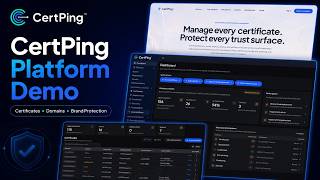
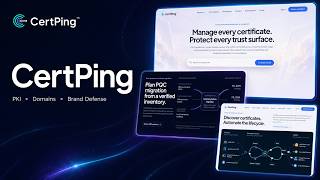
CertPing is an enterprise-grade certificate lifecycle management platform that discovers, issues, deploys, renews, and verifies certificates across cloud, Kubernetes, edge, and private infrastructure. It unifies domain, DNS, website monitoring, anti-phishing, and trademark operations in one workspace, giving security and DevOps teams a single control plane for every trust surface. Core capabilities include zero-touch automation with native provisioning to AWS ACM, Azure Key Vault, and Google Certificate Manager; DNS-01 validation via Route 53, Cloudflare, and GoDaddy; and auto-revocation of compromised certificates. CertPing continuously scans Certificate Transparency logs, DNS, and cloud environments to surface rogue, shadow, and non-compliant certificates, while its Security Intelligence engine monitors look-alike phishing domains and USPTO trademark conflicts. The platform also supports post-quantum readiness with a cryptographic bill of materials (CBOM) inventory and migration workflows targeting NIST-standard algorithms (ML-KEM, ML-DSA, SLH-DSA). CertPing integrates with major CAs (Let's Encrypt, DigiCert, Sectigo), cloud providers, and infrastructure tools like Kubernetes, Akamai, NGINX, IIS, and HAProxy. With a free tier that includes full core workflows, CertPing is accessible for teams that want to start small and scale without large upfront commitments. Unlike Keyfactor or Venafi, certification management with CertPing avoids expensive licensing, making it an attractive option for organizations seeking visibility and automation without vendor lock-in.
Behind the Verdict
CertPing is a practical choice for security and DevOps teams that have outgrown spreadsheet-based certificate tracking but are not ready for the heavy licensing of legacy PKI platforms like Keyfactor or Venafi. The free tier is unusually generous—you get the full core platform with a manageable 1 TLS certificate, 3 website monitors, and 1 anti-phishing scan, which is enough to pilot the workflow before committing. The Pay As You Go model at $30 per managed certificate per month plus metered protection fees is transparent and scales with usage, so you are not paying for unused capacity. Strengths: the zero-touch provisioning to AWS ACM, Azure Key Vault, and Google Certificate Manager is a genuine time-saver; the DNS-01 validation across Route 53, Cloudflare, and GoDaddy covers the most common setups; the CBOM inventory and PQC migration workflows are forward-looking and rare in this price range; the anti-phishing and trademark monitoring add a brand-protection layer that most certificate tools ignore. Weaknesses: the free tier's quota limits mean you will hit a paywall quickly if you manage more than a handful of certificates, and 'support' is not clearly documented—there is no visible phone or chat option, so you are largely on your own. The platform is cloud-centric; if you need fully on-premises deployment, this is not a fit. Also, CertPing charges you for the management platform, not the certificate itself, so the $30/mo per certificate is on top of any CA fees you pay—though Let's Encrypt certificates remain free. Where it fits: security teams in mid-size to large enterprises that operate across AWS, Azure, and GCP, and need automated lifecycle management without vendor lock-in. DevOps engineers automating Let's Encrypt at scale will find the DNS-01 workflow particularly useful. Where it doesn't: individual developers with a handful of certificates (the free tier limits make it overkill), teams that require on-premises deployment, and organizations that expect mobile or desktop apps.
Researching CertPing? Get your full AI stack in 60 seconds.
Free, no signup — tell us your goal and get tools matched to your budget & existing stack.
Real-world workflow fit
Concrete scenarios for the personas CertPing actually fits — and what changes day-one when you adopt it.
Your team manages certificates across AWS, Azure, and GCP, and manual renewals are causing frequent outages. You sign up for CertPing's PAYG plan and connect your cloud providers and DNS zones.
Outcome: Within a day, CertPing discovers all existing certificates, attaches ownership and policy, and automates issuance, renewal, and deployment to AWS ACM, Azure Key Vault, and Google Certificate Manager. You cut renewal time by 90% and eliminate expired-cert incidents.
You need audit-ready proof that certificates are valid and comply with CA/Browser Forum baselines. You use CertPing's free tier to scan your limited estate.
Outcome: CertPing's CBOM inventory and lifecycle audit history give you a real-time view of every certificate's validity, ownership, and policy compliance. You generate reports for PCI DSS and CA/Browser Forum baselines in minutes, replacing manual spreadsheets.
You're monitoring for phishing domains that impersonate your brand. You set up CertPing's anti-phishing monitor and trademark tracking.
Outcome: CertPing compares suspicious domains against your protected name, correlates WHOIS, DNS, and TLS evidence, and flags look-alikes. You see a continuous feed of potential impersonations and resolve them with evidence-backed investigations.
Use Cases
- Automate Let's Encrypt certificate issuance and renewal for 2,000+ certificates with DNS-01 validation.
- Detect rogue certificates issued for your domain via CT log monitoring.
- Plan post-quantum migration using CBOM inventory and NIST-standard target algorithms.
- Provision certificates to AWS ACM, Azure Key Vault, and F5 with zero-touch automation.
- Monitor look-alike phishing domains and USPTO trademark conflicts for brand protection.
- Generate compliance audit reports for PCI DSS and CA/Browser Forum baselines.
Limitations
- The Free plan is quota-limited (1 TLS certificate, 3 website monitors, 1 anti-phishing scan, 1 trademark scan) and requires sign-in.
- Pay As You Go removes usage caps with metered billing at $30 per managed certificate.
- CertPing fees cover the management platform, not certificate costs; Let's Encrypt certificates are free, but third-party CA and domain fees are separate.
- The evidence does not describe on-premises deployment, mobile or desktop apps, or specific API rate limits.
as of 2026-08-21
Verification history
We have re-verified CertPing 6 times since . Each pass re-reads the vendor's own pages and re-checks every listed field against that evidence; passes where nothing had changed are marked as such.
- — re-verified summary, description, our verdict, our analysis, pricing model, pricing tiers, features, integrations, who it suits, who should skip it
- — re-verified summary, description, our verdict, our analysis, pricing model, pricing tiers, features, integrations, who it suits, who should skip it
- — re-checked, vendor evidence unchanged
- — re-verified summary, description, our verdict, our analysis, pricing model, pricing tiers, features, integrations, who it suits, who should skip it
- — re-verified summary, description, our verdict, our analysis, pricing model, pricing tiers, features, integrations, who it suits, who should skip it
- — re-verified summary, description, our verdict, our analysis, pricing model, pricing tiers, features, integrations, who it suits, who should skip it
Free to cite with attribution — this page re-verifies continuously.
12-month cost
Project the real annual outlay, including the implied monthly cost when only an annual tier is published.
Vendor list price only. Add-on usage, seat overages, and contract minimums are surfaced under Hidden costs & gotchas.
Plans compared
For each published CertPing tier: who it actually fits, and what it adds vs. the previous tier. Cross-reference the cost calculator above for projected annual outlay.
Free
$0/mo
Ideal for
Solo developers or small teams wanting to pilot certificate lifecycle management with a single TLS certificate and basic monitoring, without any platform fee.
What this tier adds
Starter tier with full core workflows but quota-limited to 1 TLS certificate, 3 website monitors, and 1 anti-phishing scan; no free domain included.
Pay As You Go
$30 per managed certificate/mo
Ideal for
Growing teams that need unlimited certificates and automation across clouds, DNS, and edge, with metered billing that scales with usage.
What this tier adds
Removes all Free plan quotas with metered billing at $30 per managed certificate per month, plus optional monitoring from $1.99 per monitor; Let's Encrypt certificates remain free.
Where the pricing makes sense
The company stage and team size where CertPing's pricing actually pencils out — and where peers do it cheaper.
CertPing's pay-as-you-go pricing at $30 per managed certificate per month is transparent and scales with usage, making it cheaper than legacy PKI platforms like Venafi or Keyfactor that require annual enterprise contracts. For small teams, the free tier is generous, but for large estates, costs can rival enterprise competitors—though you avoid upfront licensing fees.
Setup time & first value
How long it actually takes to get something useful out of CertPing — broken out by persona, not the marketing-page minute.
For a single-person pilot, you can sign in, connect a cloud provider (e.g., AWS) and a DNS provider (e.g., Cloudflare), and get certificate discovery running in under an hour. Setting up the full lifecycle automation (issuance, deployment, and monitoring) typically takes 2–4 hours, depending on how many environments you connect. Most teams see first value within a day.
Switching to or from CertPing
How to bring data in from common predecessors and how to get it back out — written for the switcher, not the buyer.
- →From Spreadsheets: import certificate inventory via CSV and let CertPing discover live certificates from connected cloud accounts to replace manual tracking.
- →From Venafi: connect your CA (e.g., DigiCert) and cloud providers; CertPing's discovery and automation can handle lifecycle management, and you can stop renewing via Venafi's agents.
- ↗To Venafi: export certificate inventory and audit logs from CertPing; set up Venafi's connectors to your CAs and cloud providers to continue lifecycle management.
Integrations
Resources & Guides
Tutorials & Learning
Official links
Featured Head-to-Head Comparisons
Certping vs Audioeye
CertPing and AudioEye serve entirely different domains—certificate lifecycle management vs. web accessibility. Your choice depends on your compliance pain point: if you're battling SSL expiry and crypto-agility, CertPing's automation is a must; if you need ADA/WCAG compliance and legal protection, AudioEye's hybrid AI+human approach is better. Both are strong in their niches, so pick the one that matches your urgent risk.
Certping vs Push Security
Push Security and CertPing serve entirely different domains — browser security vs. certificate lifecycle management. Choose Push if your priority is blocking sophisticated browser attacks (AiTM, ClickFix) and controlling AI tool usage; choose CertPing if your challenge is certificate expiry, shadow IT subdomains, or crypto-agility. Neither is a direct competitor, so buying one does not exclude the other.
Certping vs Temporal Ai
Temporal AI and CertPing serve entirely different needs. Choose Temporal AI if you're building resilient AI agents or multi-step microservices that require fault-tolerant orchestration. Choose CertPing if you're an enterprise security team needing automated certificate lifecycle management and threat detection. They are not direct competitors; your choice depends on whether you need durable execution or certificate security.
Popular in Security & Privacy


Frequently Asked Questions
Topics
Used CertPing? Help shape our editorial sentiment research.