
Chord Commerce
Chord turns Shopify commerce data into agent actions — plain-language answers, ad spend optimization, and campaign execution without SQL or
Chord is worth a serious look precisely because its agents push changes to ad platforms and email instead of narrating a dashboard. The Context Layer is the thing to interrogate in a demo: ask how it encodes your business rules and where its answers have been wrong. It's Shopify-scoped, so non-Shopify stacks and thin-data startups should pass.
Verified 19h ago · liveness 74/100 · cite: rightaichoice.com/tools/chord-commerce
- Shopify DTC brands with data spread across half a dozen disconnected tools
- Mid-market to enterprise commerce operators with real data volume to unify
- Marketing and ops teams who spend the week pulling reports instead of acting
- Brands trying to consolidate martech spend into one platform
- Solo founders or pre-revenue startups with thin data to feed the foundation
- Brands running commerce on platforms other than Shopify
- Teams that only want faster dashboards rather than closed-loop action
We scan live Reddit threads, YouTube comments, X posts, G2 reviews and other communities — and hand you an honest verdict in under a minute.
- Honest verdict, not marketing
- Real pros & cons from real users
- Attributed quotes with receipts
3 free scans · no card needed
Skip Chord if you run commerce on a non-Shopify platform, have too little order and ad data for agents to learn from, or need an analytics tool you can set up and pay for without speaking to a sales team.
Implementation and business-rule configuration are part of onboarding, so budget internal or vendor time before agents give reliable answers.
Chord is priced for mid-market and enterprise DTC brands through a conversation with the vendor's account team, which puts it in the same bracket as warehouse-plus-BI and enterprise CDP stacks rather than self-serve analytics tools like Supermetrics. Small brands under roughly a few hundred orders a month will find the setup and contract overhead hard to justify; larger operators get a single platform where they previously paid for several tools.
In short
Chord Commerce — Chord turns Shopify commerce data into agent actions — plain-language answers, ad spend optimization, and campaign execution without SQL or. Best for Shopify DTC brands with data spread across half a dozen disconnected tools, Mid-market to enterprise commerce operators with real data volume to unify, Marketing and ops teams who spend the week pulling reports instead of acting. Contact Sales pricing.
No head-to-head comparison for Chord Commerce yet — the alternatives below are the closest matches we list.
What's new in Chord Commerce
Checked todayAcross the latest 2 updates: 1 feature update and 1 launch.
Introducing the Enriched Context Stack
Chord shipped the Enriched Context Stack, enhancing AI accuracy with layered context including schema understanding, business rules, and memory from past interactions.
Introducing Chord AI: AI That Actually Works for Commerce
Chord AI moved the platform beyond reporting into real decisioning, enabling agents to take direct actions across the commerce stack.
What people actually say about Chord Commerce — is it worth it?
We ran a structured research pass across product reviews, community discussions, and post-purchase forum threads to surface the patterns vendors won't publish themselves. Below: the recurring strengths, the hidden costs people mention most, and the cohort that consistently regrets adopting this tool.
9 mentions across 2 sources (YouTube, Product Hunt) · researched Oct 9, 2026.
Weighted by the 21 posts each of 2 sources contributed.
- +Plain-language querying that returns direct answers instead of dashboards is genuinely appealing to non-SQL operators
- +Unifies Shopify, ad platforms, CDPs, and ERPs into one source of truth for DTC brands
- +Enriched Context Stack aims to ground AI answers and reduce hallucinations via schema and business rules
- +Agents close the loop from insight to action across ads, email, and SMS
- +Strong Shopify-native fit for mid-market DTC operators already in that ecosystem
- −No genuine independent reviews exist anywhere in the data — claims are entirely unverified
- −Public search returns unrelated scam warnings and gadget videos, muddying due diligence
- −Product Hunt commenters question why it costs so much versus cheaper alternatives like Medusa
- −Pricing is opaque 'contact us' with no published tiers or free plan
- −Hard-coded to Shopify, so non-Shopify or multi-platform brands are excluded
- • No published pricing means true cost is only revealed after a sales conversation
- • A Product Hunt commenter explicitly flagged the price as high versus open-source alternatives
- • Bundled migrations and data-foundation setup effort is not itemized
Viability Score
How well maintained and how widely used is Chord Commerce? Built from what the vendor actually publishes (docs, changelog, tutorials, integrations, pricing), whether the site is live, and how much real users discuss it. How we calculate this
Last calculated: October 2026
How we score →Key Features
- Data Foundation unifying Shopify, ad platforms, CDPs, and ERPs into one source of truth
- Context Layer applying schema understanding, business rules, and institutional knowledge
- Enriched Context Stack (April 2026) for grounded, lower-hallucination AI responses
- Agents that take direct actions across the commerce stack, not just report metrics
- Plain-language data querying with grounded answers — no SQL or dashboards
- Automated insight generation surfacing meaningful patterns in commerce data
- High-impact recommendations you can act on immediately
- Ad spend optimization across Meta, Google, TikTok, and other paid channels
- Audience refinement and campaign optimization driven by agents
- Predictive models for churn, LTV, and next-purchase likelihood
- Real-time churn prediction and win-back campaign triggers
- Identity resolution to unify scattered customer profiles
- Push enriched segments into email and SMS platforms such as Klaviyo and Braze
- Martech consolidation to cut redundant tool spend
About Chord Commerce
Chord is an AI-native data platform for commerce brands that want agents to act on their data, not just report on it. It's built for mid-market and enterprise DTC operators whose numbers are scattered across Shopify, ad platforms, a CDP, and email tools — teams spending more time assembling reports than acting on them. The vendor cites operators at Sonos, Rodan + Fields, Blue Bottle Coffee, Ruggable, and MrBeast as proof points. The platform stacks three layers. A Data Foundation ingests and unifies data from Shopify, ad platforms, CDPs, and ERPs into one source of truth. The Context Layer — reinforced by the Enriched Context Stack shipped in April 2026 — applies schema understanding, business rules, institutional knowledge, and memory from past interactions so answers stay grounded. Agents sit on top and execute: optimizing ad spend, refining audiences, and triggering actions in email and SMS. You ask a question in plain language and get a direct answer. The vendor's own example: "Which campaigns drove the highest LTV customers last quarter?" returns a channel breakdown (Paid Social on Meta at 43%, email re-engagement second at 28%) rather than a dashboard to interpret. Chord reports an 86% reduction in reporting hours, 2x faster campaign launches, and 27%+ lower martech spend from consolidation. Against Looker, Supermetrics, or a warehouse-plus-BI stack, Chord pitches itself as the end-to-end replacement that closes the loop from question to action. That scope is genuinely Shopify DTC — brands running commerce elsewhere should look at different tooling.
Behind the Verdict
The interesting claim here isn't the plain-language querying — plenty of tools do text-to-SQL now. It's that Chord's agents take action: adjusting ad spend, refining audiences, triggering win-back campaigns. If your team's bottleneck is the handoff between "we know X" and "someone changed the campaign," that gap is exactly what Chord is selling against. We'd reach for Chord when you're a Shopify DTC brand big enough to have real data volume and messy enough to have six tools that don't talk. The Data Foundation plus Context Layer story is aimed at the specific pain of AI answers you can't trust because nobody encoded your business rules. The April 2026 Enriched Context Stack is the vendor's answer to that, and it's the part of the demo worth the most scrutiny. When to pass: if you run commerce on anything other than Shopify, the core premise weakens fast. If you only want faster dashboards rather than closed-loop action, a BI tool plus a warehouse will likely cost less and do the reporting job fine. And if you're a small brand with thin data, an agent platform has little to chew on. The tradeoff to weigh is scope versus control. Chord consolidates martech and closes the loop, which is the appeal — but that means trusting an agent to touch live campaigns and spend. Ask hard questions about approval workflows, audit trails, and rollback before you hand over the keys. Closest alternative depends on what you're replacing. Against Looker or a warehouse-plus-BI setup, Chord wins on action but you give up some analytical flexibility. Against Supermetrics, you're trading connector breadth for agent execution. In practice, the vendor's reported numbers (86% fewer reporting hours, 2x faster launches, 27%+ lower martech spend) are the right benchmarks to build your own pilot
Researching Chord Commerce? Get your full AI stack in 60 seconds.
Free, no signup — tell us your goal and get tools matched to your budget & existing stack.
Real-world workflow fit
Concrete scenarios for the personas Chord Commerce actually fits — and what changes day-one when you adopt it.
Asks Chord which campaigns drove the highest-LTV customers last quarter, then routes the high-LTV look-alike segment straight into Facebook Ads.
Outcome: Paid Social on Meta drove 43% of customers with LTV over $500 in Q4, up from 31% in Q3, and the look-alike audience is live without a manual export.
Uses Chord's churn prediction to identify at-risk customers and trigger a win-back flow through Klaviyo.
Outcome: Win-back campaigns fire from predicted churn rather than a static inactivity rule, and enriched profiles land back in Klaviyo for personalization.
Has agents generate the weekly business review across Shopify, ad platforms, and Amplitude.
Outcome: Reporting hours drop substantially, and the team reviews recommendations instead of assembling dashboards.
Use Cases
- Ask 'Which campaigns drove the highest LTV customers last quarter?' and get a grounded answer without SQL.
- Automatically send look-alike audiences to Facebook Ads based on AI-predicted high-LTV segments.
- Unify Shopify, Klaviyo, and ad platform data into a single customer profile for a 360-degree view.
- Trigger win-back campaigns based on real-time churn predictions from Chord agents.
- Cut reporting hours by letting agents generate weekly business reviews automatically.
- Sync enriched customer data back to Braze or Klaviyo for personalized email campaigns.
- Monitor ad spend efficiency and get recommendations to reallocate budget across channels.
- Predict LTV of new customers using AI models and adjust acquisition strategies accordingly.
Limitations
- Chord's value depends on connecting it to the rest of a commerce stack — it ingests from 38 platforms (Shopify, ad platforms, CDPs, ERPs) and pushes to others, so brands not on supported integrations get little from it.
- Getting accurate results requires upfront grounding: business rules, schema understanding, and institutional context must be configured before AI answers are trustworthy.
- Pricing is arranged through a conversation with Chord's account team rather than a published self-serve tier, which slows down trials for small teams and makes budget planning harder.
as of 2026-09-29
Verification history
We have re-verified Chord Commerce 18 times since . Each pass re-reads the vendor's own pages and re-checks every listed field against that evidence; passes where nothing had changed are marked as such.
- — re-verified summary, description, our verdict, our analysis, pricing model, pricing tiers, features, integrations, who it suits, who should skip it
- — re-verified summary, description, our verdict, our analysis, pricing model, pricing tiers, features, integrations, who it suits, who should skip it
- — re-verified summary, description, our verdict, our analysis, pricing model, pricing tiers, features, integrations, who it suits, who should skip it
- — re-verified summary, description, our verdict, our analysis, pricing model, pricing tiers, features, integrations, who it suits, who should skip it
- — re-verified summary, description, our verdict, our analysis, pricing model, pricing tiers, features, integrations, who it suits, who should skip it
- — re-verified summary, description, our verdict, our analysis, pricing model, pricing tiers, features, integrations, who it suits, who should skip it
Showing the 6 most recent of 18 verification passes.
Free to cite with attribution — this page re-verifies continuously.
Where the pricing makes sense
The company stage and team size where Chord Commerce's pricing actually pencils out — and where peers do it cheaper.
Chord is priced for mid-market and enterprise DTC brands through a conversation with the vendor's account team, which puts it in the same bracket as warehouse-plus-BI and enterprise CDP stacks rather than self-serve analytics tools like Supermetrics. Small brands under roughly a few hundred orders a month will find the setup and contract overhead hard to justify; larger operators get a single platform where they previously paid for several tools.
Setup time & first value
How long it actually takes to get something useful out of Chord Commerce — broken out by persona, not the marketing-page minute.
Expect a few weeks to first value: onboarding connects Shopify, ad platforms, and your CRM, then configures schema and business rules in the Context Layer before agents give answers you can act on. A growth lead asking a first question takes minutes once data is connected, but reliable agent execution usually needs a guided implementation alongside Chord's team.
Switching to or from Chord Commerce
How to bring data in from common predecessors and how to get it back out — written for the switcher, not the buyer.
- →From Looker or a warehouse-plus-BI stack: connect Shopify, ad platforms, and CDPs to the Data Foundation, then rebuild key reports as plain-language questions.
- →From Supermetrics plus spreadsheets: replace manual ad-platform exports with unified ingestion and let agents generate the recurring reporting output.
- →From a legacy CDP: run identity resolution inside Chord and push enriched profiles back to Klaviyo or Braze instead of maintaining a separate customer graph.
- ↗To a warehouse-plus-BI stack: export unified data and recreate reports in Looker, accepting manual work for the action layer.
- ↗To a self-serve analytics tool: move ad-platform reporting to Supermetrics if the closed-loop agent execution is not being used.
- ↗To your existing CDP and email platform alone: keep Klaviyo or Braze for activation and drop the commerce context layer.
Integrations
Resources & Guides
- Resourcechord.co
Book a Demo | Chord | Chord
Chord unifies your commerce data, adds the context AI needs, and deploys agents that optimize spend, audiences, and operations. Book a demo.
- Resourcechord.co
Integrations | 167+ Connections for Your Commerce Stack
Chord integrates with 167+ tools — connecting your commerce stack, unifying data into one model, and activating it across every platform your team relies on.
- Resourcechord.co
Knowledge Base
Helpful link from chord.co
- Resourcechord.co
Insights
Helpful link from chord.co
Tutorials & Learning
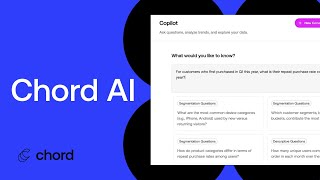
YouTube returned 6 videos for “Chord Commerce”, and we withheld 5: 5 did not mention Chord Commerce. Showing the 1 we can prove is about Chord Commerce.
Official links
Tools that pair well with Chord Commerce
Common stack mates teams adopt alongside Chord Commerce, with the specific reason each pairing earns its keep.

Chat2DB
Chat2DB turns plain English into SQL across 40+ databases in an open-source AI SQL client that keeps query execution on your own machine.

OpenAgents
OpenAgents is an open-source language agent platform for data analysis, 200+ plugins and autonomous web browsing.

Formula Bot
Better Analyst (formerly Formula Bot) turns plain-English questions into charts, dashboards, and automated data workflows.
Alternatives to Chord Commerce
View allChat2DB
Chat2DB turns plain English into SQL across 40+ databases in an open-source AI SQL client that keeps query execution on your own machine.

OpenAgents
OpenAgents is an open-source language agent platform for data analysis, 200+ plugins and autonomous web browsing.
Formula Bot
Better Analyst (formerly Formula Bot) turns plain-English questions into charts, dashboards, and automated data workflows.
Frequently Asked Questions
Best-of guides
Used Chord Commerce? Help shape our editorial sentiment research.