
Fact0
Open-source agent audit and replay: hash-chained records, signed exports, self-hosted on your own Docker Compose stack.
Pick Fact0 if you want agent audit history that stays on your own hardware and you are willing to run PostgreSQL and a dashboard yourself. The hash chain, execution replay, and Ed25519-signed evidence packs cover the mechanics compliance reviewers actually ask to see, and the docs are unusually candid — capture status is marked partial or unavailable with a reason, and the vendor states the ZIP itself is not signed. Pass if you need managed hosting, multi-user workspaces, or policy enforcement; the vendor calls this experimental software for one owner and one workspace, and Datadog or Splunk fit general-purpose logging better. Test it against your own instrumentation before trusting it as
Verified 5d ago · liveness 73/100 · cite: rightaichoice.com/tools/fact0
- AI engineering teams that want agent audit history kept on their own infrastructure
- Security reviewers who need replayable execution records plus signed PDF evidence
- Teams running Python agents that need tool-call and execution span records
- Developers who want a record of Claude Code sessions
- Teams that need hosted billing, team invitations, or role-based access control
- Buyers looking for compliance certification, policy enforcement, or an SLA
- Anyone unwilling to run and maintain Docker Compose, PostgreSQL, and upgrades themselves
We scan live Reddit threads, YouTube comments, X posts, G2 reviews and other communities — and hand you an honest verdict in under a minute.
- Honest verdict, not marketing
- Real pros & cons from real users
- Attributed quotes with receipts
3 free scans · no card needed
Skip Fact0 if you want a managed audit service with team seats, role-based access control or policy enforcement, rather than a Docker Compose stack you install, back up, upgrade and secure yourself.
Running this on your own hardware means you pay for the PostgreSQL storage, backups and TLS termination it needs — the license is MIT, but the infrastructure bill lands on you
Fact0's pricing fits teams whose volume aligns with the published tiers. Compare against the alternatives listed below for stage-specific value.
In short
Fact0 — Open-source agent audit and replay: hash-chained records, signed exports, self-hosted on your own Docker Compose stack. Best for AI engineering teams that want agent audit history kept on their own infrastructure, Security reviewers who need replayable execution records plus signed PDF evidence, Teams running Python agents that need tool-call and execution span records. Free to start; paid plans from $79/mo.
What's new in Fact0
Checked 6 days agoAcross the latest 4 updates: 1 feature update and 3 changelog entries.
v1.2.2 - Observability Analytics Fix & Dashboard UX
Fixed a 500 error in analytics and added contextual help sheets and page-local tours to six dashboard pages.
Go SDK v1.0.4
Resolved Go module path resolution issues for correct package installation.
SDK v1.0.5 / v1.0.3
Fixed Python event_id preservation and a Go socket leak in the HTTP retry loop.
v1.2.1 - LLM Traces Dashboard & Database Immutability
Added LLM Traces dashboard, PostgreSQL trigger for audit immutability, share link token reveal, and evidence pack public keys.
What people actually say about Fact0 — is it worth it?
We ran a structured research pass across product reviews, community discussions, and post-purchase forum threads to surface the patterns vendors won't publish themselves. Below: the recurring strengths, the hidden costs people mention most, and the cohort that consistently regrets adopting this tool.
28 mentions across 3 sources (YouTube, Product Hunt, Bluesky) · researched Jul 4, 2026.
Average across the 3 sources that answered — each source counts once, not each post.
- +Hash-chained ledger with SHA-256 and Ed25519 cryptography provides tamper-evident logs.
- +Supports multiple SDKs (Python, TypeScript, Go) for flexibility.
- +Natively integrates with OpenTelemetry, LangChain, LangGraph, and FastAPI.
- +Generates signed evidence packs (PDF/JSON) and read-only auditor share links.
- +Free tier offers 30,000 events/month — good for early prototyping.
- −Zero real user feedback — cannot verify reliability or ease of use.
- −Only 18 Product Hunt upvotes, no organic community buzz anywhere.
- −Off-topic YouTube and Bluesky posts waste scraping effort.
- −No reviews from Reddit, HN, GitHub, or App Store to trust.
- −Potential lock-in: proprietary audit ledger if no export standard.
- • Overage fees not specified
- • Enterprise pricing is opaque
Viability Score
How well maintained and how widely used is Fact0? Built from what the vendor actually publishes (docs, changelog, tutorials, integrations, pricing), whether the site is live, and how much real users discuss it. How we calculate this
Last calculated: October 2026
How we score →Key Features
- Hash-chained audit ledger with integrity checks on stored events
- Ed25519 cryptographically signed evidence packs
- PDF reports and JSON evidence exports in a ZIP archive
- Authenticated share links with token reveal for auditors
- Execution DAG visualization and timing waterfall
- Step-by-step replay of recorded runs without rerunning the agent
- LLM Traces dashboard for inspecting agent runs
- PostgreSQL trigger enforcing database-level audit immutability
- Capture status reporting (partial / unavailable with reasons)
- Python SDK for recording spans, tool calls and audit events
- Claude Code plugin for capturing coding sessions
- Go SDK for instrumenting agent services
- Metadata and hash capture modes to reduce content sent to the API
- Self-hosted deployment via Docker Compose (Go API, Next.js dashboard, PostgreSQL)
- Owner password login with authenticated ingestion and inspection
About Fact0
Fact0 is MIT-licensed agent audit software you run on your own infrastructure instead of a hosted service. It ships as a Docker Compose stack — a Go API, a Next.js dashboard, and PostgreSQL — that you point your agents at. Python agents connect through the SDK to record execution spans, tool calls, tool results, supported model content, and audit events. Claude Code sessions connect through a dedicated plugin that keeps a record of prompts, assistant text, tool calls, and errors while Claude keeps using your existing model configuration. Raw capture is the default, and missing, malformed, or unsupported content is reported explicitly as partial or unavailable with a reason. The core of the product is the record. A hash-chained audit ledger lets you check that stored events are consistent with their hashes and preceding links. Execution history shows the path of a run across a graph, a timing waterfall, and recorded spans. Replay reconstructs a saved run step by step — it explicitly does not rerun the agent. Signed exports produce authenticated PDF reports and evidence ZIPs, where the PDF and verification JSON match a separately trusted instance public key; the ZIP archive itself is not signed. Setup creates one owner and one workspace, with no Fact0 cloud account required. Where it sits against alternatives: general observability platforms collect telemetry but are not built to produce verifiable, hash-linked history you can hand to an auditor. Fact0 aims at that narrower job. The tradeoff is scope and maturity — the vendor labels it experimental software for one owner and one workspace, and states plainly that audit verification does not turn missing capture into complete evidence. Recent releases added an LLM Traces dashboard, a PostgreSQL trigger enforcing database-level audit immutability, share-link token reveal, and evidence-pack public keys; v1.2.2 fixed an analytics 500 error and added contextual help sheets and page-local tours across six dashboard pages.
Behind the Verdict
Fact0's selling point is the shape of the artifact, not the breadth of the platform. A hash-chained ledger you can verify against hashes and preceding links, Ed25519-signed evidence packs, and a PDF plus verification JSON that match a separately trusted instance public key — that is a different deliverable from a telemetry dashboard. If your compliance reviewer asks "show me this agent's tool calls in order, and prove the record was not edited afterward," this is built for that question. Execution history moves between a DAG, a timing waterfall, and recorded spans, and replay walks the saved events at your own pace without rerunning the agent, which matters when a run is expensive or non-deterministic. Onboarding is genuinely two paths. Python agents get an SDK that records spans, tool results, supported model content and audit events; the included example runs a nested execution with a successful tool and a handled failure and needs no model account. Claude Code gets a collector and plugin that capture supported prompts, assistant text, tool calls and errors without touching your model configuration. Metadata and hash capture modes reduce what content reaches the API, and the Claude collector keeps a private local retry spool. The weaknesses are structural, not cosmetic. Capture depends on your instrumentation for Python and on supported hooks and transcript formats for Claude — the vendor says outright that it does not capture every agent action, and that complete capture, truthful source data, regulatory compliance, and protection from an administrator replacing the whole history all fall outside the guarantee. Recent releases are maintenance-scale: v1.2.2 fixed a 500 error in analytics and added contextual help sheets and page-local tours to six dashboard pages, Go SDK v1.0.4 fixed module path resolution, and SDK v1.0.5/v1.0.3 fixed Python event_id preservation and a Go socket leak in the HTTP retry loop. That is a young codebase being hardened, and you own the upgrades, backups, TLS and disk usage. Where it fits: AI engineering teams that already run their own Postgres and want agent audit history on their own infrastructure, and security reviewers who need replayable execution records plus signed PDF evidence. Where it does not: anyone wanting a managed service, role-based access control, policy enforcement, or an SLA — and note the documented setup supports Linux and macOS only, with Docker Compose v2, Python 3 and OpenSSL 1.1.1+ as prerequisites.
Researching Fact0? Get your full AI stack in 60 seconds.
Free, no signup — tell us your goal and get tools matched to your budget & existing stack.
Real-world workflow fit
Concrete scenarios for the personas Fact0 actually fits — and what changes day-one when you adopt it.
Install the Compose stack, create the owner, issue a local API key, then instrument the agent with the Python SDK so each execution span, tool call and tool result is recorded as a chained audit event.
Outcome: You open the execution history for the run, follow the DAG and timing waterfall, and replay the saved steps without rerunning the agent to see which tool call failed and in what order.
Pull the recorded events for the agents under review, check the audit chain against stored hashes and preceding links, then export the authenticated PDF and evidence ZIP and verify them against the trusted instance public key.
Outcome: You hand over a PDF and verification JSON that match the trusted key, with any capture gaps already labelled partial or unavailable rather than silently absent.
Run the plugin prepare step against your local API, launch Claude Code with the plugin directory, and capture supported prompts, assistant text, tool calls and errors while Claude keeps your existing model configuration.
Outcome: Your coding sessions land in the same workspace as your Python agent history, inspectable alongside everything else, with the collector holding a private local retry spool for anything it could not deliver immediately.
Use Cases
- Prove every tool permission and data access in fintech loan agents for regulators
- Track patient data access in healthcare administrative assistants with reduced content capture
- Show exactly what an autonomous support bot changed, refunded, or escalated
- Audit document deletes, shares, and AI-generated summaries for legal/HR workflows
- Produce verifiable evidence packs for enterprise security reviews
- Replay failed agent runs to debug and prove what happened
- Inspect prompts and tool calls from Claude Code coding sessions
Models Under the Hood
as of 2026-10-15
Limitations
- Capture is instrumentation-dependent and not total.
- Python capture depends on how you instrument the agent; Claude capture depends on supported hooks and transcript formats, and the vendor states plainly that it does not capture every agent action.
- Missing, malformed or unavailable content is reported as partial or unavailable with a reason — but the docs list complete capture, truthful source data, regulatory compliance, and protection from an administrator replacing the whole history as outside the guarantee.
- Raw capture can contain prompts, source code, personal data and secrets, so you own access control, backups and retention.
- The ZIP archive itself is not signed; only the PDF and verification JSON inside it are verifiable against a trusted instance public key.
- The documented setup supports Linux and macOS, requires Docker Compose v2, Python 3 and OpenSSL 1.1.1+, and the release does not migrate an existing installation — setup refuses an unknown nonempty database rather than rewriting it.
- Claude Code is the only documented integration.
- The vendor labels the software experimental, for one owner and one workspace.
as of 2026-10-02
Verification history
We have re-verified Fact0 8 times since . Each pass re-reads the vendor's own pages and re-checks every listed field against that evidence; passes where nothing had changed are marked as such.
- — re-checked, vendor evidence unchanged
- — re-verified summary, description, our verdict, our analysis, pricing model, pricing tiers, features, integrations, who it suits, who should skip it
- — re-verified summary, description, our verdict, our analysis, pricing model, pricing tiers, features, integrations, who it suits, who should skip it
- — re-verified summary, description, our verdict, our analysis, pricing model, pricing tiers, features, integrations, who it suits, who should skip it
- — re-verified summary, description, our verdict, our analysis, pricing model, pricing tiers, features, integrations, who it suits, who should skip it
- — re-verified summary, description, our verdict, our analysis, pricing model, pricing tiers, features, integrations, who it suits, who should skip it
Showing the 6 most recent of 8 verification passes.
Free to cite with attribution — this page re-verifies continuously.
12-month cost
Project the real annual outlay, including the implied monthly cost when only an annual tier is published.
Vendor list price only. Add-on usage, seat overages, and contract minimums are surfaced under Hidden costs & gotchas.
Where the pricing makes sense
The company stage and team size where Fact0's pricing actually pencils out — and where peers do it cheaper.
Fact0's pricing fits teams whose volume aligns with the published tiers. Compare against the alternatives listed below for stage-specific value.
Setup time & first value
How long it actually takes to get something useful out of Fact0 — broken out by persona, not the marketing-page minute.
For a Python agent: under an hour on Linux or macOS if Docker Compose v2, Python 3 and OpenSSL 1.1.1+ are already present — the initial build takes the longest, and the included synthetic example returns a result with no model account. For Claude Code: adding the collector and plugin to an existing Claude install is a short session. Budget extra for port conflicts and for deciding which capture
Switching to or from Fact0
How to bring data in from common predecessors and how to get it back out — written for the switcher, not the buyer.
- →From no audit trail at all: instrument your existing Python agent with the SDK and start recording spans, tool calls and audit events without rewriting the agent.
- →From Datadog or Splunk APM: keep your general telemetry where it is and add Fact0 only for the verifiable, hash-linked history those platforms do not produce.
- →From ad-hoc log files: replace unstructured agent logs with the hash-chained ledger so you can check stored events against their hashes and preceding links.
- ↗To Datadog or Splunk: if you need general-purpose logging, APM and a managed service rather than verifiable agent audit history, those platforms fit that job better.
- ↗To a managed observability vendor: export your recorded events before decommissioning the self-hosted stack, since the release does not migrate an existing installation for you.
Integrations
Resources & Guides
Tutorials & Learning
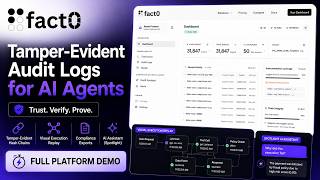
YouTube returned 6 videos for “Fact0”, and we withheld 5: 5 could not be judged, because “Fact0” is a single word that other videos use for other things. Showing the 1 we can prove is about Fact0.
Official links
Tools that pair well with Fact0
Common stack mates teams adopt alongside Fact0, with the specific reason each pairing earns its keep.

Fiddler AI
Fiddler AI is an enterprise AI control plane for agent observability, inline guardrails, and auditable AI governance.

Olares
Olares is an open-source personal AI cloud OS for running local LLMs, agents, and self-hosted apps on your own hardware.

Coro
Coro unifies endpoint, email, cloud and network security into one AI-agent workspace platform that auto-remediates 95% of threats.
Featured Head-to-Head Comparisons
Fact0 vs Sublime Security
Choose Fact0 if you need cryptographically verifiable audit trails for AI agents to pass enterprise security reviews, especially in regulated industries. Choose Sublime Security if you're an enterprise security team defending against advanced email threats like BEC/VEC with custom detection and low false positives. They serve entirely different domains.
Fact0 vs Audioeye
Fact0 and AudioEye are incomparable tools serving vastly different needs. Fact0 is for AI agent auditability in regulated industries, while AudioEye tackles web accessibility compliance. Choose Fact0 if you need tamper-evident agent logs to close enterprise deals; choose AudioEye if you need ADA/WCAG compliance to avoid lawsuits.
Fact0 vs Push Security
Fact0 and Push Security serve entirely different needs: Fact0 is a cryptographic audit trail for AI agents, essential for compliance in regulated industries, while Push Security is a browser-based threat detection platform for identity and security teams. Choose Fact0 if you need provable agent logs to pass enterprise security reviews; choose Push Security if you must defend against AiTM phishing, session hijacking, and AI tool data leaks.
Alternatives to Fact0
View all
Fiddler AI
Fiddler AI is an enterprise AI control plane for agent observability, inline guardrails, and auditable AI governance.


Frequently Asked Questions
Used Fact0? Help shape our editorial sentiment research.