
General Trajectory
Applied AI research company building foundation models that let robots, drones, and industrial machines act in the physical world.
General Trajectory is a research company first, and its public evidence is three named releases: IronBench (Sept 2026, 74.4% compliance on 900 held-out transformer specs), Phoenix (Mar 2026, onboard counter-UAS guidance resistant to jamming), and reward-guided dexterous manipulation (Nov 2025, 63% gains on hard objects). If your problem is learned control or design for real hardware, that work is worth reading closely. If you need a documented API, published docs, and a self-serve evaluation path, there is nothing here yet to evaluate. Compare against Hebbian Robotics' hflow for open robotics data pipelines if your gap is data infrastructure rather than control.
Verified 3d ago · liveness 63/100 · cite: rightaichoice.com/tools/general-trajectory
- Robotics and physical-AI research teams with a specific measurable task
- Advanced manufacturing groups exploring learned control or design automation
- Scientific R&D teams with an engineering design search problem
- Defense-adjacent teams working on autonomous systems and counter-UAS
- Production lines requiring deterministic microsecond-latency control
- Hobbyist robot builders on a tight budget
- Buyers wanting a packaged consumer or SaaS AI tool
We scan live Reddit threads, YouTube comments, X posts, G2 reviews and other communities — and hand you an honest verdict in under a minute.
- Honest verdict, not marketing
- Real pros & cons from real users
- Attributed quotes with receipts
3 free scans · no card needed
Skip General Trajectory if you need a documented, self-serve evaluation path today rather than a scoped research engagement on one task and one machine.
That places GT closer to a research engagement than a per-seat SaaS line item. Compare against open-source data infrastructure like Hebbian Robotics' hflow if part of your budget is being spent on pipeline plumbing rather than modeling.
In short
General Trajectory — Applied AI research company building foundation models that let robots, drones, and industrial machines act in the physical world. Best for Robotics and physical-AI research teams with a specific measurable task, Advanced manufacturing groups exploring learned control or design automation, Scientific R&D teams with an engineering design search problem. Contact Sales pricing.
What's new in General Trajectory
Checked 3 days agoAcross the latest 3 updates: 1 feature update and 2 launches.
IronBench: Learning to Design Power Transformers
Reinforcement learning with verifiable rewards applied to power transformer design, reporting 74.4% compliance across 900 held-out transformer specifications.
Phoenix: End-to-End Autonomous Counter-UAS
AI drone interceptors with fully onboard terminal guidance, described as resistant to jamming.
Reward-Guided Imitation Learning for Dexterous Manipulation
Preference-guided learning for robust physical-world behavior, reporting 63% gains on hard objects.
What people actually say about General Trajectory — is it worth it?
We ran a structured research pass across product reviews, community discussions, and post-purchase forum threads to surface the patterns vendors won't publish themselves. Below: the recurring strengths, the hidden costs people mention most, and the cohort that consistently regrets adopting this tool.
16 mentions across 4 sources (Hacker News, YouTube, Stack Overflow, Lemmy) · researched Sep 24, 2026.
Weighted by the 54 posts each of 4 sources contributed.
- +Unified API promises one controller across multiple robot form factors
- +Sim-to-real transfer with domain randomization lowers the cost of real-world trials
- +Pre-training across manipulation, locomotion, and navigation aims at generalist control
- +ROS 2 and Isaac Sim integrations fit existing robotics toolchains rather than replacing them
- +Zero-shot transfer to new environments, if real, shortens deployment cycles considerably
- −No public user reviews, benchmarks, or deployment case studies exist as of early 2026
- −Closed beta and contact-only pricing block independent evaluation and hands-on trials
- −Safety and conformal-prediction claims lack any external audit or field report
- −Hardware-agnostic claim is untested publicly across Franka, UR, Spot, and Unitree
- −Advanced skill level and neural-network internals raise the integration bar for PLC engineers
- • Cloud training compute for fine-tuning is billed separately and unquantified publicly
- • Real-world data-collection rigs and safety operators are the buyer's cost, not GT's
- • Integration engineering into existing PLCs and ROS 2 stacks is a substantial internal spend
- • No public free tier means evaluation costs are front-loaded through a sales process
Viability Score
How well maintained and how widely used is General Trajectory? Built from what the vendor actually publishes (docs, changelog, tutorials, integrations, pricing), whether the site is live, and how much real users discuss it. How we calculate this
Last calculated: October 2026
How we score →Key Features
- Applied AI research on physical-world systems, with research updates published on a dated timeline
- IronBench: reinforcement learning with verifiable rewards applied to power transformer design
- Reported 74.4% specification compliance across 900 held-out transformer specifications
- Phoenix: end-to-end autonomous counter-UAS built around AI drone interceptors
- Fully onboard terminal guidance for interceptors, described as resistant to jamming
- Reward-guided imitation learning for dexterous manipulation of hard objects
- Preference-guided learning, reported as 63% gains on hard objects
- Application areas spanning advanced manufacturing, scientific R&D, and autonomous defense
- Work positioned for real hardware — robots, drones, and industrial machinery
- Interactive 3D visualization on the company site for exploring capability areas
- Public research releases with named project pages (IronBench, Phoenix, Dexterous Manipulation)
- Research-led engagement model rather than a self-serve product surface
About General Trajectory
General Trajectory is an applied AI research company working on physical-world AI — models that perceive, plan, and act on real hardware rather than in a chat window. The company's public work is organized around three dated research releases: IronBench (September 2026), which learns to design power transformers using reinforcement learning with verifiable rewards and reports 74.4% compliance on 900 held-out transformer specifications; Phoenix (March 2026), an end-to-end autonomous counter-UAS system built around AI drone interceptors with fully onboard terminal guidance that is described as resistant to jamming; and Reward-Guided Imitation Learning for Dexterous Manipulation (November 2025), a preference-guided approach reporting 63% gains on hard objects. The stated application areas are advanced manufacturing, scientific R&D, and autonomous defense — a narrower and more industrial set of targets than a general robotics platform pitch. Buyers here are technical: robotics researchers, industrial automation engineers, and defense-adjacent teams who already own hardware and want a learned control layer instead of a hand-built stack per machine. The transformer-design result is notable because it is a verifiable-reward task rather than a benchmark score, and because it points at engineering design work, not just motion. GT publishes research, not product tiers. Expect an evaluation built around a specific task and a specific machine, where the research team is part of the loop.
Behind the Verdict
The most interesting thing about General Trajectory is the shape of its published work, which is more specific and less sweeping than most physical-AI pitches. Rather than claiming one model controls everything, the company surfaces three dated research releases with numbers attached.IronBench is the standout. It frames transformer design as reinforcement learning with verifiable rewards and reports 74.4% compliance across 900 held-out specifications. Verifiable rewards matter here: the reward signal is checkable, which is a different and generally more credible setup than preference-based training on motion. It also signals that GT is not only about robots — scientific and engineering design work sits under the same 'physical world' umbrella, alongside the stated application areas of advanced manufacturing and scientific R&D.Phoenix (March 2026) is an autonomous counter-UAS system: AI drone interceptors with fully onboard terminal guidance, described as resistant to jamming. Onboard guidance is the detail that matters — it implies the interceptor does not depend on a live uplink to a ground controller, which is exactly the failure mode jamming exploits. This is defense work, and it puts GT in a different procurement and regulatory context than a factory automation vendor.The dexterous manipulation update from November 2025 uses reward-guided imitation learning — preference-guided learning, per the site — and reports 63% gains on hard objects. Hard-object manipulation is where grip policies usually degrade, so it is a sensible place to publish a delta.What is missing is equally important. The site's own navigation is team, about, updates, contact. For a buyer, that means the evaluation is a conversation with a research team, scoped to one task and one machine, not a platform procurement. Performance numbers are the company's own and are not independently benchmarked. Safety-critical certification is not established. If your line needs deterministic microsecond-latency control, a learned policy is the wrong tool regardless of vendor.Where it fits: a research or advanced-engineering team with a concrete, measurable objective — a manipulation task, an inspection or intercept problem, a design-search problem like transformer specification — and the appetite to co-develop. Where it does not: a production line, a hobbyist, or anyone who needs to sign up and run something today. Hebbian Robotics' hflow, launched on Hacker News in August 2026, is a useful compare point if your bottleneck is robotics data plumbing rather than policy learning.
Researching General Trajectory? Get your full AI stack in 60 seconds.
Free, no signup — tell us your goal and get tools matched to your budget & existing stack.
Real-world workflow fit
Concrete scenarios for the personas General Trajectory actually fits — and what changes day-one when you adopt it.
You have a manipulation cell where grasps on hard objects fail at an unacceptable rate, and you want to test whether reward-guided imitation learning closes the gap before committing engineering time.
Outcome: You scope a bounded evaluation against your own objects and compare the measured failure rate against your existing controller, using GT's published 63% hard-object gain as the reference point rather than a promise.
Your team spends weeks hand-tuning transformer specifications and wants to see whether reinforcement learning with verifiable rewards can propose compliant designs faster.
Outcome: You run a design-search trial where compliance against held-out specifications is the pass/fail metric, mirroring the 900-spec, 74.4% setup GT published for IronBench.
You are evaluating onboard terminal guidance for an interceptor where a live ground uplink is the jamming vulnerability.
Outcome: You assess whether Phoenix's onboard guidance approach maps onto your platform and constraints before any procurement step.
Use Cases
- Evaluate learned policies for a manipulation task where hard-object grasps are the failure mode
- Scope an autonomous intercept or counter-UAS concept with onboard terminal guidance
- Apply verifiable-reward reinforcement learning to an engineering design search problem
- Partner with a research team on a physical-world AI problem in manufacturing or scientific R&D
- Benchmark your current control stack against a learned approach on a bounded task
Models Under the Hood
as of 2026-09-01
Limitations
- Public evidence is limited to three dated research releases, each with the company's own reported numbers (74.4% compliance on 900 held-out transformer specs; 63% gains on hard objects).
- Those figures are not independently benchmarked.
- No product tiers, documentation hub, or integration catalog is visible on the public site as of this run, and the site's own navigation is limited to team, about, updates, and contact.
- Reliability in safety-critical applications is not certified.
- If you need deterministic microsecond-latency control, a learned policy is not the right fit.
as of 2026-10-04
Verification history
We have re-verified General Trajectory 9 times since . Each pass re-reads the vendor's own pages and re-checks every listed field against that evidence; passes where nothing had changed are marked as such.
- — re-verified summary, description, our verdict, our analysis, pricing model, pricing tiers, features, integrations, who it suits, who should skip it
- — re-checked, vendor evidence unchanged
- — re-checked, vendor evidence unchanged
- — re-checked, vendor evidence unchanged
- — re-checked, vendor evidence unchanged
- — re-checked, vendor evidence unchanged
Showing the 6 most recent of 9 verification passes.
Free to cite with attribution — this page re-verifies continuously.
Where the pricing makes sense
The company stage and team size where General Trajectory's pricing actually pencils out — and where peers do it cheaper.
That places GT closer to a research engagement than a per-seat SaaS line item. Compare against open-source data infrastructure like Hebbian Robotics' hflow if part of your budget is being spent on pipeline plumbing rather than modeling.
Setup time & first value
How long it actually takes to get something useful out of General Trajectory — broken out by persona, not the marketing-page minute.
Expect the first useful output to come from a research engagement tied to your task and hardware, not from a same-day signup — plan weeks, not hours, and define the success metric before the first call.
Resources & Guides
Tutorials & Learning
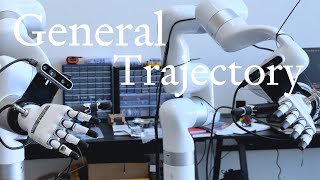
YouTube returned 6 videos for “General Trajectory”, and we withheld 5: 5 did not mention General Trajectory. Showing the 1 we can prove is about General Trajectory.
Official links
Tools that pair well with General Trajectory
Common stack mates teams adopt alongside General Trajectory, with the specific reason each pairing earns its keep.

Rhoda AI
Rhoda AI builds video-predictive robot foundation models that learn heavy industrial manipulation tasks from a single human demo.

Physical Intelligence
Physical Intelligence (π) builds vision-language-action foundation models that let one policy steer any robot through any manipulation task.

Trim
Trim is a research-stage foundation model that learns to predict how physical systems evolve over time, trading exactness for speed.
Featured Head-to-Head Comparisons
General Trajectory vs Spider Cloud
Choose General Trajectory if your core need is controlling physical robots in real-world environments with a foundation model. Choose Spider Cloud if you need reliable, low-cost web data extraction for AI agents or RAG pipelines—Spider Cloud offers immediate value with a free tier, transparent pricing, and recent innovations like Browser AI commands.
General Trajectory vs Presto Voice
You don't choose between these two unless you're in both QSR drive-thru automation and physical robotics. Presto Voice is a proven, specialized solution for QSR chains wanting revenue lift and order accuracy, with real deployments like Dairy Queen. General Trajectory is for robotics engineers building general-purpose physical intelligence, still in development with no recent public milestones. Buy Presto today for ROI; watch General Trajectory if you need a foundation model for robots.
General Trajectory vs Temporal Ai
Temporal AI and General Trajectory serve completely different domains. Temporal is a mature, open-source durable execution platform ideal for building reliable AI agents and multi-step workflows — with a free tier and recent innovations like Serverless Workers. General Trajectory targets the emerging physical world AI space for robot control, but lacks public pricing and recent updates. For most teams building AI-driven automation in software, Temporal is the safer, more accessible choice.
Alternatives to General Trajectory
View allRhoda AI
Rhoda AI builds video-predictive robot foundation models that learn heavy industrial manipulation tasks from a single human demo.

Physical Intelligence
Physical Intelligence (π) builds vision-language-action foundation models that let one policy steer any robot through any manipulation task.

Frequently Asked Questions
Categories
Topics
Used General Trajectory? Help shape our editorial sentiment research.