
Skild AI
Skild AI is building an omni-bodied robotic brain to control any robot for any physical task.
Skild AI is a research bet, not a deployable product, and should be diligenced as one. The omni-bodied thesis — one brain, any robot, any task — is genuinely differentiated from legged-hardware players like Boston Dynamics and task specialists like Covariant, and its human-video learning approach targets the real robotics data bottleneck. The three pillars on the site (security/inspection, mobile manipulation via API, autonomous packing) are the shape of a roadmap, not a shipping catalog: there are no public demos, benchmarks, or named deployments. R&D labs and innovation teams with appetite for that uncertainty and their own robot hardware are the honest fit. If you need production
Verified 3h ago · liveness 64/100 · cite: rightaichoice.com/tools/skild-ai
- Robotics R&D teams evaluating a universal brain across multiple robot types
- Industrial inspection and security operations in hazardous, unstructured sites
- Warehouse and logistics teams researching mobile manipulation via API
- Innovation labs exploring generalist physical AI learned from human video
- Teams that need an off-the-shelf robot deployable in production today
- Buyers who require public demos, benchmarks or named customers before evaluating
- Low-cost automation projects with little appetite for foundational AI investment
We scan live Reddit threads, YouTube comments, X posts, G2 reviews and other communities — and hand you an honest verdict in under a minute.
- Honest verdict, not marketing
- Real pros & cons from real users
- Attributed quotes with receipts
3 free scans · no card needed
Skip Skild AI if you need a robot you can deploy into production this quarter with published benchmarks and reference customers behind it, rather than a research-stage omni-bodied brain you would have to pilot on your own hardware.
Evaluating an omni-bodied brain likely means supplying your own robot hardware and test environment, which is a capital cost the vendor page does not cover.
No pricing model is published on any page reached this run, so Skild AI cannot be slotted against cheaper or more expensive peers on sticker price. The realistic comparison is a research partnership or scoped pilot rather than a per-seat or per-robot subscription — which puts it in the same diligence bucket as other foundational physical-AI labs, not the same bucket as task-specific automation vendors selling a finished cell.
In short
Skild AI — Skild AI is building an omni-bodied robotic brain to control any robot for any physical task. Best for Robotics R&D teams evaluating a universal brain across multiple robot types, Industrial inspection and security operations in hazardous, unstructured sites, Warehouse and logistics teams researching mobile manipulation via API. Contact Sales pricing.
No head-to-head comparison for Skild AI yet — the alternatives below are the closest matches we list.
What people actually say about Skild AI — is it worth it?
We ran a structured research pass across product reviews, community discussions, and post-purchase forum threads to surface the patterns vendors won't publish themselves. Below: the recurring strengths, the hidden costs people mention most, and the cohort that consistently regrets adopting this tool.
29 mentions across 3 sources (Hacker News, YouTube, Lemmy) · researched Aug 25, 2026.
Average across the 3 sources that answered — each source counts once, not each post.
- +Novel human-video learning approach sidesteps data bottleneck — praised by community.
- +Omni-bodied design appeals to diverse robot fleets — a major flexibility advantage.
- +Massive $1.4B funding suggests strong investor confidence and longevity.
- +API abstraction enables high-level task control for app builders.
- +Focus on real-world applications like inspection and packing adds practical appeal.
- −No public demos or case studies — unproven in real-world settings.
- −Research-stage maturity means high risk of bugs and instability.
- −Lack of transparency on pricing and support hinders evaluation.
- −Generality may sacrifice performance on specific, complex tasks.
- −Limited community feedback beyond funding announcements.
- • No public pricing — likely requires substantial upfront investment
- • Potential infrastructure costs for deploying at scale
Viability Score
How well maintained and how widely used is Skild AI? Built from what the vendor actually publishes (docs, changelog, tutorials, integrations, pricing), whether the site is live, and how much real users discuss it. How we calculate this
Last calculated: October 2026
How we score →Key Features
- Unified omni-bodied brain intended to control any robot type
- Model learns manipulation skills by watching human video
- Human-video learning positioned as an answer to the robotics data bottleneck
- Security/inspection robot platform for unstructured, dangerous environments
- Mobile manipulation platform for grasping, handover and navigation
- Low-level skills abstracted behind an API call for application developers
- Autonomous packing for precise, dexterous repetitive tasks
- Architecture decoupled from robot morphology and task type
- Generalizes across tasks without per-task programming
- Reduces constant manual inspection burden on human workers
- Backed by named funding partners
- Actively hiring
About Skild AI
Skild AI is a research-stage company building what it calls the Skild Brain — a unified, omni-bodied model intended to control any robot for any task, on the argument that an AI that understands the physical world shouldn't be constrained by robot morphology or task type. The company frames its market as physical work itself: most AI lives in cyberspace, physical reality is far more information-rich, and automating physical tasks carries outsized returns. Today the brain is described across three application pillars. A Security/Inspection Robot Platform has robots navigate unstructured, dangerous environments so people stop doing constant manual inspections. A Mobile Manipulation Platform exposes low-level skills — grasping, handover, navigation — behind an API call so developers can build applications without handling the messy physical world directly. Autonomous Packing applies precise, dexterous skill learning to repetitive tasks. The training signal is human video, which Skild presents as its answer to the robotics data bottleneck. The homepage names funding partners and lists open roles, but lists no public demos, benchmarks, named customers or case studies. Read the site as a foundational research bet, not a product catalog: the useful question is whether a scoped pilot on your own robot and task is feasible, not whether you can buy a robot from them.
Behind the Verdict
Skild AI makes a single, legible bet: that physical AI should be omni-bodied, and that a brain decoupled from robot morphology and task type is the right level of generality to solve robotics. That is a meaningful differentiator against the two adjacent archetypes. Boston Dynamics has proven legged hardware but is defined by its form factors; Covariant went deep on warehouse pick-and-place rather than broad. Skild is choosing breadth across robot types and tasks, which is a harder and slower path but a larger prize if it holds. The second differentiator is the data strategy. Skild's model learns by watching human videos, which the company frames as a scalable answer to the robotics data problem — the bottleneck that keeps most manipulation models narrow. If video-based skill learning generalizes, it sidesteps the cost of teleoperation and per-task data collection. That "if" is doing a lot of work, and the site does not publish benchmarks that would let you size it. The three pillars are worth reading carefully. Security/inspection is the most immediately legible: robots navigating unstructured, dangerous environments so humans stop doing constant manual inspections, which is a real operational pain with a real labor cost attached. Mobile manipulation is the platform play — grasping, handover and navigation abstracted behind an API call, so a developer builds applications without untangling the physical world themselves. Autonomous packing is where dexterity gets tested against repetitive, high-precision work. What the site does not give you is the other half of a buying decision. There are no public technical specifications, no benchmarks, no customer stories, no named deployments, and no product demos on the homepage. The strongest signals are funding partners and active hiring — consistent with a company building toward products rather than shipping mature ones. Treat any evaluation as a joint pilot with your own robot and your own task, and expect to supply the integration engineering. If your diligence process requires published references before you talk to a vendor, Skild will frustrate it, and that is a fair reason to wait.
Researching Skild AI? Get your full AI stack in 60 seconds.
Free, no signup — tell us your goal and get tools matched to your budget & existing stack.
Real-world workflow fit
Concrete scenarios for the personas Skild AI actually fits — and what changes day-one when you adopt it.
You have a hazardous inspection route currently walked by staff and an existing robot platform. You approach Skild to see whether the Skild Brain can drive that platform through unstructured terrain without per-route programming.
Outcome: A scoped pilot on your route and your hardware, with success measured on inspection coverage and reduction in manual rounds rather than on a vendor benchmark.
You need grasping and handover on a mobile manipulator but don't want to build the perception and control stack yourself. You evaluate exposing those skills behind an API call so your team writes application logic instead of low-level robotics code.
Outcome: A clearer build-versus-partner decision: either the abstracted skills are good enough to build on, or you keep the in-house stack.
You are studying whether a generalist manipulation model learned from human video transfers across robot types and task families, and you want a partner rather than a from-scratch training run.
Outcome: A research collaboration scoped around transfer across form factors, with your lab providing the evaluation rather than the vendor.
Use Cases
- Run autonomous inspection robots in hazardous industrial environments instead of manual rounds
- Prototype grasping and handover skills on a mobile manipulator via an API call
- Train precise packing skills from human demonstration video rather than teleoperation
- Build robot applications on abstracted low-level skills without handling the messy physical world
- Research generalist physical AI that transfers across robot types and tasks
- Scope a joint pilot with Skild on your own hardware and task before committing
Limitations
- The site provides no public technical specifications, no benchmarks, no customer success stories, no named deployments, and no product demos.
- The three pillars — security/inspection, mobile manipulation and autonomous packing — read as applications the brain enables rather than shipped products with references attached.
- The mobile manipulation platform is described as skills behind an API call, but no developer documentation is published on the site.
- Funding partners and active hiring are stated, but neither is a substitute for a reference deployment.
- Plan to run your own pilot on your own robot and task, and expect to bring integration engineering.
as of 2026-10-01
Verification history
We have re-verified Skild AI 109 times since . Each pass re-reads the vendor's own pages and re-checks every listed field against that evidence; passes where nothing had changed are marked as such.
- — re-checked, vendor evidence unchanged
- — re-checked, vendor evidence unchanged
- — re-checked, vendor evidence unchanged
- — re-checked, vendor evidence unchanged
- — re-checked, vendor evidence unchanged
- — re-checked, vendor evidence unchanged
Showing the 6 most recent of 109 verification passes.
Free to cite with attribution — this page re-verifies continuously.
12-month cost
Project the real annual outlay, including the implied monthly cost when only an annual tier is published.
Vendor list price only. Add-on usage, seat overages, and contract minimums are surfaced under Hidden costs & gotchas.
Where the pricing makes sense
The company stage and team size where Skild AI's pricing actually pencils out — and where peers do it cheaper.
No pricing model is published on any page reached this run, so Skild AI cannot be slotted against cheaper or more expensive peers on sticker price. The realistic comparison is a research partnership or scoped pilot rather than a per-seat or per-robot subscription — which puts it in the same diligence bucket as other foundational physical-AI labs, not the same bucket as task-specific automation vendors selling a finished cell.
Setup time & first value
How long it actually takes to get something useful out of Skild AI — broken out by persona, not the marketing-page minute.
For an R&D team running a scoped pilot on hardware you already own: expect weeks, not days, to first meaningful result — the site publishes no developer documentation or quickstart, so integration scoping happens in conversation with the company. For a lab exploring generalist physical AI research, the realistic timeline is a multi-month collaboration. Neither path is a same-day signup.
Switching to or from Skild AI
How to bring data in from common predecessors and how to get it back out — written for the switcher, not the buyer.
- →From Boston Dynamics fleets: evaluate the Skild Brain as the control layer over proven legged hardware rather than replacing the hardware itself.
- →From Covariant-style pick-and-place: test whether omni-bodied skill generalization covers your task variety instead of retraining a task-specific model.
- ↗To a specialized task-specific automation vendor: if your bottleneck is one well-defined repetitive task, a purpose-built system is the lower-risk path than a generalist brain.
Resources & Guides
Tutorials & Learning
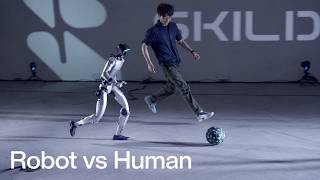
YouTube returned 6 videos for “Skild AI”, and we withheld 5: 5 could not be judged, because “Skild AI” is a single word that other videos use for other things. Showing the 1 we can prove is about Skild AI.
Official links
Tools that pair well with Skild AI
Common stack mates teams adopt alongside Skild AI, with the specific reason each pairing earns its keep.

Physical Intelligence
Physical Intelligence builds vision-language-action robot foundation models that control any robot for any manipulation task.

Cortex AI
Cortex AI supplies real-workplace egocentric video and robot trajectory data for training embodied AI and robot foundation models.

Solo Cli
Open-source Python SDK and CLI for training and deploying physical AI models — VLA and SLM — from managed cloud compute to real robot hardware.
Alternatives to Skild AI
View all
Physical Intelligence
Physical Intelligence builds vision-language-action robot foundation models that control any robot for any manipulation task.


Frequently Asked Questions
Categories
Topics
Used Skild AI? Help shape our editorial sentiment research.