
Glass Health
Clinical decision support and ambient scribing that answers clinical questions with peer-reviewed citations.
If you want clinical reasoning and note generation in one workspace, Glass Health is the most credible combined play we've reviewed — the peer-reviewed citation grounding and its placement in the physician-validated Harvard-Stanford ARISE NOHARM benchmark matter more than any scribe word-accuracy claim. The reasoning features (differential diagnosis, assessment and plan, chart summarization) are the differentiator; ambient scribing is the second half of the same subscription. The catch is fit: this suits clinicians who value evidence-cited decision support, less so teams who only want cheap, hands-off transcription. Clinicians can sign up directly; practices and health systems should expect
Verified 8h ago · liveness 60/100 · cite: rightaichoice.com/tools/glass-health
- Physicians and specialists who want evidence-cited answers and finished notes in one tool
- Residents, NPs, and PAs building differentials at the point of care
- Practices and health systems reducing documentation burden across MDs, PAs, and PharmDs
- Complex or value-based care settings where guideline-grounded reasoning matters more than speed
- Patients wanting a standalone consumer symptom checker — Glass for Patients is record navigation, not triage
- Clinicians who only need cheap hands-off transcription and nothing else
- Administrative, billing, or coding-only roles with no clinical reasoning need
We scan live Reddit threads, YouTube comments, X posts, G2 reviews and other communities — and hand you an honest verdict in under a minute.
- Honest verdict, not marketing
- Real pros & cons from real users
- Attributed quotes with receipts
3 free scans · no card needed
Skip Glass Health if you only need low-cost hands-off transcription and have no interest in citation-grounded differential diagnosis or assessment-and-plan support.
Glass Health's pricing fits teams whose volume aligns with the published tiers. Compare against the alternatives listed below for stage-specific value.
In short
Glass Health — Clinical decision support and ambient scribing that answers clinical questions with peer-reviewed citations. Best for Physicians and specialists who want evidence-cited answers and finished notes in one tool, Residents, NPs, and PAs building differentials at the point of care, Practices and health systems reducing documentation burden across MDs, PAs, and PharmDs. Free to use.
What people actually say about Glass Health — is it worth it?
We ran a structured research pass across product reviews, community discussions, and post-purchase forum threads to surface the patterns vendors won't publish themselves. Below: the recurring strengths, the hidden costs people mention most, and the cohort that consistently regrets adopting this tool.
18 mentions across 2 sources (App Store, Lemmy) · researched Jul 3, 2026.
Average across the 2 sources that answered — each source counts once, not each post.
- +Clean, intuitive interface praised by multiple clinicians.
- +Evidence-based content with inline citations for credibility.
- +Fast generation of differential diagnosis lists.
- +Ambient scribing reduces documentation burden significantly.
- +Structured note templates (H&P, progress, discharge) are helpful.
- −Very few user reviews — community feedback is scarce.
- −No information on uptime or performance under load.
- −Pricing is opaque — no publicly available plans.
- −Lack of integration details with specific EHR systems.
- −No negative experiences shared to balance the picture.
- • No free tier or trial mentioned — likely requires upfront payment or contract.
- • Potential additional costs for EHR integration setup or API usage.
Viability Score
How well maintained and how widely used is Glass Health? Built from what the vendor actually publishes (docs, changelog, tutorials, integrations, pricing), whether the site is live, and how much real users discuss it. How we calculate this
Last calculated: October 2026
How we score →Key Features
- Evidence-based clinical Q&A with peer-reviewed inline citations
- Differential diagnosis generation from symptoms, labs, and chart context
- Assessment and Plan generation for clinical documentation
- Chart summarization across the longitudinal patient record
- Clinical agent reasoning across thousands of data points
- Ambient scribing that captures the patient encounter
- History & Physical (H&P) note generation
- Progress Note generation
- Discharge Summary and Discharge Instructions generation
- Patient Handout creation
- Grounding in 38M+ peer-reviewed articles, clinical guidelines, and FDA drug information
- Glass for Patients health-record navigation
- Glass Developer API for embedding reasoning and scribing in third-party products
- HIPAA-compliant infrastructure with BAAs and PHI safeguards
- Physician-in-the-loop development and clinical evaluations
About Glass Health
Glass Health is an agentic clinical intelligence platform for physicians, NPs, PAs, PharmDs, and dentists. It pairs evidence-based clinical decision support with ambient scribing, so you can ask about symptoms, labs, medications, a chart, or a diagnosis and get an answer grounded in medical literature in the same workspace where you finish your notes. The clinical reasoning side does differential diagnosis generation, assessment and plan drafting, and chart summarization, reasoning across the full longitudinal record rather than a single prompt. On the documentation side, ambient scribing captures the encounter and produces History & Physical notes, progress notes, discharge summaries, discharge instructions, and patient handouts. The company reports 38M+ peer-reviewed articles and 40M+ PubMed citations behind its answers, plus clinical guidelines and US FDA drug information, and says it is used by 120,000+ clinicians across 170+ countries. In the Harvard-Stanford ARISE NOHARM evaluation, a physician-validated clinical safety benchmark, Glass says it ranked among the top medical AI systems, ahead of models from OpenAI and Anthropic. A Glass Developer API lets healthcare product teams embed the same reasoning and scribing. It fits clinicians who want reasoning support and paperwork handled together, and it is a closer match for complex or value-based care than for a single-provider clinic chasing the lowest per-note transcription cost.
Behind the Verdict
Glass Health's pitch is that reasoning and documentation belong in one place, and the product is built that way. You ask a clinical question — about symptoms, labs, a medication, a diagnosis, or next steps — and the Glass clinical agent reasons across the full longitudinal record and returns recommendations tied to peer-reviewed literature rather than a bare model guess. The same agent writes the note: History & Physical, progress notes, discharge summaries, discharge instructions, and patient handouts. Strengths. The evidence grounding is the headline. Glass says responses are built around 38M+ peer-reviewed articles, 40M+ PubMed citations, clinical guidelines, and US FDA drug information, with inline citations a clinician can check. That matters more in clinical use than fluency. Second, the stated performance in the Harvard-Stanford ARISE NOHARM evaluation — a physician-validated clinical safety benchmark where Glass says it ranked ahead of systems from OpenAI and Anthropic — is the kind of third-party-style validation most scribing tools do not have. Third, the platform is genuinely two products in one: decision support (differential diagnosis, assessment and plan, chart summarization) and documentation (ambient scribing plus the note types above), which means one subscription and one workspace rather than a scribe plus a reference tool. Fourth, the Glass Developer API lets healthcare product teams embed reasoning and scribing, and Glass for Patients extends record navigation to patients. Weaknesses and things to verify. The company's public material does not enumerate specific EHR integrations, so if your workflow depends on chart context flowing automatically from a particular EHR, treat that as a scoping question for Glass and your EHR team rather than something the site settles. Documentation quality and template fit vary by specialty, so a single-site or single-cohort pilot is the sensible first step. And the platform is aimed at clinicians — Glass for Patients is described as health-record navigation, not triage, so it is not a consumer symptom checker. Where it fits. Clinicians and specialists who want an evidence-cited answer and a finished note without context-switching; residents, NPs, and PAs building a differential at the point of care; practices and health systems trying to reduce documentation burden across MDs, PAs, and PharmDs; and complex or value-based care settings where guideline-grounded reasoning is the point of the purchase rather than speed. It also fits healthcare product teams that want clinical reasoning as an API rather than a build-it-yourself project. Where it doesn't. If all you need is cheap transcription with no clinical reasoning attached, you are paying for capability you won't use. If your rollout plan can't accommodate a data-governance review, a BAA, and access-control decisions for PHI, the pilot will stall before it starts.
Researching Glass Health? Get your full AI stack in 60 seconds.
Free, no signup — tell us your goal and get tools matched to your budget & existing stack.
Real-world workflow fit
Concrete scenarios for the personas Glass Health actually fits — and what changes day-one when you adopt it.
You ask Glass about a patient whose blood pressure remains elevated despite three antihypertensives, with the full chart in context, then use ambient scribing to capture the encounter and generate the progress note.
Outcome: An evidence-cited set of next-step options you can review with the patient, plus a drafted note to edit rather than dictation to clean up.
Persistent fatigue, weight gain, and brain fog with normal basic labs — you enter the presentation and labs and ask Glass what to consider next.
Outcome: A structured differential grounded in peer-reviewed literature you can check and discuss with your attending.
After a BAA and security review, the practice pilots Glass with one specialty cohort, using ambient scribing for H&P notes and discharge summaries.
Outcome: Less time spent on notes across the cohort, with reasoning support available at the point of care rather than in a separate reference tool.
Use Cases
- Generate a structured differential diagnosis for a complex patient presentation.
- Create a discharge summary and patient instructions automatically after a visit.
- Query evidence-based guidelines for a specific clinical question during rounds.
- Reduce documentation time by using ambient scribing to generate H&P notes.
- Draft an assessment and plan you can review and edit rather than write from scratch.
- Summarize a longitudinal chart before a consult or follow-up visit.
- Give patients a clearer view of their own health records through Glass for Patients.
- Embed clinical reasoning and scribing into a third-party healthcare product via the Glass Developer API.
Limitations
- Glass does not publish a list of supported EHRs on its public pages, so the current workflow, chart-context scope, and enablement plan for your environment should be confirmed with Glass and your EHR team before rollout.
- Start with the clinical job you need done rather than a generic connectivity claim, and complete the governance steps — BAA, security review, access controls — before the pilot goes live.
- Documentation output still needs clinician review: Glass outputs are decision support and drafting assistance, and final clinical judgment stays with you.
- Teams are advised to start with one specialty, site, or cohort before expanding across an organization.
as of 2026-10-08
Verification history
We have re-verified Glass Health 8 times since . Each pass re-reads the vendor's own pages and re-checks every listed field against that evidence; passes where nothing had changed are marked as such.
- — re-verified summary, description, our verdict, our analysis, pricing model, pricing tiers, features, integrations, who it suits, who should skip it
- — re-checked, vendor evidence unchanged
- — re-checked, vendor evidence unchanged
- — re-checked, vendor evidence unchanged
- — re-checked, vendor evidence unchanged
- — re-checked, vendor evidence unchanged
Showing the 6 most recent of 8 verification passes.
Free to cite with attribution — this page re-verifies continuously.
Where the pricing makes sense
The company stage and team size where Glass Health's pricing actually pencils out — and where peers do it cheaper.
Glass Health's pricing fits teams whose volume aligns with the published tiers. Compare against the alternatives listed below for stage-specific value.
Setup time & first value
How long it actually takes to get something useful out of Glass Health — broken out by persona, not the marketing-page minute.
Glass says clinicians can sign up directly, and signup is the fast path to asking a first clinical question. For practices and health systems, budget real calendar time for the BAA, security review, and access-control decisions before the first clinician goes live; piloting with one specialty or site shortens the path to a usable rollout.
Switching to or from Glass Health
How to bring data in from common predecessors and how to get it back out — written for the switcher, not the buyer.
- →From a standalone ambient scribe: add Glass alongside it for a single cohort, then consolidate once clinicians are using the reasoning features and the note output matches your templates.
- →From a point-of-care reference tool: replace literature lookups with Glass clinical Q&A that pulls chart context and returns cited recommendations in the same workspace as the note.
- →From dictation and manual templating: introduce ambient scribing on a single service line so you can compare drafted notes against your current output before expanding.
- ↗To a standalone scribe: if you only need transcription, a dedicated scribing tool covers that narrower job; you lose the citation-grounded differential and assessment-and-plan support.
- ↗To a general-purpose LLM assistant: you would gain a familiar interface but give up the peer-reviewed citation grounding, FDA drug information, clinical evaluations, and the benchmark placement Glass reports.
- ↗To a legacy reference database: you keep the literature but lose ambient scribing, note generation, and chart-context reasoning in one workspace.
Resources & Guides
Tutorials & Learning
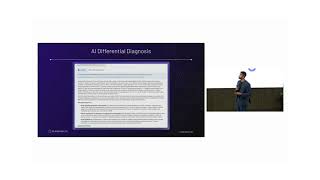
Glass Health - Googleスタートアップ・アクセラレーター・デモ・デイ
Startup Pitches
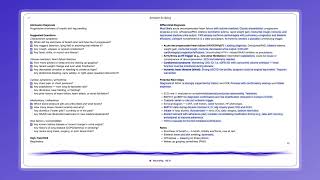
Glass Health Product Demo
Glass Health
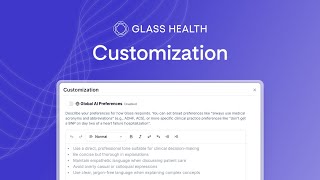
Glass Health | Customization
Glass Health
YouTube returned 6 videos for “Glass Health”, and we withheld 1: 1 did not mention Glass Health. Showing the 5 we can prove are about Glass Health.
Official links
Tools that pair well with Glass Health
Common stack mates teams adopt alongside Glass Health, with the specific reason each pairing earns its keep.

Heidi
AI ambient scribe with cited clinical evidence search, free tier for documentation and evidence lookups

Tortus
Tortus is ambient voice AI for NHS clinical documentation, capturing consultations and drafting clinician-approved notes, letters and referrals.

Nabla
Nabla is ambient AI clinical documentation that listens to patient visits and writes the note, dictation, and coding for you.
Featured Head-to-Head Comparisons
Glass Health vs Rapidsos
RapidSOS and Glass Health serve entirely different missions: one for emergency response, the other for clinical care. Choose RapidSOS if you're a public safety agency needing AI-enhanced dispatch and device data; choose Glass Health if you're a clinician wanting to reduce documentation time and get evidence-based decision support. They are not competitors—your use case dictates the choice.
Glass Health vs Codametrix
For enterprise revenue cycle leaders seeking to cut coding costs and denials at scale, CodaMetrix is the clear choice with proven ROI and KLAS #1 recognition. Glass Health is better for frontline clinicians needing decision support and scribing to reduce burnout, but it lacks billing/coding features. Choose based on your primary pain point: revenue cycle vs. clinical workflow.
Glass Health vs Isomorphic Labs
Choose Glass Health if you're a clinician seeking to reduce documentation burden and get evidence-based decision support at the point of care. Choose Isomorphic Labs only if you're a large pharma company pursuing AI-driven drug discovery at scale — it's not available to individual researchers or startups.
Alternatives to Glass Health
View all

Frequently Asked Questions
Categories
Best-of guides
Used Glass Health? Help shape our editorial sentiment research.