Instrumentl is live · pricing from $299/mo · last verified 23 Oct 2026 · viability healthy

Instrumentl
AI grant management software that matches funders, drafts proposals, and tracks spenddown in one pipeline
Instrumentl is the clearest case in this category for paying more to stop stitching tools together — matching data actually survives into Apply and Spenddown instead of dying in a funder list. Award Assistant converting award letters into tracked tasks, plus versioned Budgets, covers ground rivals usually skip. Just be honest about whether you'll use the back half of the platform.
Verdict generatedVerified 21d ago · liveness 85/100 · cite: rightaichoice.com/tools/instrumentl
- Nonprofits with an active pipeline wanting one system from prospecting through compliance
- Grant consultants and teams managing multiple client or program portfolios
- Universities, research offices, and health systems scaling grant operations
- Teams that want AI-assisted drafting plus spend tracking tied to their accounting system
- Small nonprofits searching for grants a few times a year — Discover runs $299/month paid upfront annually
- Teams that only want funder search and won't use Apply or the post-award tools
- Groups without clean accounting data or an organized proposal archive to feed the platform
We scan live Reddit threads, YouTube comments, X posts, G2 reviews and other communities — and hand you an honest verdict in under a minute.
- Honest verdict, not marketing
- Real pros & cons from real users
- Attributed quotes with receipts
3 free scans · no card needed
Skip Instrumentl if you run only a handful of applications a year and won't use AI drafting or post-award spenddown, because the entry plan at $299/month billed annually buys you a pipeline you won't fill.
The headline $299/month is the annual-commitment rate — paying month to month costs $349, a $600/year difference on the entry tier.
The ladder is priced for organizations with a working pipeline: Discover at $299/month billed annually ($349 monthly) beats buying a funder database plus a writing tool separately, but only if you apply often. Pre-Award at $499/month billed annually ($579 monthly) is mid-market territory; Full Lifecycle at $999/month billed annually ($1,159 monthly) is enterprise-adjacent and competes with dedicated post-award compliance suites. Small volunteer-run nonprofits should look at cheaper funder
In short
Instrumentl — AI grant management software that matches funders, drafts proposals, and tracks spenddown in one pipeline. Best for Nonprofits with an active pipeline wanting one system from prospecting through compliance, Grant consultants and teams managing multiple client or program portfolios, Universities, research offices, and health systems scaling grant operations. Plans from $299/mo.
No head-to-head comparison for Instrumentl yet — the alternatives below are the closest matches we list.
What is Instrumentl?
Instrumentl — AI grant management software that matches funders, drafts proposals, and tracks spenddown in one pipeline. Best for Nonprofits with an active pipeline wanting one system from prospecting through compliance, Grant consultants and teams managing multiple client or program portfolios, Universities, research offices, and health systems scaling grant operations. Plans from $299/mo.
Instrumentl is a full-lifecycle grant management platform built for organizations where grants are a standing revenue line rather than an occasional windfall. Nonprofits, grant consultants, university research offices, and health systems use it to carry a funder from research through a written application and into post-award spenddown without exporting a spreadsheet along the way. The vendor reports 5,500+ nonprofits on the platform and $1.1B+ in grants managed, with G2 at 4.9 and Capterra at 5.0. Prospecting is scored matching, not keyword search: the funder database and live RFPs rank against your programs, priorities, and eligibility. The Fall 2026 release added 37,000 human-verified opportunities and 4,000+ state grants, backed by a 24-hour accuracy guarantee on funder changes, and saved searches refresh as new grants appear. A Prospecting Assistant accepts a plain-language description of what you're funding. Claude and ChatGPT connectors expose 30+ bidirectional tools, so you can pull matches, save fits, and assign next steps from inside those assistants, with changes syncing back. Apply carries that research into drafting, adapting past proposals to each funder's context, priorities, and character counts using your templates and prior language plus 10+ years of 990 giving data. Award Assistant pulls deadlines and requirements out of award letters and converts them into tasks and calendar reminders. The new Budgets tool consolidates versioned grant budgets from draft to closeout, extracting categories from an uploaded budget and logging every version so the current one is always clear. On the post-award side, Spenddown syncs expenses from your accounting system, emails alerts for over- or underspending, and exports budget-vs-actual reports. The Fall 2026 release brought 15 integrations, with MIP accounting and a Microsoft Copilot connector announced for this quarter. Against funder-search-only databases or a spreadsheet-plus-portal setup, Instrumentl costs
Key features
- AI funder matching scored against your programs, priorities, and eligibility
- Prospecting Assistant accepts plain-language funding goals and keeps matches current
- 37,000 human-verified grant opportunities and 4,000+ state grants (Fall 2026)
- 24-hour accuracy guarantee on funder changes
- Saved searches refresh as new grants appear
- Peer prospecting shows which funders back similar organizations
- AI proposal drafting (Apply) adapted to each funder's context and character counts
- Institutional memory workspace for templates, proposal history, and prior language
- 10+ years of 990 giving data informing what to emphasize per funder
- Award Assistant extracts deadlines and requirements from uploaded award letters
- Auto-generated tasks and calendar reminders from award letters
- Budgets tool extracts categories and logs every budget version from draft to closeout
- Spenddown: expense sync from accounting software with budget-vs-actual reports
- Email spend alerts flagging over- or underspending
- Claude and ChatGPT connectors with 30+ bidirectional tools
Behind the verdict
Pick Instrumentl when grants are a program, not a hobby. If someone on your team spends most weeks prospecting, drafting, or reporting on awards, the value is in the joins: a scored match becomes a drafted proposal in your own language, an award letter becomes calendar deadlines, and an expense export becomes a budget-vs-actual report. We'd reach for it in a university research office or a health system grants team for exactly that reason — the handoffs are where hours disappear. Pass if you search for grants a few times a year. The Discover plan runs $299/month paid upfront annually, and no amount of AI drafting fixes a pipeline that doesn't exist. Teams that only want funder search and will never touch Apply or Spenddown are paying for a back half they'll ignore; a cheaper database does that job. Watch the data hygiene question. Spenddown depends on clean accounting data and Apply depends on an organized proposal archive. Show up with neither and you've bought a platform you'll feed by hand. Consultants should also check plan fit carefully — peer prospecting isn't available on consultant plans, and the user caps (3 on Discover, 5 on Pre-Award, 15 on Full Lifecycle) push anyone needing unlimited seats toward custom Enterprise pricing. The Fall 2026 release is the most substantive refresh the product has had. Two things matter for buyers: the 4,000+ state grants fill a gap that funder databases usually leave to state portals, and the 24-hour accuracy guarantee is a real commitment on stale funder records. The Claude and ChatGPT connectors with 30+ bidirectional tools are more interesting than they first look — saving a match or assigning a next step from inside an assistant you already have open beats tab-switching, provided your team actually works that way. MIP
Models under the hood
as of 2026-11-08
Limitations
- The portfolio-level award tracking view is in beta, and some connectors (MIP and Microsoft Copilot) are noted as in development rather than live.
- Match coverage depends on Instrumentl's curated, human-verified funder database (37,000 opportunities plus 990 data) rather than a live crawl of every funder.
- Peer prospecting availability varies by plan, which changes what consultants can pitch clients.
as of 2026-10-19
Researching Instrumentl? Get your full AI stack in 60 seconds.
Free, no signup — tell us your goal and get tools matched to your budget & existing stack.
Is Instrumentl still active?
Instrumentl is live · pricing from $299/mo · last verified 23 Oct 2026 · viability healthy.
Viability score
How well maintained and how widely used is Instrumentl? Built from what the vendor actually publishes (docs, changelog, tutorials, integrations, pricing), whether the site is live, and how much real users discuss it. How we calculate this
Last calculated: November 2026
How we score →What's new in Instrumentl
Checked 5 days agoAcross the latest 4 updates: 3 feature updates and 1 changelog entry.
MIP accounting integration and Microsoft Copilot connector coming this quarter
Instrumentl says MIP will join its native accounting integrations and Microsoft Copilot will get its own connector, joining Claude and ChatGPT.
Instrumentl Budgets consolidates grant budget versions from draft to closeout
Upload a budget and Instrumentl extracts categories; edits are made in plain language and each version is logged so the current one is always clear.
Instrumentl ships Claude and ChatGPT connectors with 30+ bidirectional tools
Instrumentl tools now run inside Claude and ChatGPT in both directions: pull matches, save fits, and assign next steps, with changes syncing back to Instrumentl.
Instrumentl Fall 2026 release adds state grants, 15 integrations, and Budgets
Fall 2026 release: 37,000 human-verified opportunities with 4,000+ state grants added this quarter, a 24-hour accuracy guarantee, 15 integrations, and a new Budgets tool for versioned grant budgets.
What do users say about Instrumentl?
What people actually say about Instrumentl — is it worth it?
We scanned public community sources for Instrumentl on Oct 15, 2026 and could not establish that the discussion we found is about this tool rather than something else sharing its name. Only 2 of the posts we fetched could be positively tied to Instrumentl. Rather than publish a sentiment score built on the wrong subject, we publish nothing here and re-run the scan.
How we verified this
Every listed fact about Instrumentl — pricing, features, links, status — is re-read from the vendor's own pages by our verification pipeline and each change is logged with a date; the last pass ran on 23 Oct 2026. Analysis is drafted with AI models and checked against our editorial standards before publishing; see how we verify.
Verification history
We have re-verified Instrumentl 27 times since . Each pass re-reads the vendor's own pages and re-checks every listed field against that evidence; passes where nothing had changed are marked as such.
- — changed features, pricing tiers, description, our verdict, who should skip it
- — changed our verdict, features, integrations, description, pricing tiers
- — changed pricing page, limitations
- — changed pricing tiers, description
- — changed SSL certificate
- — changed features, description, pricing tiers
Showing the 6 most recent of 27 verification passes.
Free to cite with attribution — this page re-verifies continuously.
How much does Instrumentl cost in 2026?
Instrumentl: Plans from $299/mo. Pricing last verified 23 Oct 2026.
Plans compared
Every published Instrumentl tier, its price as the vendor publishes it, who it fits, and what it adds over the tier below. The 12-month cost projection follows.
| Plan | Price | Billing | Who it's for |
|---|---|---|---|
| Discover | $299/mo | monthly | A nonprofit with a first formal grants program and up to 3 people who need an organized pipeline and matched opportunities.Adds: Starting tier: AI-matched opportunities, 37k+ RFPs and 450k+ funder profiles, saved searches with weekly updates, deadline tracking. |
| Pre-Award | $499/mo | monthly | A development team of up to 5 actively writing proposals and needing to collaborate on applications.Adds: Adds peer prospecting, Apply in-app forms and AI drafting, application snippets, Award Assistant, and CRM sync on top of Discover. |
| Full Lifecycle | $999/mo | monthly | Finance and program staff at an organization running complex awards who need spend visibility before a compliance problem.Adds: Adds real-time Spenddown, accounting system sync, planned expense logging, budget-vs-actual export, spend alerts, and 15 users. |
| Enterprise | Custom | quote | Universities, municipalities, and health systems running grants across multiple departments and sites.Adds: Adds custom user counts, unlimited projects, a centralized proposal and budget library, centralized account management, API access, and dedicated support. |
12-month cost
Project the real annual outlay, including the implied monthly cost when only an annual tier is published.
Vendor list price only. Add-on usage, seat overages, and contract minimums are surfaced under Hidden costs & gotchas.
Where the pricing makes sense
The company stage and team size where Instrumentl's pricing actually pencils out — and where peers do it cheaper.
The ladder is priced for organizations with a working pipeline: Discover at $299/month billed annually ($349 monthly) beats buying a funder database plus a writing tool separately, but only if you apply often. Pre-Award at $499/month billed annually ($579 monthly) is mid-market territory; Full Lifecycle at $999/month billed annually ($1,159 monthly) is enterprise-adjacent and competes with dedicated post-award compliance suites. Small volunteer-run nonprofits should look at cheaper funder
Has Instrumentl's pricing changed?
No plan price for Instrumentl has moved since we began logging in Aug 2026; the pricing page is re-read on every verification pass.
Who should pick Instrumentl?
Pick Instrumentl if you are Nonprofits with an active pipeline wanting one system from prospecting through compliance, Grant consultants and teams managing multiple client or program portfolios, Universities, research offices, and health systems scaling grant operations, Teams that want AI-assisted drafting plus spend tracking tied to their accounting system.
Look elsewhere if you are Small nonprofits searching for grants a few times a year — Discover runs $299/month paid upfront annually, Teams that only want funder search and won't use Apply or the post-award tools, Groups without clean accounting data or an organized proposal archive to feed the platform, Consultants who need peer prospecting — it isn't available on consultant plans.
Skip it if Skip Instrumentl if you run only a handful of applications a year and won't use AI drafting or post-award spenddown, because the entry plan at $299/month billed annually buys you a pipeline you won't fill.
GeneratedReal-world workflow fit
Concrete scenarios for the personas Instrumentl actually fits — and what changes day-one when you adopt it.
You describe your programs to the Prospecting Assistant in plain language, review AI-matched funders scored against eligibility, and shortlist five into your pipeline.
Outcome: A funded-quarter shortlist built from 450,000+ funder profiles and 37,000+ active RFPs instead of hours of keyword searching.
You open Apply on a shortlisted funder, pull a past proposal from Institutional Memory, and let AI drafting reframe it to the funder's priorities and character counts.
Outcome: A first draft built on language you already approved, with funder-specific emphasis informed by 10+ years of 990 giving data.
An award letter lands; you drag the budget in, Award Assistant extracts deadlines and requirements into tasks, and Spenddown syncs expenses from your accounting system.
Outcome: Deadlines tracked automatically and budget-vs-actual reporting exported without a rebuilt spreadsheet, with email alerts when spend drifts.
Use cases
- Find and match grants to your mission with AI-curated opportunities instead of keyword searches.
- Collaborate with your team on proposals in a shared workspace with templates and proposal history.
- Extract deadlines and requirements from award letters and turn them into tracked tasks automatically.
- Track award budgets and actuals in real time with Spenddown synced to your accounting system.
- Generate funder-ready budget-vs-actual reports and export them without rebuilding spreadsheets.
- Catch over- or underspending early via email alerts before it becomes a compliance issue.
- Review every submitted, awarded, and in-progress grant in one portfolio view (beta).
- Consolidate a funder database, writing tool, and compliance spreadsheet into a single pipeline.
Setup time & first value
How long it actually takes to get something useful out of Instrumentl — broken out by persona, not the marketing-page minute.
A development director can connect a program description and see matched funders within the first session; expect a day or two to tune saved searches. Teams adding Apply should budget a week to load templates and past proposals into Institutional Memory. Spenddown's accounting sync on Full Lifecycle is the longest step — plan on a few days with your finance lead, and Enterprise onboarding is
Switching to or from Instrumentl
How to bring data in from common predecessors and how to get it back out — written for the switcher, not the buyer.
- →From a funder database + spreadsheets: import your shortlist into Discover, then load past proposals into Institutional Memory so Apply has source material.
- →From a general CRM: move grant records into the pipeline and, on Pre-Award and above, sync the CRM rather than duplicating entries.
- →From standalone proposal software: copy templates and approved language into the Institutional Memory workspace before your next deadline.
- ↗To a cheaper funder database: export matched opportunities and funder notes before the annual term ends, since Discover holds the pipeline records.
- ↗To a dedicated accounting or compliance suite: export budget-vs-actual reports from Spenddown while access is still active.
- ↗To a niche grant suite: pull proposal history out of Institutional Memory first; it's the hardest asset to reconstruct.
Integrations
Tutorials & Learning
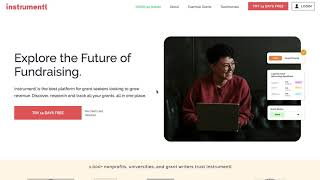
YouTube returned 6 videos for “Instrumentl”, and we withheld 5: 5 could not be judged, because “Instrumentl” is a single word that other videos use for other things. Showing the 1 we can prove is about Instrumentl.
Official links
What are the best Instrumentl alternatives?
The closest alternatives to Instrumentl we list are FundRobin, Kaiso and UpGuard. Ranked by direct product-type match, not category overlap.
| Alternative | Pricing | Starts at | Last verified |
|---|---|---|---|
| FundRobin | Freemium | Pricing not published | — |
| Kaiso | Paid | Pricing not published | — |
| UpGuard | Freemium | Pricing not published | — |
Alternatives to Instrumentl
View all


Tools that pair well with Instrumentl
Common stack mates teams adopt alongside Instrumentl, with the specific reason each pairing earns its keep.

FundRobin
FundRobin is AI grant management software that finds fit-scored funding and drafts grounded proposals for charities and universities

Kaiso
Kaiso delivers AI-drafted ISO management systems with a named expert and a written audit-ready guarantee, at a fixed price.

UpGuard
UpGuard unifies vendor risk management, attack surface, shadow AI, and trust pages in one cyber risk posture console.
Frequently asked questions
Categories
Best-of guides
For makers of Instrumentl
- Get a Verified Listing for Instrumentl ($39): a written decision within 1 working day.
- Free listing for another tool: Free reviews are decided in order, within 3 weeks of the review starting.
Used Instrumentl? Help shape our editorial sentiment research.