
MediSearch
Evidence-based medical answers with citations for patients and professionals.
MediSearch delivers cited, evidence-based answers without the noise—great for quick health questions, but not a replacement for your doctor. The free tier is limited, and deep clinical research still belongs on PubMed. If you need cheap, cited answers for common and moderately complex medical queries, it's a solid pick over generic chatbots. For personalized diagnosis or emergency help, skip it.
Verified 6d ago · liveness 68/100 · cite: rightaichoice.com/tools/medisearch
- Patients seeking cited answers
- Caregivers needing quick medical info
- Health-conscious individuals researching symptoms
- Medical students doing reference checks
- Emergency medical situations
- Users needing personalized diagnosis
- Professionals needing full-text papers
We scan live Reddit threads, YouTube comments, X posts, G2 reviews and other communities — and hand you an honest verdict in under a minute.
- Honest verdict, not marketing
- Real pros & cons from real users
- Attributed quotes with receipts
3 free scans · no card needed
Skip MediSearch if you need personalized diagnosis, emergency help, or full-text clinical papers—it's designed for quick, cited answers, not a doctor replacement.
Upgrading to Pro requires contacting sales for pricing, so you won't see the price until you initiate a conversation.
MediSearch's free tier beats generic search engines for cited health answers, but its Pro cost is opaque. For unlimited needs, alternatives like PubMed (free) or standard AI chatbots might be cheaper if you can trade citation depth.
In short
MediSearch — Evidence-based medical answers with citations for patients and professionals. Best for Patients seeking cited answers, Caregivers needing quick medical info, Health-conscious individuals researching symptoms. Free to use.
What people actually say about MediSearch — is it worth it?
We ran a structured research pass across product reviews, community discussions, and post-purchase forum threads to surface the patterns vendors won't publish themselves. Below: the recurring strengths, the hidden costs people mention most, and the cohort that consistently regrets adopting this tool.
25 mentions across 3 sources (Hacker News, Product Hunt, App Store) · researched Jul 3, 2026.
Average across the 3 sources that answered — each source counts once, not each post.
- +Provides quick, referenced answers to medical questions.
- +Clean and user-friendly interface.
- +Answers are detailed and sourced from recent literature.
- +Trusted by over 1 million users worldwide.
- +Free tier available for basic queries.
- −Pro pricing not disclosed upfront.
- −Cancellation process does not stop charges.
- −Developer unresponsive to billing complaints.
- −Avoids direct answers on rare conditions due to liability.
- −Not reliable enough for professional medical use.
- • Pro price not shown before sign-up
- • Users report continued charges after cancellation
Viability Score
How well maintained and how widely used is MediSearch? Built from what the vendor actually publishes (docs, changelog, tutorials, integrations, pricing), whether the site is live, and how much real users discuss it. How we calculate this
Last calculated: September 2026
How we score →Key Features
- Evidence-based answers with source citations
- Real-time processing of queries
- Topic filters for symptoms, treatments, risk factors
- Direct answers without ad clutter
- Free tier with daily query limit
- Pro subscription with unlimited access
- Access to peer-reviewed research and guidelines
- Covers common and complex medical questions
- Clean, distraction-free interface
- Refines results by medical topic
About MediSearch
MediSearch is a specialized medical search engine that delivers direct, science-based answers to health questions by drawing on peer-reviewed studies and authoritative medical literature. It is built for patients, caregivers, and healthcare professionals who are tired of sifting through SEO spam and want to trust what they read. Instead of returning a list of links, MediSearch processes your query in real time and returns a concise answer backed by citations, so you can verify the evidence yourself. What separates MediSearch from a generic chatbot or standard search engine is its commitment to source transparency: every answer cites its references, and you can refine results by topic filters like symptoms, treatments, or risk factors. The interface is simple: type a question, get a clear answer, dig into sources if you want more. It covers common queries like whether sport increases life expectancy, and complex clinical scenarios like whether a covid vaccine worsens arthritis or how birth control might affect relationships. Over one million users have used MediSearch, indicating real demand for reliable health information. The free tier gives a daily query limit; Pro subscription unlocks unlimited access and advanced features, with pricing available on request. MediSearch is not a substitute for professional medical advice; it won't give personalized diagnosis or replace your doctor, but for quick, cited answers that strip away noise, it's genuinely useful. In practice, it's a smarter, evidence-first alternative to Googling symptoms or relying on an AI chatbot.
Behind the Verdict
MediSearch is a niche but genuinely useful tool for anyone who wants quick, cited medical answers. Its core strength is source transparency: every response is backed by citations you can verify, which builds trust that generic AI chatbots lack. The interface is clean and focused—type a question, get a concise answer, and optionally dig into references. It handles both simple queries (does sport increase life expectancy?) and more complex ones (does a covid vaccine worsen arthritis?), making it versatile for patients, caregivers, and even medical students doing quick reference checks. The free tier's daily query limit is a reasonable entry point, though heavy users will quickly hit the ceiling and need Pro, whose pricing is not publicly disclosed—a minor transparency gap. For emergency situations, personalized diagnosis, or full-text clinical research, it falls short by design. But as a first-line tool to verify a claim or explore treatment options with credible sources, it's a practical upgrade over Googling symptoms.
Researching MediSearch? Get your full AI stack in 60 seconds.
Free, no signup — tell us your goal and get tools matched to your budget & existing stack.
Real-world workflow fit
Concrete scenarios for the personas MediSearch actually fits — and what changes day-one when you adopt it.
You feel a new symptom and want to understand possible causes without panicking.
Outcome: Type the symptom into MediSearch, get a cited answer listing common causes and when to see a doctor, and verify sources before your appointment.
You need to quickly confirm a clinical fact for a study group.
Outcome: Enter the question, review the cited references, and use them to strengthen your argument in the discussion.
You're worried about a drug interaction for a family member.
Outcome: Use MediSearch to pull up peer-reviewed studies on the interaction, so you can raise informed questions with the doctor.
Use Cases
- Verify a medical claim you read online
- Research symptoms and treatment options
- Check potential side effects of a medication
- Understand food-supplement interaction risks
- Explore peer-reviewed perspectives on a health concern
Limitations
- MediSearch provides instant, evidence-based answers to medical questions drawn from reliable sources, with source citations.
- It is explicitly not a substitute for a medical professional.
- A free tier carries a daily query limit, while MediSearch Pro offers unlimited access; the underlying AI model(s) are not named on the site.
- Pro pricing is not publicly disclosed.
as of 2026-09-01
Verification history
We have re-verified MediSearch 9 times since . Each pass re-reads the vendor's own pages and re-checks every listed field against that evidence; passes where nothing had changed are marked as such.
- — re-checked, vendor evidence unchanged
- — re-verified summary, description, our verdict, our analysis, pricing model, pricing tiers, features, integrations, who it suits, who should skip it
- — re-checked, vendor evidence unchanged
- — re-verified summary, description, our verdict, our analysis, pricing model, pricing tiers, features, integrations, who it suits, who should skip it
- — re-checked, vendor evidence unchanged
- — re-verified summary, description, our verdict, our analysis, pricing model, pricing tiers, features, integrations, who it suits, who should skip it
Showing the 6 most recent of 9 verification passes.
Free to cite with attribution — this page re-verifies continuously.
12-month cost
Project the real annual outlay, including the implied monthly cost when only an annual tier is published.
Vendor list price only. Add-on usage, seat overages, and contract minimums are surfaced under Hidden costs & gotchas.
Plans compared
For each published MediSearch tier: who it actually fits, and what it adds vs. the previous tier. Cross-reference the cost calculator above for projected annual outlay.
Free
$0/mo
Ideal for
Casual users who occasionally need a cited, evidence-based answer to a health question without paying.
What this tier adds
Starting tier with a daily query limit; you get evidence-based answers and topic filters, but caps how many questions you can ask per day.
Pro
Contact for pricing
Ideal for
Frequent researchers, caregivers, or medical students who hit the free daily limit and need unlimited access.
What this tier adds
Unlocks unlimited queries and advanced features, but pricing is only available on request, so you must contact the vendor.
Where the pricing makes sense
The company stage and team size where MediSearch's pricing actually pencils out — and where peers do it cheaper.
MediSearch's free tier beats generic search engines for cited health answers, but its Pro cost is opaque. For unlimited needs, alternatives like PubMed (free) or standard AI chatbots might be cheaper if you can trade citation depth.
Setup time & first value
How long it actually takes to get something useful out of MediSearch — broken out by persona, not the marketing-page minute.
For patients and caregivers: no setup needed—just type a question and get cited answers in under a minute. Medical students can start immediately; Pro users may need a brief contact-sales exchange to activate unlimited access, typically a few minutes.
Resources & Guides
Tutorials & Learning
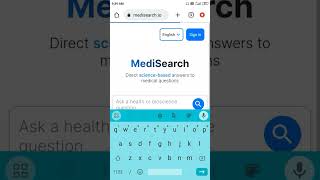
YouTube returned 6 videos for “MediSearch”, and we withheld 5: 5 could not be judged, because “MediSearch” is a single word that other videos use for other things. Showing the 1 we can prove is about MediSearch.
Official links
Tools that pair well with MediSearch
Common stack mates teams adopt alongside MediSearch, with the specific reason each pairing earns its keep.
Consensus
Consensus is an AI academic search engine that answers research questions with cited evidence from 220M+ peer-reviewed papers.

WolframAlpha
Compute verified, expert-level answers from curated data and algorithms.

Flatiron Health
Oncology real-world evidence platform that turns patient data into AI-powered cancer research insights.
Featured Head-to-Head Comparisons
Medisearch vs Isomorphic Labs
MediSearch is the clear choice for anyone seeking quick, trustworthy medical answers based on peer-reviewed research, and it's freely accessible. Isomorphic Labs, as an enterprise-only AI drug discovery platform, is irrelevant to individual users but critical for large pharma partnerships. For buyers: if you want to quickly check a health question, use MediSearch; if you are a pharma company needing AI-accelerated drug design, approach Isomorphic Labs (likely requiring millions in partnership).
Medisearch vs Rapidsos
These tools serve entirely different needs. RapidSOS is a life-critical emergency platform for 911 centers and enterprises, with AI-powered dispatch and deep integrations (e.g., AT&T ESInet). MediSearch is a consumer medical Q&A tool for evidence-based health info. Choose based on your role: public safety or enterprise safety → RapidSOS; personal health research → MediSearch.
Medisearch vs Codametrix
For individuals seeking trustworthy, science-based medical answers, MediSearch is ideal with its free tier and peer-reviewed sourcing. For large health systems wanting to slash coding costs and denials, CodaMetrix delivers enterprise-grade automation and a proven 5:1 ROI, backed by #1 Best in KLAS recognition in 2026. Choose based on your role: patient/caregiver or revenue cycle leader.
Alternatives to MediSearch
View allConsensus
Consensus is an AI academic search engine that answers research questions with cited evidence from 220M+ peer-reviewed papers.

WolframAlpha
Compute verified, expert-level answers from curated data and algorithms.

Flatiron Health
Oncology real-world evidence platform that turns patient data into AI-powered cancer research insights.
Frequently Asked Questions
Categories
Topics
Used MediSearch? Help shape our editorial sentiment research.