
Opendataloader Pdf
Open-source PDF parser for RAG pipelines with local CPU processing and top benchmark scores
For developers building RAG pipelines that demand accuracy and privacy, OpenDataLoader PDF is the top pick: its hybrid mode scores 0.907 overall, ahead of Nutrient, Docling, and Marker, while running 100% locally on CPU. The free Apache-2.0 tier covers parsing, OCR, LangChain integration, and auto-tagging, which is unusual. But this is code-first: no GUI, no managed cloud. If you need a visual interface, look at Nutrient; if you want a docling-style Python library with GPU options, compare Docling or Marker.
Verified 1d ago · liveness 64/100 · cite: rightaichoice.com/tools/opendataloader-pdf
- RAG pipeline developers needing top benchmark accuracy and speed
- Privacy-sensitive LLM data ingestion teams (local, CPU-only)
- Accessibility compliance teams targeting EAA, ADA, Section 508
- Enterprise AI teams wanting deterministic, open-source parsing
- Teams that need a GUI-based document parsing tool
- Users expecting a managed cloud API without self-hosting
- Projects requiring real-time streaming output
We scan live Reddit threads, YouTube comments, X posts, G2 reviews and other communities — and hand you an honest verdict in under a minute.
- Honest verdict, not marketing
- Real pros & cons from real users
- Attributed quotes with receipts
3 free scans · no card needed
Skip Opendataloader Pdf if your team has no engineers to wire in an SDK, or if you need a managed cloud API, a visual UI, or no-code deployment.
Hybrid mode is optional but requires external LLM API keys, so enabling it adds per-call inference cost on top of the free Apache-2.0 library.
The Apache-2.0 core is free, which fits solo developers and startups building RAG pipelines without a parsing budget. Compared with paid managed parsers like Nutrient, you save recurring API fees but pay in engineering time. Compared with Marker and Docling, both open source, the price is comparable, so the decision rests on benchmark accuracy and local-CPU support rather than cost. Enterprise pricing is custom for PDF/UA export and support.
In short
Opendataloader Pdf — Open-source PDF parser for RAG pipelines with local CPU processing and top benchmark scores. Best for RAG pipeline developers needing top benchmark accuracy and speed, Privacy-sensitive LLM data ingestion teams (local, CPU-only), Accessibility compliance teams targeting EAA, ADA, Section 508. Free to use.
What's new in Opendataloader Pdf
Checked yesterdayAcross the latest 1 update: 1 launch.
What people actually say about Opendataloader Pdf — is it worth it?
We ran a structured research pass across product reviews, community discussions, and post-purchase forum threads to surface the patterns vendors won't publish themselves. Below: the recurring strengths, the hidden costs people mention most, and the cohort that consistently regrets adopting this tool.
6 mentions across 2 sources (Hacker News, Lemmy) · researched Jul 3, 2026.
Average across the 2 sources that answered — each source counts once, not each post.
- +Fast: 60-100 pages/second on CPU without GPU.
- +Open-source Apache-2.0 license, free to use.
- +Local processing ensures data privacy.
- +Structured JSON output with bounding boxes.
- +Supports 80+ languages via hybrid OCR.
- −Community feedback is sparse and shallow.
- −No official support or community forum.
- −Unclear performance on scanned PDFs vs native.
- −Requires technical setup for non-developers.
- −Documentation depth not verified from data.
- • Optional LLM API costs if using cloud-based LLM enhancement
- • Potential compute resources needed for high throughput
Viability Score
How well maintained and how widely used is Opendataloader Pdf? Built from what the vendor actually publishes (docs, changelog, tutorials, integrations, pricing), whether the site is live, and how much real users discuss it. How we calculate this
Last calculated: September 2026
How we score →Key Features
- XY-Cut++ reading order for multi-column layouts
- Bounding box coordinates for every element
- Table extraction with border and cluster detection, handles merged cells
- Hybrid OCR supporting 80+ languages
- Optional LLM enhancement for OCR and complex tables
- Auto-tagging pipeline for PDF accessibility (PDF/UA)
- AI safety filters: hidden text, off-page content, prompt injection detection
- Noise filtering: headers, footers, watermarks
- Deterministic output (no hallucinations)
- JSON output with semantic types (heading, paragraph, table, list, image, caption)
- Markdown and HTML output for LLM contexts
- Local CPU processing, no cloud dependency, no GPU required
- High throughput: 0.015 s/page (non-hybrid), 0.463 s/page (hybrid)
- Multi-language SDK: Python, Node.js, Java, Docker
- LangChain integration
About Opendataloader Pdf
OpenDataLoader PDF is an open-source (Apache-2.0) parsing library built for AI data ingestion, especially RAG and LLM pipelines. It converts PDFs into structured JSON, Markdown, HTML, and tagged PDF, with reading order, bounding box coordinates, tables, and optional hybrid OCR supporting 80+ languages. Everything runs locally on CPU with no cloud dependency, so documents never leave your machine. The parser uses XY-Cut++ to sequence multi-column layouts in human reading order, and every element carries [x1, y1, x2, y2] coordinates for precise citations. Table extraction handles merged cells via border and cluster detection, and hybrid mode reaches 93% table accuracy with a 0.907 overall benchmark score, ahead of Nutrient (0.885), Docling (0.882), and Marker (0.861). Output JSON includes semantic types like heading, paragraph, table, list, image, and caption, plus font and size metadata. It also ships an auto-tagging pipeline that turns untagged PDFs into screen-reader-ready tagged PDFs, based on PDF Association specifications and validated with veraPDF, useful for EAA, ADA, and Section 508 work. Built-in AI safety filters strip hidden text, off-page content, and prompt injection attempts, while noise filters remove headers, footers, and watermarks. SDKs cover Python, Node.js, Java, and Docker, with an official LangChain integration. It is fast: 0.015 seconds per page non-hybrid, 0.463 hybrid. The trade-off is that it is code-first, with no GUI and no managed cloud API.
Behind the Verdict
OpenDataLoader PDF is a document parser aimed squarely at developers who own their ingestion pipeline. Its strongest card is reading order: the XY-Cut++ algorithm handles multi-column layouts, which is exactly where most parsers scramble text and quietly ruin retrieval quality. Every element carries [x1, y1, x2, y2] coordinates, so you can highlight the source passage behind an answer and let users verify it. Output is JSON with semantic types (heading, paragraph, table, list, image, caption) plus font and size metadata, and Markdown for LLM contexts. The benchmark table is the honest reason to pick it. Hybrid mode leads overall at 0.907, and its table score (TEDS) of 0.928 is well ahead of Docling (0.887) and Marker (0.808). Speed is also strong: 0.015 s/page non-hybrid, and docs cite 60+ pages per second on CPU, 100+ with batch parallelism. Determinism matters too: same input, same output, no LLM hallucination in the extraction step. The accessibility pipeline is unusual for a parser. A free PDF audit detects untagged files, auto-tagging generates structure tags (built with Hancom and Dual Lab, the veraPDF developers), and enterprise adds PDF/UA-1 or PDF/UA-2 export plus a Visual Editing Accessibility Workspace. That is a real workflow, not a checkbox. Where it falls short: it is code-first. There is no GUI, no managed cloud API, and no zero-code deployment. You install Python, Node.js, Java, or Docker SDKs and wire it in yourself. Hybrid mode needs optional LLM enhancement, which means API keys and external cost if you enable it. It is also not built for real-time streaming. If your team is non-technical, or you want a hosted service with a visual UI, Nutrient or a managed API is a better fit. If you want GPU-backed local parsing, check Marker and Docling before committing.
Researching Opendataloader Pdf? Get your full AI stack in 60 seconds.
Free, no signup — tell us your goal and get tools matched to your budget & existing stack.
Real-world workflow fit
Concrete scenarios for the personas Opendataloader Pdf actually fits — and what changes day-one when you adopt it.
You install the Python SDK with pip, run the LangChain document loader over a folder of financial PDFs, and get JSON with bounding boxes for every chunk.
Outcome: Your retrieval pipeline returns answers with citations anchored to exact page coordinates, and documents never leave your machine.
You run the free audit on existing PDF libraries to find untagged files, then use auto-tagging to generate structure tags for screen readers.
Outcome: You get a scoped remediation list and tagged PDFs aligned with PDF Association specs, reducing manual remediation effort.
You deploy the Docker SDK on internal servers to batch-process scanned invoices with hybrid OCR and table detection.
Outcome: Scanned invoices become structured rows and columns at 93% table accuracy, with no cloud data transmission.
Use Cases
- Extract structured JSON from financial PDFs for RAG-based question answering.
- Auto-tag legal documents for Section 508 accessibility compliance.
- Build citation-anchored knowledge bases with bounding box coordinates.
- Parse multi-column scientific articles into clean Markdown for LLM fine-tuning.
- Filter and sanitize PDF content for AI safety (remove hidden text, injection attempts).
- Transform scanned invoices into structured data using hybrid OCR and table detection.
Limitations
- Opendataloader Pdf runs locally on CPU and is rule-based and deterministic, offering no GPU-required local processing.
- Requires integration via SDKs (Python, Node.js, Java) and has no managed web service.
- Optional LLM enhancement may require external API keys and could incur costs.
- There is no GUI or no-code path, so non-technical teams need engineering time.
- It is also not designed for real-time streaming output.
- Hybrid mode is much slower than non-hybrid (0.463 s/page vs 0.015 s/page), so high-volume jobs need batch planning.
as of 2026-09-14
Verification history
We have re-verified Opendataloader Pdf 8 times since . Each pass re-reads the vendor's own pages and re-checks every listed field against that evidence; passes where nothing had changed are marked as such.
- — re-checked, vendor evidence unchanged
- — re-checked, vendor evidence unchanged
- — re-verified summary, description, our verdict, our analysis, pricing model, pricing tiers, features, integrations, who it suits, who should skip it
- — re-verified summary, description, our verdict, our analysis, pricing model, pricing tiers, features, integrations, who it suits, who should skip it
- — re-checked, vendor evidence unchanged
- — re-verified summary, description, our verdict, our analysis, pricing model, pricing tiers, features, integrations, who it suits, who should skip it
Showing the 6 most recent of 8 verification passes.
Free to cite with attribution — this page re-verifies continuously.
12-month cost
Project the real annual outlay, including the implied monthly cost when only an annual tier is published.
Vendor list price only. Add-on usage, seat overages, and contract minimums are surfaced under Hidden costs & gotchas.
Plans compared
For each published Opendataloader Pdf tier: who it actually fits, and what it adds vs. the previous tier. Cross-reference the cost calculator above for projected annual outlay.
Open Source
$0/mo
Ideal for
Developers and startups building RAG or accessibility pipelines who can self-host and write code to call the SDK.
What this tier adds
Free entry point under Apache-2.0: core parsing, OCR in 80+ languages, JSON/HTML/Markdown output, auto-tagging, and SDKs.
Enterprise
Custom
Ideal for
Regulated or large organizations that need compliant PDF/UA export, a tag review workspace, and guaranteed support.
What this tier adds
Adds PDF/UA-1 and PDF/UA-2 compliant export, the Visual Editing Accessibility Workspace, priority support, SLA, and custom integrations.
Where the pricing makes sense
The company stage and team size where Opendataloader Pdf's pricing actually pencils out — and where peers do it cheaper.
The Apache-2.0 core is free, which fits solo developers and startups building RAG pipelines without a parsing budget. Compared with paid managed parsers like Nutrient, you save recurring API fees but pay in engineering time. Compared with Marker and Docling, both open source, the price is comparable, so the decision rests on benchmark accuracy and local-CPU support rather than cost. Enterprise pricing is custom for PDF/UA export and support.
Setup time & first value
How long it actually takes to get something useful out of Opendataloader Pdf — broken out by persona, not the marketing-page minute.
Python developers get first output in about 60 seconds: one pip install and a short convert() call. Node.js and Java take similar, under ten minutes if the toolchain is ready. Docker adds image pull and volume setup, so budget 15 to 30 minutes. Teams planning hybrid OCR or accessibility auto-tagging should allow a few hours to tune filters and validate output against sample documents.
Switching to or from Opendataloader Pdf
How to bring data in from common predecessors and how to get it back out — written for the switcher, not the buyer.
- →From Marker: re-run your corpus through the Python SDK, keep the same output directory structure, and swap the LangChain loader for langchain-opendataloader-pdf.
- →From Docling: map your existing heading, table, and paragraph outputs to the Opendataloader Pdf JSON schema, which uses compatible semantic types.
- →From a cloud PDF API: replace the API call with a local convert() command and remove API key handling, since processing is CPU-local.
- →From PyMuPDF4LLM: switch the conversion call to parse Markdown and JSON with bounding boxes, then re-validate reading order on multi-column samples.
- ↗To Nutrient: export your parsed JSON as the source of truth and re-ingest documents through Nutrient's API if you need a managed service with a visual UI.
- ↗To Docling: move your PDF corpus to Docling's Python pipeline and compare heading and table scores before switching.
- ↗To Marker: run the same documents through Marker if you need GPU-backed parsing, then diff output against Opendataloader Pdf to spot regressions.
Integrations
Resources & Guides
- Documentationopendataloader.org
Docs · Opendataloader Pdf
Full product docs from opendataloader.org
- Quickstartopendataloader.org
Quick Start Python · Opendataloader Pdf
Get up and running fast from opendataloader.org
- Quickstartopendataloader.org
Quick Start Java · Opendataloader Pdf
Get up and running fast from opendataloader.org
- Documentationopendataloader.org
Rag Integration · Opendataloader Pdf
Full product docs from opendataloader.org
- Documentationopendataloader.org
Benchmark · Opendataloader Pdf
Full product docs from opendataloader.org
Tutorials & Learning

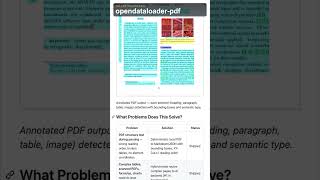
PDF資料で悩むことがもう無くなる?OpenDataLoader PDFというツールの実力!
勉強中のYui丸
OpenDataLoader-PDFでPDFからすべてを抽出 #opensource #ai #github #ocr
Build Things With AI
OpenDataLoader PDF:RAGパイプライン向けオープンソースPDFパーサー(ローカル環境、GPU不要)
Fahd Mirza
YouTube returned 6 videos for “Opendataloader Pdf”, and we withheld 1: 1 did not mention Opendataloader Pdf. Showing the 5 we can prove are about Opendataloader Pdf.
Official links
Featured Head-to-Head Comparisons
Opendataloader Pdf vs Spider Cloud
For RAG pipelines needing fresh web content, Spider Cloud is your go-to; for offline PDF extraction at blazing speed with top accuracy and privacy, Opendataloader Pdf wins. Choose based on data source: live web vs. local PDF.
Opendataloader Pdf vs Temporal Ai
These tools solve completely different problems. Temporal AI is a durable execution engine for orchestrating AI agents and microservices with reliability, while Opendataloader Pdf is a high-speed PDF parser for RAG pipelines. Choose Temporal if you need robust workflow recovery and human-in-the-loop for complex tasks; choose Opendataloader if you need fast, local, deterministic PDF extraction for LLM ingestion.
Opendataloader Pdf vs Screenplayiq
If you're a screenwriter or producer needing data-driven script analysis and box office predictions, ScreenplayIQ is the dedicated choice. For developers building RAG pipelines or needing high-speed, privacy-preserving PDF parsing, Opendataloader Pdf is free, deterministic, and top-performing. They serve entirely different verticals—choose based on your domain.
Popular in Document AI & Data Extraction

Resistant AI
AI document fraud detection and transaction monitoring that catches what rules miss.

Klippa
Klippa, now branded Doxis, turns invoices, receipts, and IDs into structured data via OCR, verification, and spend-management workflows.

Vector AI Customs
AI customs clearance automation with HS code classification and document processing.
Frequently Asked Questions
Used Opendataloader Pdf? Help shape our editorial sentiment research.