
Opik (Comet)
Comet's open-source platform for tracing AI agents, running LLM-as-a-judge evals, and auditing coding-agent spend.
Opik earns a serious look in two situations: you want to self-host observability, or your bill is dominated by coding agents. Cost Intelligence putting Claude Code and Codex spend per developer in one live view is genuinely rare in this category, and the loop where traces feed Test Suites and Ollie writes both the fix and a regression test is the part teams keep using. The 22k-star GitHub core means you can read the code before you trust it. Against LangSmith and Langfuse, Opik wins on the fix step, not on breadth. Pass if nobody on the team can wire an SDK.
Verified 23h ago · liveness 78/100 · cite: rightaichoice.com/tools/opik-comet
- Developers debugging multi-step AI agents where a single trace doesn't show the failure
- Teams that want regression tests generated automatically from real production traces
- Engineering leaders auditing Claude Code and Codex spend per developer and team
- ML engineers running LLM-as-a-judge evaluation across dev, test, and production
- Simple single-turn chatbots that don't need multi-step agent tracing
- Teams wanting a fully managed, no-code setup with zero instrumentation work
- Projects expecting drop-in evaluation templates that run without defining assertions
We scan live Reddit threads, YouTube comments, X posts, G2 reviews and other communities — and hand you an honest verdict in under a minute.
- Honest verdict, not marketing
- Real pros & cons from real users
- Attributed quotes with receipts
3 free scans · no card needed
Skip Opik if no one on your team can instrument an agent with an SDK and author your own assertions, since tracing, evals, and Ollie's fixes all stay dormant until you do.
Opik (Comet)'s pricing fits teams whose volume aligns with the published tiers. Compare against the alternatives listed below for stage-specific value.
In short
Opik (Comet) — Comet's open-source platform for tracing AI agents, running LLM-as-a-judge evals, and auditing coding-agent spend. Best for Developers debugging multi-step AI agents where a single trace doesn't show the failure, Teams that want regression tests generated automatically from real production traces, Engineering leaders auditing Claude Code and Codex spend per developer and team. Free to use.
No head-to-head comparison for Opik (Comet) yet — the alternatives below are the closest matches we list.
What's new in Opik (Comet)
Checked todayAcross the latest 5 updates: 1 feature update, 1 launch and 3 news mentions.
Jev vs. LLM-as-a-Judge for AI Evals
Comet compares Jev with LLM-as-a-judge approaches for AI evaluation on the Opik blog.
Comet extends agent observability and evaluation to Nebius AI Cloud
Opik is now listed in Nebius AI Cloud Applications, bringing agent observability and evaluation to Nebius users.
Capturing a 400-turn Claude Code session in a single image
Comet analyzes thousands of Claude Code sessions to study how developers actually use coding agents.
Export TrueFoundry AI Gateway traces to Opik with OpenTelemetry
Comet documents exporting TrueFoundry AI Gateway traces into Opik via OpenTelemetry.
UX without a UI — researching terminal UX for Opik MCP
Comet shares research notes on terminal user experience for the Opik MCP integration.
Viability Score
How well maintained and how widely used is Opik (Comet)? Built from what the vendor actually publishes (docs, changelog, tutorials, integrations, pricing), whether the site is live, and how much real users discuss it. How we calculate this
Last calculated: October 2026
How we score →Key Features
- End-to-end agent tracing across user interactions, context retrieval, and tool calls
- LLM-as-a-judge evaluation with 30+ metrics including answer relevance, context precision, hallucination, and task completion
- Test Suites with global rules plus item-level assertions producing clear pass/fail results
- Ollie coding assistant analyzes traces, suggests fixes, and implements them in your development code
- Automatic regression test case written with every Ollie fix, under built-in version control
- Agent Playground runs an entire agent configuration end-to-end with versioned prompts and parameters
- Prompt Optimizer with six algorithms for orchestration, tool calling, model parameters, and user interactions
- Real-time production trace monitoring with alerts when a user interaction fails your criteria
- Guardrails to block content and policy violations and reduce PII exposure
- Automatic audit log generation for governance and compliance teams
- Token usage and model cost tracking broken down per developer and per team
- Cost Intelligence tracks Claude Code and Codex spend, MCP installs, skills, and model selection in one live view
- Diagnostics surface silent errors and recommended fixes in production agents
- MCP server integration with a terminal-based workflow
- Trace annotation and collaboration with subject matter experts
About Opik (Comet)
Opik is Comet's open-source platform for tracing, evaluating, and monitoring AI agents. It logs every step an agent takes — user interactions, context retrieval, tool calls — then layers automated evaluation on top so failures surface in development, testing, or production instead of after launch. You instrument your agent with the SDK and get a visual trace of each run, with subject-matter experts able to annotate underperforming traces and drill into the individual prompts and responses behind an aggregate score. Evaluation runs through LLM-as-a-judge metrics: 30+ of them covering answer relevance, context precision, task completion, and hallucination, where you define success with a reference dataset or a plain-text assertion. Several pieces go past standard tracing. Test Suites take a unit-test approach with global rules plus item-level assertions and clear pass/fail output. Ollie, the coding assistant, analyzes traces, proposes fixes, implements them in your development code with built-in version control, and writes a new test case with each fix. Agent Playground runs a whole agent configuration end-to-end so you can version prompts and parameters; Prompt Optimizer offers six algorithms spanning orchestration, tool calling, and model parameters. Production coverage includes real-time trace monitoring with alerts, guardrails against content and policy violations plus PII exposure, automatic audit logs, and token and cost tracking per developer and team. Cost Intelligence audits Claude Code and Codex usage, MCP installs, skills, and model selection in one live view. Comet has since extended Opik into Nebius AI Cloud Applications and documented TrueFoundry AI Gateway trace export via OpenTelemetry. Against LangSmith, Langfuse, Arize, and Braintrust, the differentiator is the eval-to-fix loop that ends in a code change rather than a dashboard.
Behind the Verdict
The honest framing of Opik is that it is two products sharing a name. The first is a competent open-source tracer and evaluator — traces, annotations, LLM-as-a-judge metrics, guardrails, audit logs. That half competes directly with Langfuse and LangSmith, and the thing that actually separates it is the closing of the loop: Test Suites let you write global rules plus item-level assertions in plain text instead of hand-building an eval metric for each scenario, and Ollie then reads the failing trace, proposes a fix, applies it to your development code under version control, and writes a regression test alongside it. Most observability tools stop at 'here is what broke.' Opik tries to also do something about it, and that is the workflow worth evaluating the product on. The second product is Cost Intelligence, and it is aimed at a narrower and more current problem: engineering teams that cannot say what Claude Code and Codex are costing them per developer. The single live view over usage, MCP installs, skills, model selection, context retrieval, and configuration is the kind of internal-visibility surface that finance and engineering management both ask for, and Comet's own research posting on capturing a 400-turn Claude Code session suggests they are mining that telemetry rather than just reselling API invoices. If your AI spend line is dominated by coding agents, this is the reason to look. Where it is weaker: everything depends on instrumentation. Nothing happens until you wire in the SDK, and the eval model assumes you will author assertions or reference datasets yourself — there is no library of drop-in templates you can run unchanged. Self-hosting and the OpenTelemetry export path (now documented for TrueFoundry AI Gateway, alongside the Nebius AI Cloud listing) are real advantages for regulated teams, but they are also engineering work, and the enterprise surface around audit logs and guardrails sits with Comet's commercial offering rather than the free core. The comparison set is crowded — LangSmith, Langfuse, Arize, Braintrust, Galileo — and an honest read is that Opik is a strong pick for agent-heavy teams who want to own their data and want fixes, not a default recommendation for someone who wants zero-instrumentation managed tracing on day one.
Researching Opik (Comet)? Get your full AI stack in 60 seconds.
Free, no signup — tell us your goal and get tools matched to your budget & existing stack.
Real-world workflow fit
Concrete scenarios for the personas Opik (Comet) actually fits — and what changes day-one when you adopt it.
You instrument the agent with the SDK, capture a failing production trace, and annotate it with a domain expert to isolate which tool call went wrong rather than reading logs by hand.
Outcome: A single visual trace names the failing step, and you turn it into a Test Suite assertion so the same failure is caught next time.
You define plain-text assertions for desired behavior plus a reference dataset, then run 30+ LLM-as-a-judge metrics across thousands of traces from each environment.
Outcome: You compare agent versions on scores instead of vibes before shipping, and drill into the individual prompts behind any low score.
You open Cost Intelligence to see Claude Code and Codex usage per developer and team, then audit MCP installs, skills, and model selection across the org.
Outcome: You can point to which teams and configurations drive spend and where to change model selection to cut it.
Use Cases
- Trace and debug a multi-step AI agent from user query through tool call to final response
- Evaluate thousands of traces against 30+ LLM-as-a-judge metrics instead of spot-checking outputs
- Define unit tests for agent behavior with plain-text assertions and let Ollie implement and regression-test the fix
- Monitor production agents in real time and get alerted when an interaction violates your criteria
- Run prompt optimization algorithms to improve accuracy across orchestration and tool-calling steps
- Generate audit logs for compliance by capturing every action an agent takes
- Audit Claude Code and Codex spend, MCP installs, and model selection per developer and team
- Export gateway traces into Opik via OpenTelemetry to keep one observability view
Models Under the Hood
as of 2026-10-16
Limitations
- Opik only works as well as the agents it observes.
- Tracing, evaluation, and Ollie's fixes all depend on the underlying agent being instrumented, so nothing happens until you wire in the SDK.
- Setup requires technical expertise — you are working with SDKs, an OpenTelemetry export path, and potentially a self-hosted deployment rather than a point-and-click console.
- The evaluation model assumes you will define assertions or reference datasets yourself; there is no library of drop-in evaluation templates to run unchanged.
- The open-source core covers observability and evaluation, while audit logs, guardrails, and compliant enterprise deployment sit with Comet's commercial offering.
- Cost Intelligence is focused on coding agents such as Claude Code and Codex rather than arbitrary model-call spend.
as of 2026-10-21
Verification history
We have re-verified Opik (Comet) 21 times since . Each pass re-reads the vendor's own pages and re-checks every listed field against that evidence; passes where nothing had changed are marked as such.
- — re-verified summary, description, our verdict, our analysis, pricing model, pricing tiers, features, integrations, who it suits, who should skip it
- — re-verified summary, description, our verdict, our analysis, pricing model, pricing tiers, features, integrations, who it suits, who should skip it
- — re-verified summary, description, our verdict, our analysis, pricing model, pricing tiers, features, integrations, who it suits, who should skip it
- — re-checked, vendor evidence unchanged
- — re-verified summary, description, our verdict, our analysis, pricing model, pricing tiers, features, integrations, who it suits, who should skip it
- — re-verified summary, description, our verdict, our analysis, pricing model, pricing tiers, features, integrations, who it suits, who should skip it
Showing the 6 most recent of 21 verification passes.
Free to cite with attribution — this page re-verifies continuously.
12-month cost
Project the real annual outlay, including the implied monthly cost when only an annual tier is published.
Vendor list price only. Add-on usage, seat overages, and contract minimums are surfaced under Hidden costs & gotchas.
Plans compared
For each published Opik (Comet) tier: who it actually fits, and what it adds vs. the previous tier. Cross-reference the cost calculator above for projected annual outlay.
Open Source
$0
Ideal for
Teams that want to run AI observability on their own infrastructure and read the code before trusting it
What this tier adds
Starting tier: the core observability and evaluation feature set, downloaded from GitHub and run locally
Comet Cloud Free
$0
Ideal for
Individual developers or small teams evaluating agent tracing without committing infrastructure
What this tier adds
Adds hosted Opik tracing and evaluation, Test Suites, and eval metrics on top of the self-hosted core
Enterprise
Custom
Ideal for
Organizations needing a scalable, compliant deployment with governance controls
What this tier adds
Adds automatic audit logs, guardrails against policy violations and PII exposure, and compliant deployment
Where the pricing makes sense
The company stage and team size where Opik (Comet)'s pricing actually pencils out — and where peers do it cheaper.
Opik (Comet)'s pricing fits teams whose volume aligns with the published tiers. Compare against the alternatives listed below for stage-specific value.
Setup time & first value
How long it actually takes to get something useful out of Opik (Comet) — broken out by persona, not the marketing-page minute.
Setup time varies by use case. Solo users typically reach first value within an hour; teams should budget half a day for shared setup including integrations and access controls.
Switching to or from Opik (Comet)
How to bring data in from common predecessors and how to get it back out — written for the switcher, not the buyer.
- →From LangSmith or Langfuse: instrument with the Opik SDK and replay captured traces into Opik to rebuild your evaluation set
- ↗To any OpenTelemetry-compatible backend: use the documented OpenTelemetry export path rather than re-instrumenting from scratch
Integrations
Resources & Guides
- Documentationcomet.com
Docs Home - Comet Docs
Full product docs from comet.com
- Documentationcomet.com
Opik - Open-Source LLM Observability & Agent Optimization
Build, test, and optimize GenAI apps from prototype to production. Comprehensive tracing, evaluation, and prompt optimization for RAG, agents, and more.
- Resourcecomet.com
Opik
Opik is an end-to-end AI observability platform designed to help developers test, ship, and continuously improve agentic systems.
- Resourcegithub.com
GitHub - comet-ml/opik: Debug, evaluate, and monitor your LLM applications, RAG systems, and agentic workflows with comprehensive tracing, automated evaluations, and production-ready dashboards.
Debug, evaluate, and monitor your LLM applications, RAG systems, and agentic workflows with comprehensive tracing, automated evaluations, and production-ready dashboards. - comet-ml/opik
Tutorials & Learning
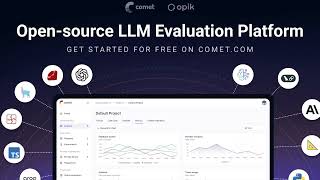
YouTube returned 6 videos for “Opik (Comet)”, and we withheld 5: 5 did not mention Opik (Comet). Showing the 1 we can prove is about Opik (Comet).
Official links
Tools that pair well with Opik (Comet)
Common stack mates teams adopt alongside Opik (Comet), with the specific reason each pairing earns its keep.

OpenAgents
Open-source research platform (COLM 2024) shipping three language agents — Data, Plugins and Web — in one chat UI, for free.

Langfuse
Open-source LLM observability, prompt management, and agent evals on one data model.
MLflow
Open source AI engineering platform for agent and LLM tracing, evaluation, prompt management, and ML lifecycle work.
Alternatives to Opik (Comet)
View all
OpenAgents
Open-source research platform (COLM 2024) shipping three language agents — Data, Plugins and Web — in one chat UI, for free.

Frequently Asked Questions
Used Opik (Comet)? Help shape our editorial sentiment research.