
testsprite-cli
TestSprite CLI writes and runs AI end-to-end tests against your live app, so agent-generated code gets verified before it merges.
If your coding agent keeps closing tickets while a flow quietly breaks, TestSprite is the verifier worth wiring into CI now — the CLI is open source and the MCP server drops into Claude Code, Codex or Cursor without new test scripts. The 3.0 fleet plus editable Feature Map made it a coverage engine rather than a test runner. Watch the tier change: live pricing now splits Standard ($39/mo billed annually, 800 credits) from Pro ($69/mo billed annually, 1,600 credits), and the old $69 Standard figure in our seed is stale. Credits are the real ceiling. Need selector-level control over assertions? Stay on Playwright.
Verified 8d ago · liveness 81/100 · cite: rightaichoice.com/tools/testsprite-cli
- AI-native teams where coding agents write most of the code
- Developers in Claude Code, Codex or Cursor who want tests verified on every merge
- Startups and mid-sized teams shipping fast without a dedicated QA engineer
- Teams needing frontend, backend and data flows covered in one suite
- Teams who need hand-crafted, behaviour-driven scripts with full control over selectors and assertions
- Projects requiring fully offline or air-gapped testing — TestSprite runs in its own cloud
- Very small projects where the 150-credit free quota runs out quickly
We scan live Reddit threads, YouTube comments, X posts, G2 reviews and other communities — and hand you an honest verdict in under a minute.
- Honest verdict, not marketing
- Real pros & cons from real users
- Attributed quotes with receipts
3 free scans · no card needed
Skip TestSprite if you need hand-authored, behaviour-driven scripts with selector-level control over every assertion — Playwright or Cypress is the right home for that, and TestSprite is deliberately an autonomous verifier rather than a script framework.
Credits, not seats, are the meter — every generation and rerun consumes the monthly allowance, so a busy agent shipping daily can burn through 400 Starter credits well before the month ends.
Free (150 credits) suits a solo dev kicking the tyres on one app; Starter at $19/mo from the second month fits a single-project team; Standard at $39/mo billed annually (800 credits) covers a product with a real pipeline; Pro at $69/mo billed annually (1,600 credits, unlimited environments and run history) fits multi-app teams running nonstop. Cheaper per-credit than mabl or testRigor enterprise seats; more expensive than hand-rolling Playwright, where the cost is your own engineering hours.
In short
testsprite-cli — TestSprite CLI writes and runs AI end-to-end tests against your live app, so agent-generated code gets verified before it merges. Best for AI-native teams where coding agents write most of the code, Developers in Claude Code, Codex or Cursor who want tests verified on every merge, Startups and mid-sized teams shipping fast without a dedicated QA engineer. Free to start; paid plans from $39/mo.
What's new in testsprite-cli
Checked 8 days agoAcross the latest 5 updates: 1 feature update and 4 news mentions.
TestSprite publishes batch of practical testing how-to guides
A series of how-to posts covering full-stack coverage, PRD-to-test generation, testing AI-generated code, MCP setup and pricing plans.
TestSprite publishes competitor comparison and review posts
Comparisons against momentic, mabl and testRigor, plus a review aimed at solo developers and AI-native startups.
TestSprite posts on test-case generation and nightly AI regression
Two posts covering generating test cases from product requirements and whether AI can run nightly full regression suites.
TestSprite 3.0: Frontend Fleet, Backend Rebuild, Feature Map & Fixtures
Adds the parallel frontend exploration fleet with auto-healing tests, a rebuilt backend engine with dynamic variables and auto cleanup, an editable Feature Map from PRD uploads, project-level file fixtures and a Data Flow API trace view.
Introducing TestSprite 2.1: Autonomous Agentic Testing
Pitches autonomous agentic testing for AI-native teams, following the 2.1.1 update that added light mode, a self-service billing portal and MCP stability fixes.
What people actually say about testsprite-cli — is it worth it?
We ran a structured research pass across product reviews, community discussions, and post-purchase forum threads to surface the patterns vendors won't publish themselves. Below: the recurring strengths, the hidden costs people mention most, and the cohort that consistently regrets adopting this tool.
17 mentions across 2 sources (YouTube, GitHub) · researched Aug 15, 2026.
Average across the 2 sources that answered — each source counts once, not each post.
- +Auto-generates end-to-end tests without writing scripts, saving time.
- +Fleet of AI agents explores app in parallel for faster coverage.
- +Failure bundle includes screenshots, DOM snapshots, root-cause, and fix.
- +MCP server integrates directly with Claude Code, Cursor, and Codex.
- +Auto-heals tests when UI drifts, keeping suites green.
- −Community feedback is sparse; few detailed user reviews exist.
- −Cloud-only operation requires internet, limiting offline use.
- −36 open GitHub issues raise questions about maturity.
- −Free tier restricted to foundational models, possibly lower quality.
- −Some viewers dismissed YouTube mentions as paid promotion.
- • Cloud compute may incur extra charges for heavy usage.
- • Upgrading models increases cost; free tier may not be enough for serious use.
Viability Score
How well maintained and how widely used is testsprite-cli? Built from what the vendor actually publishes (docs, changelog, tutorials, integrations, pricing), whether the site is live, and how much real users discuss it. How we calculate this
Last calculated: October 2026
How we score →Key Features
- Parallel AI exploration fleet drives real browsers against your live app
- End-to-end testing against deployed apps, not mocks
- Open-source CLI via npm (@testsprite/testsprite-cli)
- MCP server for Claude Code, OpenAI Codex and Cursor
- GitHub PR auto-test gate before merge (1 repo Free, unlimited on Pro)
- Auto-heal rerun repairs tests when the UI drifts, with no selector rewrites
- Failure bundle: failing step, neighbours, screenshots, DOM snapshots, test source, root-cause hypothesis, suggested fix
- Backend integration tests with multi-dependency API chains
- Dynamic Variables for cross-test resource reuse and Auto Cleanup after runs
- Auto-Auth and Smart Rerun for stable nightly regression
- File uploads and fixtures at project level — CSV, JSON, PDF, images
- Editable Feature Map auto-extracted from a PRD upload
- Data Flow view traces API invocations under different input scenarios
- Scheduled test runs and monitoring — nightly, weekly or pre-release
- Video replay of any session plus verdict and trigger retained per run
About testsprite-cli
TestSprite is an agentic testing platform for teams whose code generation outpaced their ability to verify it. You connect your app one of three ways — install the open-source CLI from npm (@testsprite/testsprite-cli, launched and now live per the vendor), add the MCP server to Claude Code, OpenAI Codex or Cursor, or paste a staging URL into the dashboard. TestSprite then reads your code and any PRD or API doc you upload, and a parallel fleet of AI agents opens the running app at once, driving a real browser or hitting a live API rather than asserting against mocks. The vendor publishes a benchmark of roughly 10 minutes from a URL to 50–100 end-to-end tests. The output is meant to be a closed QA loop your coding agent can drive. A failure arrives as one bundle: the failing step and its neighbors, screenshots, DOM snapshots, the test source, a root-cause hypothesis and a recommended fix. Auto-Heal repairs tests when the UI drifts rather than making you rewrite selectors, and passing tests are retained so coverage compounds between releases. Every pull request gets re-checked against the full suite and the result posts to the PR; schedules run nightly, weekly or pre-release, and every run is kept rather than overwritten. The 3.0 release (April 24, 2026) added the parallel frontend exploration fleet, a rebuilt backend engine with multi-dependency chains plus Dynamic Variables and Auto Cleanup, an editable Feature Map extracted from PRD uploads, project-level file fixtures (CSV, JSON, PDF, images), and a Data Flow view that traces API invocations when backend chains break. Pricing is credit-based and changed materially: the current published tiers are Free (150 credits/mo), Starter ($0 first month then $19/mo), Standard ($39/mo billed annually, 800 credits) and Pro ($69/mo billed annually, 1,600 credits), with Enterprise at $199+/mo from 10 seats. Note the seed data listed a single $69/mo billed annually Standard tier — the live pricing page now splits Standard and Pro. TestSprite runs in its own cloud, so a reachable app and internet access are required. It is not a replacement for hand-authored Playwright or Cypress scripts where you want selector-level control over assertions.
Behind the Verdict
TestSprite's central claim is that the bottleneck moved. Writing code got fast; proving it still works did not. The vendor's own framing — three weeks to hand-write a 60-test suite at the published two-to-four-hours-per-end-to-end-test benchmark — is the honest version of that argument, and it is why a tool that generates a suite in ten minutes from a URL is worth a look even if you already have Playwright in the repo. The design choice that matters most is that tests run against the deployed app, not mocks. A parallel fleet of agents explores the live product, clicking through flows the way a user would, and tests are generated from what the agents actually find rather than inferred intent from source code. That is a meaningfully different failure mode from script-based frameworks: a pass means a person could plausibly do the thing. The cost is that you need a reachable staging or production app and internet access, because TestSprite runs the browsers on its own machines — the vendor is explicit that air-gapped testing is out. The failure bundle is the second real differentiator. One self-consistent payload per failure — failing step and neighbours, screenshots, DOM snapshots, test source, root-cause hypothesis, suggested fix — is the difference between an agent that can act on a red test and one that needs a human to triage the morning. Combined with Auto-Heal (repairs when the UI drifts, no selector rewrites) and retained passing tests, coverage compounds instead of decaying, which is the actual complaint behind most abandoned E2E suites. The 3.0 release (April 24, 2026) is where backend stopped being an afterthought. A rebuilt engine supports multi-dependency integration chains, Dynamic Variables for cross-test resource reuse, Auto Cleanup that wipes test-created resources after each run, Auto-Auth and Smart Rerun for stable nightly regression. The Data Flow view traces API invocations under different input scenarios. File fixtures (CSV, JSON, PDF, images) are uploaded once at project level and wired into both frontend and backend tests. The editable Feature Map, auto-extracted from a PRD upload, acts as ground truth for generation downstream — and the vendor makes a good point that a failing test also re-surfaces a dropped requirement mid-task, which no context window does on its own. Where it fits: AI-native teams and small startups without a QA hire, plus any developer in Claude Code, Codex or Cursor who wants merges gated before they land. The CLI (open source, npm) and MCP server mean the agent that wrote the code can also read the failure and fix it in the same session. Where it does not: teams who need behaviour-driven scripts with full control over selectors and assertions should stay on Playwright or Cypress — this is an autonomous verifier, a different category. Credit budgeting is the practical constraint. Free gives 150 credits per month and one test list; Starter gives 400 credits and 5 test lists for $19/mo after the
Researching testsprite-cli? Get your full AI stack in 60 seconds.
Free, no signup — tell us your goal and get tools matched to your budget & existing stack.
Real-world workflow fit
Concrete scenarios for the personas testsprite-cli actually fits — and what changes day-one when you adopt it.
You install the open-source CLI from npm, add the MCP server to Claude Code, and point TestSprite at your staging URL. A parallel fleet of agents explores the app and generates the first suite; you commit and the GitHub PR auto-test gate re-checks it before the merge.
Outcome: The agent that wrote the code reads the same failure bundle — failing step, DOM snapshot, root cause, suggested fix — and repairs it in the same session instead of you triaging a wall of red.
You place an order and invite teammates on Standard. You upload a PRD to extract the editable Feature Map, add CSV and JSON fixtures at project level, and wire Slack notifications plus nightly scheduled runs.
Outcome: Overnight agent runs get re-verified on a cadence and silent breaks surface through Slack, with 90 days of run history retained to show when a test started failing.
You use the rebuilt 3.0 backend engine to generate multi-dependency integration chains, enable Dynamic Variables for cross-test resource reuse and Auto Cleanup, then open the Data Flow view when a chain breaks.
Outcome: API invocations are traced under different input scenarios, so debugging agent-generated backend tests feels like debugging your own code rather than guessing at hidden state.
Use Cases
- Generate and run end-to-end tests by pointing TestSprite at a live staging URL.
- Verify code written by Claude Code, Codex or Cursor agents without writing test scripts.
- Catch regressions from overnight agent runs with scheduled nightly testing.
- Upload a PRD to auto-extract an editable Feature Map and generate tests from it.
- Gate every pull request against the full suite before it merges, with results posted to the PR.
- Replay any session as video to debug what broke and drop the evidence in a PR.
- Run parallel exploration to discover flows invisible to static analysis.
- Feed real CSVs, JSON, PDFs or images into frontend and backend tests via project fixtures.
Models Under the Hood
as of 2026-09-22
Limitations
- Testing runs in TestSprite's cloud, so a reachable app and internet access are required — air-gapped setups are out.
- Free caps at 150 credits per month with 1 environment, 1 test list and 30 days of run history, on foundational models; advanced agent models (up to the most capable model on Pro) and features like advanced backend testing, auto-heal, Jira/Linear triggers and agent memory are tier-gated.
- Run history is 30 days on Free and Starter, 90 days on Standard, unlimited on Pro.
- File uploads are plan-limited.
- GitHub PR auto-test covers 1 repo on Free, 3 on Starter, 5 on Standard, unlimited on Pro.
- Enterprise starts at $199+/mo from 10 seats and is where SSO/SAML, SCIM, audit logs, IP allowlisting and single-tenant deployment live.
- Credits are a metered ceiling, not a flat seat price.
as of 2026-09-30
Verification history
We have re-verified testsprite-cli 8 times since . Each pass re-reads the vendor's own pages and re-checks every listed field against that evidence; passes where nothing had changed are marked as such.
- — re-verified summary, description, our verdict, our analysis, pricing model, pricing tiers, features, integrations, who it suits, who should skip it
- — re-verified summary, description, our verdict, our analysis, pricing model, pricing tiers, features, integrations, who it suits, who should skip it
- — re-verified summary, description, our verdict, our analysis, pricing model, pricing tiers, features, integrations, who it suits, who should skip it
- — re-verified summary, description, our verdict, our analysis, pricing model, pricing tiers, features, integrations, who it suits, who should skip it
- — re-verified summary, description, our verdict, our analysis, pricing model, pricing tiers, features, integrations, who it suits, who should skip it
- — re-verified summary, description, our verdict, our analysis, pricing model, pricing tiers, features, integrations, who it suits, who should skip it
Showing the 6 most recent of 8 verification passes.
Free to cite with attribution — this page re-verifies continuously.
12-month cost
Project the real annual outlay, including the implied monthly cost when only an annual tier is published.
Vendor list price only. Add-on usage, seat overages, and contract minimums are surfaced under Hidden costs & gotchas.
Plans compared
For each published testsprite-cli tier: who it actually fits, and what it adds vs. the previous tier. Cross-reference the cost calculator above for projected annual outlay.
Free
$0/mo
Ideal for
Solo developer or evaluator proving out the loop on one app before committing budget.
What this tier adds
Starting tier: 150 credits/mo, 1 environment, 1 test list, 30 days of run history, foundational models, CLI and IDE plugin, GitHub PR auto-test on 1 repo.
Starter
$0 first month, then $19/mo
Ideal for
Single-project team or indie developer testing one app for real, with a first month free.
What this tier adds
Adds advanced models for generation and execution, auto-heal reruns, advanced backend testing, scheduled runs and monitoring, 400 credits/mo and 5 test lists.
Standard
$39/mo billed annually
Ideal for
A product with a real CI pipeline that needs Jira/Linear triggers and longer history.
What this tier adds
Doubles credits to 800/mo, adds an advanced agent model, 3 environments, 90-day run history, 5 GitHub PR repos, Jira/Linear integrations and per-project agent memory.
Pro
$69/mo billed annually
Ideal for
Teams running many apps nonstop across a workspace, where repo and environment limits bite.
What this tier adds
Most capable agent model, 1,600 credits/mo, unlimited environments and run history, unlimited GitHub PR repos and workspace-wide agent memory.
Enterprise
$199+/mo (from 10 seats)
Ideal for
Organisations needing their own deployment, security controls and a named support contact.
What this tier adds
From $199+/mo at a 10-seat minimum: 5,000+ credits, customized AI model, single-tenant deployment, SSO/SAML, SCIM, audit logs, IP allowlisting, data residency, custom third-party integrations and a named CSM with SLA.
Where the pricing makes sense
The company stage and team size where testsprite-cli's pricing actually pencils out — and where peers do it cheaper.
Free (150 credits) suits a solo dev kicking the tyres on one app; Starter at $19/mo from the second month fits a single-project team; Standard at $39/mo billed annually (800 credits) covers a product with a real pipeline; Pro at $69/mo billed annually (1,600 credits, unlimited environments and run history) fits multi-app teams running nonstop. Cheaper per-credit than mabl or testRigor enterprise seats; more expensive than hand-rolling Playwright, where the cost is your own engineering hours.
Setup time & first value
How long it actually takes to get something useful out of testsprite-cli — broken out by persona, not the marketing-page minute.
Install the CLI and point it at a staging URL: the vendor benchmarks about 10 minutes from a URL to 50–100 end-to-end tests, so a solo developer sees first results in one sitting. Adding the MCP server to Claude Code, Codex or Cursor is a few minutes more. Teams on Standard or above should budget an afternoon for PRD upload, Feature Map review, fixtures and nightly scheduling before trusting the
Switching to or from testsprite-cli
How to bring data in from common predecessors and how to get it back out — written for the switcher, not the buyer.
- →From Playwright: keep your existing specs for selector-level assertions while TestSprite covers the flows you never got around to scripting, since it verifies the running app rather than re-running your scripts.
- →From Cypress: point TestSprite at the same staging environment to generate coverage on paths your hand-authored suite misses, and let the PR gate re-check merges.
- →From manual QA releases: upload the PRD to extract the editable Feature Map, then let nightly scheduled runs replace the pre-release click-through pass.
- →From mabl or testRigor: run TestSprite against the same app on Free or Starter for a month to compare generated coverage before deciding whether to consolidate suites.
- ↗To Playwright: export the logical flows TestSprite discovered and hand-author assertions where you need selector-level control — TestSprite is a verifier, not a script-authoring framework.
- ↗To mabl or testRigor: if you need vendor-hosted suites with different enterprise packaging, the concepts (environments, schedules, PR gating) map across directly.
- ↗To a self-hosted runner: Enterprise's single-tenant deployment is the path if your constraint is data residency rather than tooling; TestSprite runs its browsers on its own machines otherwise.
Integrations
Resources & Guides
Tutorials & Learning
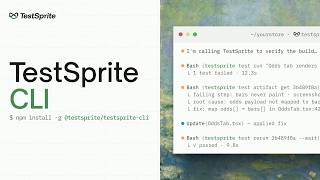
TestSprite CLI — コーディングエージェントが自身の作業を検証できるようにする(オープンソース)
TestSprite
TestSprite CLI - エージェント型コーディングのための検証レイヤー!
Execute Automation

รีวิว TestSprite CLI ตัวช่วยตรวจงานของโค้ด AI Agent แบบอัตโนมัติ | หมีไลฟ์โค้ด EP.156
หมีไลฟ์โค้ด - Me Live Code
YouTube returned 6 videos for “testsprite-cli”, and we withheld 3: 3 did not mention testsprite-cli. Showing the 3 we can prove are about testsprite-cli.
Official links
Tools that pair well with testsprite-cli
Common stack mates teams adopt alongside testsprite-cli, with the specific reason each pairing earns its keep.

Kerno
Runtime verification for AI coding agents that validates code against your live stack before the PR exists

Ellipsis
Ellipsis Agent Cloud runs Claude Code and Codex coding agents in managed cloud sandboxes defined by environment.yaml.

QA Wolf
QA Wolf maps your app with AI, writes Playwright tests from prompts, and runs them in parallel containers — or does the whole job for you.
Featured Head-to-Head Comparisons
Testsprite Cli vs Bito
Bito and TestSprite serve complementary roles: Bito provides system-wide context for coding agents across multi-repo projects, while TestSprite automates end-to-end testing by exploring live apps. If your pain point is cross-repo dependency understanding and architectural planning, choose Bito. If you need a terminal-based AI test automation tool that feeds failure bundles back to your coding agent, choose TestSprite. They can be used together for a full development-testing workflow.
Testsprite Cli vs Cognition Ai
Choose Cognition AI (Devin) if you need an autonomous software engineer that handles the full dev cycle—planning, coding, testing, and shipping—and your enterprise demands legacy modernization, native VM support, and a financial productivity guarantee. Choose TestSprite CLI if your workflow is AI-native (Claude Code, Cursor, Codex) and you need a lightweight, terminal-driven test automation tool that feeds actionable failure bundles directly to your coding agent. For testing alone, TestSprite is simpler and cheaper; for end-to-end development, Devin is more comprehensive.
Testsprite Cli vs Poolside Ai
Poolside AI and TestSprite CLI solve entirely different problems. Choose Poolside if you need a secure, custom foundation model for code generation in regulated, air-gapped environments. Choose TestSprite if you're an AI-native team needing an autonomous test suite that grows as your app evolves and feeds failure diagnostics back to your coding agents.
Pieces For Developers vs Testsprite Cli
Choose Pieces for Developers if your pain is losing context across apps, meetings, and code tools—it builds an automatic, searchable memory. Choose TestSprite if your pain is trusting AI-written code—it autonomously tests your app and bundles failures with root-cause hypotheses. They solve different problems: one captures what you've done, the other validates what your AI agent just wrote.
Replit Agent vs Testsprite Cli
If you need to build and deploy a full-stack app from a prompt, Replit Agent is your one-stop cloud IDE. But if you already have a live app and your coding agent (Claude Code, Cursor, Codex) is shipping fast, TestSprite CLI is the missing verifier that catches regressions without manual test writing. Choose based on whether you're creating or verifying.
Alternatives to testsprite-cli
View all


Frequently Asked Questions
Categories
Used testsprite-cli? Help shape our editorial sentiment research.