Demoboost is live · pricing from $375/mo billed annually · last verified 23 Oct 2026 · viability healthy

Demoboost
AI-powered demo automation that builds interactive product demos from one click-through and turns buyer engagement into intent signals.
Buy Demoboost when demo engagement data has to land in your CRM and change which deals your reps chase — that feedback loop is the product, not a sidebar. Click-through capture plus Wingman prompt editing gets you a working demo fast, and Demo Intent Signals is the reason to pay. Budget honestly: $375/mo Start Up (billed annually) is creation only, with no CRM sync and no Revenue Intelligence; the pieces presales teams actually want need Growth at $1,200/mo billed annually. If you only need a demo builder, Navattic and Storylane are cheaper places to look.
Verdict generatedVerified 7d ago · liveness 81/100 · cite: rightaichoice.com/tools/demoboost
- Presales teams automating standard demos to protect live time for complex deals
- Sales reps who need demo engagement data flowing into CRM
- Product marketing teams turning launches into reusable demo narratives
- Customer success teams scaling onboarding and expansion conversations
- Teams with a demo-tool budget under $375/mo billed annually
- Simple screenshot or video demo needs where intent scoring never gets used
- Companies without a defined sales process to attach buyer intent to
We scan live Reddit threads, YouTube comments, X posts, G2 reviews and other communities — and hand you an honest verdict in under a minute.
- Honest verdict, not marketing
- Real pros & cons from real users
- Attributed quotes with receipts
3 free scans · no card needed
Skip Demoboost if you only need a shareable interactive demo for your website and have no plan to act on per-viewer intent data — you would be paying $375/mo billed annually for the builder and leaving the Revenue Intelligence layer, which needs Growth at $1,200/mo billed annually, unused.
Annual billing is the only published cadence, so $375/mo Start Up commits you to a full year of spend before you have seen whether your team uses the analytics.
Demoboost prices as a mid-market platform: $375/mo Start Up and $600/mo Essentials (both billed annually) are above what a solo marketer pays for a demo builder, while Growth at $1,200/mo billed annually is where the intent analytics and CRM sync finally exist. Compared with lighter demo tools, you are paying a premium for Revenue Intelligence, not for the builder. Enterprise is custom-quoted for SSO and full whitelabeling.
In short
Demoboost — AI-powered demo automation that builds interactive product demos from one click-through and turns buyer engagement into intent signals. Best for Presales teams automating standard demos to protect live time for complex deals, Sales reps who need demo engagement data flowing into CRM, Product marketing teams turning launches into reusable demo narratives. Plans from $375/mo billed annually.
No head-to-head comparison for Demoboost yet — the alternatives below are the closest matches we list.
What is Demoboost?
Demoboost — AI-powered demo automation that builds interactive product demos from one click-through and turns buyer engagement into intent signals. Best for Presales teams automating standard demos to protect live time for complex deals, Sales reps who need demo engagement data flowing into CRM, Product marketing teams turning launches into reusable demo narratives. Plans from $375/mo billed annually.
Demoboost is a demo automation platform for B2B SaaS revenue teams. You click through your product once and it captures the flow as an interactive HTML demo or sandbox; from there its AI copilot, Wingman, adapts copy, data, graphs, images and language from a prompt for a specific account, industry or persona. Six demo formats sit on the platform — HTML product tours, screenshot demos, video demos, mobile demos, sandbox demos and live demo overlays — with format access gated by plan. Around creation it layers the part it actually sells: Demo Intent Signals, which track what each viewer explored, revisited, shared and dropped off on, plus Revenue Intelligence analytics on Growth that map which people on the buying committee engaged and where deals are moving. Presales builds and governs the core demo story, sales personalises and delivers it, product marketing turns launches into reusable narratives and customer success reuses the same assets for onboarding and expansion. It competes with Navattic, Storylane, Demostack, Reprise and Saleo; the distinction Demoboost pushes is the analytics layer on top of the builder rather than the builder itself. Four annual tiers start at $375/mo billed annually.
Key features
- Single click-through capture that becomes an interactive HTML demo or sandbox
- Wingman AI copilot: edit copy, data, graphs, images and language by prompt
- AI Guide Refine, AI Narrative and AI Translate for per-audience demo narratives
- AI Graph Variables that swap dynamic data inside demos
- AI Avatars and voiceovers with video narrations
- AI Themes and an AI Interface Edit for restyling demo builds
- Six formats: HTML tours, screenshot demos, video, mobile, sandbox, live overlay
- Live demo overlay presented on top of the real product with speaker notes
- Demo Intent Signals tracking views, clicks, drop-off and shares per viewer
- Buying committee mapping: see who on the account explored what
- Revenue Intelligence analytics tying demo activity to deal progression
- Sales Rooms and Demo Hubs with autoplay
- Dynamic playlists with choose-your-own-journey menus
- Advanced lead form builder with Martech and Sales Tech form integrations
- Native CRM integrations and webhooks for pushing engagement data out
Behind the verdict
Demoboost divides cleanly into two halves, and only one of them is hard to copy. The first half is demo creation. You click through your product once, Demoboost turns the capture into an interactive demo or sandbox, and then Wingman — its prompt-driven copilot — rewrites copy, data, graphs, images and language so the same asset fits a named account, industry or persona. AI Guide Refine, AI Narrative, AI Graph Variables, AI Translate, AI Themes, speaker notes and AI avatars fill out the toolkit, and six delivery formats (HTML, screenshot, video, mobile, sandbox, live overlay) cover most of the buyer journey from website embed to technical sandbox evaluation. That is competent and genuinely fast, but Navattic, Storylane and Saleo are all in the same territory. The second half is the argument for the product. Demo Intent Signals record what a viewer explored, how deep they went, what they revisited and shared, and — the useful bit — who else on the buying committee showed up. Growth folds that into Revenue Intelligence analytics and native CRM integrations so engagement reaches the record your reps actually work from; Enterprise adds overlay demos, SSO, role-based access control and full domain whitelabeling. Demoboost's own July 2026 blog post, "Beyond the Demo: Why Revenue Intelligence Is the Real AI Prize", states the strategy plainly: creation is commoditising, the intent layer is the asset. The weaknesses follow the tier ladder. The capability Demoboost markets as its differentiator is not on Start Up or Essentials — Revenue Intelligence and native CRM integrations start at Growth, $1,200/mo billed annually. Mobile demos, AI avatars, custom themes and the advanced lead form builder are locked to Essentials; sandbox demos, AI Narrative, AI Translate, Sales Rooms and autoplay to Growth; unlimited overlay demos, SSO and full whitelabeling to Enterprise. Professional service hours are capped per plan (1 hour/month on Essentials, 4 on Growth, 6 on Enterprise) and support walks from email on Start Up to a dedicated CSM and priority SLA on Enterprise. If your team will not act on intent scoring, you are paying a premium for analytics you never open. Where it fits: mid-market and enterprise B2B SaaS with a defined sales process, a presales function that can own the core demo story, and enough deal volume that "which account is actually engaging" changes the forecast. Where it does not: teams that just need a clean demo embedded on a marketing site, short-cycle low-ACV products where the analytics overhead outweighs the deal value, and anyone whose budget sits under $375/mo.
Models under the hood
as of 2026-10-22
Limitations
- Every plan is billed annually and starts at $375/mo, so entry cost is real before you have proven anything.
- The capabilities Demoboost sells hardest are spread across three higher tiers: mobile demos, AI avatars and custom themes need Essentials ($600/mo billed annually); sandbox demos, AI Narrative, AI Graph Variables, AI Translate, Sales Rooms, native CRM integrations and Revenue Intelligence analytics need Growth ($1,200/mo billed annually); unlimited overlay demos, SSO and full domain whitelabeling need Enterprise, which is custom priced.
- Professional service hours are capped by plan — 1 hour/month on Essentials, 4 on Growth, 6 on Enterprise — and support runs from email on Start Up to a dedicated CSM and priority SLA on Enterprise.
- Seats are fixed per tier (2 on Start Up, 5 on Essentials, 10 on Growth), and partial domain whitelabeling only arrives on Growth while full whitelabeling is Enterprise-only.
as of 2026-10-23
Researching Demoboost? Get your full AI stack in 60 seconds.
Free, no signup — tell us your goal and get tools matched to your budget & existing stack.
Is Demoboost still active?
Demoboost is live · pricing from $375/mo billed annually · last verified 23 Oct 2026 · viability healthy.
Viability score
How well maintained and how widely used is Demoboost? Built from what the vendor actually publishes (docs, changelog, tutorials, integrations, pricing), whether the site is live, and how much real users discuss it. How we calculate this
Last calculated: October 2026
How we score →What's new in Demoboost
Checked 7 days agoAcross the latest 3 updates: 3 news mentions.
Beyond the Demo: Why Revenue Intelligence Is the Real AI Prize
Demoboost argues the real AI value sits in revenue intelligence rather than demo creation, restating its focus on turning demo engagement into intent analytics.
Demostack vs Saleo: What's the best demo automation platform for you?
A buyer's comparison of Demostack and Saleo, published as Demoboost positions itself against both in demo automation evaluations.
How AI Analyzes Buyer Intent Signals from Product Demos
An explainer on the AI analysis behind demo-derived buyer intent signals, covering a core Demoboost capability.
What do users say about Demoboost?
What people actually say about Demoboost — is it worth it?
We scanned public community sources for Demoboost on Aug 24, 2026 and could not establish that the discussion we found is about this tool rather than something else sharing its name. Our own analysis of that scan says the posts were off-subject. Rather than publish a sentiment score built on the wrong subject, we publish nothing here and re-run the scan.
How we verified this
Every listed fact about Demoboost— pricing, features, links, status — is re-read from the vendor's own pages by our verification pipeline and each change is logged with a date; the last pass ran on 23 Oct 2026. Pages mix model-assisted synthesis with human review; see how we verify.
Verification history
We have re-verified Demoboost 19 times since . Each pass re-reads the vendor's own pages and re-checks every listed field against that evidence; passes where nothing had changed are marked as such.
- — changed hidden costs, who should skip it, switching out, limitations, summary, setup time, our verdict, use cases, who it suits, pricing fit, features, pricing tiers, description, switching in
- — changed description, who should skip it, features, who it suits, summary, our verdict, pricing tiers
- — changed limitations, pricing page
- — changed SSL certificate
- — changed pricing fit, who it suits, description, our verdict, features, hidden costs, limitations, switching in, switching out, who should skip it, pricing tiers, setup time, summary, use cases
- — changed limitations, pricing page, integrations, description, features, summary, pricing tiers, who it suits, our verdict, who should skip it
Showing the 6 most recent of 19 verification passes.
Free to cite with attribution — this page re-verifies continuously.
How much does Demoboost cost in 2026?
Demoboost: Plans from $375/mo billed annually. Pricing last verified 23 Oct 2026.
Plans compared
Every published Demoboost tier, its price as the vendor publishes it, who it fits, and what it adds over the tier below. The 12-month cost projection follows.
| Plan | Price | Billing | Who it's for |
|---|---|---|---|
| Start Up | $375/mo billed annually | monthly, billed annually | An individual creator or small team building its first interactive demos, with 2 seats and no CRM sync requirement.Adds: Starting tier at $375/mo billed annually: unlimited HTML, screenshot and video demos, AI Guide Refine, default themes and secure sharing. |
| Essentials | $600/mo billed annually | monthly, billed annually | A growing team that needs mobile demos, AI narration and lead capture, with a dedicated CSM attached.Adds: Adds unlimited mobile demos, 5 seats, AI Avatars, AI Interface Edit, custom themes, advanced lead form builder, webhooks and 1 hour/month of professional services. |
| Growth | $1,200/mo billed annually | monthly, billed annually | Sales and presales teams that need sandbox demos and demo engagement data flowing into CRM, at 10 seats.Adds: Adds unlimited sandbox demos, Revenue Intelligence analytics, native CRM integrations, AI Narrative, AI Graph Variables, AI Translate, AI Themes, Sales Rooms and 4 hours/month of professional services. |
| Enterprise | Custom | quote | Large, globally distributed revenue organizations needing SSO, full whitelabeling and governance across teams.Adds: Custom-priced: adds unlimited overlay demos, custom seats, AI-powered creation and personalization, SSO, full domain whitelabeling, team usage analytics and a priority SLA. |
12-month cost
Project the real annual outlay, including the implied monthly cost when only an annual tier is published.
Vendor list price only. Add-on usage, seat overages, and contract minimums are surfaced under Hidden costs & gotchas.
Where the pricing makes sense
The company stage and team size where Demoboost's pricing actually pencils out — and where peers do it cheaper.
Demoboost prices as a mid-market platform: $375/mo Start Up and $600/mo Essentials (both billed annually) are above what a solo marketer pays for a demo builder, while Growth at $1,200/mo billed annually is where the intent analytics and CRM sync finally exist. Compared with lighter demo tools, you are paying a premium for Revenue Intelligence, not for the builder. Enterprise is custom-quoted for SSO and full whitelabeling.
Has Demoboost's pricing changed?
No plan price for Demoboost has moved since we began logging in Aug 2026; the pricing page is re-read on every verification pass.
Who should pick Demoboost?
Pick Demoboost if you are Presales teams automating standard demos to protect live time for complex deals, Sales reps who need demo engagement data flowing into CRM, Product marketing teams turning launches into reusable demo narratives, Customer success teams scaling onboarding and expansion conversations.
Look elsewhere if you are Teams with a demo-tool budget under $375/mo billed annually, Simple screenshot or video demo needs where intent scoring never gets used, Companies without a defined sales process to attach buyer intent to, Short-cycle, low-ACV products where analytics overhead outweighs deal value.
Skip it if Skip Demoboost if you only need a shareable interactive demo for your website and have no plan to act on per-viewer intent data — you would be paying $375/mo billed annually for the builder and leaving the Revenue Intelligence layer, which needs Growth at $1,200/mo billed annually, unused.
GeneratedReal-world workflow fit
Concrete scenarios for the personas Demoboost actually fits — and what changes day-one when you adopt it.
Captures the core product flow in one click, uses Wingman to build an approved HTML demo and a sandbox variant, then locks the content so AEs can personalise copy per account without changing the story.
Outcome: Standard demos stop consuming live presales hours, and the team keeps one governed product narrative across every rep.
Sends a personalised demo before the first call, then presents live from a Sales Room with speaker notes; Demo Intent Signals show which workflows the buyer revisited and whether a second stakeholder joined.
Outcome: The first call starts from what the buyer already explored, and follow-up targets the features they actually engaged with instead of a generic recap.
Turns the launch into a reusable demo narrative with AI Narrative and AI Translate, distributes it as a choose-your-own-journey playlist on the website and through the sales team.
Outcome: Launch messaging reaches every channel in one consistent demo, and website engagement data shows which use cases pull prospects in.
Use cases
- Embed short interactive tours on your website so prospects see the product before booking a call
- Send a self-qualifying demo before the first meeting and walk in knowing what the buyer explored
- Run sandbox environments where technical evaluators try the product hands-on
- Present live with a demo overlay, speaker notes and an approved talk track
- Let buyers navigate a choose-your-own-journey playlist by interest
- Route demo intent signals into CRM so reps prioritise the deals gaining momentum
- Map the buying committee by seeing who on the account engaged and what they cared about
- Reuse existing demos for onboarding, feature adoption, QBRs and expansion
Setup time & first value
How long it actually takes to get something useful out of Demoboost — broken out by persona, not the marketing-page minute.
First demo: one click-through plus a Wingman prompt, so you can have an HTML tour the same afternoon — the capture-and-edit loop is the fastest part. CRM-connected intent reporting is a different project: you need Growth (billed annually) for native integrations and Revenue Intelligence, plus time to agree with sales ops which engagement events map to which CRM fields. Budget a few days from
Switching to or from Demoboost
How to bring data in from common predecessors and how to get it back out — written for the switcher, not the buyer.
- →From Navattic: re-capture the same product flows with the one-click recorder, then rebuild branching as playlists and demo menus — Demoboost has no importer for existing tour files.
- →From Storylane: reuse your guided tours as the narrative source and let AI Guide Refine and AI Narrative regenerate per-audience variants instead of hand-editing each screen.
- →From Demostack or Saleo: move the demo story into HTML and sandbox formats first, then add overlay demos only if you reach Enterprise, since overlay is gated there.
- →From hand-built screenshots and slide decks: click through the product once and replace the deck with an interactive demo, keeping the deck as the leave-behind.
- ↗To Navattic: export your screen captures and rebuild tours there if you only need website-embedded demos and no intent layer.
- ↗To Storylane: treat your Demoboost demos as the narrative spec and rebuild in Storylane when you want a lighter, cheaper builder.
- ↗To Demostack or Saleo: move to a sandbox- or overlay-first platform if live demo environments matter more than engagement analytics.
- ↗To an in-house build: keep the CRM engagement mapping you defined for Revenue Intelligence so intent scoring survives the switch.
Resources & guides
Tutorials & Learning
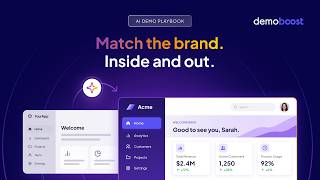
YouTube returned 6 videos for “Demoboost”, and we withheld 5: 5 could not be judged, because “Demoboost” is a single word that other videos use for other things. Showing the 1 we can prove is about Demoboost.
Official links
What are the best Demoboost alternatives?
The closest alternatives to Demoboost we list are Reprise, Komo and Sybill. Ranked by direct product-type match, not category overlap.
| Alternative | Pricing | Starts at | Last verified |
|---|---|---|---|
| Reprise | Contact Sales | Custom pricing | — |
| Komo | Freemium | Pricing not published | — |
| Sybill | Freemium | Pricing not published | — |
Alternatives to Demoboost
View all

Tools that pair well with Demoboost
Common stack mates teams adopt alongside Demoboost, with the specific reason each pairing earns its keep.

Reprise
Enterprise demo creation platform that captures your app, injects prospect-specific data, and ships governed demos from one agentic workspace.

Komo
Komo turns web and LinkedIn buyer signals into scored accounts and cited research for B2B sellers.

Sybill
Sybill is an AI sales assistant that auto-updates CRM fields and turns sales calls into executed follow-ups.
Frequently asked questions
Best-of guides
Used Demoboost? Help shape our editorial sentiment research.