
FetchSandbox MCP
FetchSandbox runs AI coding agent fixes through deterministic API sandbox evals — proving integrations fail before and pass after.
The before/after receipt is the rare reliability claim a customer can falsify in 30 seconds, and running it inside the coding agent's loop beats bolting replay on afterward. Pricing is the friction: $200 per workspace per month on Pro is a real commitment for a solo dev, and the free tier's 5 fixes a month disappears quickly. If you ship Stripe, Twilio, or webhook-driven billing most weeks with an MCP-compatible agent, it pays for itself; if you don't, Postman plus hand-rolled mocks is still the cheaper default.
Verified 1d ago · liveness 77/100 · cite: rightaichoice.com/tools/fetchsandbox-mcp
- Developers whose AI coding agent writes and fixes API integrations
- Teams shipping Stripe, Twilio, or webhook-driven billing code weekly
- CI pipelines that need an exit-code gate on real integration regressions
- Engineers debugging duplicate, out-of-order, or stale webhook bugs
- Teams not running an MCP-compatible coding agent
- Tests that need live production data or real provider quotas
- Load, stress, or performance testing
We scan live Reddit threads, YouTube comments, X posts, G2 reviews and other communities — and hand you an honest verdict in under a minute.
- Honest verdict, not marketing
- Real pros & cons from real users
- Attributed quotes with receipts
3 free scans · no card needed
Skip FetchSandbox if your team doesn't run an MCP-compatible coding agent like Cursor or Claude Code — the whole product assumes the agent that wrote the fix also runs the check.
Pro includes 100 fixes a month; going past that adds $3 per fix, which stacks fast during a busy refactor week.
FetchSandbox's free tier ($0 per developer, 500 runs and 5 fixes a month) is enough to prove the engine works on one integration. Pro at $200 per workspace per month fits a team already committed to agent-written API code; Team at $999 per month is for orgs running up to 10 workspaces with fixes delivered as PRs from CI. Solo devs comparing against a free Postman-plus-mocks stack will feel the jump.
In short
FetchSandbox MCP — FetchSandbox runs AI coding agent fixes through deterministic API sandbox evals — proving integrations fail before and pass after. Best for Developers whose AI coding agent writes and fixes API integrations, Teams shipping Stripe, Twilio, or webhook-driven billing code weekly, CI pipelines that need an exit-code gate on real integration regressions. Free to start; paid plans from $200/mo.
What people actually say about FetchSandbox MCP — is it worth it?
We ran a structured research pass across product reviews, community discussions, and post-purchase forum threads to surface the patterns vendors won't publish themselves. Below: the recurring strengths, the hidden costs people mention most, and the cohort that consistently regrets adopting this tool.
13 mentions across 2 sources (YouTube, Product Hunt) · researched Aug 24, 2026.
Average across the 2 sources that answered — each source counts once, not each post.
- +Forces AI agents to prove fixes with end-state verification and receipts
- +Stateful sandboxes let teams test reordered events and delayed retries
- +Failure injection and idempotency testing address real billing pain
- +Simple setup via MCP standard; works with any compatible AI agent
- +Detailed logs and version-controlled test scenarios aid debugging
- −No support yet for custom internal enterprise APIs in sandbox
- −No long-term community data on reliability or uptime
- −Comparisons to contract testing tools like Pact are unanswered
- −Sandbox realism depth unproven; false confidence risk
- −Freemium pricing details unclear; hidden limits possible
- • Pricing details for Pro/Enterprise are not publicly listed, a barrier to budgeting
Viability Score
How well maintained and how widely used is FetchSandbox MCP? Built from what the vendor actually publishes (docs, changelog, tutorials, integrations, pricing), whether the site is live, and how much real users discuss it. How we calculate this
Last calculated: October 2026
How we score →Key Features
- Deterministic eval for AI coding agents via MCP server and CLI
- Before/after verification: scenario must fail on old code and pass on the fix
- Full integration scenarios with state carried between steps
- Webhook simulation including duplicate, out-of-order, and stale delivery
- Injects 4xx/5xx errors, rate limiting, and retries
- Pre-configured provider twins: Stripe, GitHub, OpenAI, Paddle, Twilio, Resend, Clerk
- Additional provider twins: Privy, AgentMail, Surge, Kulipa, WorkOS
- Custom REST API sandboxes imported from an OpenAPI spec
- No API keys, OAuth, or partner onboarding — isolated sandbox, no real charges
- Receipt URLs naming the version tested, observed behavior, and coverage limits
- Runs inside Cursor, Claude Code, Codex CLI, VS Code, and Windsurf
- CI gate that blocks merges on failing integration scenarios
- Fixes delivered as pull requests from CI on the Team plan
- MIT-licensed MCP and CLI on GitHub
- Dashboard with run history and monitoring
About FetchSandbox MCP
FetchSandbox is a verification engine for teams whose AI coding agents keep touching API integrations. Instead of trusting a green CI build, it runs one full integration scenario against both your old code and the candidate fix, then only calls something fixed when the scenario fails on the old version and passes on the new. The verdict is an exit code plus a receipt, not a reviewer's opinion. The engine treats a run as a whole workflow, not a single call. A Stripe accept_payment run can create a customer, attach a card, charge it, and catch the confirming webhook — with the sandbox holding state between steps so the customer you just made exists for the charge. It covers the things unit tests skip: duplicate, out-of-order, and stale webhooks, 4xx/5xx errors, rate limiting, retries, and async state passed between steps. Pre-configured provider twins include Stripe, GitHub, OpenAI, Paddle, Twilio, Resend, Clerk, Privy, AgentMail, Surge, Kulipa, and WorkOS, plus your own REST APIs imported from an OpenAPI spec. No API keys, OAuth, or partner onboarding — nothing touches production data. It ships as an MCP server and CLI that plug into Cursor, Claude Code, Codex CLI, VS Code, and Windsurf, so the agent that wrote the fix also runs the check. Every verified fix produces a receipt URL naming the version tested, what was observed, and what stayed unverified — paste it into the PR or Slack thread. The MCP and CLI are MIT-licensed; you pay for the hosted sandboxes and webhook simulation. Positioned against the mock-server-plus-Postman stack, FetchSandbox is narrower and more opinionated: it will not do load testing or reproduce live production data, and it assumes you already have an MCP-compatible agent in the loop.
Behind the Verdict
FetchSandbox's core idea is genuinely narrow and that is its strength. It doesn't try to be a general test runner or a load testing tool. It asks one question — does this integration still do what you expect after a change — and it answers it with a binary verdict backed by a receipt that names the version tested, the observed state, and what remains unverified. The refundable part is the before/after precondition: a fix only counts when the same scenario fails on the old code and passes on the new. That single rule eliminates the most common false positive in API testing, which is a test that passes because it never exercised the failure path. The scenario model is where it earns its keep. A run is a whole workflow, not a single call. A Stripe accept_payment run creates a customer, attaches a card, charges it, and catches the webhook — with state carried between steps so the customer exists for the charge. Failure injection covers the cases unit tests skip: duplicate, out-of-order, and stale webhooks, 4xx/5xx errors, rate limiting, retries, and async state passed between steps. One customer testimonial from the vendor's site puts it plainly: pointing it at an invoice.paid handler surfaced a duplicate-webhook bug where dedup was a check-then-add rather than an atomic primitive. The distribution choice matters as much as the engine. Shipping as an MCP server and CLI that run inside Cursor, Claude Code, Codex CLI, VS Code, and Windsurf means the agent that wrote the fix also runs the check, instead of a human remembering to click replay in a separate dashboard. The MCP and CLI are MIT-licensed, so the interface layer is auditable and the paid part is the hosted sandboxes and webhook simulation. Where it doesn't fit: it tests against isolated sandboxes with representative test data, not live production data or real provider quotas. If your diligence depends on reproducing an exact production payload, this won't do it. It assumes an MCP-compatible agent or command-line workflow already exists. Self-hosted deployment, SSO, and audit are Enterprise-only. The vendor itself says it started with API-heavy teams and is extending the engine with pilot teams toward services, jobs, queries, and application code — meaning outside API integrations, you are on the roadmap rather than the product.
Researching FetchSandbox MCP? Get your full AI stack in 60 seconds.
Free, no signup — tell us your goal and get tools matched to your budget & existing stack.
Real-world workflow fit
Concrete scenarios for the personas FetchSandbox MCP actually fits — and what changes day-one when you adopt it.
Your coding agent fixes an invoice.paid handler. You ask the agent to run the FetchSandbox integration scenario, which exercises a duplicate webhook against both the old dedup logic and the new atomic write.
Outcome: The scenario fails on the old code with two effects for one record and passes on the fix, producing a receipt URL you paste into the PR.
You wire the CLI into the build so every PR touching Stripe billing runs the accept_payment scenario — create customer, attach card, charge, catch the confirming webhook — with state carried between steps.
Outcome: The CI gate blocks the merge on a failing exit code, so a contract regression never reaches production.
An intermittent stale-webhook bug won't reproduce locally. You point FetchSandbox at the handler with out-of-order delivery injected and the sandbox holding state between the charge and the confirming event.
Outcome: The failure reproduces deterministically, and the receipt timeline connects the request, response, and webhook attempt so you can explain why it failed.
Use Cases
- Validate an AI-generated API fix before deploying to production.
- Reproduce duplicate, out-of-order, or stale webhook bugs deterministically.
- Gate a deploy in CI on an exit code proving the integration still works.
- Test Stripe billing flows — create customer, attach card, charge, catch webhook — without real keys.
- Import your own REST API from an OpenAPI spec and test it in an isolated sandbox.
- Attach a replayable receipt URL to a fix PR so reviewers can verify the claim.
- Catch contract and workflow-state regressions that unit tests miss.
Limitations
- FetchSandbox tests against isolated sandbox environments with representative test data, not live production data or real charges, so results depend on how closely the sandbox replicates your dependencies.
- It presumes you already use an MCP-compatible coding agent or command-line workflow to run scenarios.
- Self-hosted deployment, SSO, and audit are Enterprise-only, and the vendor states it is still focused on API-heavy teams, with services, jobs, queries, and application code being extended with pilot teams.
- Results apply to the recorded scenarios and observation windows, not every possible production condition.
- If a required check was not measured, the overall result can remain inconclusive.
as of 2026-10-10
Verification history
We have re-verified FetchSandbox MCP 5 times since . Each pass re-reads the vendor's own pages and re-checks every listed field against that evidence; passes where nothing had changed are marked as such.
- — re-checked, vendor evidence unchanged
- — re-verified summary, description, our verdict, our analysis, pricing model, pricing tiers, features, integrations, who it suits, who should skip it
- — re-verified summary, description, our verdict, our analysis, pricing model, pricing tiers, features, integrations, who it suits, who should skip it
- — re-checked, vendor evidence unchanged
- — re-checked, vendor evidence unchanged
Free to cite with attribution — this page re-verifies continuously.
12-month cost
Project the real annual outlay, including the implied monthly cost when only an annual tier is published.
Vendor list price only. Add-on usage, seat overages, and contract minimums are surfaced under Hidden costs & gotchas.
Plans compared
For each published FetchSandbox MCP tier: who it actually fits, and what it adds vs. the previous tier. Cross-reference the cost calculator above for projected annual outlay.
Free
$0 per developer
Ideal for
Solo developer with an MCP-compatible agent who wants to prove one integration scenario works before paying anything.
What this tier adds
Starting tier: 500 runs and 5 fixes a month, full catalog access, MCP and CLI included, no credit card required.
Pro
$200 per workspace, per month
Ideal for
A single team shipping API integrations most weeks and gating merges in CI on integration scenarios.
What this tier adds
Adds 10,000 runs and 100 fixes a month, receipts and run history, and the CI gate — with $3 per extra fix and $5 per extra 10,000 runs.
Team
$999 per month
Ideal for
An org running several teams on agent-written API code that wants fixes delivered as PRs from CI.
What this tier adds
Adds up to 10 workspaces, unlimited runs, 500 fixes a month, fixes as PRs from CI, and up to 5 of your own APIs from a spec.
Enterprise
Custom
Ideal for
Regulated or large orgs that need self-hosted deployment, SSO, audit trails, and an SLA on continuously verified workflows.
What this tier adds
Adds drift detection, SSO, audit, SLA, self-hosted deployment, internal services built for you, and fixes included.
Where the pricing makes sense
The company stage and team size where FetchSandbox MCP's pricing actually pencils out — and where peers do it cheaper.
FetchSandbox's free tier ($0 per developer, 500 runs and 5 fixes a month) is enough to prove the engine works on one integration. Pro at $200 per workspace per month fits a team already committed to agent-written API code; Team at $999 per month is for orgs running up to 10 workspaces with fixes delivered as PRs from CI. Solo devs comparing against a free Postman-plus-mocks stack will feel the jump.
Setup time & first value
How long it actually takes to get something useful out of FetchSandbox MCP — broken out by persona, not the marketing-page minute.
Free tier: minutes — connect the MCP server to Cursor or Claude Code and run a catalog scenario against a provider twin, no keys required. Pro: an afternoon to wire the CLI into an existing CI pipeline and add a passing/failing gate. Team and Enterprise: a pilot, since environment access and failure controls are agreed before the work starts.
Switching to or from FetchSandbox MCP
How to bring data in from common predecessors and how to get it back out — written for the switcher, not the buyer.
- →From Postman plus mock servers: import your REST API from an OpenAPI spec and swap hand-rolled mocks for provider twins with state and webhook simulation.
- →From hand-rolled webhook replay scripts: replace the local replay harness with an MCP tool call the coding agent runs itself.
- →From pure unit-test suites: keep them, then add one full integration scenario per risky dependency to cover state and async failures unit tests skip.
- ↗To a general mock-server stack: export your OpenAPI spec and rebuild the provider twins as static mocks if you only need call-level stubbing.
- ↗To load-testing tools: if your real requirement is throughput rather than correctness, a performance harness is the right successor.
- ↗To a full observability platform: if you need production reproduction rather than sandbox verification, wire your telemetry into a replay tool instead.
Integrations
Resources & Guides
- Documentationfetchsandbox.com
Docs · FetchSandbox MCP
Full product docs from fetchsandbox.com
- Resourcefetchsandbox.com
Pricing · FetchSandbox MCP
Helpful link from fetchsandbox.com
- Resourcegithub.com
Mcp · FetchSandbox MCP
Helpful link from github.com
- API Referencegithub.com
Cli · FetchSandbox MCP
Methods, params, types from github.com
Tutorials & Learning

Connect FetchSandbox MCP to Lovable | Paddle + Resend
FetchSandbox
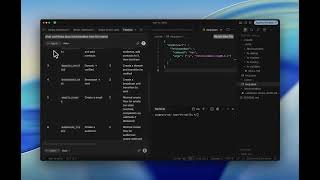
Discover Resend Workflows with FetchSandbox MCP in Cursor
FetchSandbox
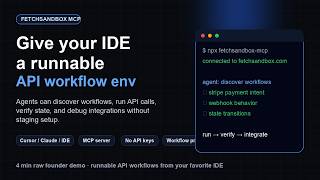
FetchSandbox MCP: Run API workflows from Cursor, Claude, or your IDE
FetchSandbox
YouTube returned 6 videos for “FetchSandbox MCP”, and we withheld 2: 2 did not mention FetchSandbox MCP. Showing the 4 we can prove are about FetchSandbox MCP.
Official links
Tools that pair well with FetchSandbox MCP
Common stack mates teams adopt alongside FetchSandbox MCP, with the specific reason each pairing earns its keep.

Fimo
Fimo runs autonomous website agents on your own Git repo, keeping your site self-updating after launch.

Ellipsis
Run Claude Code and Codex coding agents in managed cloud sandboxes defined by YAML in your repo.

testsprite-cli
TestSprite CLI writes and runs AI end-to-end tests against your live app, so agent-generated code is verified before it merges.
Featured Head-to-Head Comparisons
Fetchsandbox Mcp vs Dbos
If your pain is proving that AI-generated integration fixes won't break production, FetchSandbox MCP is the surgical tool you need — it's cheap insurance for AI coding workflows. But if you're building autonomous agents that must survive failures, handle human approval loops, or run cron jobs without extra infrastructure, DBOS is the stronger foundation, especially if you're already on Postgres. Choose based on your bottleneck: validation vs. reliability.
Fetchsandbox Mcp vs Smithery
If your pain is trusting AI-generated integration code, FetchSandbox MCP is the focused, safety-first choice — it proves fixes work in isolation before they touch production. If you're building agents and need fast access to a broad tool ecosystem with auth handled for you, Smithery is the pragmatic pick. Pick FetchSandbox for validation rigor, Smithery for breadth and speed.
Fetchsandbox Mcp vs Temporal Ai
If your pain point is proving that AI-written integration code actually works before it hits production, FetchSandbox MCP is the surgical tool you need. But if you're building AI agents or multi-step workflows that must survive API failures and crashes without losing state, Temporal AI is the heavyweight champion. Choose based on whether you need a sandbox for validation or a durable runtime for orchestration.
Alternatives to FetchSandbox MCP
View all
Fimo
Fimo runs autonomous website agents on your own Git repo, keeping your site self-updating after launch.

Ellipsis
Run Claude Code and Codex coding agents in managed cloud sandboxes defined by YAML in your repo.

testsprite-cli
TestSprite CLI writes and runs AI end-to-end tests against your live app, so agent-generated code is verified before it merges.
Frequently Asked Questions
Used FetchSandbox MCP? Help shape our editorial sentiment research.