
Gecko Security
AI SAST that traces business-logic and multi-step attack chains across your code, infrastructure and design docs, then fixes the root cause in one PR.
Buy Gecko if your incidents trace back to logic flaws that span services — that is the specific job it was built for, and the free 10-scan trial lets you point it at a real repo before you commit. Pro at $100/mo is genuinely cheap for 100 scans plus APIs, custom rules and Jira/Linear/Slack/ClickUp/Shortcut. Look at Semgrep or Snyk instead if you need broad rule coverage or dependency and container scanning in one bill, and skip it entirely if nothing of yours runs through CI/CD or you want sub-second linter feedback.
Verified 20h ago · liveness 79/100 · cite: rightaichoice.com/tools/gecko-security
- AppSec teams at microservices shops where cross-service attack chains are the real risk
- Engineering orgs with an established CI/CD pipeline that want security in the PR, not a separate dashboard
- Teams building on dynamically typed languages let down by brittle AST-based scanners
- Startups validating deep SAST on real repos through the 10-scan free trial
- Teams wanting fast linter-style feedback — deep scans take minutes
- Solo developers or small repos with no AppSec owner to tune rules and triage findings
- Organizations with no CI/CD pipeline, since PR checks and contextual scanning assume automated runs
We scan live Reddit threads, YouTube comments, X posts, G2 reviews and other communities — and hand you an honest verdict in under a minute.
- Honest verdict, not marketing
- Real pros & cons from real users
- Attributed quotes with receipts
3 free scans · no card needed
Skip Gecko if you want sub-second linter-style feedback inside your editor, or if nothing in your workflow runs through a CI/CD pipeline — its PR checks, cross-repo context and auto-fix PRs all assume automated scans.
PR checks count toward your scan allowance and re-run on every commit, so an active repo can eat Pro's 100 monthly scans well before the month is out.
At $100/mo, Pro undercuts most commercial SAST seats and sits well below enterprise platforms that bundle SCA and container scanning but rarely model multi-service logic. The 10-scan trial is enough for an AppSec lead to validate depth on a real repo. Enterprise is custom annual billing determined by engineering org size and deployment model, and lands closer to what platform security suites charge. If you mainly need cheap breadth of rules, Semgrep's open-source core is the cheaper path.
In short
Gecko Security — AI SAST that traces business-logic and multi-step attack chains across your code, infrastructure and design docs, then fixes the root cause in one PR. Best for AppSec teams at microservices shops where cross-service attack chains are the real risk, Engineering orgs with an established CI/CD pipeline that want security in the PR, not a separate dashboard, Teams building on dynamically typed languages let down by brittle AST-based scanners. Free to start; paid plans from $100/mo.
What's new in Gecko Security
Checked todayAcross the latest 1 update: 1 news mention.
What people actually say about Gecko Security — is it worth it?
We ran a structured research pass across product reviews, community discussions, and post-purchase forum threads to surface the patterns vendors won't publish themselves. Below: the recurring strengths, the hidden costs people mention most, and the cohort that consistently regrets adopting this tool.
11 mentions across 2 sources (Hacker News, Lemmy) · researched Jul 3, 2026.
Average across the 2 sources that answered — each source counts once, not each post.
- +Finds complex, multi-step vulnerabilities that traditional SAST tools miss.
- +Semantic code graph understands logic and data flow across microservices.
- +CI/CD integration with auto-fix PRs speeds up remediation.
- +Compiler-accurate indexing works with dynamically typed languages.
- +Natural language security rules lower barrier for non-expert users.
- −Accused of stealing CVE credit from original researchers.
- −Requires excessive GitHub permissions, not fine-grained per repo.
- −Scrapes GitHub activity and sends spam emails.
- −Some reported vulnerabilities are trivially obvious, not 0-days.
- −Public disputes erode trust in the company's ethics.
- • Exact pricing for Pro and Enterprise is not publicly listed.
- • Self-hosted deployment likely requires significant infrastructure investment.
Viability Score
How well maintained and how widely used is Gecko Security? Built from what the vendor actually publishes (docs, changelog, tutorials, integrations, pricing), whether the site is live, and how much real users discuss it. How we calculate this
Last calculated: October 2026
How we score →Key Features
- AI-native semantic graph that maps multi-step attack chains across services
- Compiler-accurate code indexing for dynamically typed languages
- Business logic and broken access control detection
- Cross-repo and cross-trust-boundary contextual scanning
- Threat modelling across services and release cycles
- Prioritization by remote exploitability and attack path
- One-click auto-fix PRs that repair a flaw class and its variants
- Guardrails that enforce merged fixes on future PRs and coding agents
- Plain-English custom rules, e.g. 'no service writes data to a third-party API'
- CI/CD integration with PR/MR bot reviews
- Deep scans plus lightweight PR checks re-run on every commit
- Remote MCP server for Claude, Claude Code, ChatGPT, Codex and Cursor
- REST v1 API with cursor pagination, idempotency keys and HMAC-signed webhooks
- GitLab token expiry reminders and token rotation API
- Customer-facing release versions with a version-to-digest lookup endpoint
About Gecko Security
Gecko Security is an AI-native static application security testing (SAST) platform built for teams who keep getting breached by logic flaws rather than known signatures. Instead of pattern matching a single file, Gecko reads your code, infrastructure and design docs as one system and maps how data and trust boundaries actually move between services, languages and repos. That is how it surfaces the things rule-based scanners tend to leave on the floor: broken access control, IDOR, SSRF, injection and the multi-step chains that only become exploitable when one service talks to another. Findings are ranked from the attacker's perspective by the attack path they form, so a cluster of low-severity bugs that adds up to a takeover outranks an unreachable critical. Each finding ships with the full source-to-sink call chain and a working proof of concept. When you accept a fix, Gecko traces it back to the design decision that caused it, finds every variant across your repos, and opens one pull request in your codebase's style. Every merged fix becomes a guardrail enforced on later PRs and inside the AI agents writing your code, which is why Gecko pushes recurrence over MTTR as the metric that matters. It plugs into the places you already work: GitHub (including GitHub Enterprise Server), GitLab (including self-managed and GitLab Dedicated), Jira, Linear, Slack, ClickUp, Shortcut, DefectDojo and GitLab vulnerability export. A remote MCP server lets Claude, Claude Code, ChatGPT, Codex and Cursor query findings and fixes directly, with scopes capped by your role. Gecko is SOC 2 compliant, and Enterprise adds on-prem, private cloud or hybrid deployment where the scanner runs inside your own AWS account. The free trial is 10 scans on your own code (deep scans or PR checks, and you can start from a ZIP upload or public repo without connecting anything). Pro is $100 per month for 100 scans plus team management up to 5, APIs, plain-English custom rules and tracker integrations. Enterprise is custom annual billing with unlimited scanning, SSO (SAML/OIDC) with SCIM, RBAC mirroring repo permissions, audit logs, IP allowlisting and hybrid deployment.
Behind the Verdict
Gecko's core bet is that the vulnerabilities that actually get exploited are not single-line mistakes but decisions — a missing ownership check, a service that trusts a caller it shouldn't — and that you can only find those by reading code, infrastructure and design intent together. Everything in the product follows from that. The semantic graph is compiler-accurate rather than AST-derived, which is also why it holds up on dynamically typed languages where call-graph scanners get brittle. Scans run across repos, so a check that is fine inside one service but broken at a trust boundary is still visible. Strengths. The output is unusually complete: full source-to-sink call chain plus a working proof of concept, so arguments about whether a finding is real mostly stop. Prioritization is by remote exploitability and attack path rather than a flat severity list, which is the correct ordering for a team that cannot fix everything this sprint. The auto-fix flow is the differentiator — one PR repairs the design decision and every variant it produced, written in your codebase's style, and the merged fix becomes a guardrail that runs on later PRs and inside coding agents. Gecko's positioning of recurrence over MTTR is the honest framing: closing tickets fast while the same flaw class returns next quarter is not progress. Where it fits. AppSec and platform teams running microservices, especially polyglot shops on Python, Ruby, JavaScript or PHP, and organisations that need source code to stay in their own cloud. The hybrid deployment path puts the scanner inside your AWS account, and Enterprise adds on-prem or private cloud, SSO via SAML or OIDC with SCIM provisioning, role-based access mirroring repo permissions, audit logs and IP allowlisting. The MCP server is a real workflow change, not a checkbox — Claude, Codex, ChatGPT and Cursor can pull findings and fixes under role-capped scopes. Where it does not fit. Deep scans take minutes, not milliseconds, so if you want a linter you will be unhappy. Everything is scan-metered: the trial is 10 scans total, Pro is 100 per month, and PR checks re-run on every commit, which is exactly how teams burn an allowance quickly — that is the usual reason they move to Enterprise. The workflow assumes an automated pipeline and a repo host; there is no meaningful version of Gecko for a team that merges by hand. Its scope is application source, not dependencies, containers or compiled mobile and desktop binaries, so it complements an SCA and container scanner rather than replacing one. And it needs someone to own rules, triage and merges. Without an AppSec owner, findings pile up. Against Semgrep or Snyk, the trade is deliberate: you give up breadth of pre-built rules and get depth of understanding, at the cost of scan time and a real CI/CD pipeline. Keep your pen test for compliance and run Gecko on every commit for the depth in between.
Researching Gecko Security? Get your full AI stack in 60 seconds.
Free, no signup — tell us your goal and get tools matched to your budget & existing stack.
Real-world workflow fit
Concrete scenarios for the personas Gecko Security actually fits — and what changes day-one when you adopt it.
Connect GitHub, run a 10-scan free trial across the three highest-risk repos, triage the prioritized findings with the full call chains, then enable PR checks once the baseline is clean.
Outcome: A baseline of exploitable logic flaws with proofs of concept, an agreed prioritization order, and a decision on Pro at $100/mo or Enterprise based on how fast PR checks consume the allowance.
Add the Gecko GitHub App, set PR checks to run on every commit, and route findings into Jira or Linear while keeping Slack notifications for the team channel.
Outcome: Risky merges blocked before they land, with one-click auto-fix PRs that repair the whole flaw class rather than the single reported line.
Connect the remote MCP server so Claude Code and Codex can pull findings and candidate fixes under role-capped OAuth scopes, then verify each merged fix with a Gecko rescan.
Outcome: Agents write against existing guardrails instead of re-introducing fixed vulnerability classes, and recurrence — not ticket velocity — becomes the tracking metric.
Use Cases
- Run Gecko on every pull request so risky merges are blocked before they land
- Write plain-English rules like 'no service writes data to a third-party API' and enforce them across repos
- Map full attack paths across microservices to catch business logic flaws isolated scans miss
- Ship one auto-fix PR that repairs a design flaw and every variant it created
- Threat model across services and release cycles to catch design problems early
- Scan a ZIP upload or public repo to see real findings before you connect anything
- Let Claude, Codex or Cursor query findings and fixes over MCP under role-capped scopes
- Export findings to DefectDojo or GitLab for central vulnerability management
Models Under the Hood
as of 2026-09-25
Limitations
- Scanning is metered, and PR checks re-run on every commit, so 100 scans per month on Pro is consumed faster than the number suggests — high-volume teams typically end up on Enterprise.
- Enterprise is custom-priced and annual billing only, and it is also where SSO (SAML/OIDC) with SCIM, role-based access mirroring repo permissions, audit logs, IP allowlisting and on-prem or hybrid deployment live; Pro caps team management at 5 users.
- Deep scans take minutes rather than seconds, so Gecko does not replace a fast linter.
- Its scope is application source, not dependencies, containers or compiled mobile and desktop binaries, and its workflow assumes a code host and an automated pipeline.
- The vendor's accuracy claims (8x more true positives, 90% fewer false positives, roughly one hour average time to remediation) are self-reported rather than independently benchmarked.
as of 2026-10-07
Verification history
We have re-verified Gecko Security 8 times since . Each pass re-reads the vendor's own pages and re-checks every listed field against that evidence; passes where nothing had changed are marked as such.
- — re-verified summary, description, our verdict, our analysis, pricing model, pricing tiers, features, integrations, who it suits, who should skip it
- — re-verified summary, description, our verdict, our analysis, pricing model, pricing tiers, features, integrations, who it suits, who should skip it
- — re-verified summary, description, our verdict, our analysis, pricing model, pricing tiers, features, integrations, who it suits, who should skip it
- — re-verified summary, description, our verdict, our analysis, pricing model, pricing tiers, features, integrations, who it suits, who should skip it
- — re-verified summary, description, our verdict, our analysis, pricing model, pricing tiers, features, integrations, who it suits, who should skip it
- — re-verified summary, description, our verdict, our analysis, pricing model, pricing tiers, features, integrations, who it suits, who should skip it
Showing the 6 most recent of 8 verification passes.
Free to cite with attribution — this page re-verifies continuously.
12-month cost
Project the real annual outlay, including the implied monthly cost when only an annual tier is published.
Vendor list price only. Add-on usage, seat overages, and contract minimums are surfaced under Hidden costs & gotchas.
Plans compared
For each published Gecko Security tier: who it actually fits, and what it adds vs. the previous tier. Cross-reference the cost calculator above for projected annual outlay.
Free
$0 (10 total scans)
Ideal for
AppSec or platform engineer evaluating deep SAST on a real repo before asking for budget
What this tier adds
Starting tier: 10 total scans on your own code, including CI/CD integration with PR/MR bot review and one-click autofix, with no payment required.
Pro
$100/mo
Ideal for
A small security or platform team putting scanning on every pull request across a handful of services
What this tier adds
Adds 100 scans per month, team management up to 5 users, Gecko APIs, plain-English custom rules, and Jira, Linear, Slack, ClickUp and Shortcut integrations.
Enterprise
Custom (annual billing only)
Ideal for
Engineering organizations that need scanning everywhere, in their own cloud, and must pass an internal vendor review
What this tier adds
Adds unlimited scanning, SSO (SAML/OIDC) with SCIM, role-based access mirroring repo permissions, audit logs, IP allowlisting, on-prem/private cloud/hybrid deployment and priority support, on custom annual billing.
Where the pricing makes sense
The company stage and team size where Gecko Security's pricing actually pencils out — and where peers do it cheaper.
At $100/mo, Pro undercuts most commercial SAST seats and sits well below enterprise platforms that bundle SCA and container scanning but rarely model multi-service logic. The 10-scan trial is enough for an AppSec lead to validate depth on a real repo. Enterprise is custom annual billing determined by engineering org size and deployment model, and lands closer to what platform security suites charge. If you mainly need cheap breadth of rules, Semgrep's open-source core is the cheaper path.
Setup time & first value
How long it actually takes to get something useful out of Gecko Security — broken out by persona, not the marketing-page minute.
Connecting GitHub is an app install, GitLab.com takes an access token and connects in minutes, and self-managed GitLab uses a service account plus PAT — expect under 30 minutes to your first findings. Full rollout varies: a solo AppSec lead with CI/CD already in place can enable PR checks the same day, while an enterprise needing SSO, SCIM, audit logs or hybrid deployment should budget weeks for
Switching to or from Gecko Security
How to bring data in from common predecessors and how to get it back out — written for the switcher, not the buyer.
- →From Semgrep: keep your existing rules for fast in-editor feedback and add Gecko as the deep cross-repo pass that finds the multi-service logic flaws rules miss.
- →From Snyk Code: leave dependency and container scanning where it is and point Gecko at the application source, since it does not cover those categories.
- →From manual code review: run a deep scan first to build a baseline of business logic findings with call chains, then set PR checks to keep them from returning.
- →From a point-in-time pen test: keep the engagement your compliance framework requires and run Gecko on every commit for the depth in between.
- ↗To Semgrep: export findings to DefectDojo or GitLab and port plain-English rules into Semgrep rule syntax if you need self-hosted rule breadth instead of depth.
- ↗To Snyk: move to a suite that bundles SCA and container scanning when consolidating vendors matters more than multi-step logic detection.
- ↗To a pen-test-only program: keep Gecko findings as scope input for an annual engagement if you cannot maintain an AppSec owner for continuous triage.
Integrations
Resources & Guides
Tutorials & Learning

Building an AI AppSec Engineer
Resilient Cyber
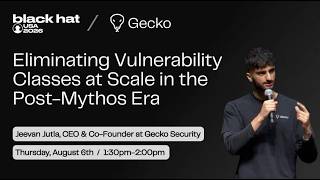
Gecko Security: Eliminating Vulnerability Classes At Scale In The Post Mythos Era
JJ
YouTube returned 6 videos for “Gecko Security”, and we withheld 4: 4 did not mention Gecko Security. Showing the 2 we can prove are about Gecko Security.
Official links
Tools that pair well with Gecko Security
Common stack mates teams adopt alongside Gecko Security, with the specific reason each pairing earns its keep.
Wiz
Wiz connects code, cloud, and runtime into one security graph so teams can fix the risks attackers can actually reach.

aiCode.fail
AI code auditor that scans AI-generated snippets for hallucinated imports, security flaws and logic errors before you commit them.

Cycode
Agentic Development Security Platform that governs AI-written code from IDE prompt to CI/CD runtime.
Featured Head-to-Head Comparisons
Gecko Security vs Sublime Security
Gecko Security and Sublime Security serve entirely different domains: code vulnerability detection vs. email threat defense. Gecko excels for engineering teams wanting deep, low-false-positive code analysis integrated into CI/CD, while Sublime is ideal for SOC teams needing advanced email security with custom detection rules. Choose based on your primary attack surface—code or email—since they are not direct competitors.
Gecko Security vs Audioeye
Choose Gecko Security if your priority is finding and fixing deep, 0-day vulnerabilities in your codebase with AI-powered semantic analysis; go with AudioEye if you need automated web accessibility compliance, including scans, overlays, and legal documentation. They solve different problems, so pick based on your compliance or security needs.
Gecko Security vs Push Security
Choose Push Security if your primary threat is browser-based attacks (AiTM, session hijacking) and AI tool data leakage; it provides real-time visibility and automated hunting across all browsers. Choose Gecko Security if your priority is finding and fixing complex code vulnerabilities (business logic, 0-days) in CI/CD with auto-fix PRs. They address entirely different layers of the security stack.
Alternatives to Gecko Security
View allWiz
Wiz connects code, cloud, and runtime into one security graph so teams can fix the risks attackers can actually reach.
aiCode.fail
AI code auditor that scans AI-generated snippets for hallucinated imports, security flaws and logic errors before you commit them.
Frequently Asked Questions
Categories
Used Gecko Security? Help shape our editorial sentiment research.