
Zeon Systems
Zeon Systems converts natural-language experiment prompts into simulated, robot-executed wet lab protocols.
Zeon is worth a serious look when protocol variety, not throughput, is the bottleneck — the world-model preview before physical execution is the part that actually de-risks a run, and eight hackathon teams shipping agent-to-robot prototypes on the platform is more than demo-ware. It is a poor fit if you need self-serve onboarding or a published price list. Rigid liquid handlers still win when one assay runs forever.
Verified 19m ago · liveness 50/100 · cite: rightaichoice.com/tools/zeon-systems
- Labs automating evolving, non-standard experiments that don't fit rigid automation
- AI researchers evaluating physical-world agents in scientific settings
- Drug discovery and materials science teams that need programmable flexibility
- Scientists who want to simulate a workflow before running it on robots
- High-throughput labs standardized on one assay and single-purpose machines
- Non-technical users without any robotics or lab automation experience
- Projects that don't involve physically manipulating lab equipment
We scan live Reddit threads, YouTube comments, X posts, G2 reviews and other communities — and hand you an honest verdict in under a minute.
- Honest verdict, not marketing
- Real pros & cons from real users
- Attributed quotes with receipts
3 free scans · no card needed
Skip Zeon Systems if you need published pricing and a self-serve pilot before you can get budget approval, or if your lab runs one standardized high-throughput assay where a fixed liquid handler already does the job.
Pricing is contact-only, so there is no published rate card to budget against — expect a custom quote that scales with instruments, seats, and how many protocols you run.
Zeon is contact-only pricing with no published tiers, which puts it out of reach for solo researchers and small academic groups that need a listed rate to justify spend. It fits funded discovery teams and AI research groups with capital budget and existing instruments. Cheaper and far more transparent peers for standard work: Opentrons. For rigid high-throughput lines: Beckman Biomek.
In short
Zeon Systems — Zeon Systems converts natural-language experiment prompts into simulated, robot-executed wet lab protocols. Best for Labs automating evolving, non-standard experiments that don't fit rigid automation, AI researchers evaluating physical-world agents in scientific settings, Drug discovery and materials science teams that need programmable flexibility. Contact Sales pricing.
What's new in Zeon Systems
Checked 9 days agoAcross the latest 3 updates: 3 news mentions.
What Eight Teams Built at Zeon's AI Science World Model Hack
Zeon hosted an AI science world model hackathon where eight teams showcased new scientific automation prototypes built on its lab platform.
Inside the Zeon Stack
Zeon detailed the technical stack behind its AI-powered robotics, walking through the key components that connect scientific intent to physical execution.
Automating the Long Tail of Science
Zeon laid out its approach to automating niche, non-standard scientific workflows with AI and robotics rather than fixed high-throughput hardware.
Viability Score
How well maintained and how widely used is Zeon Systems? Built from what the vendor actually publishes (docs, changelog, tutorials, integrations, pricing), whether the site is live, and how much real users discuss it. How we calculate this
Last calculated: October 2026
How we score →Key Features
- Natural language prompt describes the experiment to run
- Coding agent converts protocols into lab workflows using available skills
- World model simulation previews the workflow before robots move
- Executes workflows on robots using instruments already in your lab
- Operates the same instruments, labware, and benchtop environments scientists use
- Programs new experiments in minutes as protocols change
- AI continuously monitors each step and reasons about errors during the run
- Tracks every action, state, image, and result for repeatable review
- Closed-loop execution with adaptive error handling
- AI-in-the-loop or human-in-the-loop control options
- Endpoint for AI agents running physical-world scientific evaluations
- Supports protein synthesis and screening via agent loops
- Runs sealed plate unsealing and 96-well plate handling tasks
- Deployed in labs across America running experiments daily
About Zeon Systems
Zeon Systems builds AI-powered lab robotics that turns a plain-language experiment prompt into a runnable wet lab workflow. You describe the protocol — prep a master mix, pipette into sample wells, seal the plate, hold at 30 degrees for five hours — and a coding agent converts it into a workflow built from the skills and instruments actually present in your lab. The company calls itself a bridge between scientific intent and physical execution. The loop has four steps. Prompt: natural language goes in. Simulate: the workflow is previewed in a world model of your lab before any robot moves. Run: execution happens on the robots and instruments you already own, on the same labware and benchtop environments your scientists use. Monitor: AI watches every step, flags errors, and reasons about what is happening as the run proceeds, with AI-in-the-loop or human-in-the-loop control. Zeon's public framing is the long tail of science — niche, non-standard workflows that fixed high-throughput hardware was never designed for. Scientists reprogram new experiments in minutes as protocols change, and every action, state, image, and result is tracked so runs stay repeatable and reviewable. The company also positions itself as a physical-world endpoint for AI agents running scientific evaluations: at its AI Science World Model Hack, eight teams built prototypes on the platform, including protein synthesis and screening agent loops and 96-well plate handling with sealed plate unsealing. The audience is biology, chemistry, materials science, and drug discovery teams whose protocols keep moving, plus AI researchers who need real lab hardware under their agents. Against Opentrons or Beckman Biomek, Zeon trades standardized throughput for adaptability on experiments that never settle into one assay.
Behind the Verdict
The interesting thing about Zeon isn't the robotics — it's the simulation step. Most lab automation pitches skip straight to execution and ask you to trust the run. Previewing a workflow in a world model of your own lab, on your own instruments, before anything moves is the difference between a bug that costs you a plate and a bug that costs you nothing. We'd weigh that heavily.Pick Zeon when your protocols change faster than your automation can keep up — the long tail problem the company keeps writing about. Screening campaigns, protein work, plate-handling tasks that humans find tedious but never quite do the same way twice. The natural-language prompt plus coding agent means a scientist, not an automation engineer, can draft the workflow.Pass if you're running one assay at high volume on a fleet of single-purpose machines. Opentrons and Beckman Biomek are cheaper per plate and better understood by your procurement team. Zeon's value is adaptability, and you pay for adaptability whether or not you use it.A practical caveat: the company's own copy is thin on specifics. Before you commit, ask exactly which of your instruments are supported and what a real run costs per plate. The hackathon record is encouraging — BioMate's protein synthesis and screening loop, Tacit Teacher's 96-well handling — but hackathon deployments and production lab runs are different animals.When to seriously consider it: your team has robotics experience or is willing to build it, your workflows resist standardization, and you want an endpoint where software agents can act on physical science. That last use case — evaluating AI scientists in the physical world — is where Zeon has the least competition right
Researching Zeon Systems? Get your full AI stack in 60 seconds.
Free, no signup — tell us your goal and get tools matched to your budget & existing stack.
Real-world workflow fit
Concrete scenarios for the personas Zeon Systems actually fits — and what changes day-one when you adopt it.
Writes a natural language prompt describing a master mix prep, pipetting into sample wells, sealing, and a 5-hour 30°C incubator shaker hold. Reviews the workflow in the world model simulation, then runs it on the lab's existing instruments while AI monitors each step.
Outcome: A protocol that would have needed custom scripting runs unchanged, with every action, state, image, and result captured for review.
Uses Zeon as the endpoint where an agent loop actually executes in the lab, with AI-in-the-loop control, and runs protein synthesis and screening tasks on real plates.
Outcome: Agent behavior is measured against physical experimental outcomes rather than simulated benchmarks.
Reprograms a plate-handling and unsealing workflow in minutes when the protocol changes, reusing the same benchtop instruments instead of buying new single-purpose machines.
Outcome: Protocol churn stops being an automation blocker.
Use Cases
- Automate flexible chemistry workflows that change frequently
- Run scientific AI evals by creating real-world environments for agents
- Execute protocols with reduced human variability and full data capture
- Enable AI systems to perform physical experiments in drug discovery
- Orchestrate multi-step biology assays with adaptive error handling
Limitations
- Access requires contacting the company — no self-service, public tiers, or published pricing are disclosed.
- The platform is built around deploying physical robots into existing lab instruments, so adoption requires substantial robotics and integration expertise rather than being a plug-and-play tool.
- Specific hardware compatibility, throughput ceilings, and scalability details are not published in the evidence.
as of 2026-09-15
Verification history
We have re-verified Zeon Systems 9 times since . Each pass re-reads the vendor's own pages and re-checks every listed field against that evidence; passes where nothing had changed are marked as such.
- — re-verified summary, description, our verdict, our analysis, pricing model, pricing tiers, features, integrations, who it suits, who should skip it
- — re-verified summary, description, our verdict, our analysis, pricing model, pricing tiers, features, integrations, who it suits, who should skip it
- — re-verified summary, description, our verdict, our analysis, pricing model, pricing tiers, features, integrations, who it suits, who should skip it
- — re-checked, vendor evidence unchanged
- — re-checked, vendor evidence unchanged
- — re-checked, vendor evidence unchanged
Showing the 6 most recent of 9 verification passes.
Free to cite with attribution — this page re-verifies continuously.
Where the pricing makes sense
The company stage and team size where Zeon Systems's pricing actually pencils out — and where peers do it cheaper.
Zeon is contact-only pricing with no published tiers, which puts it out of reach for solo researchers and small academic groups that need a listed rate to justify spend. It fits funded discovery teams and AI research groups with capital budget and existing instruments. Cheaper and far more transparent peers for standard work: Opentrons. For rigid high-throughput lines: Beckman Biomek.
Setup time & first value
How long it actually takes to get something useful out of Zeon Systems — broken out by persona, not the marketing-page minute.
No setup ETA is published. Expect a sales conversation first, then integration work to map your existing instruments and skills into the platform — plan weeks, not minutes, and budget for in-house robotics and integration expertise. Scientific users can prompt a new experiment in minutes once the lab is configured.
Switching to or from Zeon Systems
How to bring data in from common predecessors and how to get it back out — written for the switcher, not the buyer.
- →From manual bench protocols: describe the experiment in natural language and let the coding agent assemble a workflow from the skills in your lab, then validate it in simulation before you retire the manual version.
- →From rigid liquid-handling automation: keep your existing instruments and move the non-standard, changing protocols onto Zeon rather than rewriting them for a fixed deck.
- ↗To fixed liquid-handling automation: if throughput becomes the constraint, standardized assays can move to single-purpose machines while Zeon keeps the long-tail protocols.
Resources & Guides
Tutorials & Learning

What if science could move at the speed of thought? | Zeon Systems (YC X25) Launch Video
Zeon Systems
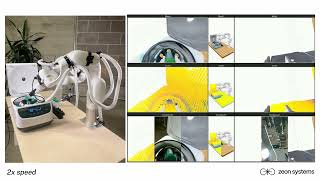
Automated centrifuge loading (uncut full video)
Zeon Systems
YouTube returned 6 videos for “Zeon Systems”, and we withheld 4: 4 did not mention Zeon Systems. Showing the 2 we can prove are about Zeon Systems.
Official links
Tools that pair well with Zeon Systems
Common stack mates teams adopt alongside Zeon Systems, with the specific reason each pairing earns its keep.

Calvin
Open-source simulated benchmark for language-conditioned, long-horizon robot manipulation from the University of Freiburg.

Physical Intelligence
Physical Intelligence (π) builds vision-language-action robot foundation models — one generalist policy for any manipulation task.

SciSpace BioMed Agent
An AI co-scientist that chains 150+ biological tools to run multi-omics, clinical genomics, and drug discovery analysis from plain-language prompts.
Featured Head-to-Head Comparisons
Zeon Systems vs Isomorphic Labs
Choose Zeon Systems if you need flexible, programmable lab robotics to automate non-standard experiments in biology, chemistry, or materials science — it empowers scientists with hands-on control. Choose Isomorphic Labs if you are a large pharma company seeking a deep partnership for AI-driven drug design from the Nobel-winning AlphaFold team. Both are contact-priced and target different scales: Zeon is for evolving benchtop workflows, while Isomorphic is for massive drug development programs.
Zeon Systems vs Codametrix
These tools serve completely different domains. Choose CodaMetrix if you lead revenue cycle operations at a large health system and need proven ROI in medical coding automation. Choose Zeon Systems if you are a scientist or AI researcher needing flexible, programmable robotics for evolving lab experiments. There is no overlap.
Zeon Systems vs Presto Voice
These are not competitors — pick based on which problem you own. If you run drive-thrus for a multi-location QSR brand, Presto Voice is the shortlist: it's purpose-built for order-taking and upselling at the speaker post, recently added a Toast Partner Ecosystem path, and sells as a managed deployment with ROI reporting. If you run a wet lab, Zeon Systems is the shortlist: it turns plain-language prompts into simulated, robot-executed protocols on instruments you already own, with closed-loop monitoring. Nobody is choosing between a drive-thru headset replacement and lab automation robotics.
Alternatives to Zeon Systems
View all
Calvin
Open-source simulated benchmark for language-conditioned, long-horizon robot manipulation from the University of Freiburg.

Physical Intelligence
Physical Intelligence (π) builds vision-language-action robot foundation models — one generalist policy for any manipulation task.

SciSpace BioMed Agent
An AI co-scientist that chains 150+ biological tools to run multi-omics, clinical genomics, and drug discovery analysis from plain-language prompts.
Frequently Asked Questions
Used Zeon Systems? Help shape our editorial sentiment research.