
Munder Difflin
An open-source multi-agent harness that runs a virtual office of AI clones on your existing Claude Code and Codex subscriptions.
Munder Difflin earns a look because it doesn't ask you to buy another model subscription — it runs on the Claude Code, Codex or Gemini CLI plan you already pay for, and the free tier is genuinely free forever under MIT. The Pro case rests almost entirely on Stapler, the floating capture widget, and the single-window orchestrator. What's missing is the thing most buyers ask about first: background execution. Your laptop has to stay on.
Verified 14d ago · liveness 63/100 · cite: rightaichoice.com/tools/munder-difflin
- Developers already running Claude Code, Codex or Gemini CLI who want multiple agents working at once
- Solo engineers and freelancers who want an orchestrator, task queue and memory in one local window
- Small engineering teams (2-20 seats) that need clone-to-clone messaging without trusting a relay
- Privacy-sensitive shops where code, keys and context legally can't leave the laptop
- Anyone who needs agents running while the laptop is closed — sandboxes are announced but not for sale
- Non-technical users: every clone runs a CLI coding agent in a terminal
- Teams wanting a hosted web dashboard with server-side execution instead of per-device keys
We scan live Reddit threads, YouTube comments, X posts, G2 reviews and other communities — and hand you an honest verdict in under a minute.
- Honest verdict, not marketing
- Real pros & cons from real users
- Attributed quotes with receipts
3 free scans · no card needed
Skip Munder Difflin if you are not already a daily user of Claude Code or Codex, need transparent pricing, require multi-user collaboration, or prefer a platform with established documentation and support.
The product is in early access, so you may face unexpected pricing changes or feature limitations as it matures.
Pricing is contact-based with no public tier list, making it hard to compare with peers. Since it's an add-on to Claude Code and Codex, your total cost will include those subscriptions. Likely best for solo developers and small consultancies already paying for those agents; larger teams may find per-seat or usage costs prohibitive versus building in-house automation.
In short
Munder Difflin — An open-source multi-agent harness that runs a virtual office of AI clones on your existing Claude Code and Codex subscriptions. Best for Developers already running Claude Code, Codex or Gemini CLI who want multiple agents working at once, Solo engineers and freelancers who want an orchestrator, task queue and memory in one local window, Small engineering teams (2-20 seats) that need clone-to-clone messaging without trusting a relay. Free to start; paid plans from $39/user/mo.
What's new in Munder Difflin
Checked 2 days agoAcross the latest 8 updates: 8 community discussions.
Munder Difflin reads Muse and Grok Bot security docs on password access
Post examines Meta Muse and Grok Bot login requests against both companies' security documentation, detailing who can see user passwords.
Munder Difflin publishes Muse alternatives guide
Seven alternatives to Meta Muse for users who can't or won't use it, covering open source agents that run locally and hosted options from OpenAI, Google and SpaceXAI.
Munder Difflin compares its own agent stack against Grok Bot pricing tiers
Comparison post breaks down what $20, $30, $100 and $300 a month buys with Grok Bot, noting it has no standalone plan and ships bundled with SuperGrok and Cursor.
Munder Difflin features in Indian open source vs big tech comparison
Ten Indian open source AI projects lined up against big tech competitors, pairing Munder Difflin with Muse and Grok Bot.
Munder Difflin positions against Databricks Omnigent
Comparison post identifies OmniAgent as Databricks' open source meta harness Omnigent and lays out alternatives checked on 14 Sep 2026.
Munder Difflin names itself among Herdr alternatives
Alternatives roundup checked on 14 Sep 2026 lists tmux, Munder Difflin, Claude Squad, cmux, Orca, Conductor, Superset and Emdash by fit.
Munder Difflin explains Codex usage limits under ChatGPT Pro
Guide clarifies there is no Codex Max plan, detailing what ChatGPT Pro 5x and 20x tiers provide in Codex and how the weekly limit works.
Munder Difflin guides stretching Claude Code Max plans
Guide covers model choice, context hygiene, prompt caching, subagents and unattended runs for Claude Code Max users, checked against Anthropic's own pages.
What people actually say about Munder Difflin — is it worth it?
We ran a structured research pass across product reviews, community discussions, and post-purchase forum threads to surface the patterns vendors won't publish themselves. Below: the recurring strengths, the hidden costs people mention most, and the cohort that consistently regrets adopting this tool.
21 mentions across 3 sources (YouTube, Product Hunt, GitHub) · researched Aug 15, 2026.
Average across the 3 sources that answered — each source counts once, not each post.
- +Free and open source under MIT license
- +Uses Claude Code and Codex, so benefits from their agent improvements
- +Multi-agent architecture with orchestrator and workers scales productivity
- +Clever Office-themed naming boosts memorability and community goodwill
- +Local harness keeps data on your machine, reducing privacy concerns
- −Windows-specific startup bugs (error 193, missing modules) frustrate users
- −Circuit breaker false-fires on idle agents and token bursts
- −Setup is confusing—no easy way to switch between Claude Code and Codex
- −Gamification confuses some users in a serious tool
- −Limited documentation on how agents decide task completion
- • Requires a paid Claude Code or Codex subscription (e.g., $100/mo plan mentioned) to run agents
- • Local resource usage for running multiple agents may require powerful hardware
- • No cloud offering yet, so scaling may require your own infrastructure
Viability Score
How well maintained and how widely used is Munder Difflin? Built from what the vendor actually publishes (docs, changelog, tutorials, integrations, pricing), whether the site is live, and how much real users discuss it. How we calculate this
Last calculated: September 2026
How we score →Key Features
- Run an office of AI clones as real agents in real terminals
- Wrap twelve CLI coding agents including Claude Code, Codex, Gemini CLI, Copilot and Cursor
- Uses your existing agent subscriptions and their hourly limits
- Stapler Pro-only floating widget: screenshot, drag a box, add a line, send
- Record voice messages up to five minutes, transcribed to text
- Record meetings in ten-minute parts, transcribed on your own Groq key
- Hide-from-screen-share and recording toggle for captures
- Clone-to-clone messaging sealed per device with X25519, XChaCha20, Ed25519
- Pro workspace: orchestrator, agents, tasks, inbox, automations, memory
- Teams unlocks orchestrator-to-orchestrator messaging across seats
- Model pickers read the live list at launch, so new models arrive without a version bump
- Local-first: code, keys and personal context never leave the machine
- MIT-licensed open source node, protocol and crypto on GitHub
- Chinese and Arabic interfaces with RTL support added in v0.4.6
- 227-skill catalog and prerequisites page added in v0.4.4
About Munder Difflin
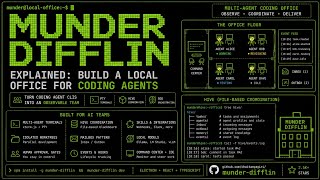
Munder Difflin is a free, open-source, MIT-licensed agent harness that lets you run an office of AI clones — each one a real agent in a real terminal, wrapping a CLI coding agent you already pay for. Twelve providers are supported off the shelf: Claude Code, Codex, Grok, Kimi Code, Antigravity, Qwen, Gemini CLI, OpenCode, Crush, Pi, Copilot and Cursor. Instead of a new model subscription, it piggybacks on the hourly limits of subscriptions you already have, so the floor itself costs no tokens to render. The pitch is a working floor of agents rather than one chatbot session. The free tier covers the classic office running locally on your machine with unlimited local agents across those twelve providers. Pro ($150/year on the current launch offer, normally $200, or $20/month) adds the Pro workspace — orchestrator, agents, tasks, inbox, automations and memory in one window — plus Stapler, a floating capture widget that screenshots, records up to five-minute voice messages, records meetings transcribed in ten-minute parts on your own Groq key, and can hide itself from screen shares and recordings. Privacy is the architectural claim, not a marketing line: code, keys and personal context never leave the machine, and clone-to-clone messages are sealed per device with X25519, XChaCha20 and Ed25519 so the relay carries a box it cannot open. Teams ($39/seat/month or $399/seat/year, 2–20 seats) unlocks orchestrator-to-orchestrator messaging across seats under each person's own keys. Telemetry is limited to buckets and fixed words — no email, account id, payment id or typed content — and is published in TELEMETRY.md with a Do Not Track switch. Development has been fast and noisy: seven releases in eight days between v0.3.8 and v0.4.4, a #5 Product of the Day finish on Product Hunt, and v0.4.6 adding Chinese and Arabic interfaces with RTL support. If you're weighing it against cloud agent platforms, the trade is local control and existing subscriptions versus hosted
Behind the Verdict
Pick Munder Difflin if you already run Claude Code or Codex daily and want more than one agent session at a time. The free tier is not a demo — unlimited local agents, twelve providers, MIT source, same binary as the paid plans. You can evaluate the whole model before paying anything, which is rare in this category. Pay for Pro when Stapler is the thing you'd actually use. Screenshot a region, drag a box, add one line and send it to your orchestrator. Record a five-minute voice message and it lands as text. Record a meeting in ten-minute parts transcribed on your own Groq key. There's a hide-from-screen-share toggle. It's off until you enable it in the Pro sidebar, and the free build doesn't have it at all. Teams is the interesting upgrade for small engineering groups. Each person's orchestrator runs on their own machine under their own keys, and messages are sealed per device, so the relay can't read the payload. For 2–20 seats at $39/seat/month, that's a real alternative to routing agent chatter through a shared cloud account. Where it bites: your laptop must be on. The clone runs on your machine and stops when the machine does. Sandboxes — hosted machines where a job keeps running after the lid closes — are advertised as coming and explicitly not for sale yet. If overnight handoffs and morning PRs are your core requirement, this isn't that product today. 3 AM remote control from an app is also undated. Version 0.5.2 is what the site is shipping, and the model pickers read the live list at launch, so new models arrive without a version bump — Gemini 3.8 Flash, Gemini 3.7 Flash, Fable 5.1 and GPT-6 Astra landed with 0.5.0. Recent history includes a Windows agent messaging bug caused by a 1980s cmd.exe parsing rule and a spend counter that underreported by 59%,
Researching Munder Difflin? Get your full AI stack in 60 seconds.
Free, no signup — tell us your goal and get tools matched to your budget & existing stack.
Real-world workflow fit
Concrete scenarios for the personas Munder Difflin actually fits — and what changes day-one when you adopt it.
Before starting your day, you check your GitHub issues and PRs. Normally this takes an hour of triaging and reviewing.
Outcome: You deploy a clone to triage new issues, respond with your typical tone, and review simple PRs. By mid-morning, your inbox is clear and you've reclaimed an hour for feature work.
You manage multiple clients, each with their own coding style and communication preferences.
Outcome: You create a separate clone per client, each trained on their codebase and your past interactions. The clones handle boilerplate tasks and status updates, letting you focus on high-value architecture and strategy.
You spend hours writing documentation and code comments for your team's projects.
Outcome: You configure a clone to generate consistent documentation and comments based on your standards. You review and approve the output, cutting documentation time in half while keeping quality high.
Use Cases
- Automate code reviews with a clone that understands your standards.
- Have a clone triage and respond to GitHub issues in your voice.
- Delegate boilerplate coding tasks to a clone while you focus on architecture.
- Create a personal assistant clone to manage your calendar and emails.
- Use a clone to generate documentation and code comments consistently.
- Scale your freelance work by deploying multiple clones for different clients.
Models Under the Hood
as of 2026-09-22
Limitations
- Free, open-source multi-agent harness that wraps CLI coding agents you already run, consuming your existing subscription hourly limits.
- Pro features such as the Stapler floating capture widget require a paid plan ($150/year after a 14-day trial).
- Runs locally on macOS, Windows and Linux, and the agent floor simulation itself consumes no tokens.
- Model availability is driven by the underlying agent's picker list at launch, so you get whatever models your agent subscriptions expose.
as of 2026-08-29
Verification history
We have re-verified Munder Difflin 4 times since . Each pass re-reads the vendor's own pages and re-checks every listed field against that evidence; passes where nothing had changed are marked as such.
- — re-verified summary, description, our verdict, our analysis, pricing model, pricing tiers, features, integrations, who it suits, who should skip it
- — re-checked, vendor evidence unchanged
- — re-verified summary, description, our verdict, our analysis, pricing model, pricing tiers, features, integrations, who it suits, who should skip it
- — re-checked, vendor evidence unchanged
Free to cite with attribution — this page re-verifies continuously.
12-month cost
Project the real annual outlay, including the implied monthly cost when only an annual tier is published.
Vendor list price only. Add-on usage, seat overages, and contract minimums are surfaced under Hidden costs & gotchas.
Where the pricing makes sense
The company stage and team size where Munder Difflin's pricing actually pencils out — and where peers do it cheaper.
Pricing is contact-based with no public tier list, making it hard to compare with peers. Since it's an add-on to Claude Code and Codex, your total cost will include those subscriptions. Likely best for solo developers and small consultancies already paying for those agents; larger teams may find per-seat or usage costs prohibitive versus building in-house automation.
Setup time & first value
How long it actually takes to get something useful out of Munder Difflin — broken out by persona, not the marketing-page minute.
Early access and contact-based onboarding mean setup time varies. For a developer already familiar with Claude Code or Codex, expect 1-2 days to configure your first clone, including defining workflows and safety rules. For a non-technical user, setup could take significantly longer or require technical assistance.
Switching to or from Munder Difflin
How to bring data in from common predecessors and how to get it back out — written for the switcher, not the buyer.
- →From [Claude Code or Codex manual workflows]: [Import your saved workflows and style preferences to Munder Difflin]
- ↗To [Manual Claude Code or Codex processes]: [Export your clone configurations and workflows back to direct agent usage]
Integrations
Resources & Guides
Tutorials & Learning

Official links
Tools that pair well with Munder Difflin
Common stack mates teams adopt alongside Munder Difflin, with the specific reason each pairing earns its keep.

Ellipsis
Define cloud coding agents in environment.yaml, deploy them by merging a PR, and run Claude Code or Codex with scoped permissions and hard spend caps.
Claude Code
Claude Code is Anthropic's agentic coding assistant that plans, edits, and runs commands across your repo from the terminal, IDE, or browser.

Refact.ai
Open-source autonomous AI coding agent that plans, executes, and deploys tasks inside VS Code and JetBrains IDEs.
Featured Head-to-Head Comparisons
Munder Difflin vs Genspark
If you're a researcher or non-technical professional wanting a one-stop AI workspace for research, docs, and automation, pick Genspark — it's freemium and feature-rich. If you're a developer living in Claude Code or Codex and want to clone your workflow into autonomous agents, go with Munder Difflin, despite the opaque pricing.
Munder Difflin vs Cryptohopper
Choose Cryptohopper if you trade crypto and want automated, strategy-driven bots across major exchanges; it's feature-rich and has a clear pricing model. Choose Munder Difflin if you're a developer wanting to offload routine coding tasks to AI clones—it's a niche productivity tool, but pricing is opaque, so you'll need to contact them to see if it fits your budget.
Munder Difflin vs Air Ai
If you're a developer wanting to clone yourself for coding tasks, Munder Difflin is the obvious choice—it's built for Claude Code and Codex and focuses on personal productivity. But if you're in defense or military logistics, Air AI is unmatched: it compresses materiel release from 15 to 3 months and has real contracts to back it. These tools serve entirely different worlds, so pick based on your domain, not on feature comparison.
Alternatives to Munder Difflin
View all
Ellipsis
Define cloud coding agents in environment.yaml, deploy them by merging a PR, and run Claude Code or Codex with scoped permissions and hard spend caps.
Claude Code
Claude Code is Anthropic's agentic coding assistant that plans, edits, and runs commands across your repo from the terminal, IDE, or browser.

Frequently Asked Questions
Best-of guides
Used Munder Difflin? Help shape our editorial sentiment research.