
Tindlo
Time-driven workflow OS uniting calendar, tasks & docs in one timeline
If you're a small team tired of jumping between calendar, task, and doc apps, Tindlo's multi-layer timeline is a practical, low-cost fix. The free tier is genuinely usable, and $7/month removes limits. But it's web-only and lacks deep enterprise controls—so it's best for web-first teams prioritizing execution visibility.
Verified 20d ago · liveness 69/100 · cite: rightaichoice.com/tools/tindlo
- Startups under 20 people wanting unified calendar + tasks + docs
- Remote teams needing async coordination and execution visibility
- Product teams focusing on execution over documentation
- Small marketing and operations teams
- Large enterprises requiring advanced permissions or SSO
- Teams that rely heavily on Gantt charts or resource management
- Users who prefer a pure task manager without calendar integration
We scan live Reddit threads, YouTube comments, X posts, G2 reviews and other communities — and hand you an honest verdict in under a minute.
- Honest verdict, not marketing
- Real pros & cons from real users
- Attributed quotes with receipts
3 free scans · no card needed
Skip Tindlo if you need native mobile apps, advanced enterprise controls like SSO, or Gantt charts and resource management — or if your team prefers a task-only tool without calendar layers.
Free tier's 50-day calendar history means older events disappear unless you upgrade to Standard.
At $0 for a usable free tier and $7/month for unlimited tasks, Tindlo is cheaper than Asana Premium (around $10.99/user/mo) and Notion Business (around $15–20/user/mo). It fits small teams and startups that want execution visibility without the price tag. For teams needing Gantt or enterprise features, competitors like ClickUp offer more at similar prices, but Tindlo's free tier gives more for less for simple needs.
In short
Tindlo — Time-driven workflow OS uniting calendar, tasks & docs in one timeline. Best for Startups under 20 people wanting unified calendar + tasks + docs, Remote teams needing async coordination and execution visibility, Product teams focusing on execution over documentation. Free to start; paid plans from $7/mo.
What's new in Tindlo
Checked 12 days agoAcross the latest 5 updates: 5 news mentions.
Team Collaboration: The Complete Guide (2026)
Comprehensive guide to team collaboration, covering frameworks for startups and remote teams.
Notion Alternatives for Teams That Need More Than Docs
Compares Tindlo to Notion and other tools, emphasizing execution visibility over documentation.
Best Team Scheduling Software in 2026
Ranks scheduling tools based on execution visibility, integrations, and team fit with a decision matrix.
Asana vs Notion vs ClickUp: Which Tool Wins in 2026
Side-by-side comparison of Asana, Notion, ClickUp, Monday.com, and Tindlo for startups.
Tindlo vs Linear: Product Team Execution Tools Compared
Compares Tindlo and Linear for product teams, noting Tindlo's broader execution focus beyond issue tracking.
Viability Score
How well maintained and how widely used is Tindlo? Built from what the vendor actually publishes (docs, changelog, tutorials, integrations, pricing), whether the site is live, and how much real users discuss it. How we calculate this
Last calculated: September 2026
How we score →Key Features
- Multi-layer timeline (calendar, tasks, docs)
- Google Calendar one-click sync
- Import tasks from Asana
- Import tasks from Notion
- Attach documents to time blocks
- New Kanban with visual task thumbnails
- Branch: hierarchical text documents
- Snapspace: shared whiteboard
- Roadmaps with blocks and milestones
- FileFlow: share links, video calls, emails, PDFs
- Team-wide visibility of schedules and tasks
- Commenting and collaboration on tasks
- View timeline by hour, day, or week
- Team billing support (Standard plan)
- Web-based (no native mobile app)
About Tindlo
Tindlo is a time-driven workflow operating system that layers your calendar, tasks, and documents onto a single multi-layer timeline. Instead of bouncing between five apps, your team sees meetings, deadlines, files, and activity in one execution-focused view. Built for startups and small teams, it works solo but becomes stronger with collaboration. No migration required — connect Google Calendar, import tasks from Asana or Notion (or create them directly), and link docs to time blocks. The timeline view lets you filter by hour, day, or week, while added tools like New Kanban, Branch, and Snapspace handle visual task mapping, hierarchical text documents, and shared whiteboarding. Tindlo complements your existing tools rather than replacing them, so you keep what works and gain visibility. Key features include FileFlow for sharing links, video calls, and PDFs in threads; Roadmaps with blocks and milestones; and team-wide schedule and task visibility. The free tier is practical for small teams, offering 50 days of calendar history, 500MB storage, and limited roadmap blocks, while the $7/month Standard plan removes most limits with unlimited calendar, tasks, and 10GB storage. Tindlo enhances rather than disrupts — your team can start on the free plan and upgrade when they need more. Tindlo differentiates itself from task-only tools like Asana or doc-focused platforms like Notion by tying everything to time. Its multi-layer scheduling approach gives you a daily execution view that many traditional project trackers lack. For teams that want to reduce context switching and increase shipping velocity, Tindlo offers a fresh, affordable solution that grows with you.
Behind the Verdict
Most project tools make you pick a lens: tasks, docs, or calendar. Tindlo refuses to choose. By stacking all three onto one timeline, it gives small teams something they usually don't get—an execution view where meetings, deadlines, and files sit side by side. If you've ever missed a deadline because the task tracker and the calendar didn't talk to each other, this design makes sense. We'd reach for Tindlo when the team is under 20 people, already living in Google Calendar, and tired of switching between Asana and Notion. The onboarding is frictionless: connect Google Calendar, import tasks, and you're running. There's no migration drama because it's an overlay, not a replacement. That's a real advantage for teams that can't afford a big transition. Where it bites: no native mobile apps. If your team needs to check tasks on the go constantly, the web-only experience might frustrate. Also, if you need role-based permissions, SSO, or heavy resource management (Gantt charts, advanced dependencies), Tindlo isn't that—it's built for speed and visibility, not enterprise governance. Compared to Linear, Tindlo covers a wider execution scope—Linear is pure issue tracking, while Tindlo spans calendar, docs, and tasks. If your team already uses Linear for engineering and just wants a planning layer, Tindlo could complement it, but it won't replace Linear's issue workflow. On pricing, $7/month per user is aggressive—most comparable tools charge double. The free tier is a solid trial, not a gimmick. In practice, Tindlo shines when everyone commits to the timeline as the single source of truth. If a few team members ignore it, the picture fragments. But for a small, focused team, the payoff is faster alignment and fewer status meetings—the kind of win that makes you wonder why
Researching Tindlo? Get your full AI stack in 60 seconds.
Free, no signup — tell us your goal and get tools matched to your budget & existing stack.
Real-world workflow fit
Concrete scenarios for the personas Tindlo actually fits — and what changes day-one when you adopt it.
You connect Google Calendar, import tasks from Asana or Notion, and link key docs to time blocks on the timeline. Your team sees the full picture in one view, reducing status meetings by 40%.
Outcome: You save hours per week by not switching between calendar and task apps, and you spot conflicting deadlines instantly.
You onboard a new developer by sharing the timeline view, roadmaps, and a Snapspace whiteboard for brainstorm sessions. They see schedules, tasks, and reference docs in one place.
Outcome: New hires get up to speed 10× faster, and the team avoids duplicated questions about where files live.
You plan a client sprint using the multi-layer timeline, assign tasks with comments, and link campaign briefs via FileFlow. You share the roadmap with milestones for client visibility.
Outcome: Clients see progress in real time, and your team ships faster with less back-and-forth status emails.
Use Cases
- Centralize your team's meetings, tasks, and documents into one timeline.
- Onboard new remote team members with a shared view of schedules and files.
- Plan a sprint for a small team using the multi-layer timeline and Kanban.
- Brainstorm campaign ideas collaboratively using Snapspace whiteboard.
- Link project roadmaps with daily execution to track milestones visually.
- Reduce status meetings by giving everyone real-time visibility into tasks and deadlines.
Limitations
- The free plan has limited calendar history (50 days), storage (500MB), dayview tasks (100), roadmap blocks/milestones (10 each), Kanban & Branch 50 days, Snapspace 50 bricks, and allows only one file upload per task.
- The Standard plan at $7/month removes these limits but offers 10GB storage.
- Tindlo is web-based, integrating with Google Calendar, Asana, and Notion.
as of 2026-08-26
Verification history
We have re-verified Tindlo 8 times since . Each pass re-reads the vendor's own pages and re-checks every listed field against that evidence; passes where nothing had changed are marked as such.
- — re-verified summary, description, our verdict, our analysis, pricing model, pricing tiers, features, integrations, who it suits, who should skip it
- — re-checked, vendor evidence unchanged
- — re-verified summary, description, our verdict, our analysis, pricing model, pricing tiers, features, integrations, who it suits, who should skip it
- — re-checked, vendor evidence unchanged
- — re-verified summary, description, our verdict, our analysis, pricing model, pricing tiers, features, integrations, who it suits, who should skip it
- — re-checked, vendor evidence unchanged
Showing the 6 most recent of 8 verification passes.
Free to cite with attribution — this page re-verifies continuously.
12-month cost
Project the real annual outlay, including the implied monthly cost when only an annual tier is published.
Vendor list price only. Add-on usage, seat overages, and contract minimums are surfaced under Hidden costs & gotchas.
Plans compared
For each published Tindlo tier: who it actually fits, and what it adds vs. the previous tier. Cross-reference the cost calculator above for projected annual outlay.
Free
$0/mo
Ideal for
Solo users or small teams exploring Tindlo with under 100 dayview tasks and light file storage needs.
What this tier adds
Starts free with 50-day calendar history, 500MB storage, 100 dayview tasks, and limited roadmap/kanban/snapspace quotas.
Standard
$7/mo
Ideal for
Power users and growing teams needing unlimited tasks, calendar, and roadmap blocks with 10GB storage.
What this tier adds
Adds unlimited calendar, tasks, blocks, milestones, Kanban, Branch, and Snapspace, plus team billing support.
Where the pricing makes sense
The company stage and team size where Tindlo's pricing actually pencils out — and where peers do it cheaper.
At $0 for a usable free tier and $7/month for unlimited tasks, Tindlo is cheaper than Asana Premium (around $10.99/user/mo) and Notion Business (around $15–20/user/mo). It fits small teams and startups that want execution visibility without the price tag. For teams needing Gantt or enterprise features, competitors like ClickUp offer more at similar prices, but Tindlo's free tier gives more for less for simple needs.
Setup time & first value
How long it actually takes to get something useful out of Tindlo — broken out by persona, not the marketing-page minute.
Connect Google Calendar in one click (under 2 minutes). Import tasks from Asana or Notion right away (or create new ones) — around 5–10 minutes for a typical team. Attaching docs takes seconds per time block. Most teams get value within the first hour; a full rollout with team onboarding takes a few hours.
Switching to or from Tindlo
How to bring data in from common predecessors and how to get it back out — written for the switcher, not the buyer.
- →From Asana: Export tasks as CSV and import them, or use Tindlo's built-in Asana import to bring tasks over.
- →From Notion: Export pages as CSV or Markdown and import them; or manually re-create tasks in Tindlo's timeline.
- →From Google Calendar: Connect your calendar in one click — no migration needed, meetings appear as a layer.
- ↗To Asana: Export tasks as CSV from Tindlo and import into Asana.
- ↗To Notion: Export Timeline or task data as CSV and import into Notion databases.
- ↗To ClickUp: Export tasks and documents as CSV, then import into ClickUp's structured lists.
Integrations
Resources & Guides
Tutorials & Learning
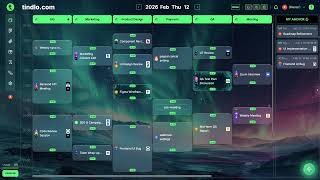
YouTube returned 4 videos for “Tindlo”, and we withheld 3: 3 could not be judged, because “Tindlo” is a single word that other videos use for other things. Showing the 1 we can prove is about Tindlo.
Official links
Featured Head-to-Head Comparisons
Tindlo vs Gem
Choose Gem if you lead recruiting at a growth-stage or enterprise and need an AI-powered all-in-one platform to source, screen, schedule, and manage candidates. Choose Tindlo if you run a small startup (<20 people) and need a lightweight unified view of calendar, tasks, and docs without recruiting features. These tools serve entirely different needs—Gem is a recruiting OS, Tindlo is a general team scheduling OS. For recruiting teams, Gem is the clear winner; for tiny teams wanting simplicity, Tindlo is free and focused.
Tindlo vs Guesty
Choose Tindlo if you're a startup or small team needing to unify calendar, tasks, and docs in one timeline. Choose Guesty if you manage vacation rentals and need AI-powered automation across booking channels. They serve completely different use cases.
Tindlo vs Poke Interaction Co
Tindlo and Poke serve fundamentally different needs. Tindlo is a web-based work OS for small teams to unify calendar, tasks, and docs in a timeline view, ideal for startups needing execution visibility. Poke is an AI assistant embedded in messaging apps, automating personal tasks like email, calendar, and health tracking. Choose Tindlo for collaborative project execution; choose Poke for hands-free individual productivity.
Popular in Project Management
Trello AI
Visual Kanban boards with Butler automation, Power-Ups, and an MCP server that connects Trello to AI tools.


Restaurant365
Restaurant365 is the AI-powered restaurant back-office platform built on the full P&L — accounting, inventory, scheduling, and payroll.
Frequently Asked Questions
Best-of guides
Topics
Used Tindlo? Help shape our editorial sentiment research.